Golgari Midrange: Winning Without the Cub

Note: This article was translated from Chinese by AI and may contain errors. Read the original Chinese version.
To Badger, or Not to Badger… If I Rashly Take a Step, Will We Part on Un-Badger-ly Terms?
Professor Choi Jong-hoon of Seoul National University put it well: “When you’re considering whether to buy or not, don’t buy!”
Since I chose Jeskai Energy Control at the 10th Championship in Modern, once that event wrapped up I somehow gave myself a challenge: for the Standard events that follow, I would play black-green why on earth did I talk myself into this. My playstyle gets along terribly with green, so I figured I’d take the chance to play it lightly.
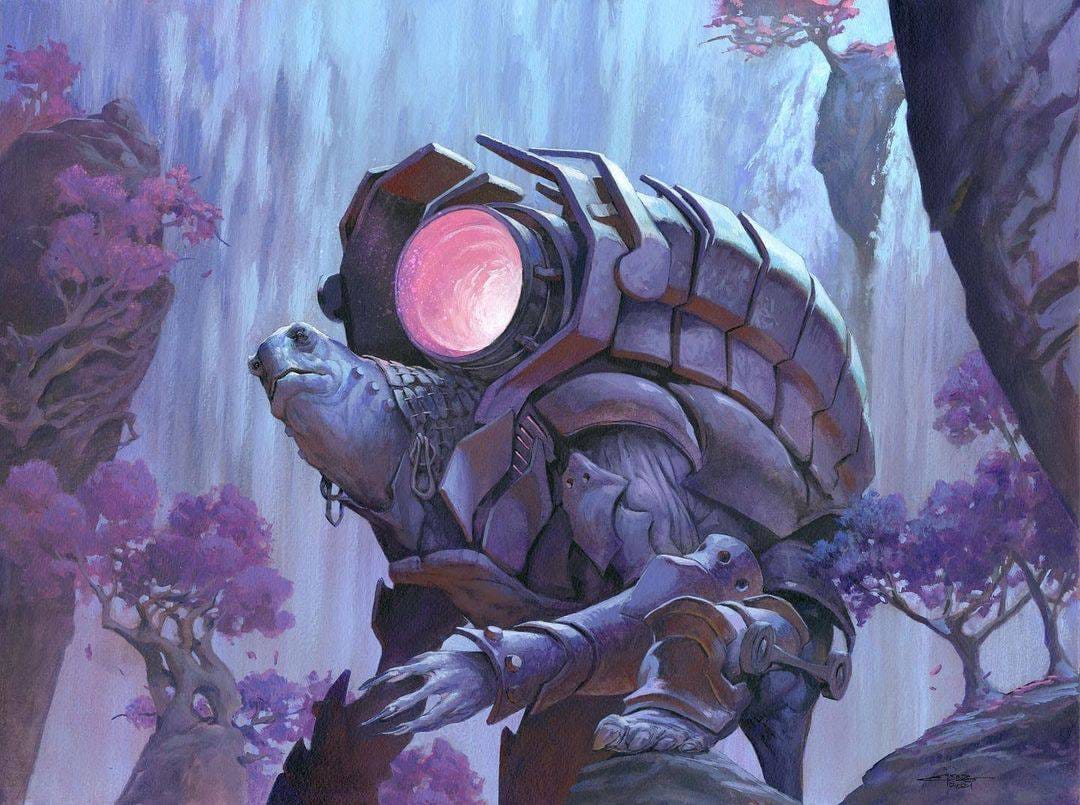
It didn’t go very well at first, and right after that, Avatar: The Last Airbender (TLA) was released. One card in it, Badgermole Cub, looked extremely powerful and seemed almost certain to change the metagame, but it isn’t a card I like, for two reasons:
- It’s too expensive XD.
- I don’t like builds that rely too heavily on ramping into big spells.
I believe the key to picking a deck is: you have to be able to accept the way that deck loses.
Once the deck is built, over the long process of living with it, there will certainly be moments of defeat. Even an expert with a 60% win rate still faces roughly 40% losses, but some losses are acceptable, and some will magnify your frustration. For me personally, I can’t accept the moment when I want to go big, my mana dork gets removed, and then I’m out of options feeling like a fool, so I held myself back from picking up those four Badgermole Cub…
So I had to find a way to win without the badger. From Tarkir: Dragonstorm (TDM) I noticed an enchantment, Hollowmurk Siege, and felt that the mechanics and flexibility it could pair with were exactly what I like, so I set out on the niche route of putting counters to earn dividends.
No Rambling, On to the Decklist
The 11th Taiwan Championship has just wrapped up, and thanks to the effort of the pilot, ZHAN, this deck earned a rather respectable 20th place at 4-3-0. First, a simple tournament report:
R1 Mono-Green Landfall (shun yu Chuang) LL
R2 Simic Rhythm (bonba Dala) WW
R3 Temur Prowess (Wei_Hao_Huang) WLW
R4 U - B-R - G Reanimator (家豪 郭) WW
R5 Temur Otters (Eason271) LWW
R6 Mono-White (Chiyou) LL
R7 Bant Omniscience (Ho Zhi Mao) LL
I won’t go into the game-by-game records in this article. If you want to know more, feel free to head here after reading this one but finish this one first.
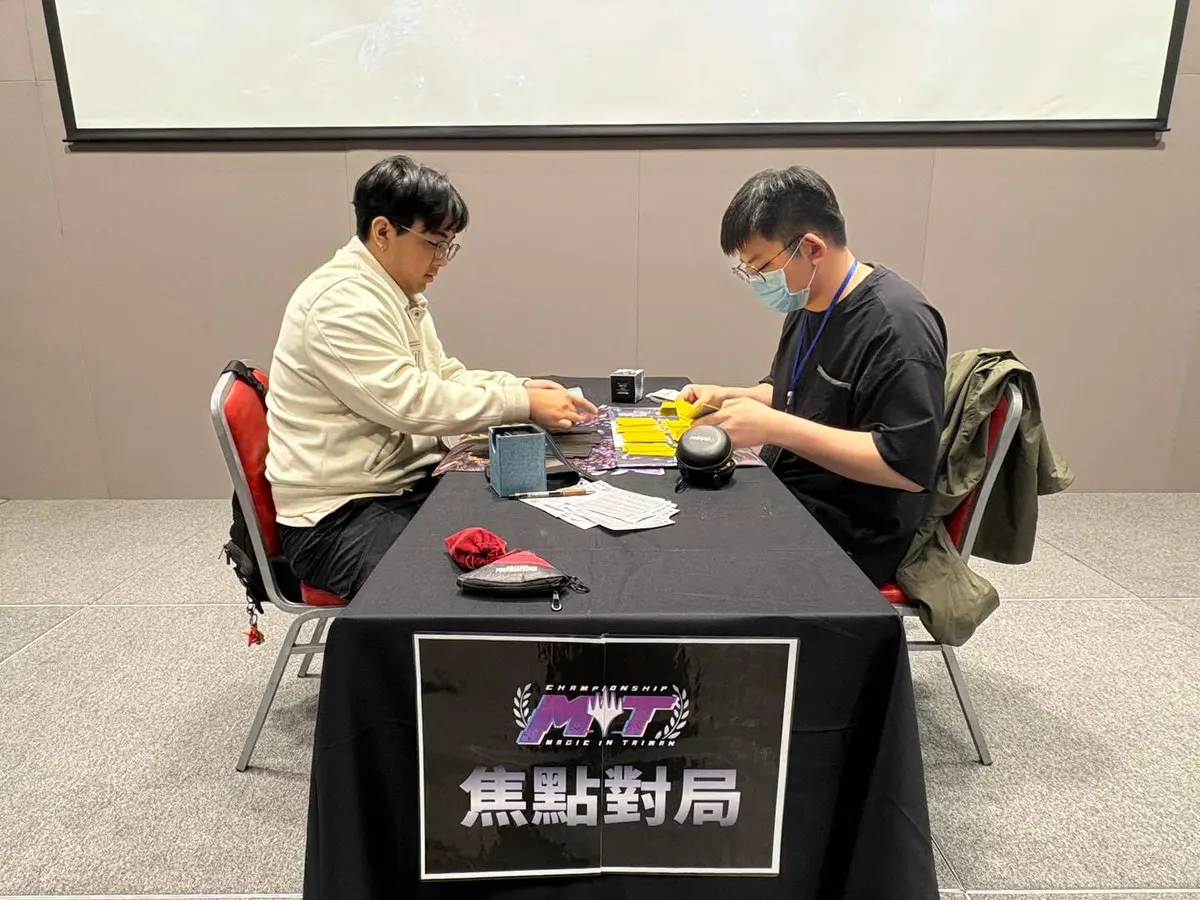
The pilot, ZHAN, sat at the feature match table in round 5 and had a fierce battle with the runner-up, Chiyou.
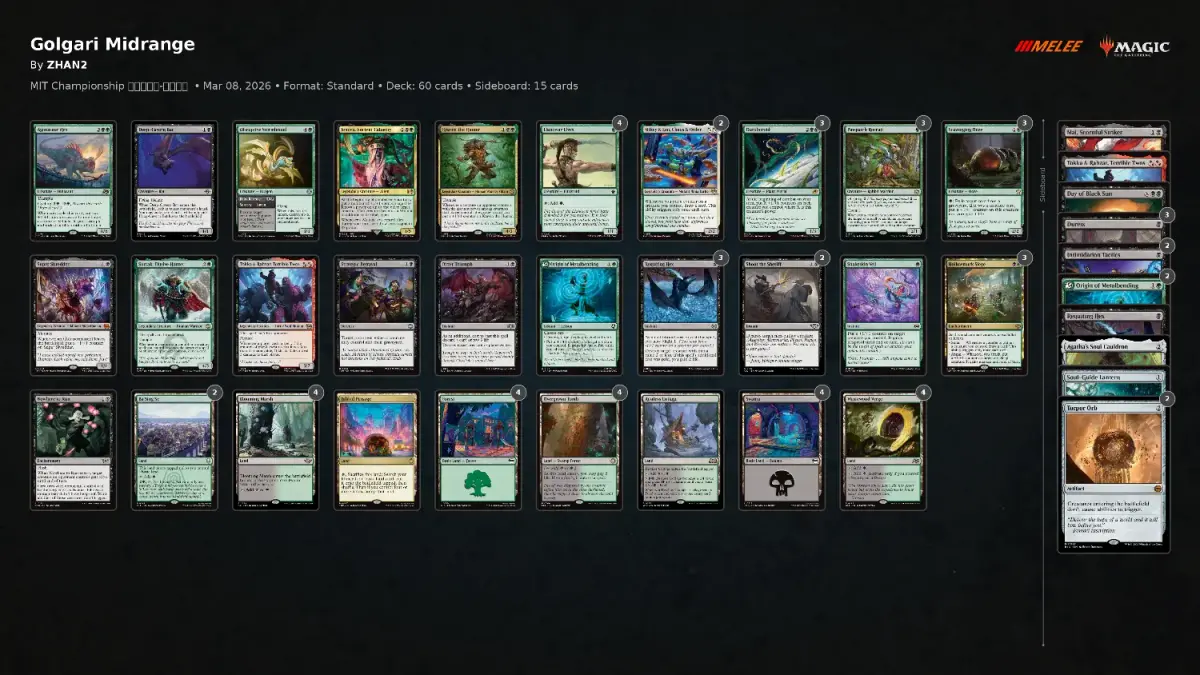
The deck list on the day. If you want to know why ZHAN and I swapped decks, feel free to read the reasons after finishing this article
but finish this one first.
Still, after the event we both felt it wasn’t quite perfect. I think it was because the new set, Teenage Mutant Ninja Turtles (TMT), came out only one week before the Championship (which should count as a rare situation), so every player had to face time pressure in every respect, and naturally the shortcomings showed up very nakedly afterward.
That’s why I quickly worked out a new version after the event. Today’s deck share will mainly focus on the new version, and talk about why I made small adjustments after going through the seven rounds of the Championship.
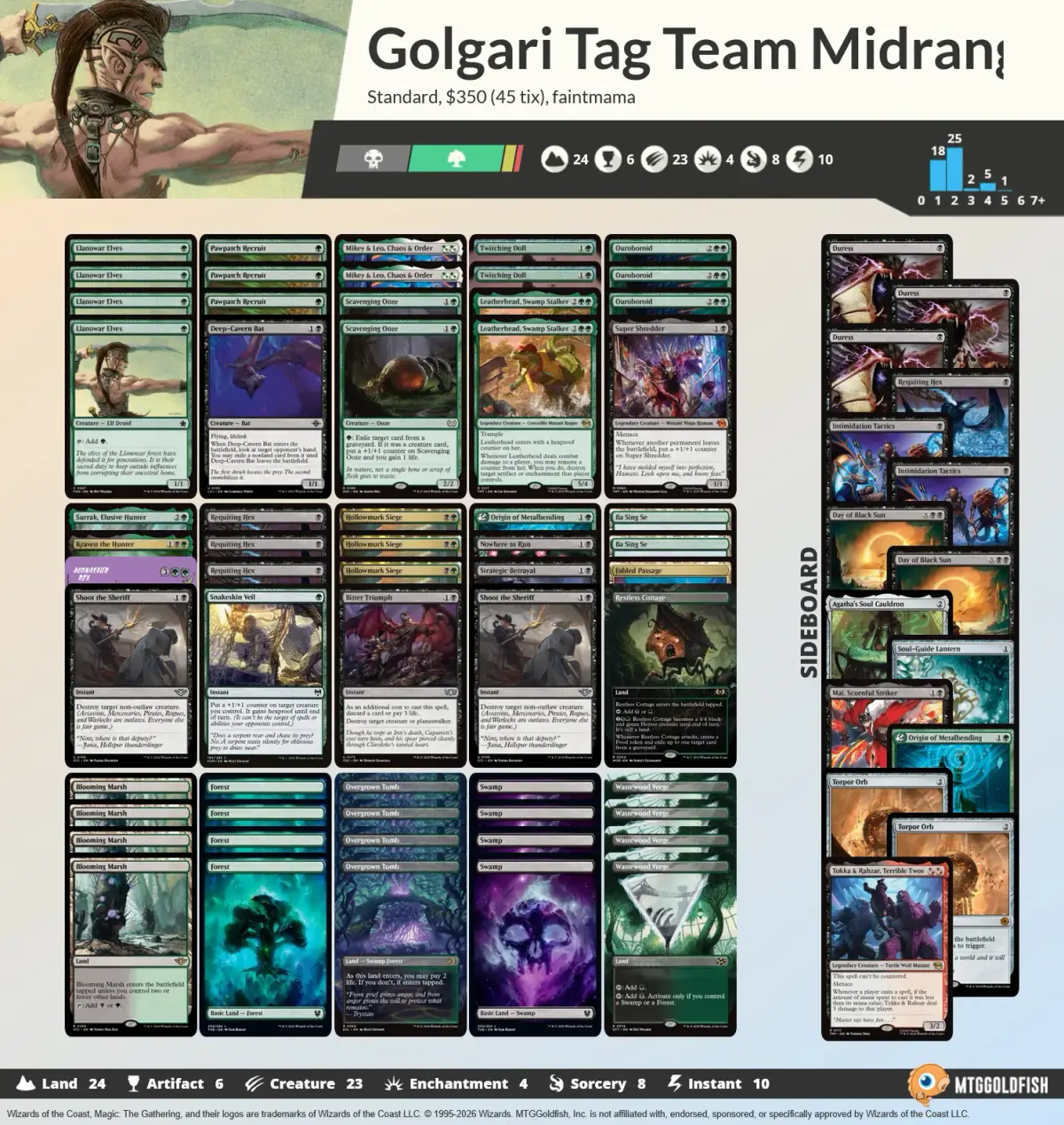
The new build is here.
Main Deck: The 60 Cards
First I have to explain to readers that because Magic has the legend rule, players are used to avoiding, at the deckbuilding stage, extreme situations where they can’t cast copies back to back. Low-cost and high-cost spells are the clear starters and closers, but for the two- and three-mana backbone spells, you pick various quality cards that fit the theme, which also adds psychological pressure in the competitive tier with open decklists. The deck’s theme is still clear, but the road to victory is relatively intricate, and while piloting it you also have to clearly understand every detail in the build to know what you are playing for.
The advantage of this approach is a higher ceiling and more room for players to use the mulligan to piece together a correct opening hand (especially when you know your opponent’s information and your deck holds a powerful card to punish them, so you can think in terms of expected value); the downside is that it is harder to pilot and takes a certain amount of practice and understanding. If newer players want to use the list as a reference, you might first consolidate some of the fiddly settings into your favorite two- and three-mana spells, and once you’re familiar, fine-tune a version that suits you.
I also want to praise ZHAN here; through this Championship he proved he is absolutely a powerful pilot. Now on to the main deck breakdown:
Llanowar Elves x4: Nothing much to say, a regular at tournaments. If the opponent doesn’t deal with it right away, get ready to ramp and apply pressure, and if it eats removal, it may indirectly protect late-game creatures but usually I’d still very much like it to live.
Pawpatch Recruit x3: Flexibility is its strength, letting you do something on both one mana and three mana. Both the creature itself and the tokens created by offspring let you put a +1/+1 counter on another creature whenever one of your creatures becomes a target, which is the start of your opponent’s decision headaches. Because the metagame has non-interactive builds like Mono-Green Landfall and Simic Rhythm, I reluctantly dropped to three to avoid too many dead cards in those matchups.
Mikey & Leo, Chaos & Order x2: When I reviewed the new set’s previews five days before the event, I found “Huh? Isn’t this a creature version of Hollowmurk Siege with a narrower range?” It greatly freed up this build in the details. Since this deck needs enough creatures to support our counters, and also a certain amount of removal to trade up, the number of creature and noncreature spells were both so tight that they can hardly be changed. If it weren’t a legendary creature, I might consider playing three and then lowering the number of Hollowmurk Siege.
Scavenging Ooze x2: It combines graveyard hate, putting +1/+1 counters, and life gain, giving the pilot the option of keeping a close eye on graveyard decks in game 1. Considering the many Izzet Prowess and Mono-White builds in the metagame (including the blue-splash variants), I reluctantly dropped to two after the Championship.
Twitching Doll x2: A foolproof card that turns a green base into any color, but its use goes beyond that: have you ever thought about drawing cards while making mana? If not, you can start imagining it now. The second activated ability helps us buy time against the Mono-White archetype, and paired with Ouroboroid it can leave the opponent completely speechless. Not discovering this pairing in time was a big regret of mine at this Championship; this creature was only added after the Championship.
Super Shredder x1: The price king of the Ninja Turtles set, with a ceiling that is plain to see; I once turned him into a double-digit-sized Super Super Shredder at the end of a game. But in a late-game standoff, he can also be a terrible topdeck whose size isn’t enough to affect the board. By my playing experience, he suits 1, 3, or even 4 copies depending on the deck and since Super Shredder is expensive too, I went with 1.
Deep-Cavern Bat x1: The only creature that doesn’t directly interact with the theme, but since I personally wanted a chance to see the opponent’s information in game 1, I put it in. Here I compare Deep-Cavern Bat and Super Shredder, which cost exactly the same: in terms of the board pressure needed to win the match, Super Shredder clearly has more potential; but on a board where it is likely to eat removal, Deep-Cavern Bat is better, because it lets us learn the opponent’s hand and can even directly disrupt their game plan.
In a race against the Mono-White archetype, Deep-Cavern Bat is a creature very much worth investing in and protecting.
Surrak, Elusive Hunter x1: A powerful creature that draws a card whenever the opponent casts a spell targeting our creature, with trample built in, and it doesn’t get countered. Unfortunately the metagame has the non-interactive Mono-Green Landfall and Simic Rhythm builds, so I reluctantly play only one.
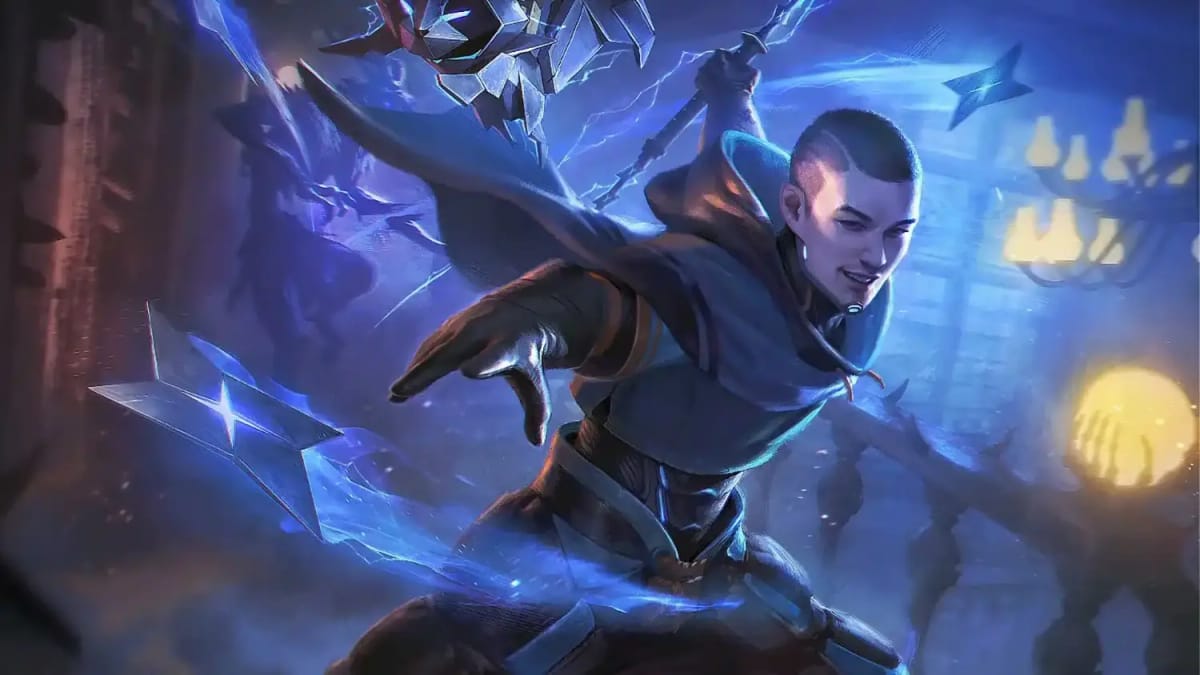
Kraven the Hunter x1: Whatever the theme, as long as it’s a black-green midrange deck with a decent amount of removal, I think he is a super-strong legendary creature beyond your imagination: trample, card draw, and +1/+1 counters. It will give the opponent a headache, or leave them with a bloody head.
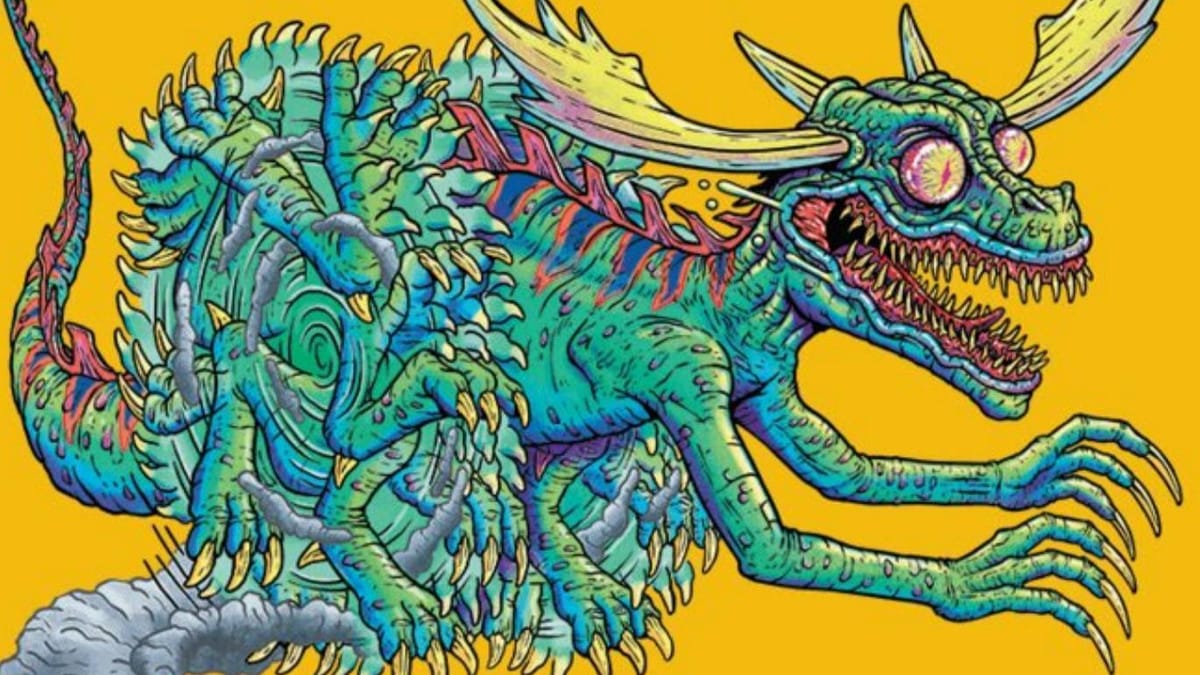
Ouroboroid x3: The most expensive piece in the deck, but since I very shrewdly bought it before the price rose, it still fits the frugal theme. No need to explain much; it’s a creature that makes the board spiral out of control if the opponent doesn’t deal with it in time, matching the selection standard of a four-drop has to win.
Leatherhead, Swamp Stalker x2: The biggest overlooked gem of this event. Because my time was limited and I could only skim, I saw the hexproof counter and decided it was a creature this deck didn’t need, which was a real pity (inner voice: but this deck lets the opponent target whatever they like!). Leatherhead, Swamp Stalker comes with a counter-placing effect, can strip any counters off itself to blow up a wave of artifacts and enchantments, and then with a 5/4 body and trample, it can even apply faster, more direct pressure than Ouroboroid…
Agonasaur Rex x1: A three-mana cycling card that can put two +1/+1 counters and give that creature indestructible and trample until end of turn, and of course you also get a card in hand from cycling. In the late game when both sides ran out of resources, I’ve also won a match by casting it straight, and I think it’s a somewhat flexible (though the cost isn’t pretty) niche card good on both offense and defense.
Hollowmurk Siege x3: The core of the deck. Sultai or Abzan are both options, testing the player’s understanding of the current board, and of course casting two in a row and choosing one mode each is also a very strong decision. After discovering Mikey & Leo, Chaos & Order before the Championship, I dropped from the original four copies to three; after all, an enchantment without creatures is useless.
The most important detail is that when the opponent puts a stun counter on our creature, we can draw a card. This is something Mikey & Leo, Chaos & Order can’t do.
Nowhere to Run x1: ZHAN and I also love this card in casual Commander XD. In a metagame with enough Izzet Prowess, I think it deserves a main deck slot.
Requiting Hex x3: It was precisely because Lorwyn Eclipsed (ECL) came out with this removal spell that I decided to stick with this unique route. Early on it is an instant-speed one-mana removal spell, and in the mid-to-late game you can use the Blight ability to put -1/-1 counters, gain life, and then draw cards; its ceiling in this build is extremely high. Whenever and however you use it, it is an instant for a single black mana, so good that in extreme cases, killing your own creature to put -1/-1 counters and draw cards is still a profit I can say that because I really did it.
Snakeskin Veil x1: Its floor is a poor man’s Opt. I decided to play one before the Championship, and after the Championship I felt there was no need to take it out. In the competitive tier with open decklists, it has some psychological-game value.
Shoot the Sheriff x2: Universal removal; just be careful not to target a creature type you shouldn’t that changeling is the biggest trap.
Bitter Triumph x1: With the escort of Scavenging Ooze in this deck, I think it can fit one copy. Better range, but the cost isn’t small.
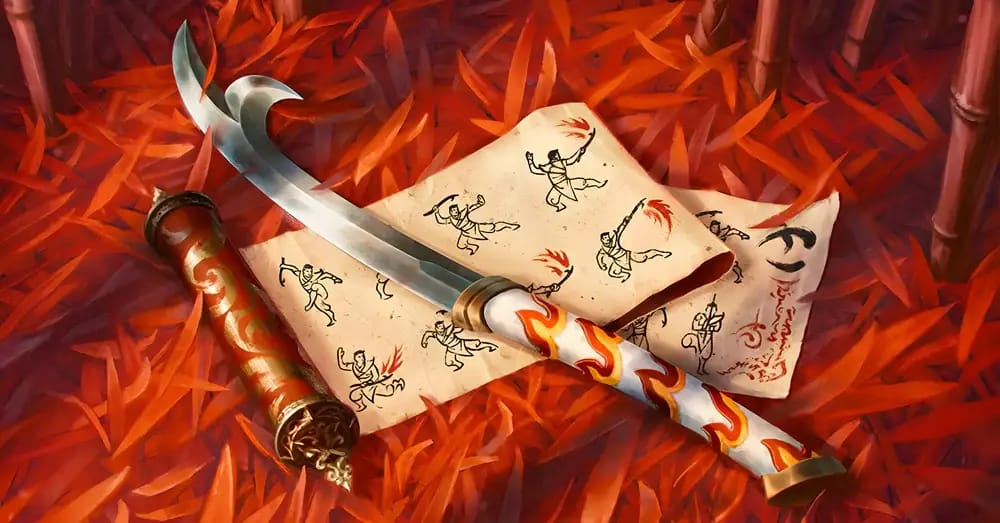
Origin of Metalbending x1: A clever idea from cephille after Avatar: The Last Airbender (TLA) was released. At its best it gives one creature indestructible and a +1/+1 counter, greatly reducing the damage from a sweeper (survive with one, draw one). And it can also be a removal spell; as the old saying goes, flexibility is strength.
Strategic Betrayal x1: A sorcery-speed card for game 1 that hates graveyards and also deals with a creature. It’s a jack of all trades, master of none, and in some matchups it gets cast first.
Blooming Marsh x4: The four indispensable fast lands in this build. Listing them at the front of the lands means play them as early as possible, as the saying goes: gather flowers while you may.
Wastewood Verge x4: Its floor is that it only makes green, but in a build that applies early pressure with green creatures that’s perfectly acceptable. With the addition of Overgrown Tomb, it is even more stable.
Overgrown Tomb x4: Lorwyn Eclipsed (ECL) was late, but better late than never.
Ba Sing Se x2: Earthbend not only lets lands join combat, it also fits this deck’s put counters, earn dividends theme even better, so two copies is not excessive at all.
Restless Cottage x1: A transforming land that can sometimes help us break a standoff. Standard has already entered an explosive tempo where you have to hate graveyards as soon as possible, so exiling one card from a graveyard can only be considered a bonus; don’t expect it to solve the problem entirely.
Fabled Passage x1: It can make Super Shredder a slightly more super Shredder, can thin the deck when the opportunity arises, and when you have plenty of mana, it can also do some fancy low-value interactions with Ba Sing Se.
Forest x4: We always need it.
Swamp x4: We always need it.
Sideboard: The 15 Cards
Duress x3: If there were enough sideboard slots, I would definitely play four but there will never be enough. It can take out one half of the A+B in a combo deck, can discard the opponent’s sweeper or removal, and can force Izzet Prowess to play the game with a small hand size with you.
Intimidation Tactics x2: A card that discards and also exiles an opponent’s creature or artifact; to some degree it counts as a way to defend against ETB (Enter the Battlefield) effects, and it also lets you gain unknown information. It has a chance to take out one half of the A+B in a combo deck, and can also make a deck with equally strong creatures short of key spells.
Soul-Guide Lantern x1: Decks like Sultai Reanimator still pile up the graveyard too fiercely. Depending on future metagame changes, I may need one more.
Requiting Hex x1: The low-cost, high-efficiency removal in this build. In suitable matchups, bet on one more; otherwise, reluctantly take three out of the main deck.
Torpor Orb x2: Used to punish Dimir Midrange, Dimir Excruciator, Izzet Spellementals, Simic Rhythm and other decks, I can’t be bothered to list them all because creature ETBs in the current metagame are just too crazy. Using it affects the main deck’s Deep-Cavern Bat, but I feel there’s no need to deliberately take it out; just pay a little attention to sequencing; Leatherhead, Swamp Stalker will still have its hexproof counter when it enters, which is absurd.
Agatha’s Soul Cauldron x1: This card shows my playfulness and is one of the few rather greedy choices. It can put +1/+1 counters, hate graveyards, and depending on both graveyards, pull off fancier, more outlandish offense and defense; its ceiling is very high, and its floor is a board with no creature to put +1/+1 counters on. It costs more than Soul-Guide Lantern and can’t clear the opponent’s graveyard all at once; depending on future metagame changes, I may need to switch to one more Soul-Guide Lantern. Only with it can I occasionally make the dull joke that I’m “Cauldron Jing”.
Mai, Scornful Striker x1: Since this deck has the problem of having to keep a certain number of creature spells, I try to pick creatures when choosing cards to punish specific opponents. Mai, Scornful Striker is a very uncomfortable presence for Izzet Prowess, and it really did shine at the Championship.
Tokka & Rahzar, Terrible Twos x1: Used to punish Gran-Gran, many cost-cheating elements, Warp-type spells, Sneak-type spells, and it can even stop Airbend combos.
Origin of Metalbending x1: I originally played two in the sideboard, but one is actually enough, which was a big regret of mine at this Championship.
Day of Black Sun x2: I originally played only one in the sideboard, but in a metagame with mostly Izzet Prowess and Mono-White you actually need two, or consider switching to one Maelstrom Pulse; in any case, it was also a big regret of mine at this Championship.
Post-Tournament Review
Though this is a somewhat heavy section, let me still go over the cards I cut after the event.
Cut 1 Jenova, Ancient Calamity from the main deck: ZHAN and I both have a bond with this card. Before the event, using keyword search, I found that with Jenova, Ancient Calamity on the battlefield, if a Mutant dies during my turn, I draw cards equal to that Mutant’s power ooh, I love drawing cards, my eyes lit up immediately.
Since Jenova, Ancient Calamity triggers at the beginning of combat to turn another creature into a Mutant and put a +1/+1 counter on it, with too much information in the mid-game, I thought the opponent might overlook the detail that nearly all creatures in the new set, Teenage Mutant Ninja Turtles (TMT), have the Mutant type; if they played by their usual habits and misjudged and killed one on my turn, we’d get a big boost in hand resources (and the sting of the mistake would eat away at them). However, this never played out at a real tournament, and Jenova, Ancient Calamity was just an inefficient expensive card that didn’t meet the standard of a four-drop that has to win.
Interestingly, MTGGoldfish also discovered this funny situation after us (mixing Final Fantasy and Turtles together like a pissing beef meatball), and Jenova, Ancient Calamity has a build where it is better suited to shine, so readers who love it might want to build it and play. In any case, Jenova, Ancient Calamity is the culprit that made me overlook Leatherhead, Swamp Stalker XD I don’t like it anymore.
Cut 1 Scavenging Ooze from the main deck: This isn’t a misjudgment, just a small adjustment for the metagame.
Cut 1 Tokka & Rahzar, Terrible Twos from the main deck, keeping 1 in the sideboard: Now that Jenova, Ancient Calamity is gone, the Mutant-type bonus no longer exists, so we can adopt a main deck plan with steadier range and payoff.
Cut 1 Disruptive Stormbrood // Petty Revenge from the main deck: The chance of destroying artifacts and enchantments from the main deck rose sharply because of adding Leatherhead, Swamp Stalker, so I reluctantly cut it.
I can actually accept the flexibility of Disruptive Stormbrood // Petty Revenge, but jeffchen doesn’t like this choice very much.
Cut 1 Origin of Metalbending from the sideboard: Because the current metagame calls for it. After the build adjustments, we need not play so passively.
Finally, here is also the sideboard plan I wrote for the 11th Championship. Although it differs from the current version by five cards, it is still offered for interested readers to look at though ZHAN said he played it more aggressively and wouldn’t follow all of my swaps, what a brat.
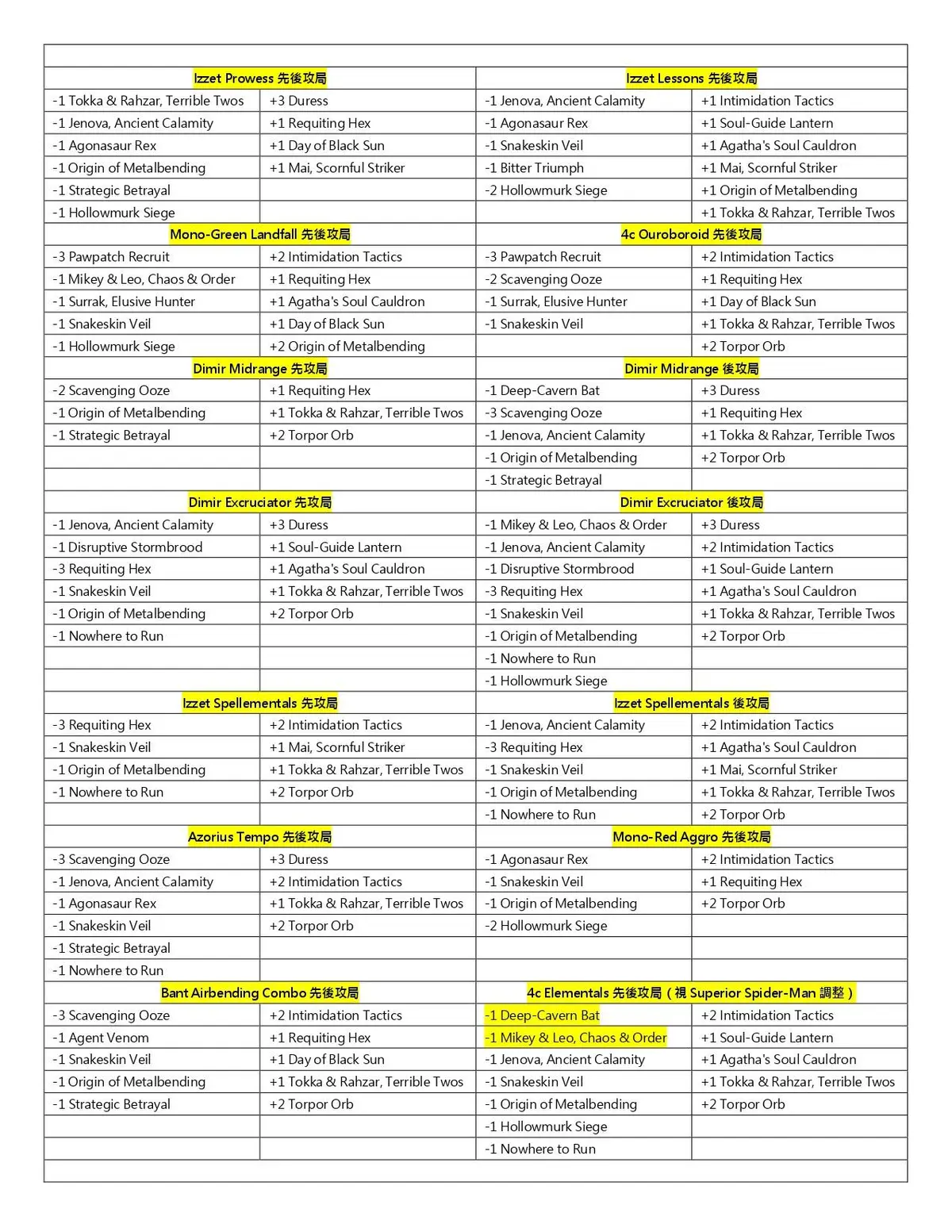
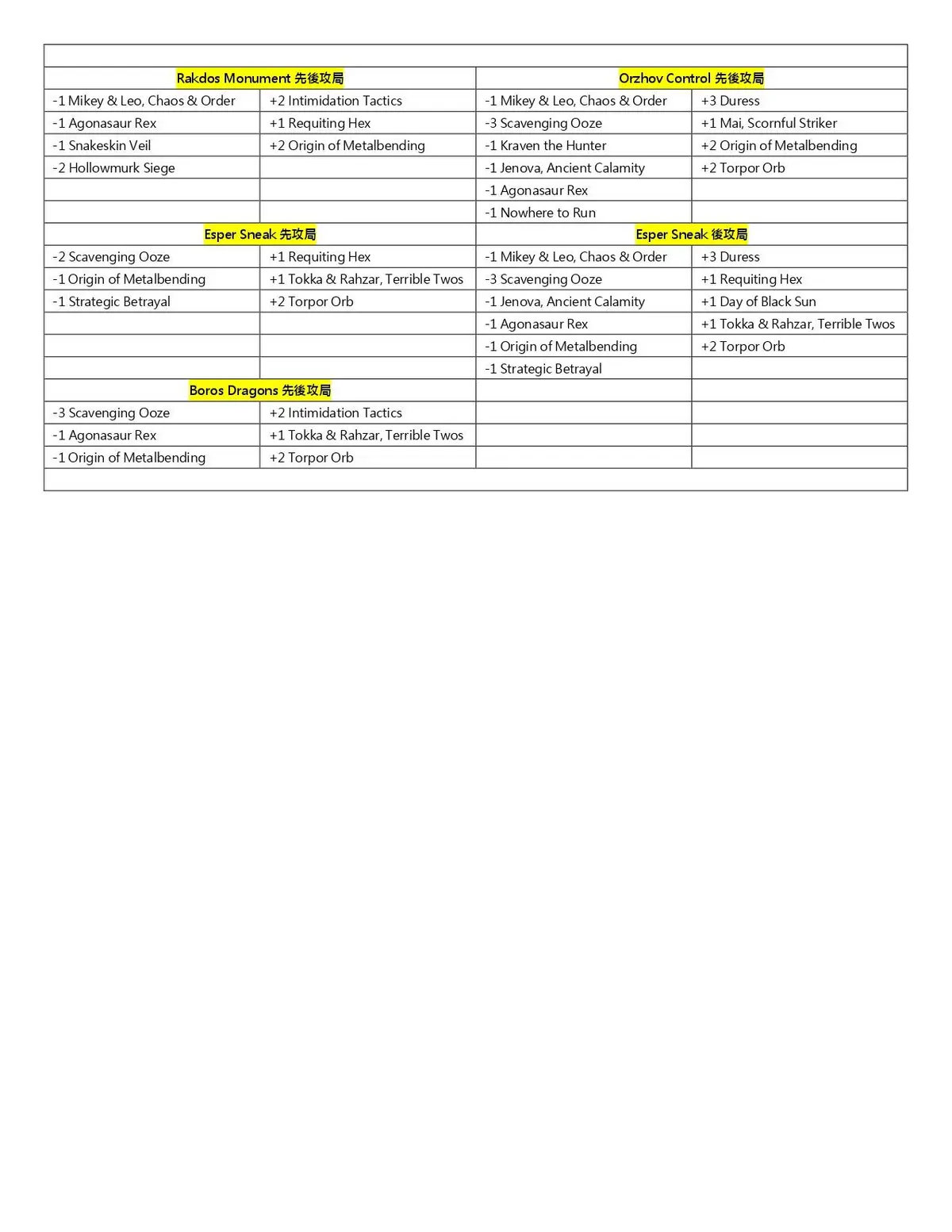
The sideboard plan that ZHAN turned his nose up at; I hereby condemn his ungrateful attitude.
Conclusion
Every time I score some results with an off-meta deck, I steel myself and share it publicly on Guildmages’ Forum, but more than recommending my own build, what I really want to convey is the joy of building your own. The sense of achievement and the experience points are hard for other forms to match.
Admittedly, in the era of big data, a self-created deck doesn’t necessarily stand up easily against the mainstream, but ZHAN and I pulled it off once with passion and ingenuity. We have also felt frustrated; right now we’re just wandering at the edge of the tournament scene without time to devote ourselves fully, but long accumulation has made us better at living with this game.
This time we again got the name Golgari Midrange into the upper-middle of MTG Tournaments, and whether this old-bottle-new-wine homebrew build will shake the meta a little, I will keep watching with a small hope.
I invite readers to enjoy and savor Constructed formats from different angles. You can also look forward to ZHAN bringing his self-made Standard deck White-Black Control: Vampire Rooms soon: the man who will pilot two decks in a single season and destroy the room with both is on his way, but please wait until he is done working overtime.
- Title
- Golgari Midrange: Winning Without the Cub
- Author
- faintmama, ZHAN
- Created at
- March 13, 2026
- License
- This work is licensed under CC BY-NC-SA 4.0 .