Wilds of Eldraine Standard First Look: Golgari Fight Obliterator

Note: This article was translated from Chinese by AI and may contain errors. Read the original Chinese version.
Although the title says Standard first look, this is not a deck built on the new Eldraine cards, but an improvement on an existing list.
I have been piloting this Fight Obliterator deck for about the past six months. It feels very good to play, and Wilds of Eldraine gave it a small number of new cards that shore up its original weaknesses considerably.
What kind of player will like this deck
- Black players who can’t afford Sheoldred, the Apocalypse
- People who enjoy watching the opponent’s grimace after their lands get blown up
- People who value a resource war built on trading threats for removal
- People who like punishing life-racing aggro decks
What kind of player will not like this deck
- People who dislike having too many dead cards in game 1 against control
- People who dislike a higher number of tapped lands for color fixing, which can slow down development
Deck Analysis
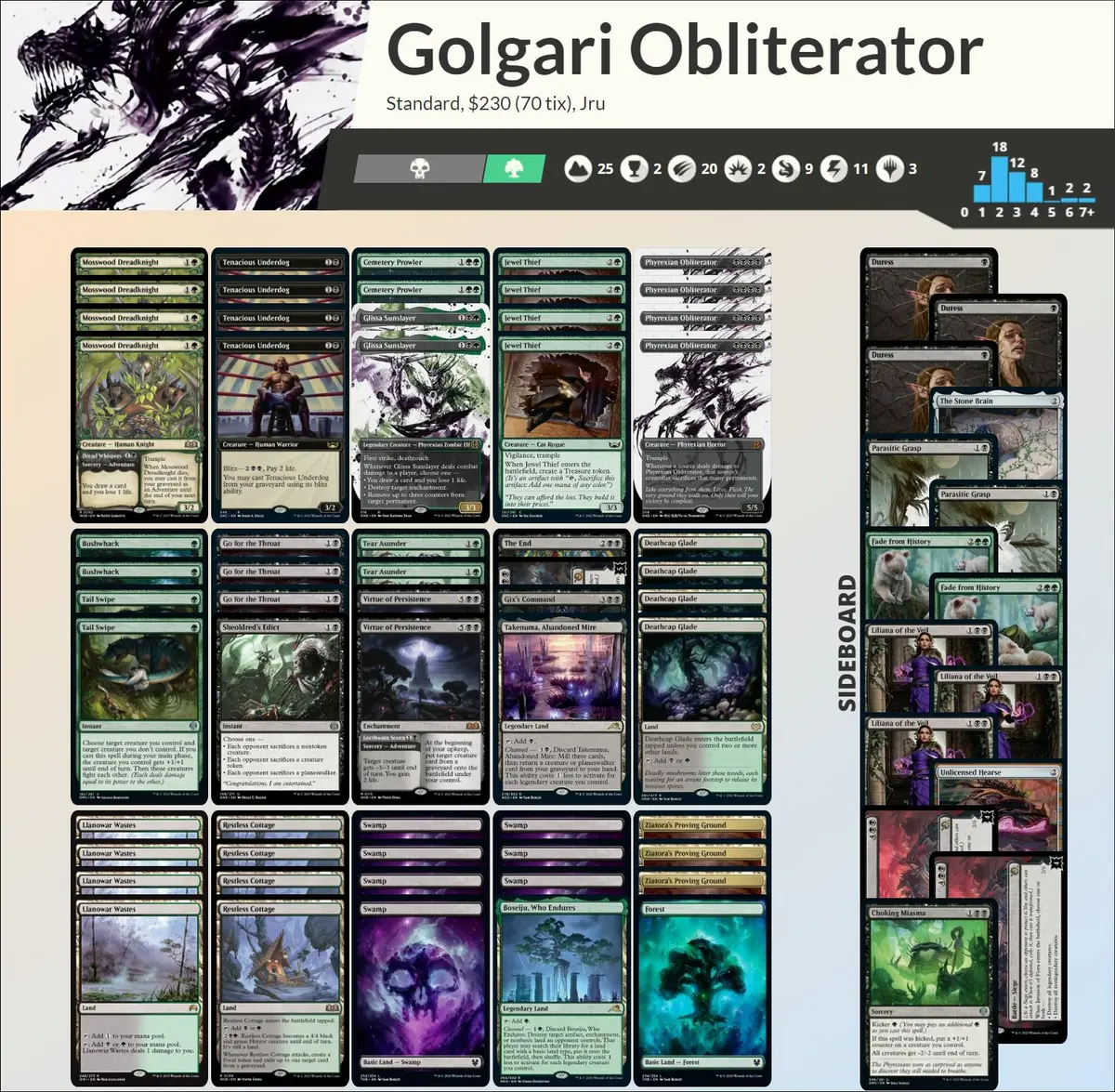
This is a midrange resource-war creature deck with a combo bolted on. The combo is as the title says: by pairing Phyrexian Obliterator with fight spells, you force a source controlled by the opponent to deal damage to Obliterator, which makes the opponent sacrifice that many permanents. Since the ability says permanents rather than nonland permanents, the opponent has to sacrifice lands when they don’t have enough other permanents.
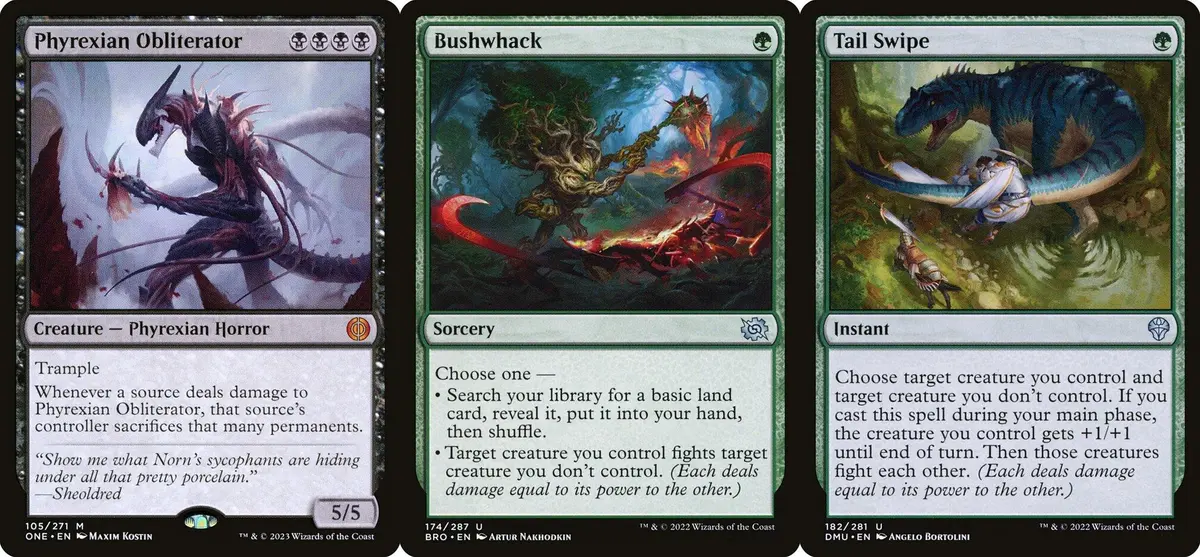
As for the fight spells, the practical options in Standard are Bushwhack and Tail Swipe, each with pros and cons. Bushwhack can fetch a land so it never becomes a dead card, which improves the deck’s consistency, but as a sorcery-speed fight spell it is easy to respond to, and in the worst case the opponent responds with removal and gets a two-for-one. Tail Swipe being an instant makes it better as removal, and its +1/+1 mode cast in the main phase sometimes works wonders, forcing through a path or trading boards, but as a pure fight spell it also carries a high risk of being a dead card. After all my testing so far, keeping a 2:2 split gives the most flexibility.
However, although fight Obliterator is this deck’s selling point, you shouldn’t force the combo when playing. Treat it as a Plan B that you can sneak in when everything lines up. Plan A is still a normal midrange resource war. Obliterator has strong board presence even standing alone, and when a fight spell can safely serve as a one-mana removal spell, don’t be stingy with it. Especially against the various black decks, being too fixated on pairing with Obliterator makes you miss the window to cast safely and get locked down by the opponent’s instant-speed removal.
Deck Glue: Jewel Thief

When it comes to the MVP single card that holds this deck together, it may be a common that nobody even considered playing: Jewel Thief.
A 3/3 vigilance trample for three mana actually has very strong combat ability. It stabilizes your defense while freely chipping away at the opponent’s life total, and it is naturally resistant to The Wandering Emperor. The Treasure it makes on entering is also very useful: it gives the deck a ceiling of turn-four five mana for Obliterator plus a fight spell, eases the tempo loss from too many tapped lands for color fixing, and keeps Obliterator from being color-screwed. It is also an excellent early bait for removal, and compared with real mana creatures it has the advantage of being a body that can fight right away.
Land Savior: Restless Cottage

Speaking of tapped lands for color fixing, I have to mention the most noticeable real upgrade in this set: Restless Cottage.
Because of Obliterator, to satisfy its demanding black mana requirements, you have to push your black sources to the limit. After testing, my conclusion is that of 25 lands, at most 2 can be lands that don’t produce black. To make sure the secondary color doesn’t get screwed because of that, you have to use lots of dual lands, and in the original list I even used gain lands. (They occasionally work wonders too. In the last tournament, a red aggro player got out of lethal range thanks to the gain land.) Adding a manland this time is a completely zero-cost, painless upgrade for this deck.
Other Single-Card Choices
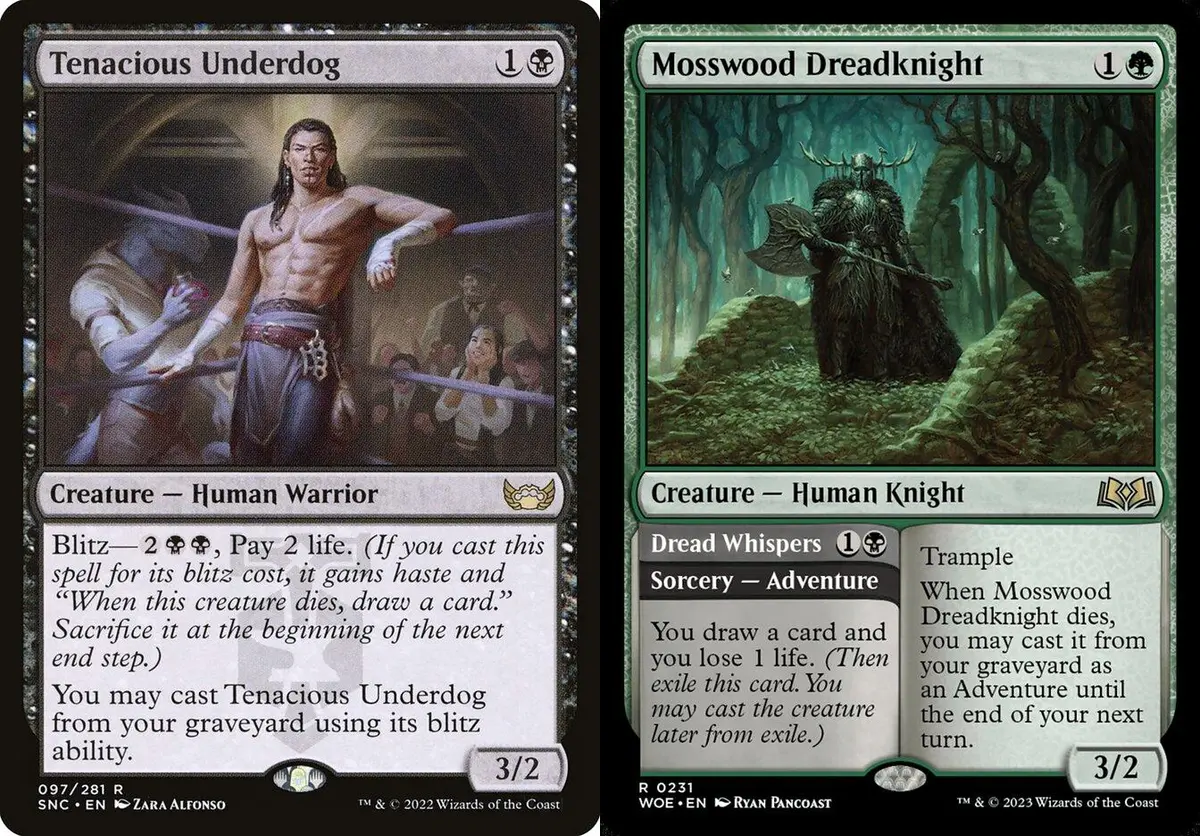
Two-mana plays: Tenacious Underdog & Mosswood Dreadknight
In the past I used Tenacious Underdog & Reckoner Bankbuster. After Reckoner Bankbuster got banned I couldn’t find a satisfying proactive two-drop, so I had to look at higher costs. WOE added Mosswood Dreadknight, which offers resources and tempo both, and I am very bullish on this new card. However, both of these draw cards by paying life, so they must be used carefully in fast matchups. In the past, even with just Underdog I often kept paying right up to the moment before the danger line. (On that point I actually miss the gain lands a little…)
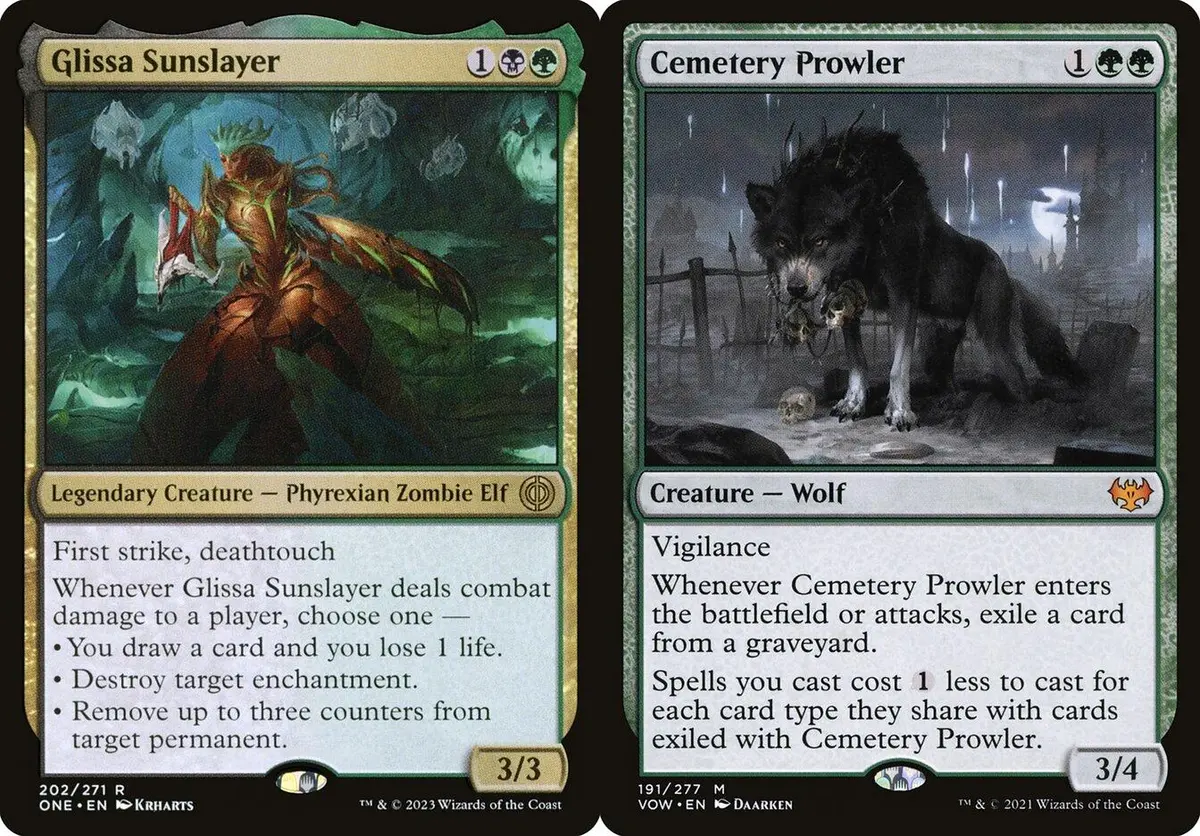
Three-mana plays: Glissa Sunslayer & Cemetery Prowler
Glissa Sunslayer needs no explanation. If she weren’t legendary I’d love to play a full four. The focus here is Cemetery Prowler. In reality, purely from the standpoint of graveyard hate consistency or life-total swing, Graveyard Trespasser should be the better choice, not to mention that to satisfy Obliterator’s black costs this deck is relatively short on green mana. In fact I did use Graveyard Trespasser in my initial testing, but in actual play I found Cemetery Prowler fits my needs best! First, since I included 4 fight spells, I want my creatures to have somewhat better stats. The other three-drop 3/3s easily trade with creatures like
Bloodtithe Harvester and Corpse Appraiser, and the only way to force a board clear is to use Tail Swipe as a sorcery in the main phase. With an option that has a 3/4 body, operational flexibility goes up a lot. In addition, Cemetery Prowler’s cost reduction is actually very practical: combined with the Treasure from Jewel Thief, it lets you instantly flood the board at low cost, or reduce the blitz cost of my Tenacious Underdog. Using the cost reduction to blitz twice in one turn, gaining resources and tempo at once, is this deck’s classic scene.
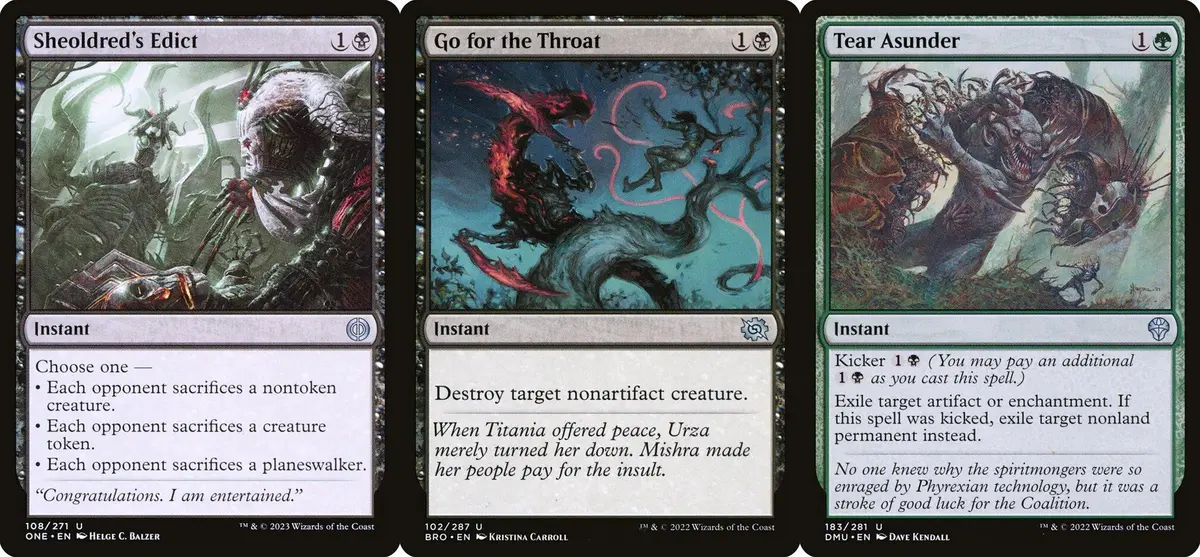
Two-mana removal: Sheoldred’s Edict & Go for the Throat & Tear Asunder
The two-mana removal is relatively standard. Since there are simply too many artifacts and enchantments that strongly influence the board these days, I chose to main deck 2 Tear Asunder. It can also be kicked into exile removal that hits any nonland permanent, which may cost some tempo but at least never becomes a dead card. Also, as an aside, the reason this deck doesn’t use Cut Down is that the one-mana removal slots are already filled by the fight spells. Compared with early tempo kills, I need reliable hard removal more.

Two-mana removal and finisher: Virtue of Persistence // Locthwain Scorn
This is one of my favorite new cards of the set. Although the Adventure side, Locthwain Scorn, as a two-mana -3/-3 sorcery doesn’t seem great on range or timing, it is plenty good as early-to-mid-game removal in the current environment. What matters most to this deck is the 2 life it gains, because the deck has far too many ways to pay life, so extra life gain is naturally very welcome. The Virtue of Persistence side is relatively hard to remove and can serve as a finisher. With the acceleration from Jewel Thief and Cemetery Prowler, casting the Virtue side is also likely to be easier. When adding this card I cut other expensive single cards. The two-mana Adventure option is basically free, so it should add early-game flexibility in play.
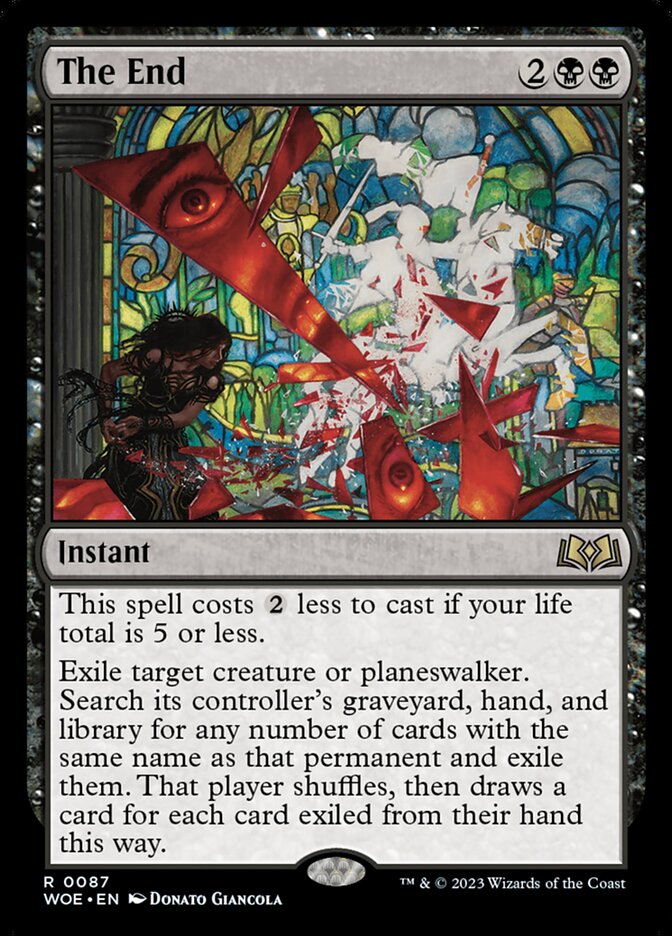
Another new card is the four-mana The End. Its power is beyond doubt, but the tolerance of the four-mana slot is limited, and the high end has other single cards that are equally hard to give up, so I decided to play 1 of each for now and fine-tune based on testing after the Standard environment updates.
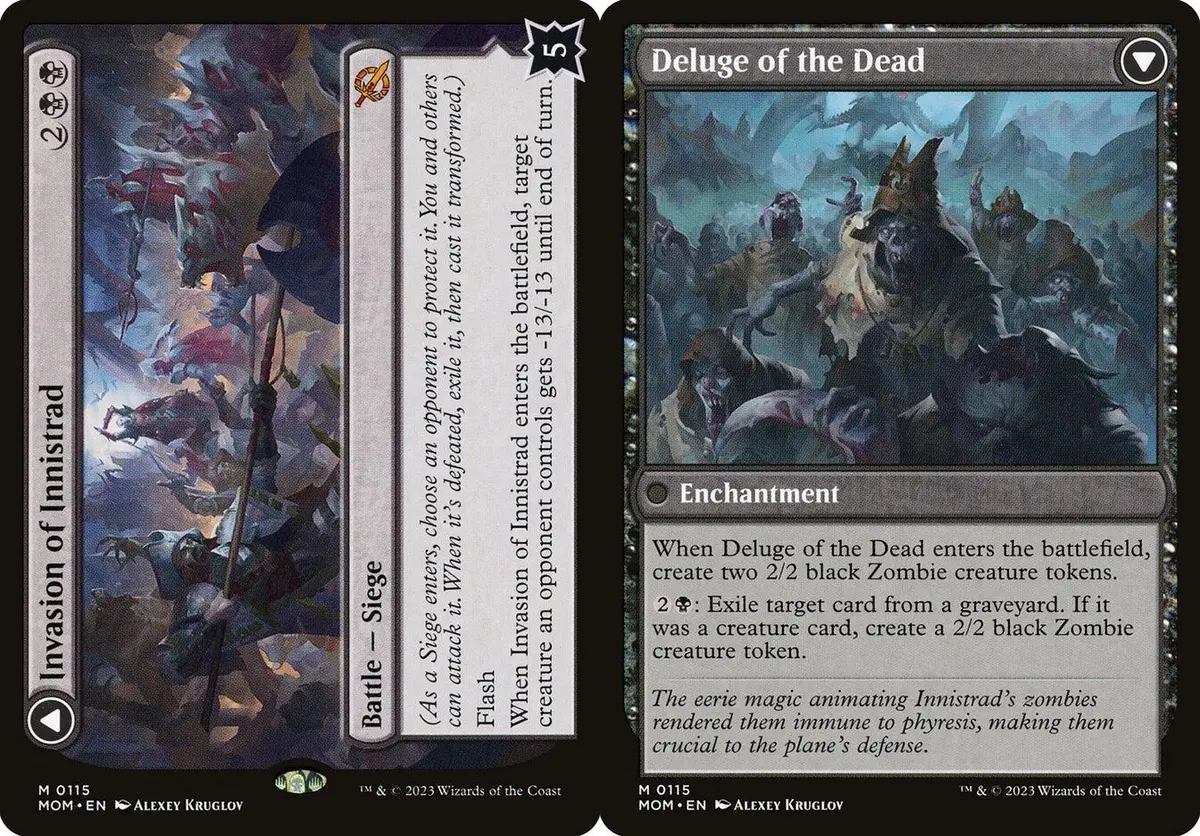
This is why I can’t play a full set of The End. Invasion of Innistrad // Deluge of the Dead is, to me, the big gift of the MOM set, and a card I think this set undersells. As removal its value isn’t high but it is acceptable, and once flipped it is a game-defining bomb that combines graveyard hate with board development, and it comes with two 2/2 Zombies just by entering. In my current testing, once I successfully flip it, it usually becomes a direct winning point. Obliterator can punch through the battlefield in one hit, and the price for the opponent to block Obliterator is very painful. The other attackers make good use of how nearly free attacking is, and with Glissa acting as a Questing Beast on the battlefield, the actual difficulty of pulling it off is not high. In my original build I ran 3 main deck, and I gave up the slots to try new cards, but I suspect they will very likely go back in. Also, Invasion of Innistrad is the spiritual successor of this deck after losing Invoke Despair.

Gix’s Command is a panacea of a single card. Playing more than one clogs the deck, so one is just right. The main deck has plenty of life payment and lacks answers to going wide (usually Wedding Announcement // Wedding Festivity), and Gix’s Command fills both needs at once.
Single Cards Given Up or Not Used

Shigeki, Jukai Visionary: Originally the finisher-level core of the resource war, and also able to act as a wall and ramp against opponents with insufficient removal. Because of the new WOE resource cards I’m trying giving it up for now. Later, if Tenacious Underdog & Mosswood Dreadknight feel like too much life payment in testing, I’ll consider cutting one and putting Shigeki back.

Briarbridge Tracker: Works well with Jewel Thief. Even if you eat the Clue while it is alive, you can keep up the output as long as the Treasure is still there, and one more vigilance attacker again shows respect for The Wandering Emperor. Because as a card-drawing attacker it is similar to Mosswood Dreadknight, I’m trying the cheaper Mosswood Dreadknight first.

The Cruelty of Gix: Mosswood Dreadknight greatly raised the need to pay life, and purely as graveyard recursion it overlaps with Virtue of Persistence, so I’m trying giving it up for now. But that also loses the flexibility I used to have with chapter two of The Cruelty of Gix, Grim Tutor, to find Shigeki for a lot of resources, find Gix’s Command to clear the board, or find the fight combo. Whether this trade is worth it still needs experimenting.

Glorious Sunrise: Honestly it is great in every way and fits this deck very well. It’s just that after I tested other single cards that took up the high-cost slots at the start, there was no chance to squeeze it back in. If I can find room, I’d like to put it back.
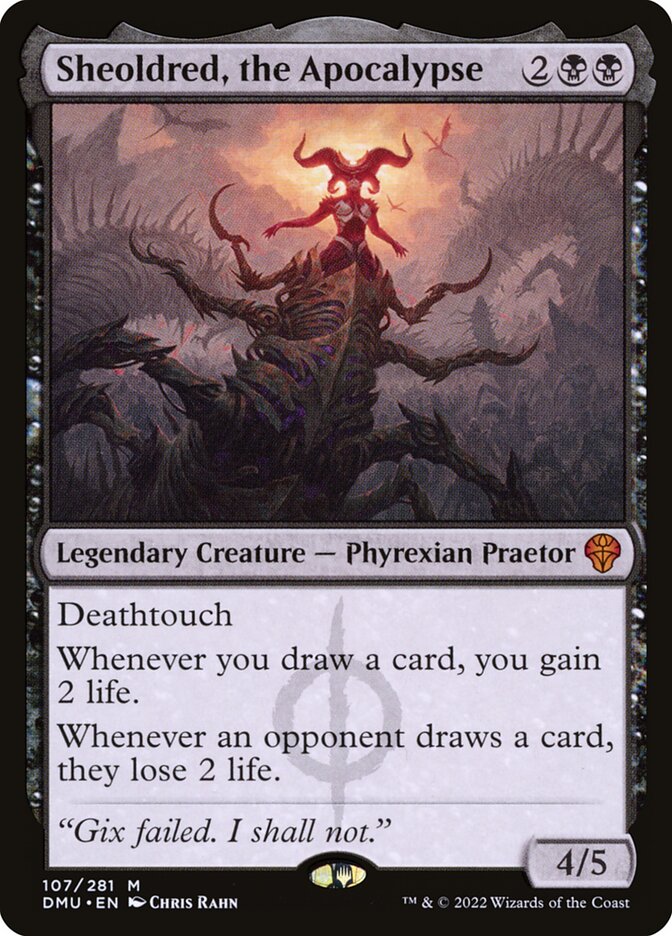
Sheoldred, the Apocalypse: There is actually no reason not to play her, it’s just that Obliterator already takes up 4 of the four-mana threat slots, and Obliterator does well enough at fighting life-racing decks. There is a reasonable justification for not needing Sheoldred, the Apocalypse while keeping the deck’s strength. Of course, her life gain is tempting enough, especially alongside the life-payment resource engine of Tenacious Underdog & Mosswood Dreadknight. Swap Obliterator directly for Sheoldred, the Apocalypse, then swap out the fight spells and cut the tapped lands, and this deck can quickly turn into a regular midrange deck.

Sheoldred, the True Scriptures: If you position her in a high-cost removal slot, swapping one high-cost removal spell for Sheoldred is totally fine. Unfortunately there are many good four- and five-drops but not enough slots, so this comes down to personal choice.
Sideboard
Because the environment will change dramatically with the release of WOE, it is hard to fine-tune the sideboard right now, so I’m just copying over the original list’s sideboard for reference.
Play Notes
This is a deck that balances offense and defense. There is no absolute game plan, but that doesn’t mean you can rush in aimlessly. On the contrary, you need to keep checking your game plan against your hand and the state of the game. Below are several common play notes and decision points.
● Against white midrange decks with lots of exile removal, in the early turns you can appropriately hold back Tenacious Underdog in hand and only blitz it once you reach four mana, making sure Underdog sits in the graveyard on the opponent’s turn and doesn’t get hit by Lay Down Arms & Ossification. But for white midrange, which gets better the later the game goes, this is not always the right play. Conversely, if you want to force out the opponent’s removal to clear the way for more important attackers later, Underdog is a good bait.
● When the opponent has The Wandering Emperor or Elspeth’s Smite, if your life total gives you room, you can blitz Underdog without attacking to buy time to draw cards, and throw the dilemma at the opponent: flash in The Wandering Emperor and give up on dealing with Underdog, or pass a turn and let you draw a free card.
● Against opponents with sweepers, be careful not to overextend. Just keep the number of attackers to the level where the opponent can’t afford to ignore the pressure. Against exile sweepers like Farewell, pay extra attention to the position and remaining copies of Underdog.
● Cemetery Prowler can exile an instant from the graveyard when declaring an attack, and cast a cost-reduced instant removal spell before blockers are declared to clear the way.
● Tenacious Underdog’s blitz is a cast, so it can be reduced by Cemetery Prowler’s ability.
● Glissa Sunslayer’s counter-removal ability can remove Defense Counters on the battlefield, and if you have cast a Saga like The Cruelty of Gix that hasn’t finished running, you can also remove counters to run it again.
● If you choose to go for the fight plan, pay attention to whether the opponent has the mana to respond with removal. The instant Tail Swipe has a higher play ceiling. When you hold both Bushwhack & Tail Swipe with enough mana, you can use Bushwhack first, and if the opponent responds, respond with Tail Swipe.
● Once most opponents learn about the fight Obliterator trick, they will bring in more Obliterator removal in sideboard games and will pay attention to holding up mana against the fight combo. Against such opponents in sideboard games, you can take out the fight spells or even Obliterator, letting the opponent lose tempo from holding up mana while your normal midrange plan overwhelms them.
But against control, even if the opponent has no creatures at all, you don’t necessarily have to take out Obliterator. A five-power attacker for four mana still pressures the opponent, so check first whether you have too much removal.
● Since this deck has a very high number of tapped lands, plan carefully before playing a land how much mana you need this turn, and don’t forget to count Cemetery Prowler’s cost reduction and the Treasure from Jewel Thief.
How to Tune This Deck?
In principle, this is a midrange deck piled up from powerful single cards, with at most a fight Obliterator combo bolted on. Overall there are no absolutely locked slots. Cards with a similar role can be swapped freely, and giving up fight Obliterator can also turn it into a regular midrange deck.
My current build’s main deck is specialized toward removal. In the current environment it handles most aggro and creature-midrange decks well, but it is very hard to play game 1 against traditional control decks that carry almost no early-to-mid-game creatures, white-based midrange decks whose creatures are all small and go wide with lots of exile removal, and blue tempo decks that punish slower midrange. If these decks are a high proportion in your local environment, try cutting some removal from the main deck and adding discard and resource-refill cards. If there are many go-wide decks centered on Wedding Announcement, making spot-kill value too low, you can also consider moving the sweeper to the main deck.
These small changes depend on the current environment, and the local environment may differ among players too. Which jobs go to the main deck and which can be handled by the sideboard can all be adjusted according to your understanding of your own environment.
- Title
- Wilds of Eldraine Standard First Look: Golgari Fight Obliterator
- Author
- Jru
- Created at
- September 5, 2023
- License
- This work is licensed under CC BY-NC-SA 4.0 .