
Season 11 Standard MITQ: Mono-White Token Control

Note: This article was translated from Chinese by AI and may contain errors. Read the original Chinese version.
Foreword: Why This Deck?
This deck is my answer to the recent Standard Vivi Cauldron environment, and it earned me a qualification at this season’s MITQ #11.
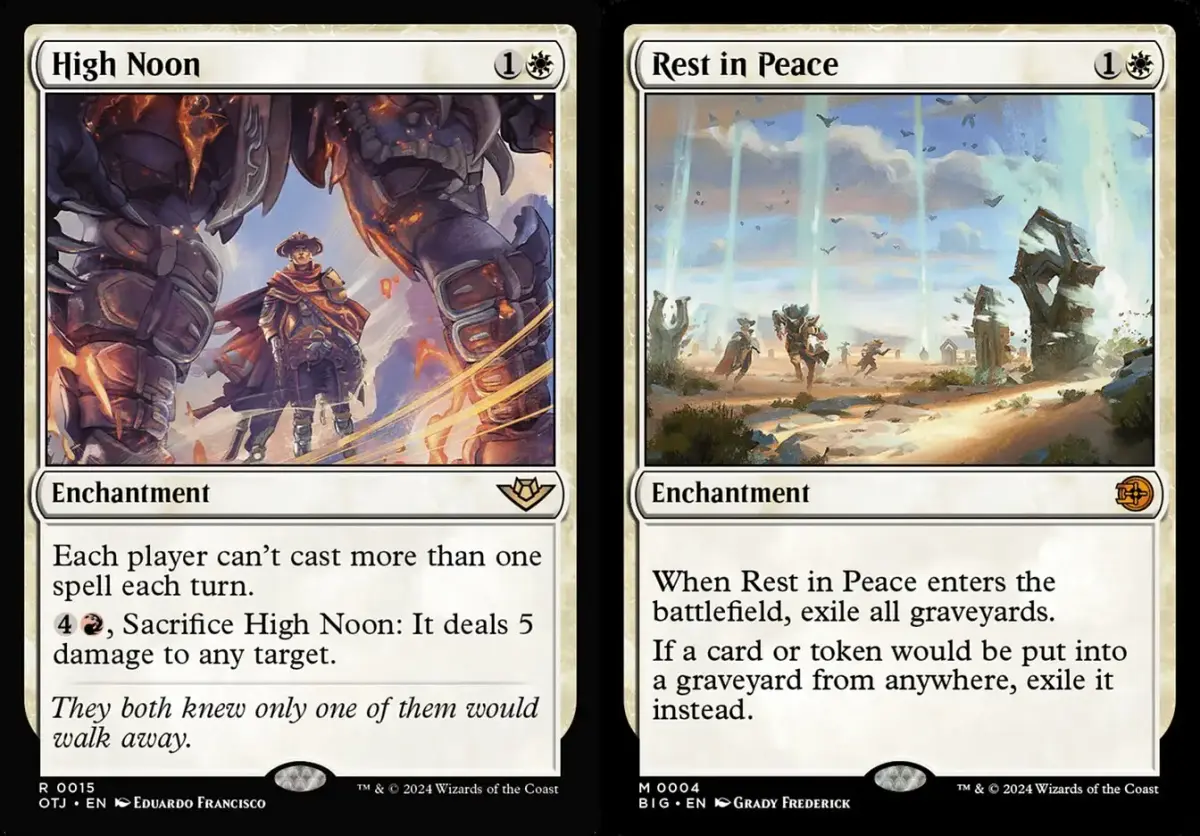
In the current Standard environment, even if you don’t play Vivi Cauldron you have to be prepared for it, or else play an aggro deck even more extreme than Vivi Cauldron; otherwise it’s very hard to get good results at a tournament. After trying many approaches, I concluded that from a control angle, a white control deck running Rest in Peace and High Noon is still the best answer to Vivi Cauldron.
(You ask why control was a given? All I can say is that I’m doing control for the sake of control.)
Vivi Cauldron has a huge number of graveyard-using abilities, so Ghost Vacuum can only hold it back to a limited extent, and I think you still have to commit to Rest in Peace. However, Vivi Cauldron isn’t a deck that focuses on the graveyard; its normal board presence is as strong as a top-tier midrange deck, with the graveyard as an extra resource, so just locking the graveyard will still get you run over. This is where High Noon comes in. Vivi Cauldron’s power is often built on doing a huge amount in a single turn; once it is limited to casting one spell per turn, it runs very clunkily, and sometimes it even spends an entire turn just casting a draw spell. Even if it can generate lots of mana through Vivi, holding a fistful of cards with no room to cast them doesn’t help. High Noon is also a big killer against Izzet Prowess. Vivi, stop being naughty.
The first thing I tried was Azorius control, putting High Noon straight into the main deck. After all, for a control deck, if the opponent can only do one thing a turn, answering one card per turn isn’t hard; and if the opponent dares to cast something unimportant as bait, they’ve wasted their whole turn’s action and given us a window to cast our card-draw spells. I was fairly satisfied with this Azorius control deck in testing, and it can basically be taken to a tournament. Even so, this Azorius control deck has some obvious problems. The first is that it is extremely disadvantaged against the Dimir tempo deck built on Enduring Curiosity + Kaito, Bane of Nightmares; Draw-Go control against flash tempo is just too painful, and that’s the second most popular deck in the environment after Vivi Cauldron. The other issue is that High Noon also interferes with us to a certain degree, since most of what we do relies on spells too, although usually the opponent suffers more, that’s true.
This is where the advantages of white token control show up. First, white token control has a natural edge against Dimir tempo, and is much better than Azorius control at handling board pressure or fighting back. In addition, white token control has lots of mana sinks, so even without High Noon I often cast only one spell a turn and spend the rest of my mana on activated abilities. So if you want a control deck with High Noon in the main deck, I think white token control is the better-matched choice. A mono-colored deck is also a bit safer on life total against the red aggro deck’s Sunspine Lynx.
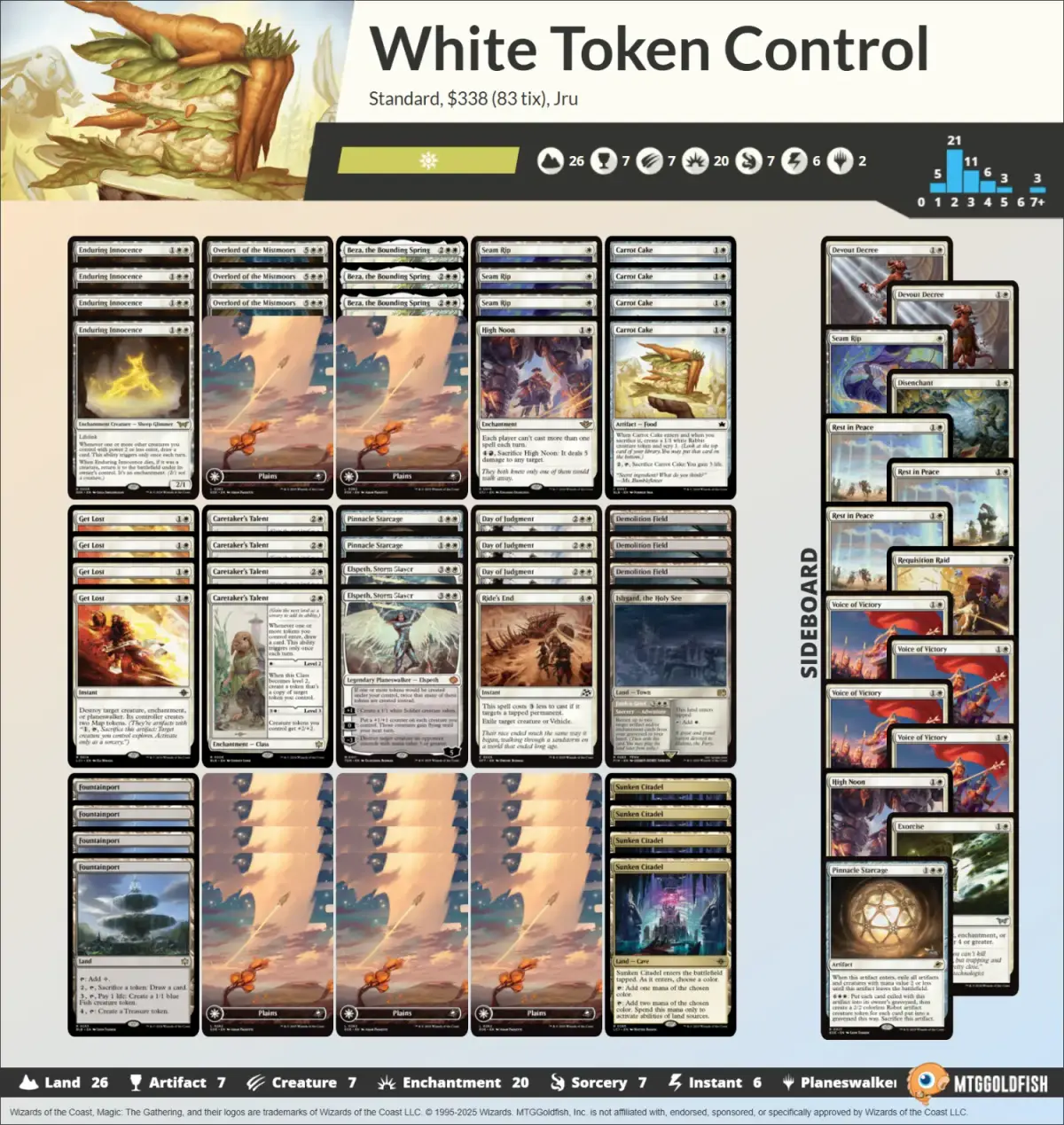
Deck Overview
Decklist link
Game Plan
The token game plan comes down to two words: value & stall. This deck’s card-advantage ceiling is arguably the highest in all of Standard, but the cost is an extremely clunky tempo; building a board takes a long time, and in the early game you usually have no room to try to win through an attack, as just holding off the opponent’s offense is already tight. So the game plan is to slow the opponent’s tempo as much as possible while keeping your resource chain intact, and once the board is fully established, overwhelm the opponent with a mountain of resources.
Resource Engines
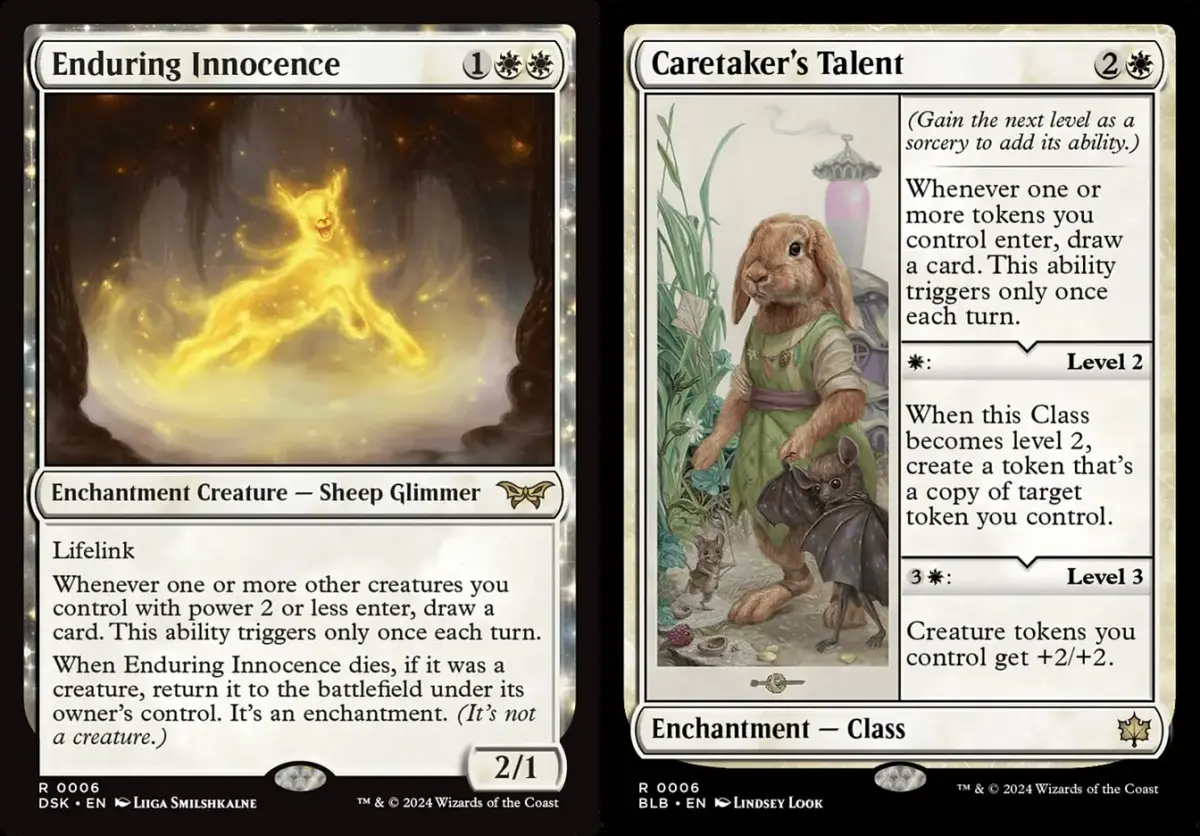
These are where the deck gets its name and also its core resource engines, and without a doubt both are played as full playsets. Each has its pros and cons.
- Enduring Innocence (4):
Because it has two lives, opponents lacking exile-based removal are ground down in resource trades against it with practically no answer, and it is a lifelink creature that can chump block itself, which also helps stall the opponent’s offense. But what makes it good as a creature also makes it vulnerable: Torch the Tower is its natural predator, as a single one-mana burn spell can eradicate it for good. So against an opponent with Torch the Tower, you can actively let it chump block in combat; it’s safer after it dies than while it’s still a creature.
- Caretaker’s Talent (4):
The starting point of white token control’s rise. Level 2 provides a card-advantage opportunity by itself, and Level 3 is the key to pushing back with creatures. There are a few things to watch out for when using Caretaker’s Talent:
● Leveling up the Class is an activated ability and can itself be responded to. If you activate it to go to Level 2 and the opponent has instant-speed removal, they can respond and destroy it; the Level 2 ability only triggers once you’ve successfully reached Level 2.
● When copying a token at Level 2, if you worry the creature will be killed in response, you can target your own Treasure.
● After Level 3, all your tokens will have power greater than 2, so token creatures entering afterward will no longer trigger Enduring Innocence’s card draw. Be aware of this mutual interference when you need resources; conversely, you can also use it to avoid drawing too many cards.
Both of these card-draw enchantments trigger mandatorily, so although drawing cards is very important, you must also be careful not to draw too many cards and deck yourself. This matters especially in control mirrors, where the risk of decking is even higher than the risk of dying to life total. Generally two card-draw enchantments on the battlefield are plenty, three is the limit, and any more and the self-destruct risk becomes hard to control.
Creatures
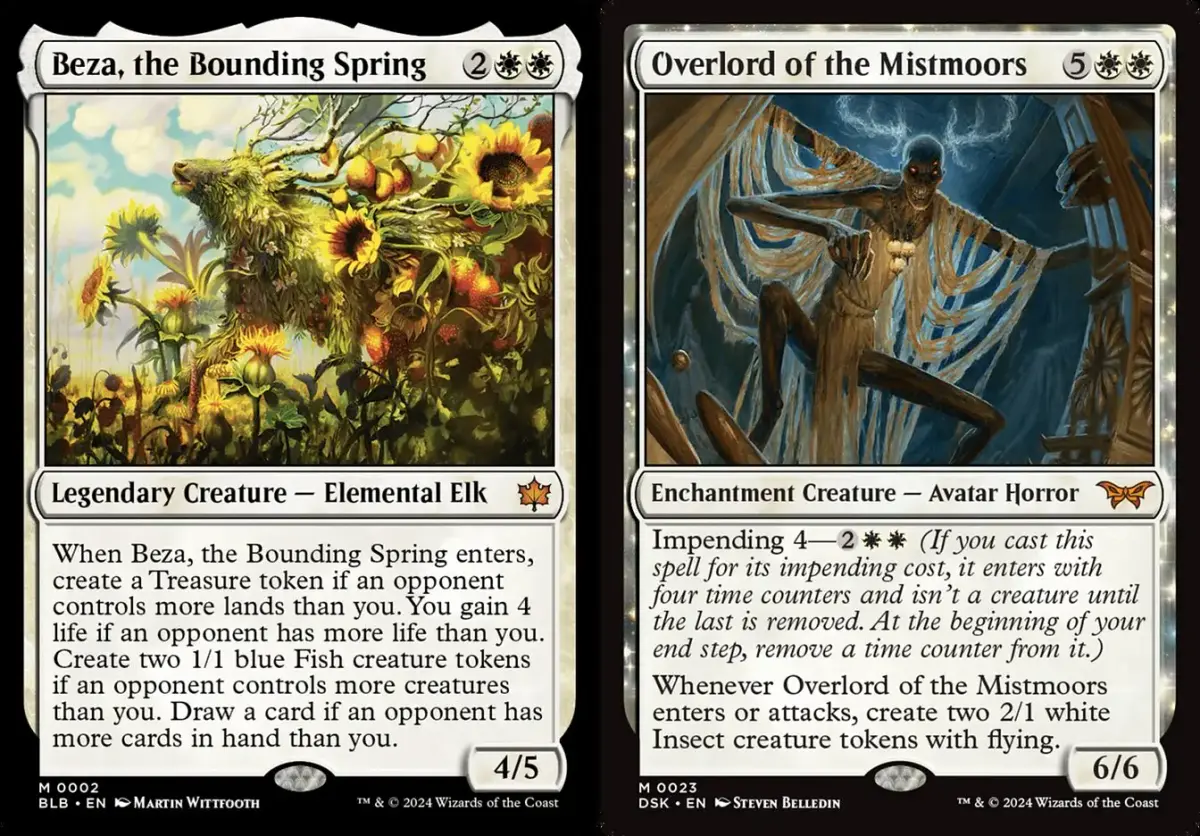
A longtime helper for control decks; one card buys you a large amount of board buffer. Recently some Azorius control decks have moved it to the sideboard, bringing it in only against aggro decks to hold off the offense, but the fact that it makes a token is simply too good in this deck, so it stays high in importance.
The key damage source for winning, and also the core force against Dimir tempo.
Token Sources
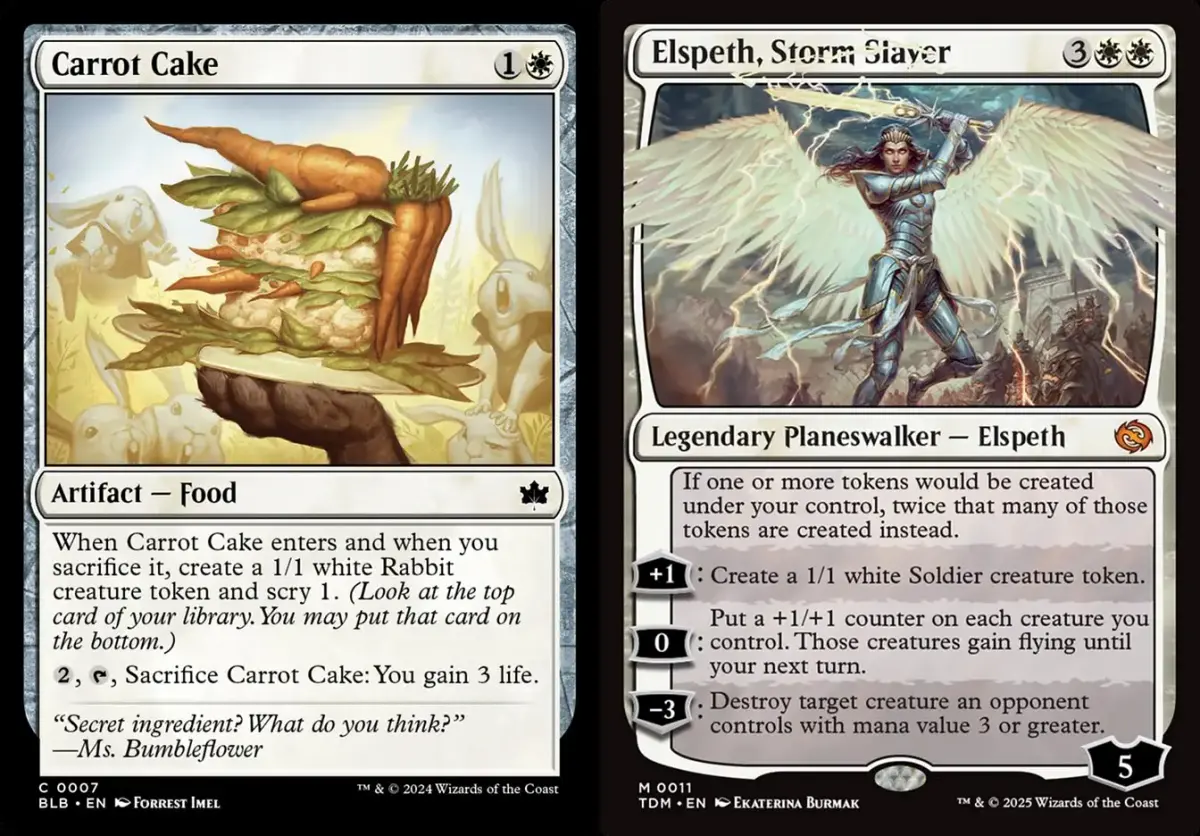
- Carrot Cake (4):
Because it makes tokens at instant speed for just 2 mana, it fills the tempo gap of the clunkier activation cost of Fountainport, and the life gain gives us more defensive breathing room. It’s the most stable all-purpose card in game 1, though in sideboarded games it’s also easy to move its slots to targeted sideboard cards.
Note that making the Rabbit token and scry 1 is one complete action; only after this action finishes do the abilities triggered by the token entering go on the stack. If it’s triggered by activating Carrot Cake’s sacrifice-itself-to-gain-3-life ability, the gain-3-life ability goes on the stack first and resolves last.
The key that pushed token control to a whole new level. Normally, as long as you’ve built a defense that can hold off one attack, this card can roll straight into a winning board once it lands. Even Azorius control decks with not that many tokens are willing to treat her as a finisher, so you can imagine how strong she is in our token deck.
Single-Target Removal
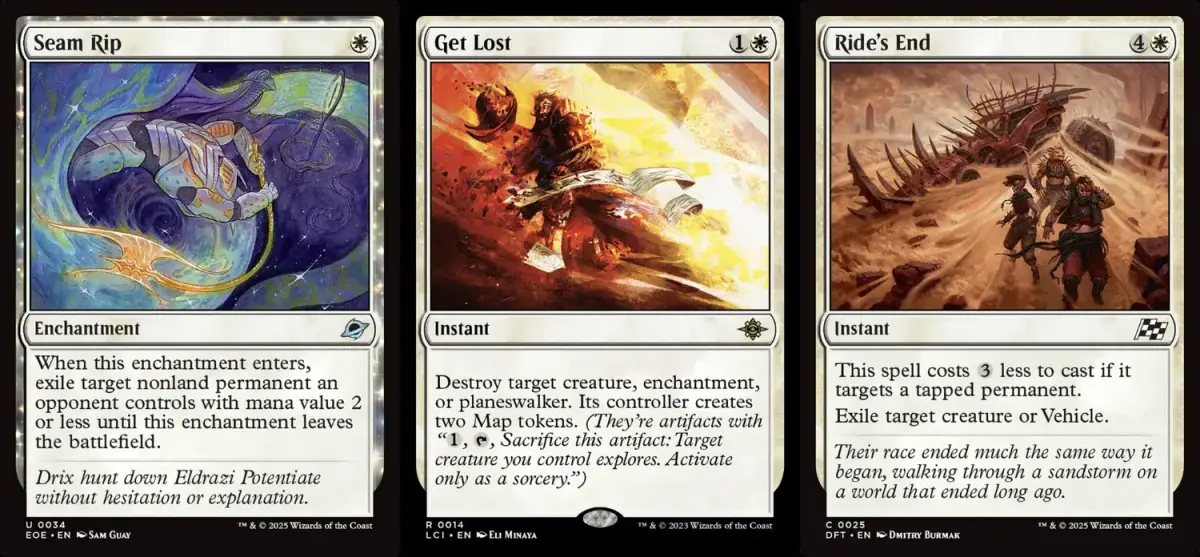
- Seam Rip (3):
This is actually a good reason to choose white. At a time when one-mana removal is generally weak and toughness-based removal is constantly pushed out of range by Proft’s Eidetic Memory, this mana-value-based removal feels much safer, and it can also deal with troublesome artifacts and enchantments such as Proft’s Eidetic Memory and Agatha’s Soul Cauldron. There’s another reason I dropped Elspeth’s Smite entirely in favor of it: it’s just too easy to run into Voice of Victory these days. Basically, the only remaining advantage of Elspeth’s Smite is that it can answer Enduring Curiosity, and the token package already has that covered, so we don’t need that marginal benefit.
- Get Lost (4):
The strongest two-mana removal in Standard. Although its side effect really is big, it’s still better than being unable to answer the opponent’s key card. Because Get Lost is often the only answer in specific situations, you need to plan its use carefully; if a problem can be solved by chump blocking to buy time, there’s no need to rush to spend Get Lost.
- Ride’s End (1):
Four instant-speed removal spells is still too few, so I added a fifth. It has no side effects, and it can also clean up Enduring Curiosity completely. If I could, I’d like to squeeze in another one, but I really couldn’t find the slot.
Sweepers
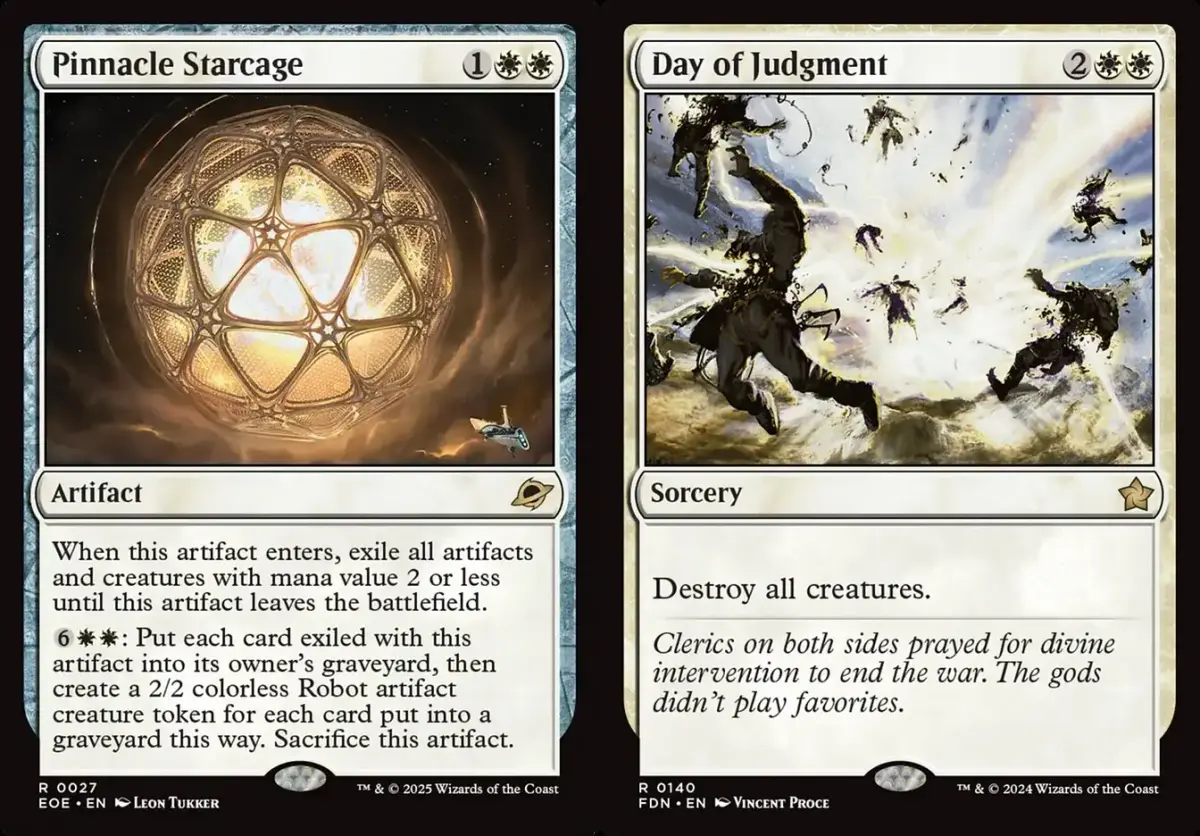
- Pinnacle Starcage (2):
Standard is getting sharper and sharper in tempo, and Pinnacle Starcage performs decently even in the main deck, but too many copies can still get clunky, so two main deck copies is about right. Since we’re a token deck, casting it might clear our own board more thoroughly than the opponent’s, so before using it you can let your tokens chump block as much as possible to minimize our losses. Also, it can’t exile enchantments, which works nicely with our many low-cost enchantments.
- Day of Judgment (3):
A plain, unadorned sweeper. Although I just said the environment’s tempo has gotten much sharper, it isn’t to the point where everyone’s creatures cost two or less, so a straightforward sweeper is still key to controlling the board, and after repeated testing I feel it shouldn’t go below three copies.
High Noon

- High Noon (1):
I already spent plenty of ink in the foreword discussing why High Noon goes in the main deck, so I won’t repeat it here. Although our deck doesn’t run red lands, High Noon’s sacrifice-itself-to-deal-5 activated ability can still be used: red mana can come from a Treasure, or from naming red with Sunken Citadel when you’re sure it will finish the opponent. (But so far I’ve never run into a situation that needed this.)
Although in expectation High Noon can cause the opponent enormous trouble, be aware that in some situations it can lock you out instead. The most common scenario is when the opponent has already built a board and offense while holding a counterspell or protection spell; then you can only cast one removal spell a turn, the opponent defuses one per turn, and you get stolen tempo and blown out.
Although it mainly targets Vivi decks, quite a few small-curve fast-development decks also suffer when they see this.
Lands
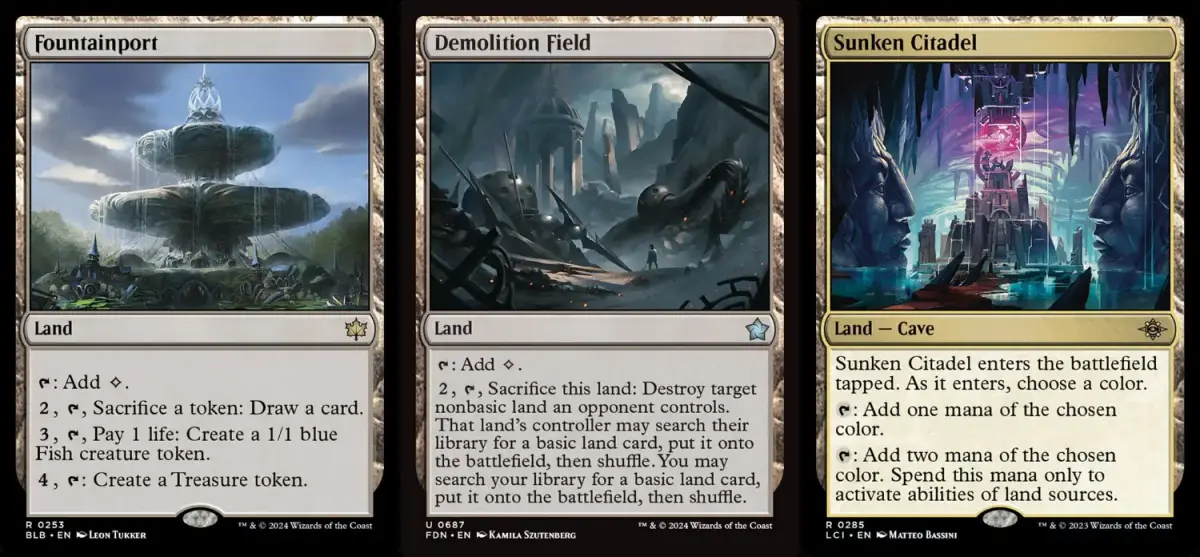
The biggest advantage of a mono-colored deck is low color-fixing pressure, which leaves a huge number of slots for utility lands.
- Fountainport (4):
One of the deck’s core key cards. It can keep making tokens, or eat tokens to draw cards, and also serve as a wall of air to block one wave of attackers; as long as the opponent has no trample, no matter how big their creatures are, they get ground to death by Fountainport, and against control it can win the game by itself. With High Noon on the battlefield, Fountainport’s excellent mana-sink ability can quickly widen the resource gap with the opponent.
- Demolition Field (3):
There are so many utility lands in Standard now that land destruction lands have considerable value too, but most decks can’t afford many of them because of color-fixing pressure; we, thanks to being mono-colored, can run three. If I could, I’d love to fill the playset, but then the color-screw risk would get a bit high.
- Sunken Citadel (4):
A good friend of utility lands; one land producing two mana is just too valuable.
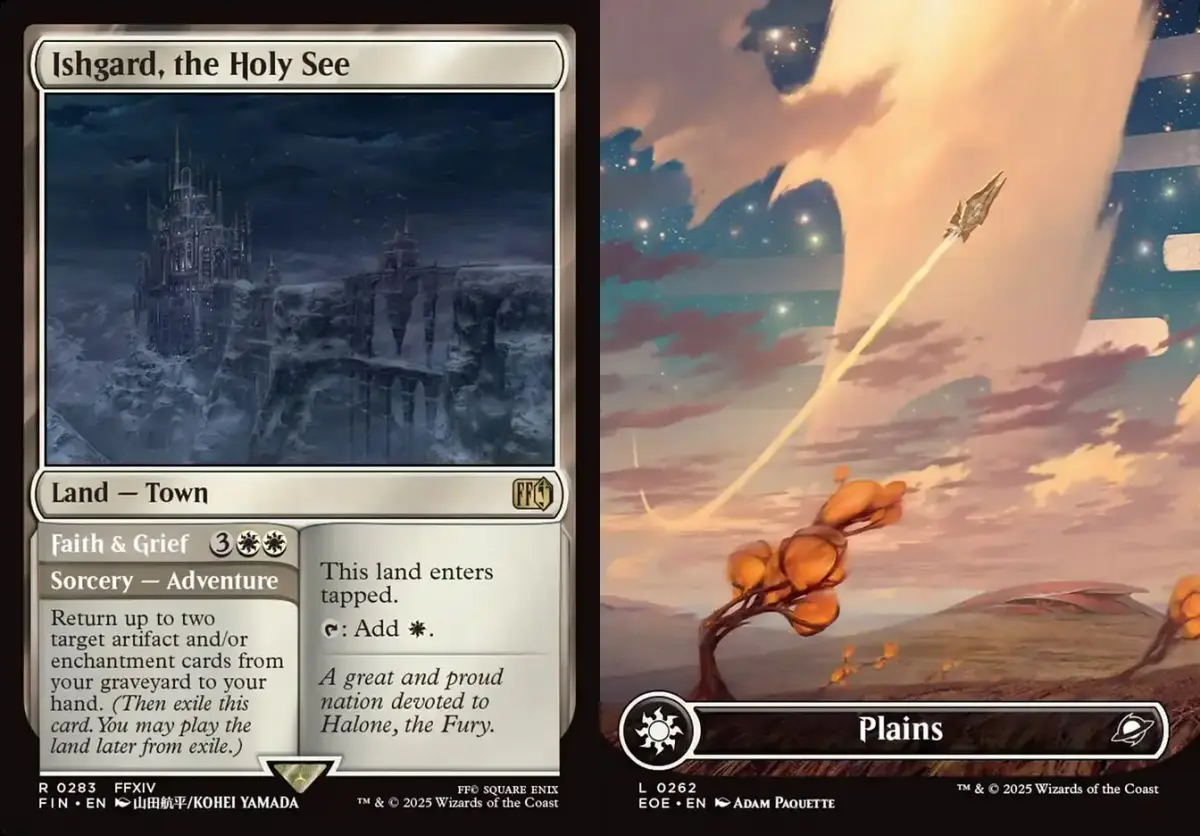
Because we have a huge number of artifacts and enchantments, its Adventure easily recovers key resources for us, and the floor is just a land of the right color that enters tapped, which costs us little.
- Plains (14):
From a purely color-fixing standpoint, we actually have the room to swap N Plains for Sunbillow Verge, so that High Noon can activate its deal-5 ability without squeezing out red mana from strange places; or to add some utility lands that produce white. The only reason I stopped adding more utility lands is to avoid being punished by Sunspine Lynx, which does way too much damage to control.
Sideboard
- High Noon (1):
This second High Noon in the sideboard could actually go in the main deck. If you plan to run two main deck High Noons, you can swap slots with one main deck Beza, the Bounding Spring or Overlord of the Mistmoors, depending on how you read the day’s metagame. I chose 1 main and 1 side as the more conservative configuration; after all, although High Noon has a very high ceiling, its floor is a plain dead card, and in many matchups where it isn’t key, drawing a second copy really makes you want to die. But if you’re quite sure that Vivi decks make up close to half the field at this tournament, you can decisively go with the 2 main deck configuration.
- Rest in Peace (3):
The strongest graveyard hate. I originally ran 2, but as I kept testing I felt the graveyard-using abilities in the current environment are just too strong, and giving them full respect isn’t excessive. Although Rest in Peace also messes with our own Enduring Innocence, usually breaking the opponent’s game plan matters more, and when you have Rest in Peace in your deck, you can also actively let Enduring Innocence chump block before Rest in Peace enters.
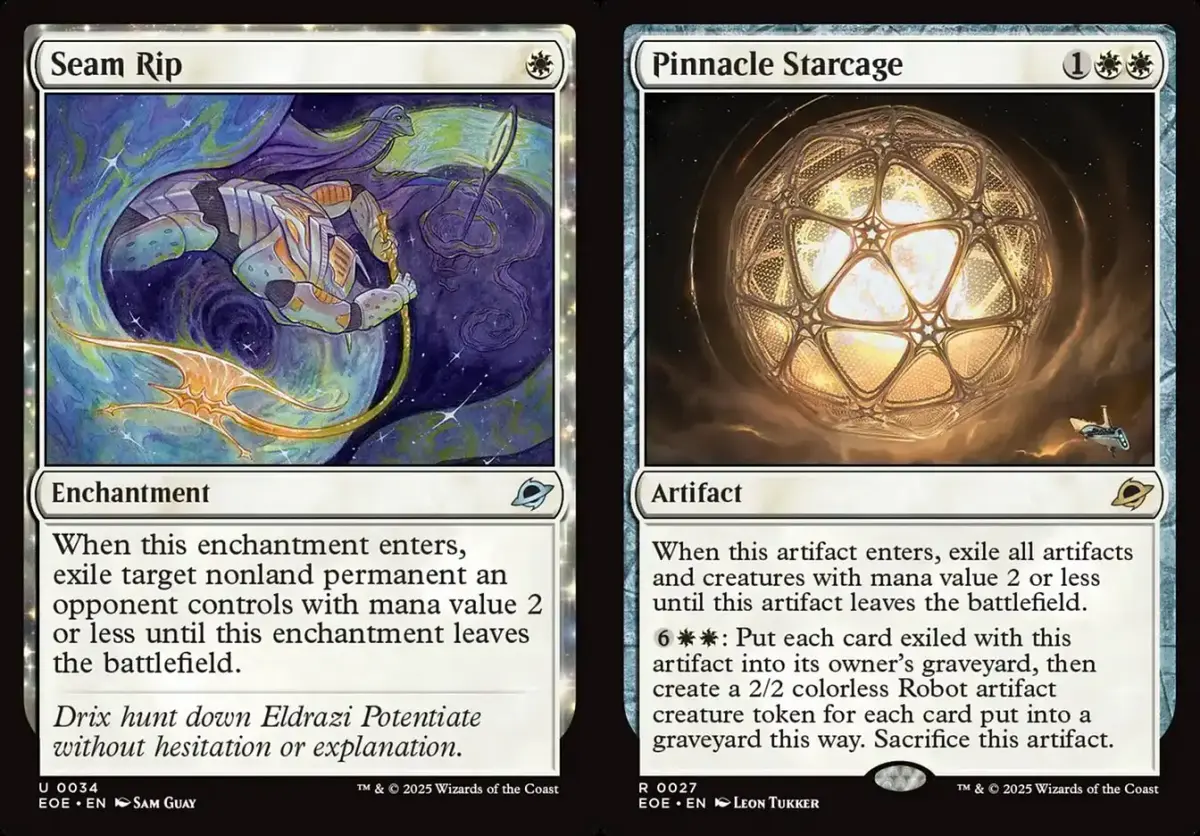
- Seam Rip (1) & Pinnacle Starcage (1):
Both are extra supplements to the main deck’s conditional removal; when you see a suitable small-curve opponent, swap in more of this good removal.
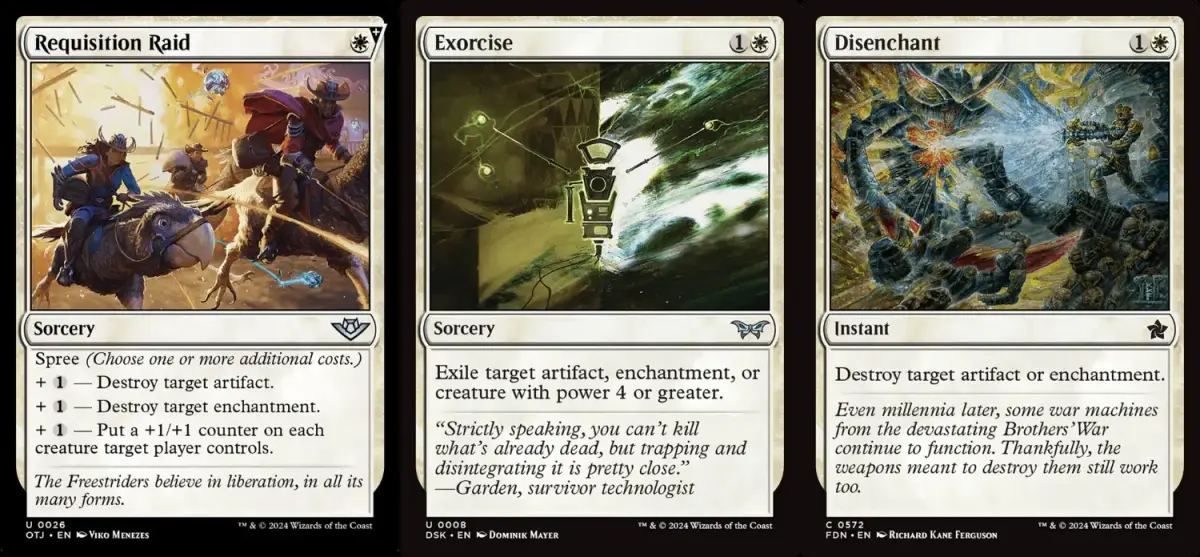
Although these are all answers to artifacts and enchantments, each has its own advantages and its own situations where it applies, and none is a strict upgrade over another, so I run one of each.
- Requisition Raid (1):
The MVP against Vivi Cauldron; one card can destroy Agatha’s Soul Cauldron + Proft’s Eidetic Memory / Fear of Missing Out, and grow our whole token team on the side. Since so many cards in the environment are artifacts or enchantments, it can occasionally counter some unexpected opponents too, such as taking Demon Wall + Unholy Annex // Ritual Chamber away together. Although its ceiling is high, against an opponent without both an artifact and an enchantment it is just a very inefficient two-mana one-for-one sorcery-speed kill spell, so you shouldn’t run too many.
- Exorcise (1):
Among artifact and enchantment removal it is top-tier in versatility, and against midrange/control decks with big creatures it can also work, especially since we lack removal for indestructible key finishers like Ketramose, the New Dawn. Since the added value is so high, why not run a full playset? The reason is below:
- Disenchant (1):
People often say that if Exorcise were an instant, Disenchant would be completely crying in the bathroom, but the key is that Exorcise is not an instant. Although Exorcise has high added value, the slot I usually need mainly targets artifacts and enchantments; whether it can also hit a creature or exile something isn’t really important, and Vivi Cauldron has a very strong ability to snowball the board in an instant, with the key starting point of that snowball being exactly Agatha’s Soul Cauldron or Proft’s Eidetic Memory. Vivi Cauldron decks are capable of going wild in a single turn starting from an empty board, so a sorcery-speed answer card may well be too late to solve my key problem, which makes instant-speed Disenchant still necessary. Subjectively, I even think re-adding Disenchant was the key to finalizing this deck.
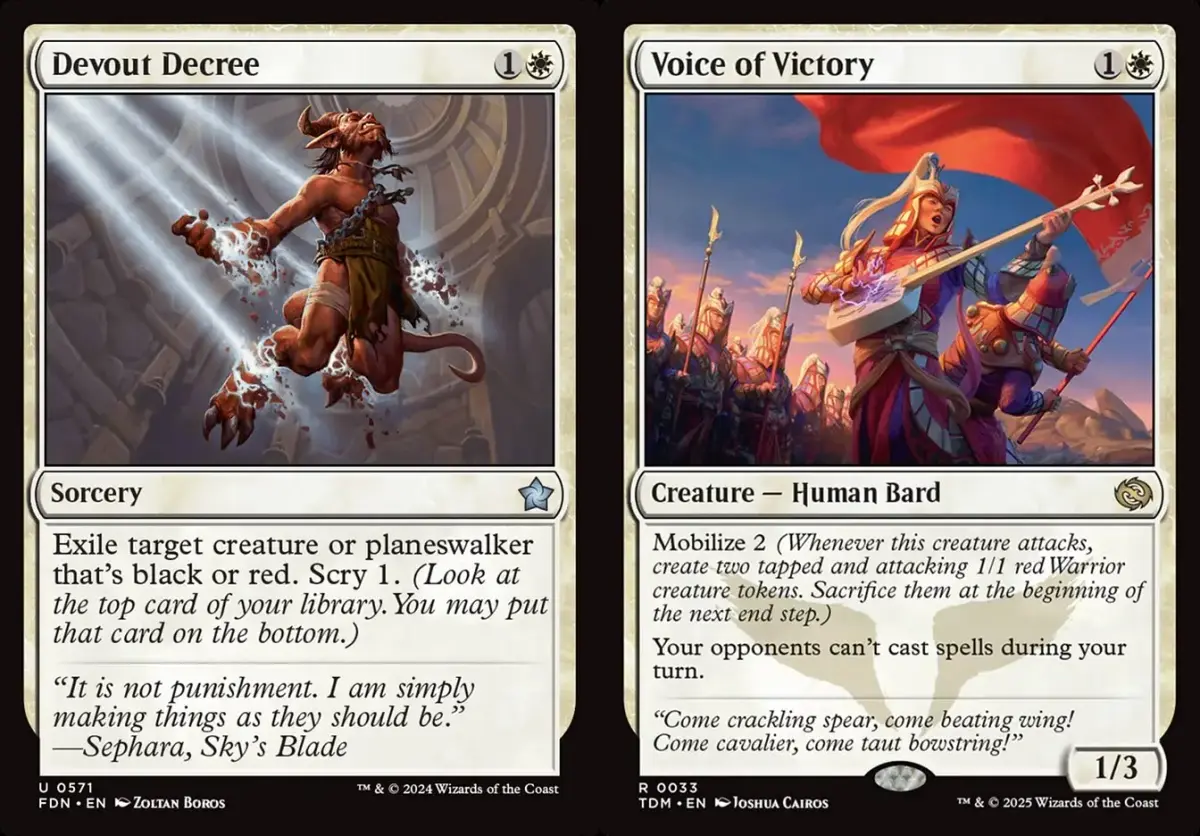
- Devout Decree (2):
It gives me more room to respond to the core attackers of the opposing Vivi Cauldron, as well as Kaito, Bane of Nightmares; it’s also quite good against red aggro and Unholy Annex // Ritual Chamber midrange decks; and it’s a very rare and precious answer when facing Ketramose, the New Dawn.
- Voice of Victory (4):
A god card against flash tempo and Draw-Go control; one copy can easily collapse the opponent’s game plan. Since these two archetypes make up a considerable share of the field, and my other sideboard cards have limited effect against both, I run a full four copies to round out the sideboard’s answers.
Although in theory you can use it against any deck that plays blue with counterspells, in practice it performs oddly against decks that don’t prioritize Draw-Go play, because their boards are usually so strong that it can’t attack through, and slots also need to go first to removal or other more efficient targeted cards; after that, the available slots are mostly used up, so whether you need Voice of Victory against such a deck depends on how many protecting counterspells the opponent has.
Matchups & Sideboard Plans
General Principles
Sideboarding is never set in stone; even for decks with the same name, different detailed configurations will require different strategies from us, and sometimes there’s a mind game with multiple sideboarding ideas, so the most important principle when sideboarding is still to stay flexible.
One of the most common points of mind games is whether we bring in Voice of Victory. As I said above, against blue-based go-wide decks, Voice of Victory mostly can’t attack through, and its role is purely to counter protecting counterspells; against opponents who rely heavily on counterspells as their answer it is a god card, but most decks now also have sideboard plans that don’t rely on counterspells, so the sideboarding pattern against blue opponents is quite random.
Answering Common Hate Cards
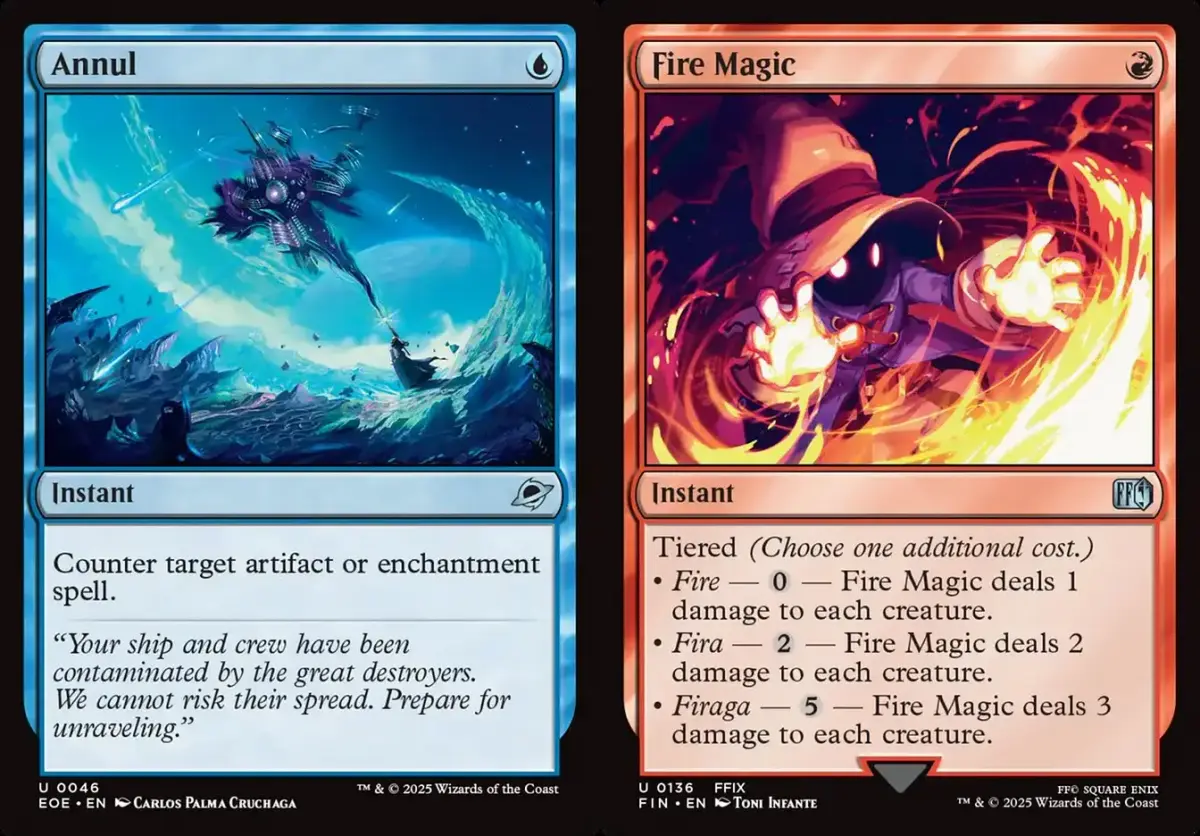
Annul, reprinted in EOE, does enormous damage to this deck, since over half of our nonland cards are within its range. Before, when the opponent left one mana up, you only had to play around Spell Pierce; now there’s also the one-mana hard counter Annul, and this card is so important in the current environment that it’s not rare to see people sideboard three. With Voice of Victory protecting, it’s easy, but when you have to face counterspells without Voice of Victory, a few cards will always get countered, so you must plan which cards are truly key to winning and which are expendable pieces to bait counterspells, and also keep track of how likely it is that the opponent currently holds a counterspell.
Another card that easily collapses our defense is Fire Magic, which just about every red opponent will have. It’s common to see the opponent wipe the board at instant speed at the end of our turn, then burst out a wave of damage on their own turn; besides actively trying to get one Caretaker’s Talent up to Level 3 first, most of the time you need to consciously leave a bit more room to make tokens at instant speed.
Vivi Cauldron
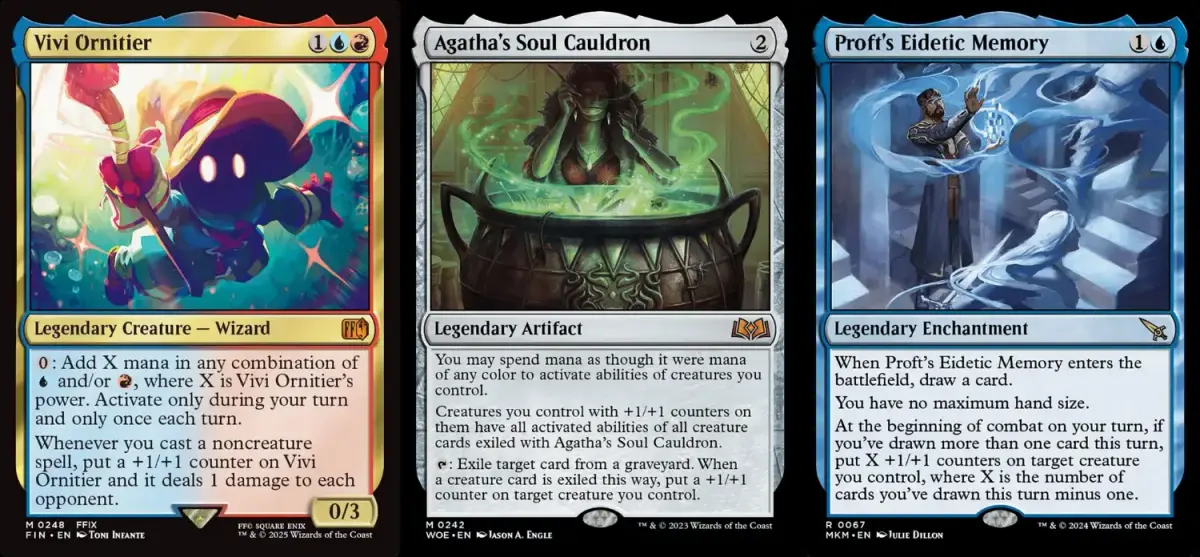
| Ont | In |
|---|---|
| Enduring Innocence -1 | Rest in Peace +3 |
| Beza, the Bounding Spring -1 | High Noon +1 |
| Overlord of the Mistmoors -1 | Requisition Raid +1 |
| Carrot Cake -2 | Disenchant +1 |
| Pinnacle Starcage -2 | Devout Decree +2 |
| Elspeth, Storm Slayer -1 |
Vivi Cauldron has so many attack angles that we need to bring in this many sideboard cards to handle it. But honestly, even after boarding the matchup is just even; after stuffing in a whole pile of targeted cards it only gets pulled to even, which is just how absurd Vivi Cauldron is.
It may be a surprise that Exorcise isn’t brought in. The reason is that although Vivi Cauldron has many artifacts and enchantments in the deck, there won’t be many on the battlefield at the same time, since Proft’s Eidetic Memory & Agatha’s Soul Cauldron are both legendary, and these can also be handled by Seam Rip, so the current swaps already provide enough answers; against Vivi Cauldron, Requisition Raid & Disenchant are still better at solving the key problems.
Izzet Prowess
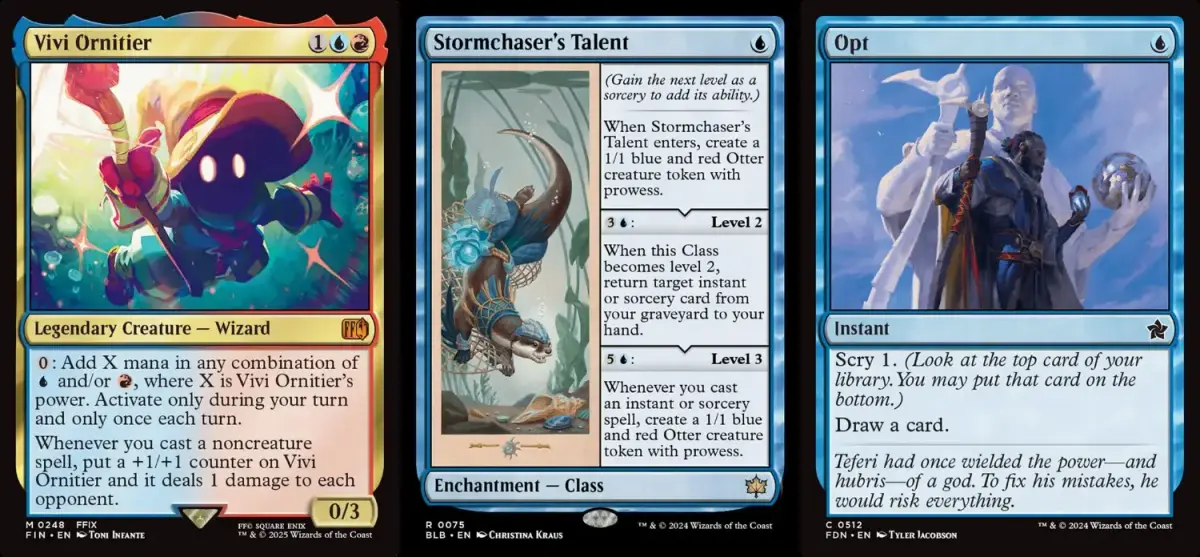
| Ont | In |
|---|---|
| Enduring Innocence -3 | High Noon +1 |
| Overlord of the Mistmoors -1 | Requisition Raid +1 |
| Carrot Cake -2 | Exorcise +1 |
| Elspeth, Storm Slayer -1 | Disenchant +1 |
| Devout Decree +1 | |
| Voice of Victory +2 |
Although I’ve given a sideboard table, honestly this matchup’s sideboard table is not very useful as a reference, because the detailed configurations of Izzet Prowess differ so much, and different configurations call for completely different targeted cards.
- Full playset of Astrologian’s Planisphere → need extra Pinnacle Starcage
- How heavily the opponent relies on counterspells → number of Voice of Victory varies
- Number of red win-condition Plan Bs in the sideboard, like Ral, Crackling Wit → may need more Devout Decree
- Whether they run Get Out, forming a repeated recursion chain with Stormchaser’s Talent → may need Rest in Peace, or Voice of Victory protection to make sure the enchantment removal succeeds
What’s more common is that Prowess’s attackers or key resource points are often artifacts or enchantments, so artifact and enchantment removal is especially useful. Also, Izzet Prowess has more than a few exile-burn spells, so Enduring Innocence easily disappears without earning anything, but not bringing it at all lets the opponent save a bunch of slots for other effective targeted cards, so leaving a few in makes the opponent’s decisions harder.
In this matchup, pay special attention to whether the opponent’s build has Crash Through; if it does, the pressure to clear the board will be very high, because our defensive plan mostly relies on blockers chump blocking.
Dimir Tempo
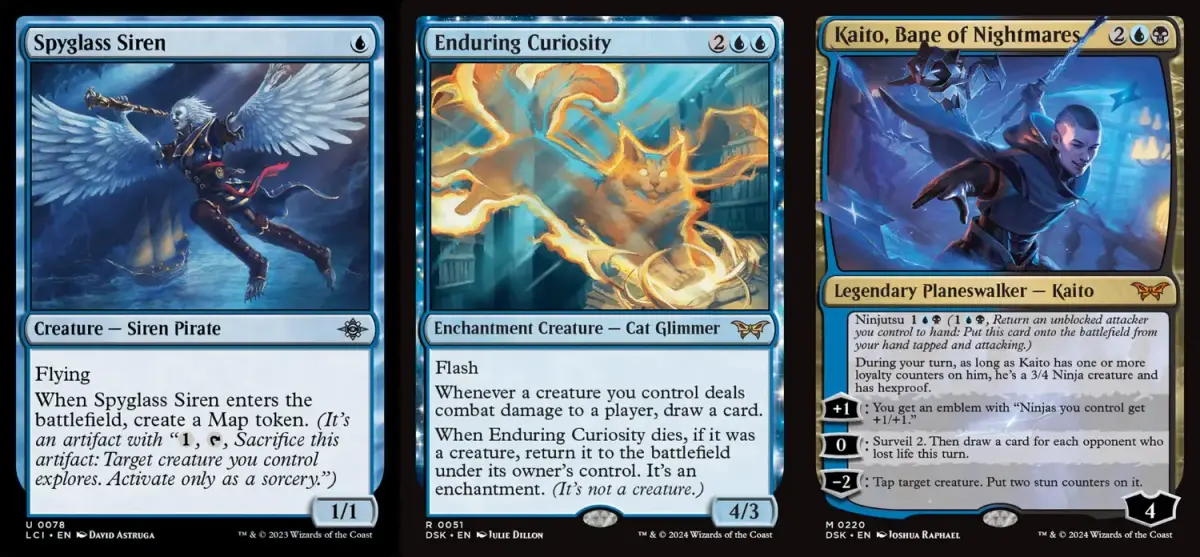
| Ont | In |
|---|---|
| High Noon -1 | Devout Decree +1 |
| Carrot Cake -2 | Voice of Victory +4 |
| Elspeth, Storm Slayer -2 |
High Noon against flash tempo is basically locking yourself, so don’t use it except as a seven-mana burn spell.
Devout Decree is an excellent answer to Kaito, Bane of Nightmares; if the opponent’s share of black creatures is high enough (especially with Deep-Cavern Bat), Devout Decree can be changed to +2, and usually once you draw Voice of Victory, the opponent has trouble maintaining their tempo.
Azorius Control
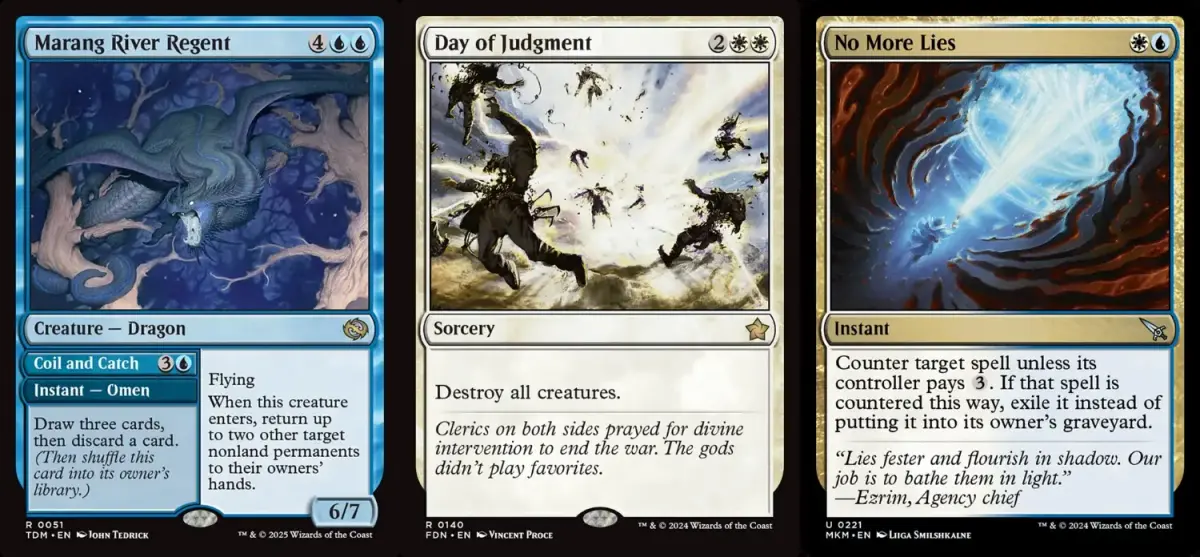
| Ont | In |
|---|---|
| Seam Rip -3 | Exorcise +1 |
| High Noon -1 | Disenchant +1 |
| Carrot Cake -1 | Voice of Victory +4 |
| Pinnacle Starcage -1 |
Because Azorius control’s creatures are all big guys, Exorcise can also serve as creature removal, and current Azorius control also relies heavily on Overlord of the Mistmoors; it and Elspeth, Storm Slayer are the deadliest threats for both sides, so Pinnacle Starcage isn’t entirely taken out, and the sideboard also brings in Disenchant to deal with Overlord of the Mistmoors.
In this matchup our card advantage is far stronger than the opponent’s, so we should instead be careful not to draw too many cards and self-destruct. And because we have so many strong draw engines, and the slow pace of this matchup already gives more chances to draw slowly, the most crucial thing is to watch the opponent’s few win conditions closely; to ensure the removal succeeds, baiting counterspells with a resource engine or our own finisher is sometimes worthwhile. Since we have many more win conditions, we’re relatively less afraid of being killed off without a finisher compared to Azorius control; it’s just that our damage efficiency is truly low, so what we fear more is that the board can win but our library can’t last until we win.
Although the section is named Azorius control, most blue control decks that run counterspells + instant-speed card draw can be filed under this heading, such as the recently rising non-green four-color control; the response is essentially unchanged, and the biggest difference is that targeted removal is adjusted based on the opponent’s card choices.
Ketramose Control
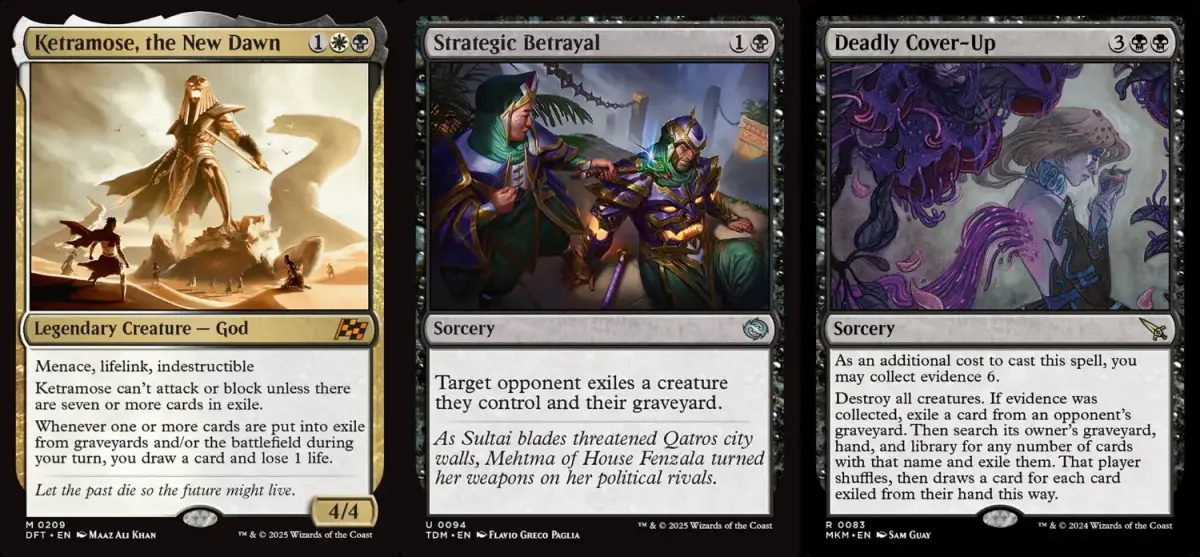
| Ont | In |
|---|---|
| Seam Rip -3 | Requisition Raid +1 |
| High Noon -1 | Exorcise +1 |
| Pinnacle Starcage -2 | Disenchant +1 |
| Devout Decree +2 | |
| Voice of Victory +1 |
A nightmare matchup. Ketramose, the New Dawn is hard enough to answer by itself, and with a pile of exile-based kill spells and enchantment removal, the advantage of our card-advantage engines being hard to answer disappears too, and against their graveyard/hand/library exile effects, a control deck like ours can basically only throw up its hands. In many cases Disenchant may be thrown onto our own Enduring Innocence to dodge the hand-and-library exile of The End or Deadly Cover-Up.
Ketramose control has two schools of secondary resource engines, the versions that use Mazemind Tome and those that use Unholy Annex // Ritual Chamber. The Unholy Annex // Ritual Chamber version is harder for us, as it is naturally a great fit for control, but whichever version it is, our answers stay the same. When facing the Mazemind Tome type, remember not to try to exile their Mazemind Tome with Seam Rip or Pinnacle Starcage (unless that book hasn’t drawn a card yet and they currently lack the mana to activate it to draw); if you exile a book that has already earned cards, what awaits is them buying the book back and getting a fresh set of free card draws.
Orzhov Sacrifice
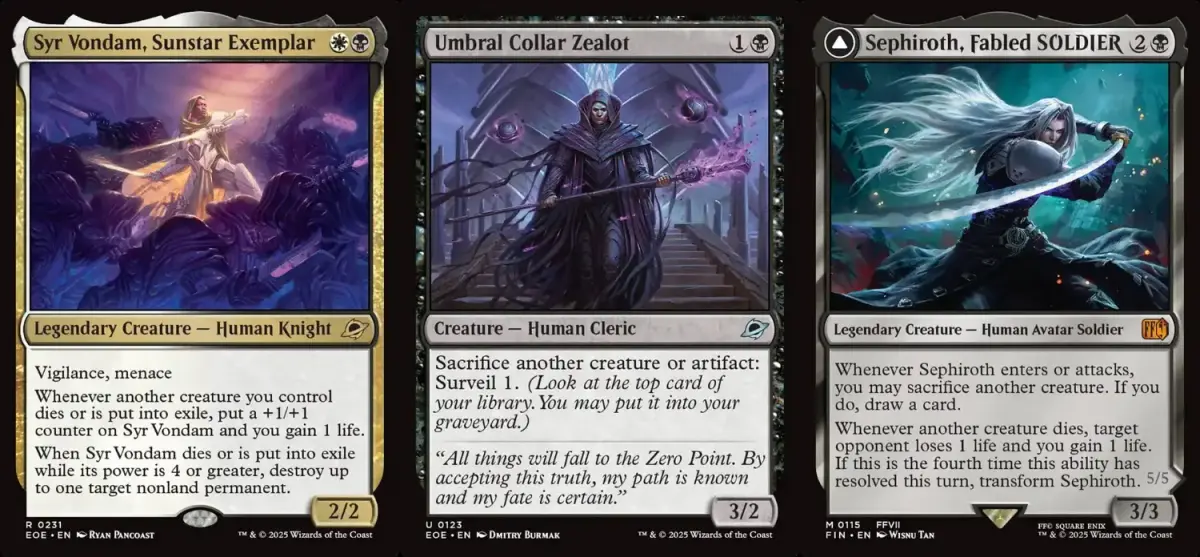
| Ont | In |
|---|---|
| Overlord of the Mistmoors -1 | Rest in Peace +3 |
| Get Lost -3 | Pinnacle Starcage +1 |
| High Noon -1 | Seam Rip +1 |
| Carrot Cake -2 | Devout Decree +2 |
Rest in Peace turns creature deaths into exile, which sidesteps quite a few abilities that trigger when creatures die as well as some creatures that crawl back from the graveyard, and it is the core hate card against Orzhov sacrifice.
On the contrary, Get Lost, originally the best kill spell, is laughably bad in this matchup. The opponent is a pile of small creatures to begin with, and after Get Lost resolves the board may even be stronger than before, and it even gives the opponent a pile of extra sacrifice fodder; keeping one copy to hold instant-speed ability against key cards is enough.
Although the opponent is a small-curve deck, their hand resources aren’t actually that many, so the restriction High Noon can impose is rather awkward; unless you cast it on time, it is usually you who gets locked more severely.
Esper Bounce
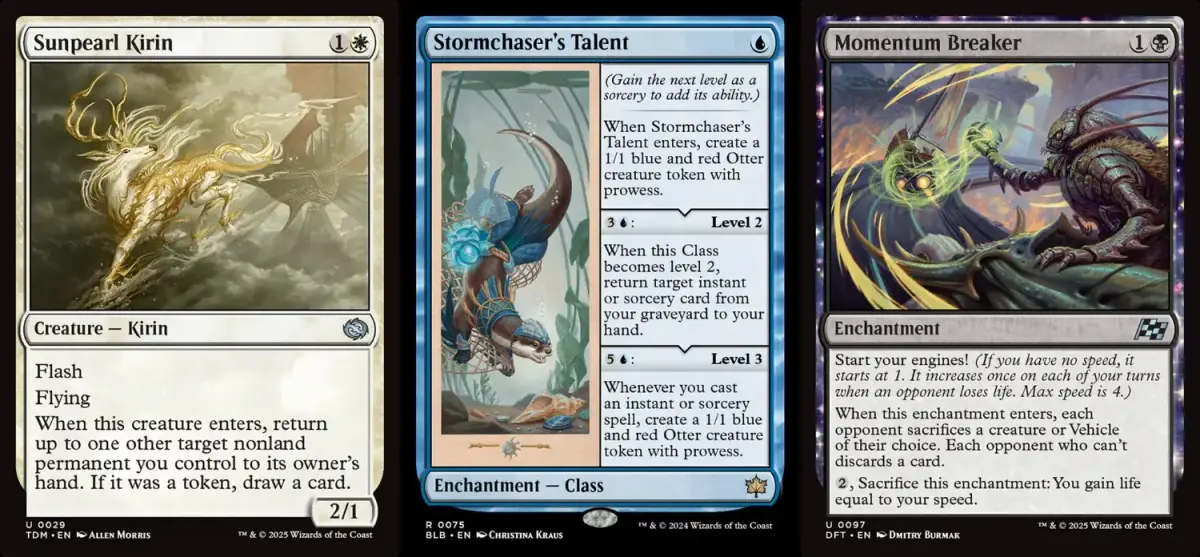
| Ont | In |
|---|---|
| Carrot Cake -2 | High Noon +1 |
| Day of Judgment -1 | Pinnacle Starcage +1 |
| Disenchant +1 |
In testing this is close to a free win; the advantage of repeatedly recycled removal doesn’t pose any real threat to us, and it’s hard for the opponent to cut off our resource engines. They may be frantically bouncing things back and forth for resources, while after I just drop a few tokens I’m a whole stack ahead on resources, and since we’re constantly gaining life, the opponent has trouble killing us by stealing tempo.
This is a standard small-curve deck that creates advantage by doing things repeatedly, so High Noon makes its already poor matchup even worse. Although they have many artifacts and enchantments, their ability to save themselves is also decent, and sorcery-speed removal easily becomes a pure loss of a card, so I only brought in instant-speed Disenchant, plus a Pinnacle Starcage to clean up their crowd of two-mana-or-less small creatures, which is already more than enough.
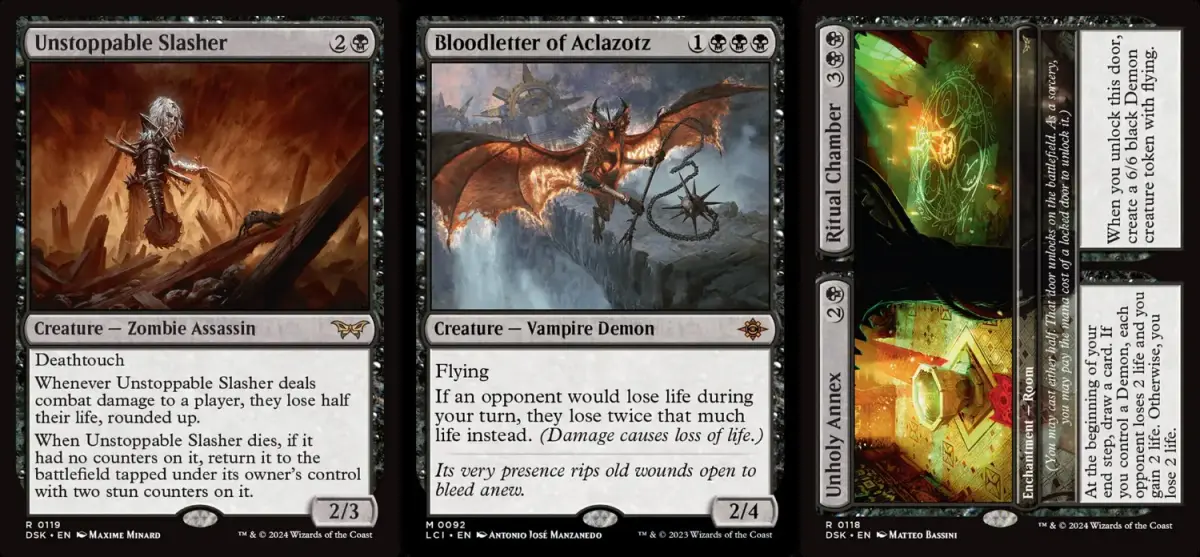
Mono-Black Demons
| Ont | In |
|---|---|
| High Noon -1 | Requisition Raid +1 |
| Carrot Cake -2 | Exorcise +1 |
| Pinnacle Starcage -2 | Disenchant +1 |
| Devout Decree +2 |
If they run the Demon Wall version, Requisition Raid is the MVP, but even if they have no artifacts you may still need Requisition Raid to bail you out, or the pressure from Unholy Annex // Ritual Chamber is just too great.
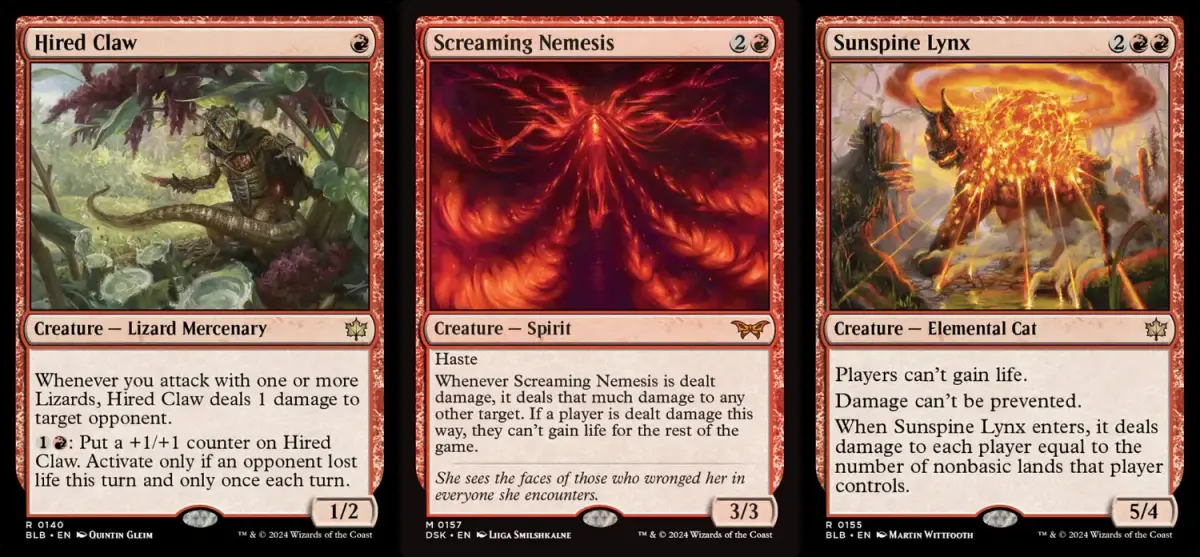
Red-Based Aggro
| Ont | In |
|---|---|
| Overlord of the Mistmoors -1 | Pinnacle Starcage +1 |
| Caretaker’s Talent -2 | Seam Rip +1 |
| Elspeth, Storm Slayer -1 | Devout Decree +2 |
Although normally Get Lost is awkward against aggro, against today’s red aggro you have to bring it, because their attackers are developing toward midrange, and each one is a key threat, not the kind you can slowly stall with tokens, especially Screaming Nemesis; once it locks out our life gain successfully, we basically might as well stop playing. Sunspine Lynx & Nova Hellkite are also things we absolutely don’t want standing on the battlefield. And because in this matchup our life gain can easily be locked out and we can get burned out, we actually can’t play too passively and must start actively trying to build a board and fight back fairly early.
The biggest pain point of the current sideboard is exactly this matchup. In the past, whenever I played a white deck I would bring at least 3 Authority of the Consuls, but slots are really tight now, and at the point when I last tuned this deck, red aggro’s share was in a subtle position, leaving it unclear how much respect it deserved, so I temporarily dropped Authority of the Consuls.
But based on later metagame statistics, especially the results of the Orlando Spotlight, we should still respect red aggro with Authority of the Consuls; the specific adjustment ideas are introduced in the section Reassessing Red Aggro Answers After the Orlando Spotlight.
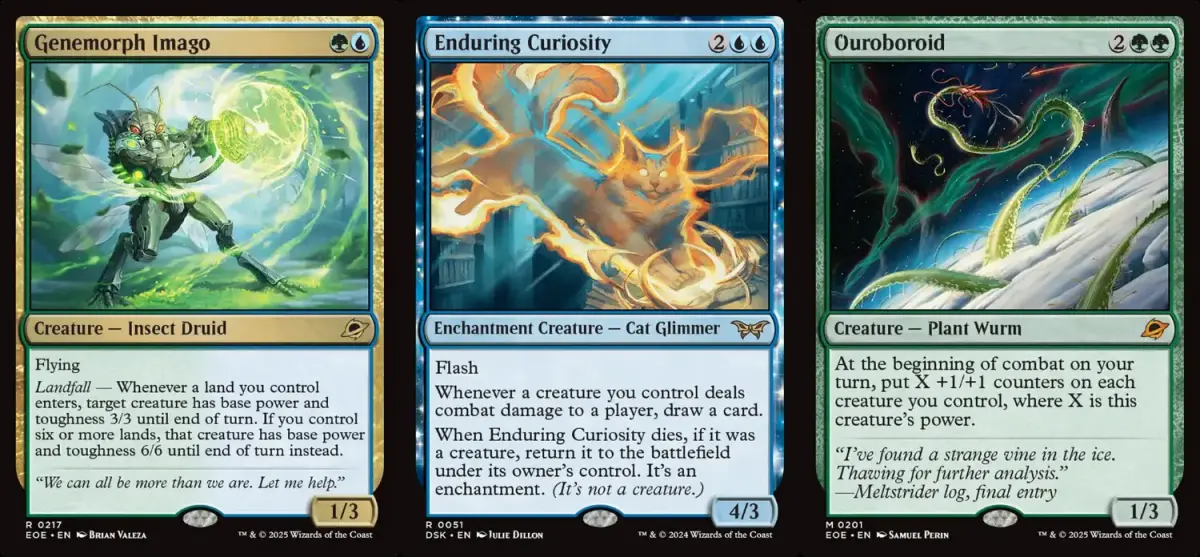
Simic Midrange
| Ont | In |
|---|---|
| High Noon -1 | Pinnacle Starcage +1 |
| Carrot Cake -2 | Seam Rip +1 |
| Exorcise +1 |
This Simic midrange deck has a very dense curve of low-cost creatures, so the range of Seam Rip & Pinnacle Starcage looks great. As for bringing in Exorcise, the main purpose isn’t actually to handle Enduring Curiosity, but the post-board Sab-Sunen, Luxa Embodied; that thing is far scarier to us than Ketramose, the New Dawn. Its trample ignores the blocker line that tokens excel at, and on the removal side we’re also missing the 2 Devout Decree we could use; even counting the main deck Ride’s End, we have only 2 removal spells in total that can answer Sab-Sunen, Luxa Embodied, so hold these two exile-based kill spells and don’t use them carelessly until Sab-Sunen, Luxa Embodied is confirmed gone; whether you can deal with Sab-Sunen, Luxa Embodied will most likely be the deciding watershed of the post-board games.
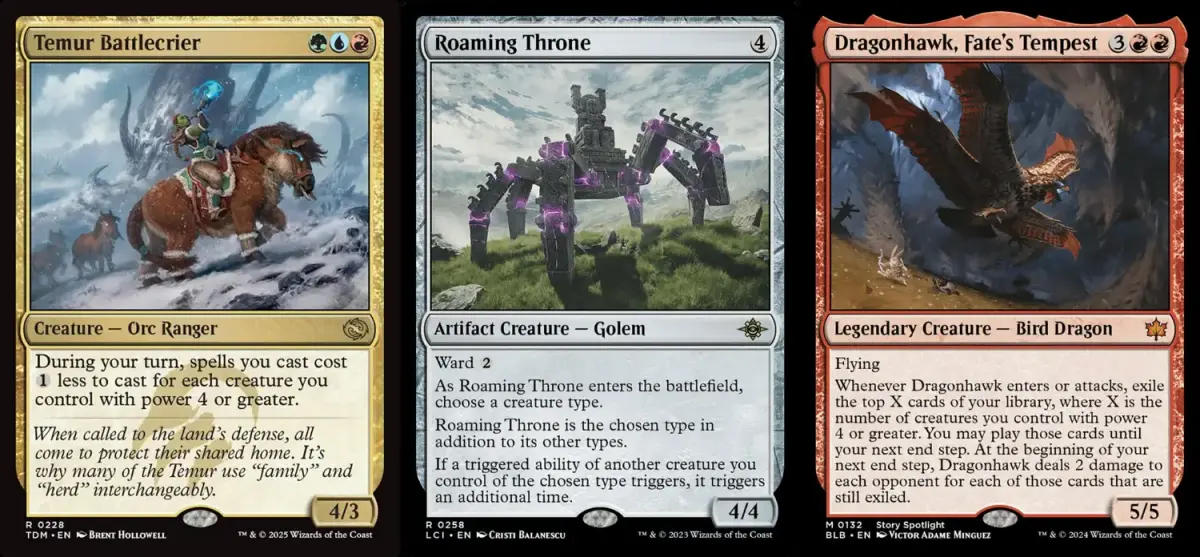
Temur Battlecrier Combo
| Ont | In |
|---|---|
| Seam Rip -3 | High Noon +1 |
| Pinnacle Starcage -2 | Exorcise +1 |
| Disenchant +1 | |
| Devout Decree +2 |
Pinnacle Starcage is basically completely useless in this matchup, and Seam Rip is also useless unless it’s aimed at a turn-one Llanowar Elves.
Because one of this deck’s burst points comes from casting powerful spells in succession at low cost, High Noon can cause considerable disruption, and Devout Decree & Exorcise are also generally useful removal in this matchup; as for Disenchant, it’s really just to respect Roaming Throne, which can spiral out of control instantly if not dealt with right away. Also, against opponents who run more protection spells and protecting counterspells in the sideboard, you may need Voice of Victory to make a sacrificial play for your sweepers.
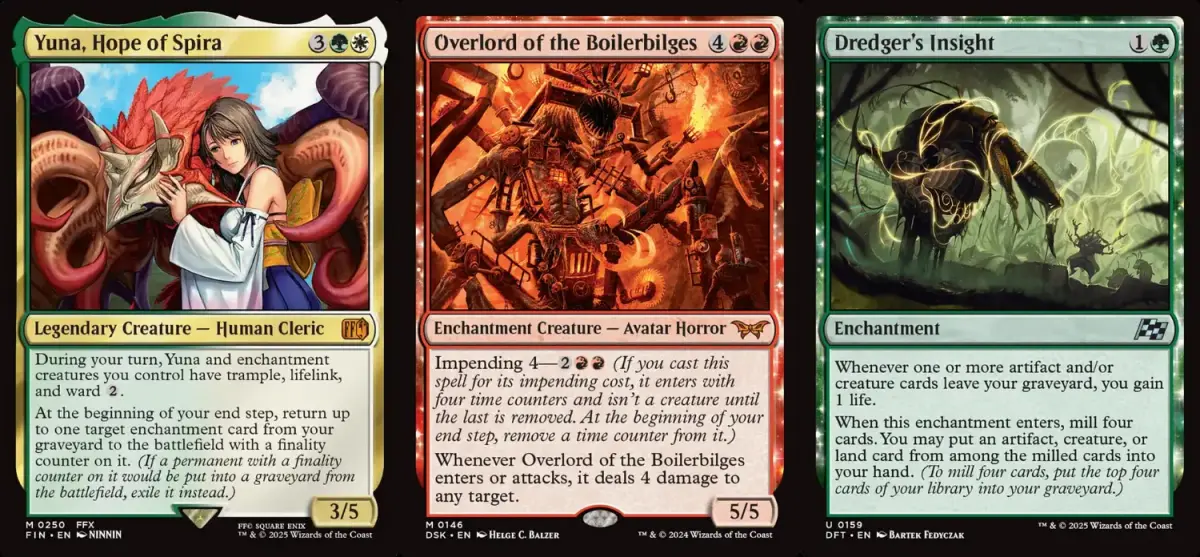
Naya Yuna
| Ont | In |
|---|---|
| Enduring Innocence -1 | Rest in Peace +3 |
| Overlord of the Mistmoors -2 | Requisition Raid +1 |
| Seam Rip -2 | Exorcise +1 |
| High Noon -1 | Disenchant +1 |
| Pinnacle Starcage -2 | Devout Decree +2 |
Basically, as long as Rest in Peace successfully locks things down, the whole game is low pressure. This is one of the few matchups where Carrot Cake is kept first, because the opponent’s strongest win condition is Overlord of the Boilerbilges burning you out, so Carrot Cake’s gain-3 is key.
Reassessing Red Aggro Answers After the Orlando Spotlight
Below are the deck statistics for both days of this Orlando Spotlight (GP); these two sets of data fully show the characteristics of the current Standard environment.
Day 1 statistics: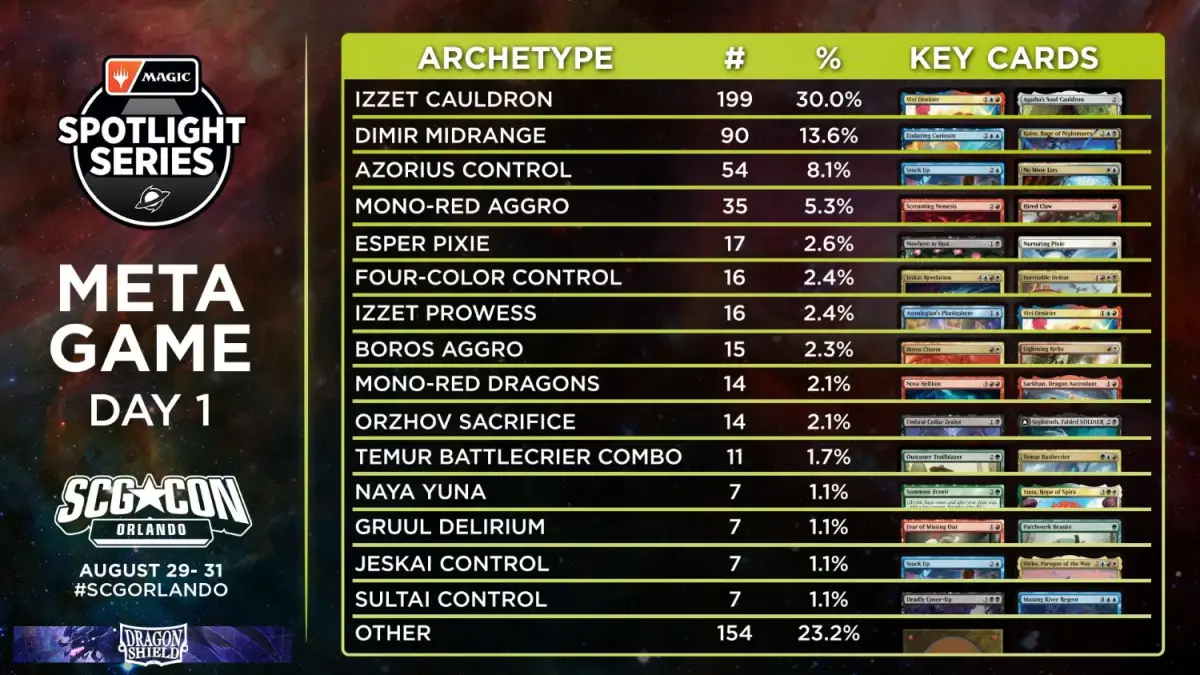
Day 2 statistics: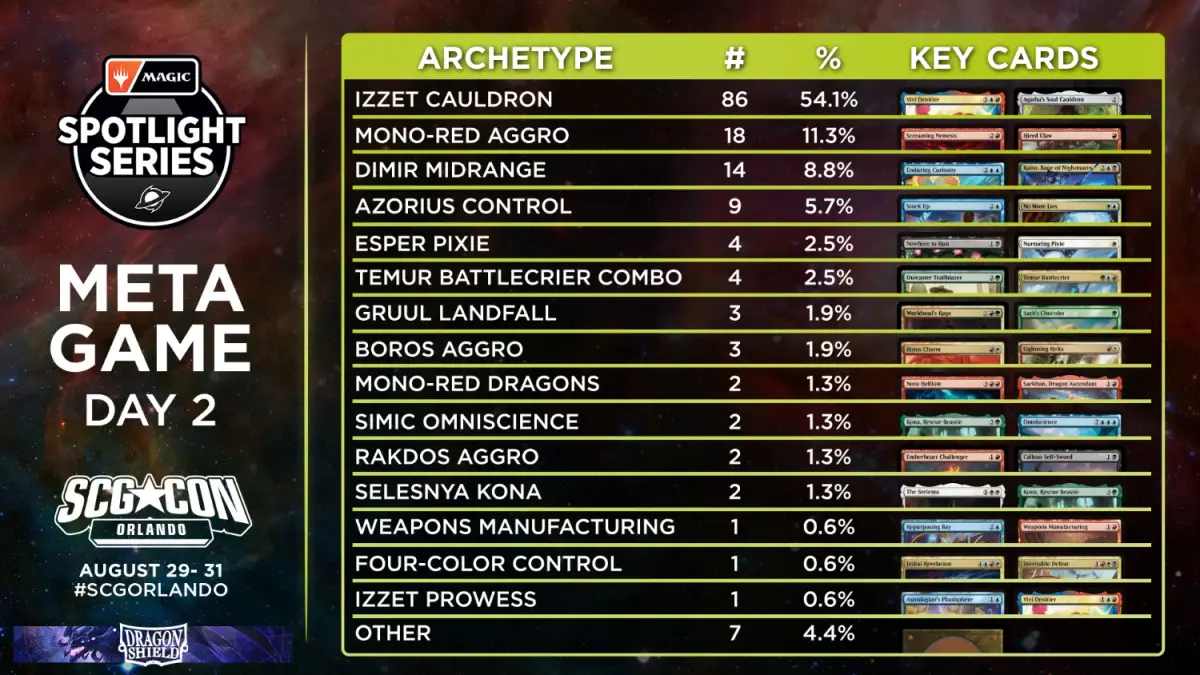
Let’s first talk about how to squeeze out slots for the sideboard Authority of the Consuls. If I’m going to add Authority of the Consuls, my habit is to add at least 3, and these 3 slots come from Seam Rip x1 and Voice of Victory x2, for the following reasons:
- Seam Rip: We already have a great deal of removal for low-cost permanents, and in matchups where we need to raise the share of that kind of removal further, it may be more efficient to prioritize Pinnacle Starcage. In addition, one of Seam Rip’s few targets is red aggro, and swapping in Authority of the Consuls is even more powerful.
- Voice of Victory: Although it is a big killer against both Dimir tempo & Azorius control, these two decks aren’t bad matchups for us in game 1 anyway, and against decks other than these two, even if I bring it, I wouldn’t bring a full playset.
So at this point, the trade-off for these 3 slots effectively becomes whether to respect red aggro, or to respect Dimir tempo + Azorius control?
Let’s look back at the GP statistics above. The Day 1 deck distribution is roughly the normal distribution of the current Standard environment, and when I made my construction trade-offs I also referred to statistics with the same trend. By these statistics, Dimir tempo & Azorius control are 2nd and 3rd in metagame share respectively, so being able to target both at once seems to have a much better expected value than targeting only 4th-place red aggro, but looking back now, this is actually a mental trap.
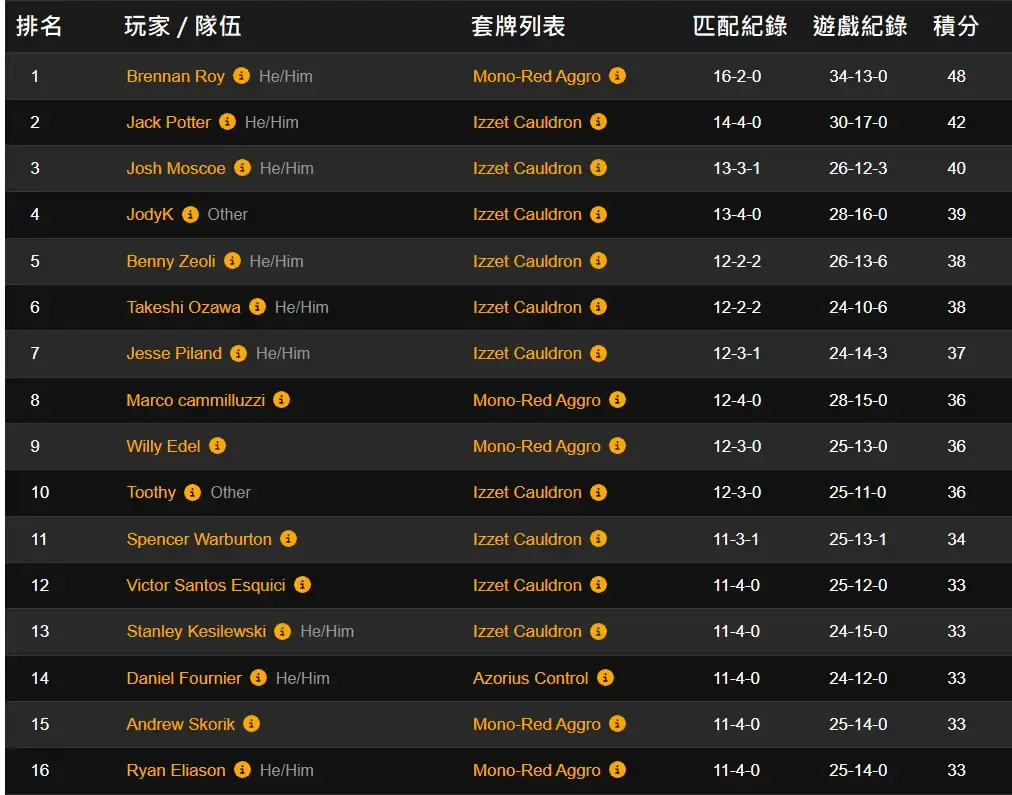
Now let’s look at Day 2: red aggro, with a conversion rate over 50%, jumped to 2nd place on Day 2. The reason is simple: according to various statistics, red aggro is the only meta deck with a positive win rate against Vivi Cauldron (though only about 53%), and Vivi Cauldron is a monopoly-level presence in the environment, a phenomenon that basically can’t change until the banned list update, so it can be predicted that when you want to climb to the top of a tournament, your encounter rate with red aggro will be much greater than the normal distribution probability, and as the idea that red aggro can handle Vivi Cauldron gradually becomes a consensus, the share of red aggro players itself will rise.
So back to our deck: is answering red aggro harder than Dimir tempo & Azorius control? The answer is not only yes, but the gap is huge. The first thing that makes red aggro hard to handle is the life-gain lock + direct damage of Screaming Nemesis & Sunspine Lynx, which are so strong that I think they are runaway cards designed by mistake (Wizards, do you remember why Rampaging Ferocidon was banned back then?). The other point is that the new card Nova Hellkite is also a powerful threat that is hard to answer properly; the key blockers this deck uses to defend against flyers are the Insect tokens made by Overlord of the Mistmoors, but Nova Hellkite can kill one on ETB, and the fact that it leaves the battlefield when Warp ends is actually an advantage for it, because that dodges sweepers, and even after we sweep the board it comes back the next turn with haste and beats us up, an attack rhythm that is completely seamless; we don’t have that many instant-speed kill spells either, which is one of the reasons Authority of the Consuls is more important against red aggro now than before.
On the other hand, I don’t find the matchups against Dimir tempo & Azorius control hard to handle, so it’s indeed fine not to respect them to this degree; although after this change the control matchup will have little sideboard material to use, overall the pros still look like they outweigh the cons.
Conclusion
The current environment is very similar in the direction of its problems to the environment before the last ban announcement, and even more extreme in degree. Basically ordinary fair proactive decks have no room to survive at all; decks other than Vivi must all develop toward extremes, either extremely fast or extremely targeted, to find a thread of hope in this environment. Clearly Vivi Cauldron’s power, and the resulting extremity of the environment, is no longer something the environment can regulate by itself; the only answer is a banned list update. I hope Wizards doesn’t play dead this time, and that when it’s really time to cut losses they steel themselves and use the emergency ban announcement mechanism…
- Title
- Season 11 Standard MITQ: Mono-White Token Control
- Author
- Jru
- Created at
- September 2, 2025
- License
- This work is licensed under CC BY-NC-SA 4.0 .