
Orzhov Control: Vampire Rooms

Note: This article was translated from Chinese by AI and may contain errors. Read the original Chinese version.
Introduction: Why Orzhov Control
Let me tell you a secret: “In this game, as long as your life total doesn’t hit zero, you won’t lose!” (under normal circumstances)
This deck was originally a midrange deck, building a board advantage with black creatures and white removal, then pulling ahead on resources with Unholy Annex and winning step by step. But with no decisive key card, I often got hurt badly by Unholy Annex in the race over life totals, or the board went out of balance and I got run over, so I started looking for cards that could build a board while also protecting my life total.
As the build iterated and new sets came in, there were Firdoch Core, which interacts with Unholy Annex; Cease, which can target the graveyard and also provide evidence costs; a powerful sweeper plus Surgical Extraction effect in Deadly Cover-Up; an excellent creature that combines lifegain and finishing in Morlun, Devourer of Spiders; and Ketramose, the New Dawn, which combines all of the above strengths. These made the original midrange deck more and more controlling, and led to this Orzhov Control: Vampire Rooms.
Deck Build and Match Overview
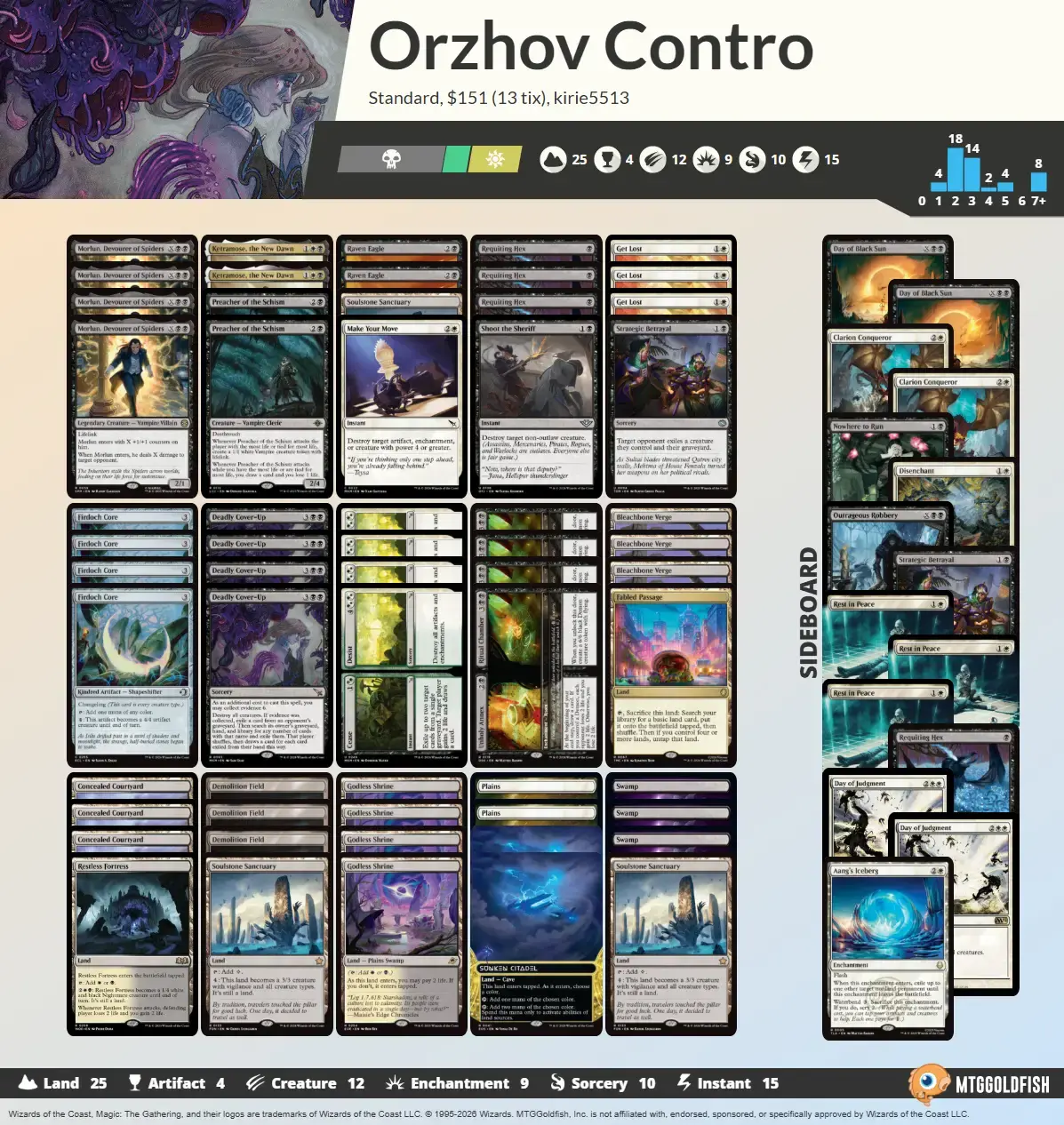
After playing a few games on MTGA to confirm there were no problems with the general direction, I went straight to the 3/8 LCQ. Here is that day’s report:
R1 Jeskai Control VV
In the control mirror, I had more damage and lifegain, and the opponent wasn’t a deck that wins with a one-shot combo either, so the resources and damage provided by Unholy Annex were enough to pull ahead and win.
R2 Red-White Dragons VV
The biggest threat in this matchup is Nova Hellkite. As soon as I found a chance to sweep the board with Deadly Cover-Up and exile all the Nova Hellkites, I could slowly steady the table with Unholy Annex and spot removal, and then just one or two activations of Morlun, Devourer of Spiders would be more than the opponent could stand.
R3 White Weenie Splashing Blue VXV
What I worried about most in preparation this time was Izzet Prowess and White Weenie aggro, because both have an extremely high burst ceiling, and if the control player makes one misjudgment, the game can tip entirely to one side.
In game one I kept a hand with a sweeper and spot removal, which basically let me get safely through to five mana and come back with the sweeper, but I drew too many colorless lands, which pushed the sweeper back; after sweeping I was down to 3 life, but the opponent had no resources either, and I still had Unholy Annex and Firdoch Core standing, so the opponent conceded.
In game two the opponent kept a hand that could go wide and refill with Quantum Riddler. After painfully exiling Quantum Riddler I was out of resources too, and could only be killed.
In game three the opponent, with many cards still in hand, cast a Quantum Riddler via Warp. I judged that the opponent’s hand was not smooth and that my resources could just support using Deadly Cover-Up to sweep and exile Quantum Riddler, so I spent an extra removal spell on the QR. After the QR was dealt with, I still had Ketramose, the New Dawn on the board to anchor the game, and the opponent had no way to deal with it at all, so I won.
Locking up the qualification was still quite happy. Besides the deck being sturdy and my not having serious land screw or flood, more importantly there were no strange mistakes that day, and I could enjoy every game. More than winning or losing, I prefer to play the deck’s contents well and show my game plan in full. Perhaps, just perhaps, my desire to show off swelled a little, so I borrowed my good friend faintmama’s Win Without the Badger deck to take on the main MIT event, because I knew that compared to my middle-of-the-road control deck, this Win Without the Badger has more build details to polish, and better shows the builder’s love for Magic: The Gathering.
Afterward I played one more LCQ to keep my feel for the cards.
R1 Rakdos Discard VXV
I don’t really understand this deck; I only know it burns very fast. With the support of the new card Cool but Rude, I really almost got my head bashed in. Luckily the opponent miscalculated lethal, or I’d have been out at 0-2.
R2 4C Living End XV?
In game one, after confirming the opponent was on Living End, I planned to interrupt the opponent’s combo with Cease. Unfortunately I drew too many lands to plan the following turns, and had to turn in a Cease early to dig. Although I successfully got Unholy Annex and Firdoch Core onto the battlefield, I had no spare resources to deal with the graveyard before the combo of Superior Spider-Man and Bringer of the Last Gift resolved.
In game two I simply set up Rest in Peace, and used Demolition Field to keep the opponent from having two green mana to cast Wistfulness and tear down Rest in Peace. That bought me time and I took the win.
In game three I again wanted to buy time with Rest in Peace, but it got countered. I didn’t finish the match, but judging by how it was going it was hard to say, and since I had already qualified, I stepped aside for the last two players to fight for the spot.
Deck Analysis
As I said in the introduction, this deck really is one I slowly turned from midrange into control in order to stay alive. The overall build is also quite standard: 4 sweepers + 8 spot removal spells plus other permanents that can build a board advantage. It is a rather plain build with no tech.
Creatures (10):
Morlun, Devourer of Spiders: 4 copies. You could say this is the deck’s main creature. With its lifelink support, you are bolder about paying life early, and if you really have nothing to do, casting it once with X=3 still gives a big enough creature. The pity is that its mana value is only 2 on the battlefield, so it is easy to remove. I originally wanted to give one slot to Callous Sell-Sword to raise the finishing ceiling, but a lone Callous Sell-Sword just clogs the hand too much. With multiple Morlun you can throw them away and still gain life, but Callous Sell-Sword wouldn’t even get a chance to be used, so I obediently took it out.
Ketramose, the New Dawn: 2 copies, and Raven Eagle: 2 copies, make up the deck’s secondary plan. In matchups where drawing cards with Unholy Annex isn’t suitable, I want Raven Eagle to hold back the opponent’s fliers and make up for the life lost to Unholy Annex. Raven Eagle can also actively interact with Ketramose, the New Dawn, triggering its draw effect on purpose. But both are a bit clunky as a lone card, so I only play two of each.
Preacher of the Schism: 2 copies. These 2 are the most flexible choice in the whole deck, but what I like about them is that they are creatures that steady the board. I ended up choosing Preacher of the Schism simply because it has a big butt and deathtouch so it can easily trade with the opponent’s creatures (and it’s a Vampire, so it fits the theme), and in control matchups it has a chance to draw cards. In short, it’s versatile enough, so I chose it.
Sorceries and Instants (17):
Requiting Hex: 3 copies. Control always needs spot removal that gets you through the early game.
Get Lost: 3 copies. An excellent answer that handles creatures, enchantments, and planeswalkers; if you have white, there’s no reason not to play it. I only play 3 because I couldn’t find a fourth.
Shoot the Sheriff: 1 copy. You should now worry less about the Outlaw issue, but there is still some risk, and its range isn’t as good as Get Lost. Friends who have 4 Get Lost should just play 4 Get Lost.
Strategic Betrayal: 1 copy. I hope it can help exile the graveyard to meet Ketramose’s requirement of seven cards in exile.
Make Your Move: 1 copy. A rather free slot. After the deck was built I felt there were too few single cards against artifacts, and I finally chose Make Your Move because it can also deal with high-power creatures (the Elementals that Lorwyn brings, and so on).
Deadly Cover-Up: 4 copies. Besides being an ordinary sweeper, after paying the evidence cost it can also exile dangerous cards from the opponent’s library, graveyard, and hand, making it a sweeper that fits the control playstyle very well. I also considered Villainous Wrath to speed up the finish, but later felt that after dealing with the opponent’s threats I could win slowly, so I used Deadly Cover-Up.
Cease: 4 copies. This deck’s all-purpose card. Besides digging and maintaining the life line, it also interacts with Ketramose and can pay Deadly Cover-Up’s evidence cost on its own. It’s a universal card you’re happy to draw early, mid, or late, so there’s no reason not to play 4.
Artifacts and Enchantments (8):
Firdoch Core: 4 copies. It comes with Changeling, so on the battlefield it is a DEMON that can interact with Unholy Annex, and in some matchups you want to reach five mana faster to cast Deadly Cover-Up and sweep the board. It provides mana early, the DEMON type midgame, and a 4/4 body late: an excellent single control card. I personally also wanted to try adding The Soul Stone and Mox Jasper to raise the ceiling, but I had no time to test, so the build ended up more conservative.
Unholy Annex: 4 copies. It is the core of the whole deck; wins and losses both depend on its demon card. It’s not an exaggeration to say the deck is built around Unholy Annex: earning resources and building offense, it has everything control needs, and the only pity is that it hurts your life total. This deck was born to avoid that side effect.
Lands (25):
Bleachbone Verge: 3 copies, Concealed Courtyard: 3 copies, Godless Shrine: 4 copies. Good friends among dual lands, to avoid color screw.
Fabled Passage: 1 copy. I personally like using it in place of a basic land; it isn’t necessary.
Soulstone Sanctuary: 3 copies, Restless Fortress: 1 copy. Good partners among manlands. Each has its own pros and cons, but I chose 3 Soulstone Sanctuary because Unholy Annex really hurts too much.
Demolition Field: 3 copies. I hesitated over whether I needed it, but couldn’t think of anything better to play, and in actual play it did come in handy. All I can say is that blowing up lands isn’t necessarily important, but shuffling the library is (it can shuffle away the card the opponent left on top of the library after using a Map token).
Sunken Citadel: 2 copies. It fixes colors and supports the ability of activated-ability lands, only it’s a tapped land. I also considered replacing these two with Cavern of Souls to make sure Morlun can enter the battlefield, but later found that more often it gets handled by Spider-Sense, so I still played Sunken Citadel.
3 Swamp and 2 Plains: because we have Fabled Passage and Demolition Field, I chose to put in a few more basic lands, and also hoped to reduce the pressure from Sunspine Lynx.
I also considered playing Amonkhet Raceway to raise Morlun’s ceiling: drain once when it enters, then attack right away and drain again, which sounds great however you think about it, but I had no time to test.
Sideboard and Swap Strategy
Requiting Hex: 1 copy. Against faster decks you want to increase your chances of drawing a one-mana removal spell, so I brought 1.
Nowhere to Run: 1 copy. A sideboard card that respects hexproof and ward; to avoid your removal being swapped away by the opponent’s tricks, bring it in whenever needed.
Strategic Betrayal: 1 copy. If the opponent plays graveyard strategies, you’ll want one more way to answer them. It’s a pity that it’s a sorcery, but paired with Cease it can still handle most matchups.
Rest in Peace: 3 copies. The perennial choice against graveyards.
Outrageous Robbery: 1 copy. For the control mirror, and it can also enable Ketramose, so I brought 1.
Disenchant: 1 copy. A sideboard card to hopefully deal with artifacts.
Aang’s Iceberg: 1 copy. A sideboard card to hopefully deal with artifacts and planeswalkers; I’d also consider swapping it in if the opponent’s deck has too many threats to answer.
Clarion Conqueror: 2 copies. Swap it in if the opponent has too many planeswalkers; it can also limit Badgermole Cub running away.
Day of Black Sun: 2 copies. Swap it in if the opponent is too good at making tokens; the lose-all-abilities part is mainly meant to answer mono-green’s indestructible creatures.
Day of Judgment: 2 copies. If the opponent is a midrange deck that relies on creature bodies and abilities, I like adding a few more sweepers; at worst it’s a four-mana removal that trades for one of the opponent’s important expensive creatures, which is no loss.
If the opponent has a faster deck, I take out 1 to 2 Unholy Annex, and to avoid just skipping a turn early on, I also take out Firdoch Core for removal or sweepers that solve problems in time. Conversely, if the opponent has a more controlling deck, I take out 1 to 2 Requiting Hex and Preacher of the Schism, bring in Outrageous Robbery to steal resources, and choose problem-solving cards such as Rest in Peace, Disenchant, or Aang’s Iceberg depending on the opponent’s threats.
Thoughts
This was my first time getting through an LCQ. Many times before, I failed to qualify at MITQs and LCQs, and after this experience I think having friends to play with is very important.
Everyone can look at the metagame breakdown and theorycraft deck interactions, but having someone actually share match experience, point out key cards in a matchup, or even lend you a deck to actually pilot is far better than doing it yourself. Although it is easy now to gather deck data and find match videos online, feedback from someone discussing and interacting is more useful than theorycrafting alone. I didn’t understand many interactions myself, and I only came to understand the game better by asking around.
Qualifying this time, and even reaching a 20/75 result at MIT, I don’t think is because I’m so great; it is more because of my friends’ support and encouragement. I’m a rather troublesome person, and many small things get magnified in my head. I’m grateful for everyone’s kindness, and especially thank faintmama for the encouragement.
- Title
- Orzhov Control: Vampire Rooms
- Author
- ZHAN
- Created at
- March 19, 2026
- License
- This work is licensed under CC BY-NC-SA 4.0 .