Rakdos Discover: King of Midrange

Note: This article was translated from Chinese by AI and may contain errors. Read the original Chinese version.
Introduction
Hi everyone, I’m Clark Shih, aka Wild Knight. At the end of last year I heard that 2024 would be the year of Standard, and back in December I had already picked out the deck I wanted to play. Over these two months I’ve watched this deck go from off-meta to a Tier 1 deck, and from its original build to the current configuration, so I suppose I count as an OG player of this deck?
Why You Should Pick Rakdos Discover
Simple: you pick black for the bats, Gix, and Preacher of the Schism, and you pick red for the Discover creatures. I think that, apart from a clearly unfavorable matchup against Domain, this deck has a slight edge against everything else. Unlike Domain, it doesn’t lack early interaction, and it still has plenty of mid-to-late-game threats. Overall, it’s a deck that overperforms at every stage of the game.
About Rakdos Discover
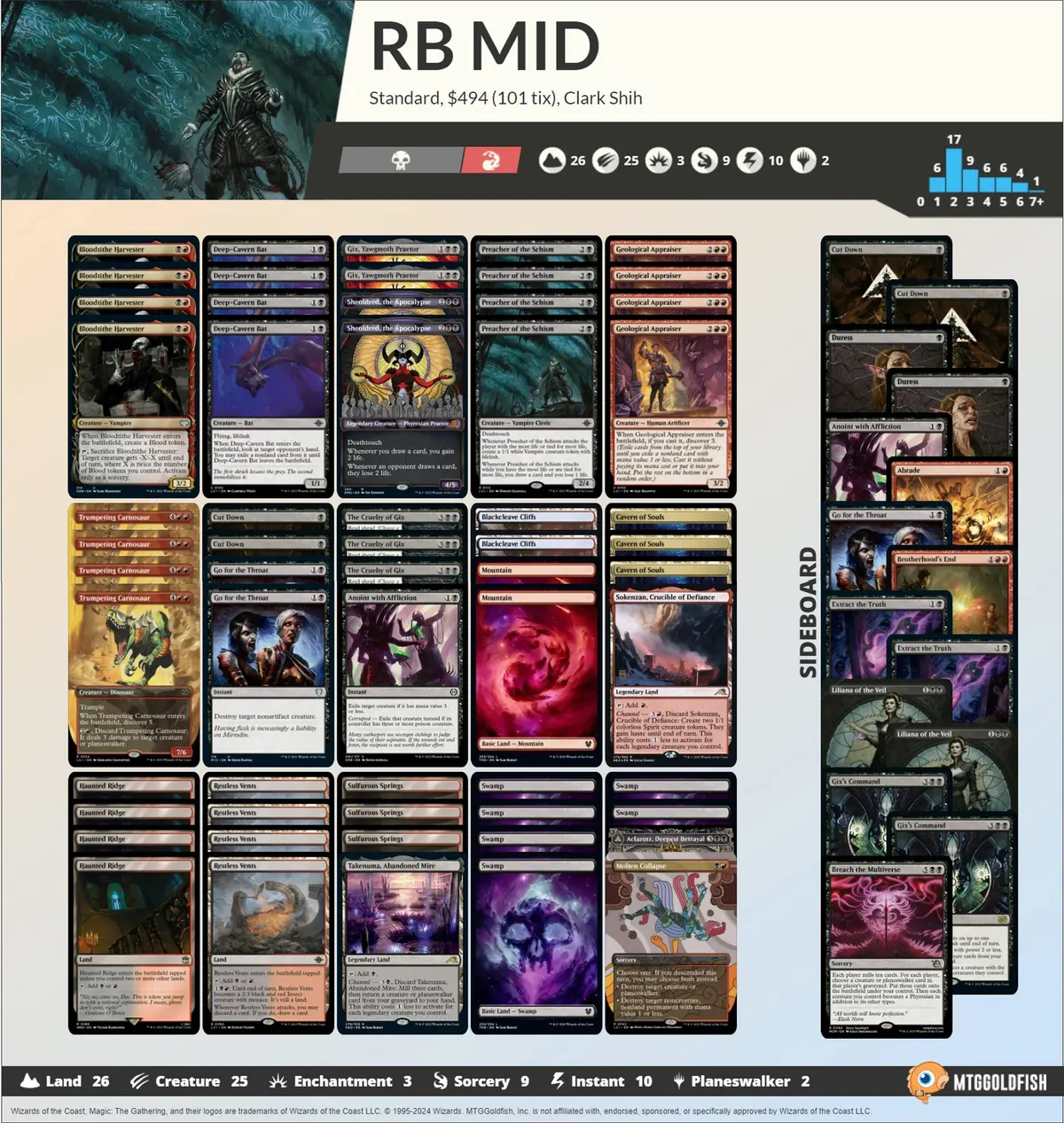
This is my current decklist. I’ll explain it in several parts.
Deck Core
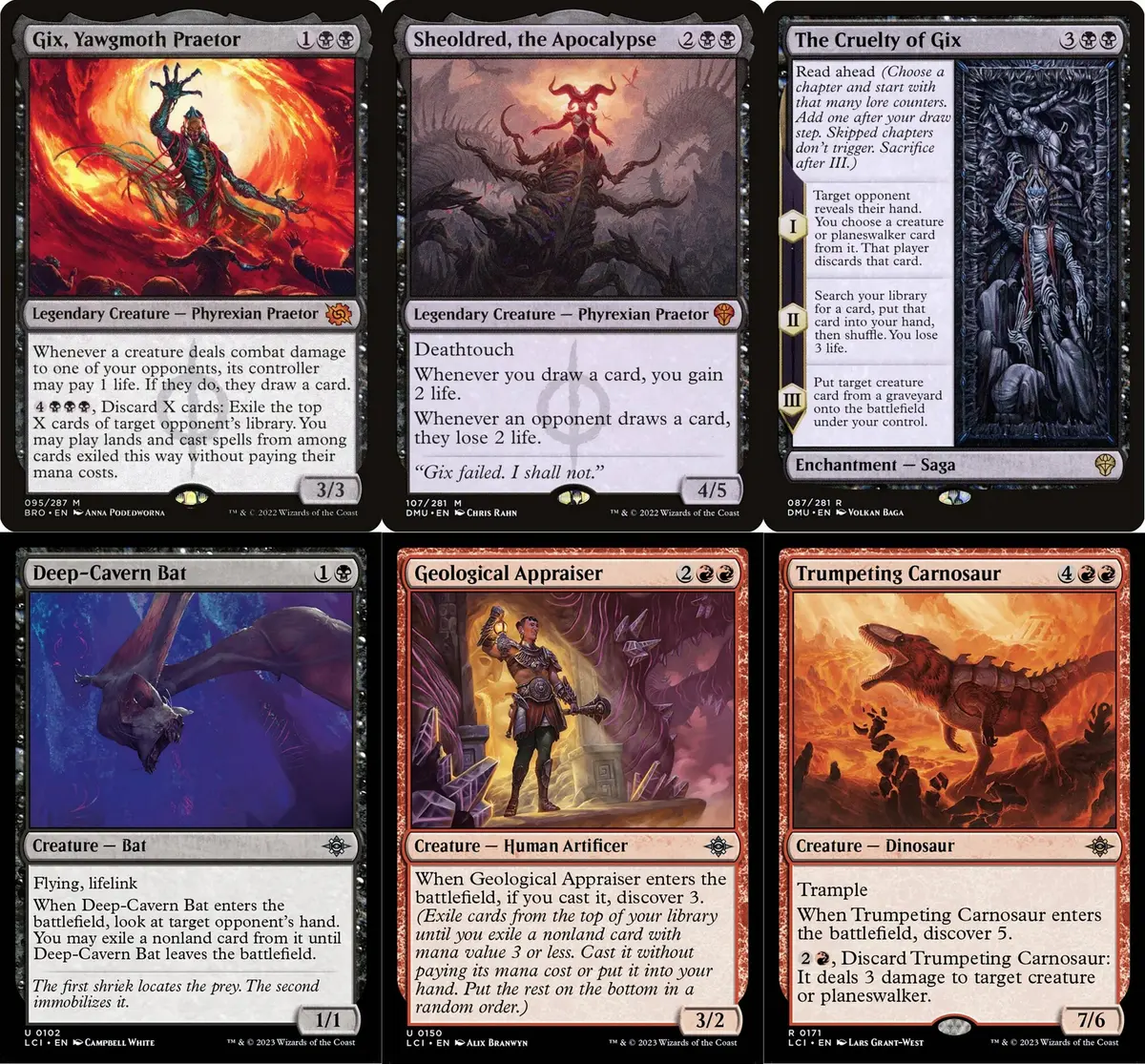
4 Deep-Cavern Bat:
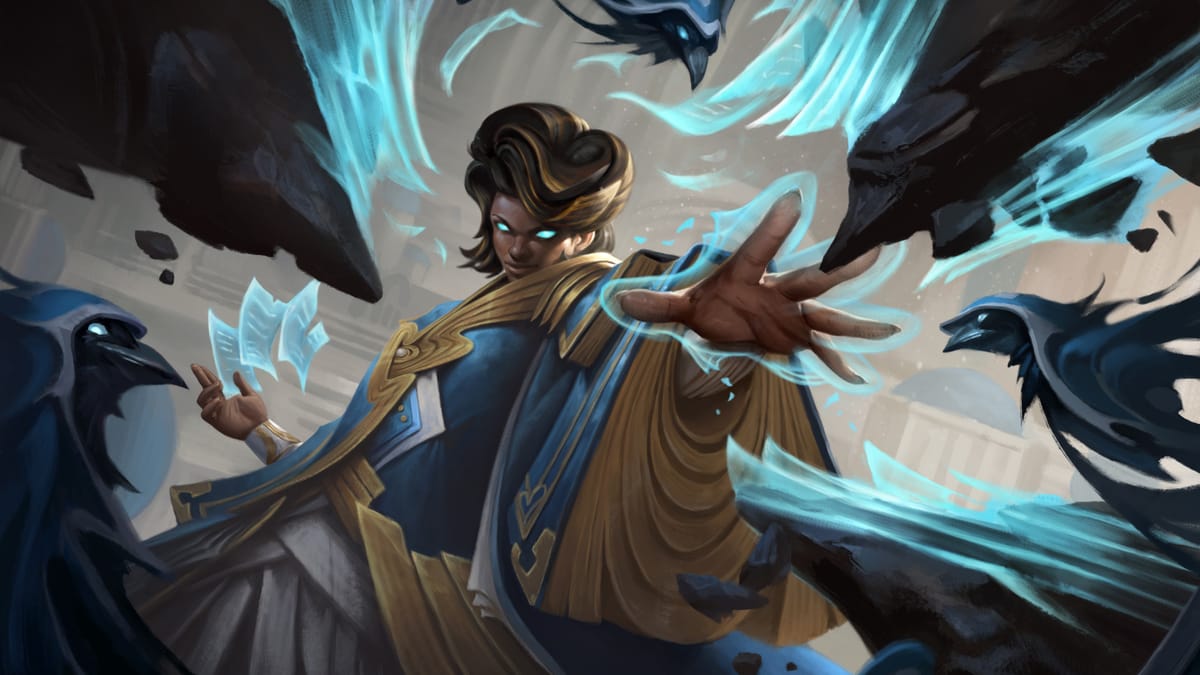
A black supernova. A 1/1 flying lifelinker is already good, and taking a card from the opponent’s hand makes it the top two-drop choice for any deck that plays black.
2 Gix, Yawgmoth Praetor:
The bat’s best friend. Drawing cards when it deals damage is strong on its own, and the activated ability lets you rise from the ashes when behind and press the advantage when ahead.
4 Geological Appraiser:
The Standard version of Bloodbraid Elf. It has no haste, but being able to put the card you flip into your hand is better than Bloodbraid Elf. Note that its ability only triggers when you cast it.
4 Trumpeting Carnosaur:
The deck’s best finisher. Discover 5 is already good enough, a 7/6 trampler puts huge pressure on the board, and it can also be used as a removal spell. In short, super strong.
2 Sheoldred, the Apocalypse:
A powerful card. It is very strong when the opponent hasn’t drawn removal, and you can even win the game directly through her, but that is on the premise that the opponent has no removal. The current environment demands immediate impact on the turn a card enters, and Sheoldred clearly lacks that, so for this reason Geological Appraiser is sometimes the better turn-four play. Compared with the dominating presence she had in Pioneer, in the current Standard environment she mostly serves as a life-gain card and a defensive blocker.
3 The Cruelty of Gix:
The deck’s lubricant. Chapter one is hand disruption, which performs well against Domain; chapter two is a tutor, find whatever you’re missing, no need to elaborate; chapter three is the essence of this card: you can dig up Trumpeting Carnosaur for maximum value, or dig up the opponent’s powerful creature to gain an advantage.
Support Cards
Removal:
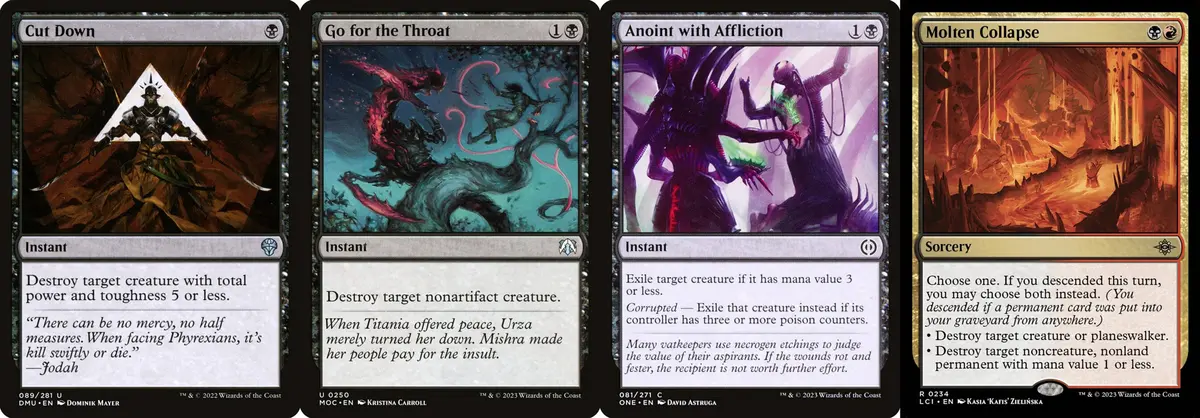
- The standard 2 to 3 copies of Cut Down
- 2 to 3 copies of Go for the Throat
- Paired with 1 copy of Anoint with Affliction
- I personally added one extra Molten Collapse as planeswalker removal, so that a planeswalker landing doesn’t cost me tempo
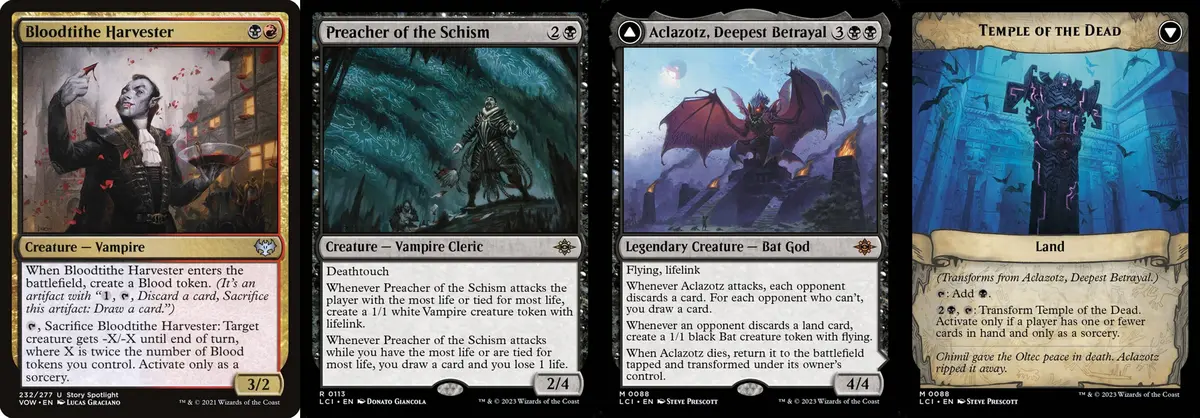
Bloodtithe Harvester:
A two-mana, three-power attacker that can also act as removal, and the Blood token helps filter your hand. Remember that it reduces the opponent’s power and toughness, which lets Cut Down kill creatures it otherwise couldn’t.
Preacher of the Schism:
Another black supernova. Getting a bonus just from attacking is practically ghost-like. A 2/4 deathtoucher is not only hard to block profitably, it is also exceptional on defense, and it is one of the few creatures that can actually hold off Subterranean Schooner early. Make good use of the bonus it gets when attacking: a 2/4 deathtoucher is of course excellent on defense, but attacking is how it delivers its maximum value.
Aclazotz, Deepest Betrayal:
An excellent five-drop that performs well against midrange and aggro decks. The bat god, a 4/4 flying lifelinker, is very strong on both offense and defense, and the advantage is even more obvious when both sides are racing in life totals. However, it has no enter-the-battlefield value and is relatively weak against Domain decks, so we usually take it out in sideboarded games against Domain. The most eye-catching part is its recursion: in midrange and aggro matchups, both sides usually run out of cards in hand quickly, so it is easy to meet the condition for it to come back, which makes it an extremely valuable card.
Land Choices
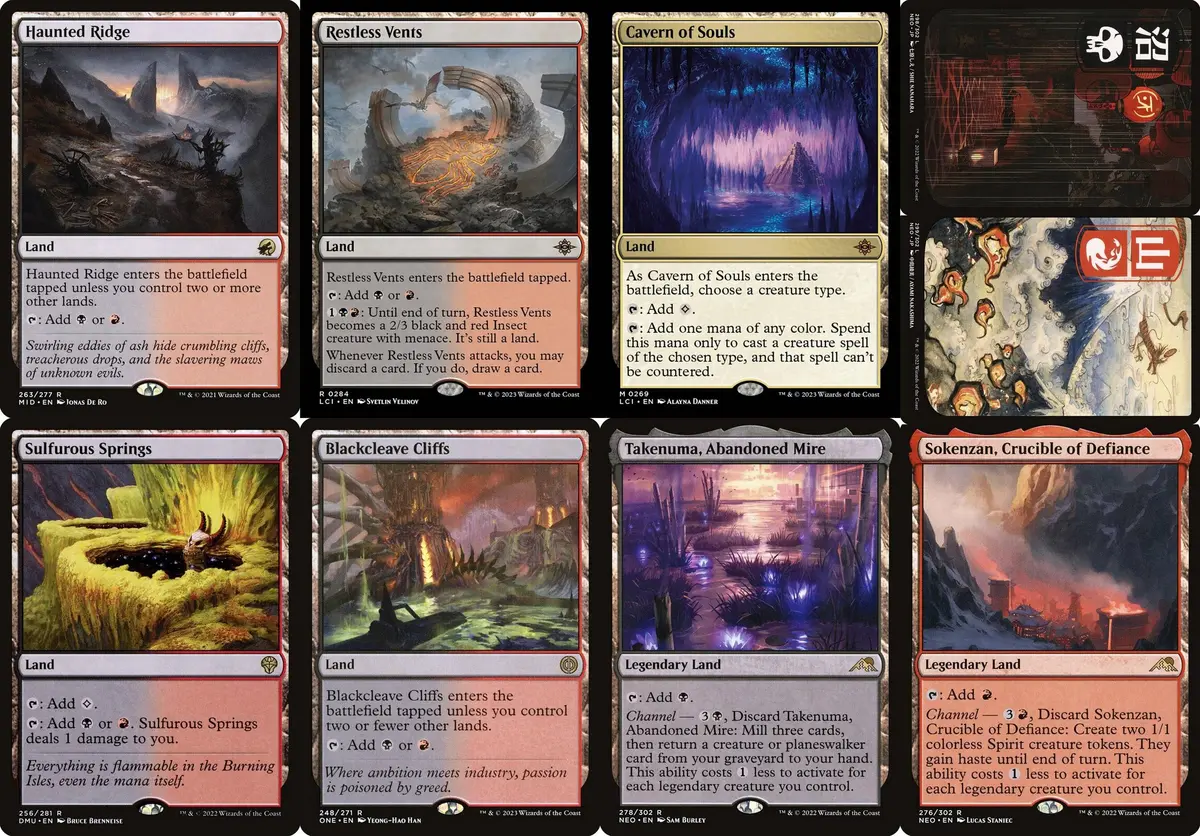
In the past most lists played 25 lands, but recently 26 lands has become the norm. I think the main reason is that with 25 lands the chance of getting stuck on lands is still too high. After all, even Pioneer Rakdos midrange, whose mana curve tops out at 4, plays 25 lands, so with this many five-mana and even six-mana spells, playing only 25 lands really makes no sense. Here is the breakdown of each land:
- Haunted Ridge: The best dual land in Standard. Play a full set.
- Restless Vents: Although it enters tapped, the deck has only two one-drops, so there is just enough time to play this. As a creature, its menace and looting ability are excellent. Play a full set.
- Cavern of Souls: Although the deck has many different creature types, since the red creatures all need two red mana, in addition to making creatures uncounterable it also happens to help with color fixing. In my testing, 4 copies was a bit too many and 3 was just right.
- Sulfurous Springs: A dual land that can enter untapped. I didn’t go up to 4 copies because drawing two of them puts pressure on your life total against creature decks. Playing too few causes color problems, though, and this land can also be used with Preacher of the Schism to adjust your life total for greater value.
- Blackcleave Cliffs: A dual land that can enter untapped under certain conditions. Since the cards in the deck still cost quite a lot, you can’t play many; 2 copies is enough.
- Takenuma, Abandoned Mire: A very good card. Early on it is almost no different from a Swamp, and late in the game it can be recycled; retrieving powerful creatures late in the game matters a lot. Play 1 copy.
- Sokenzan, Crucible of Defiance: Same as Takenuma, early on it is almost no different from a Mountain, and late in the game it can be recycled, good for both offense and defense. Play 1 copy.
- Basic lands: 6 Swamp, 2 Mountain. This deck is still built on a black foundation, so you need more Swamps.
Sideboard Choices
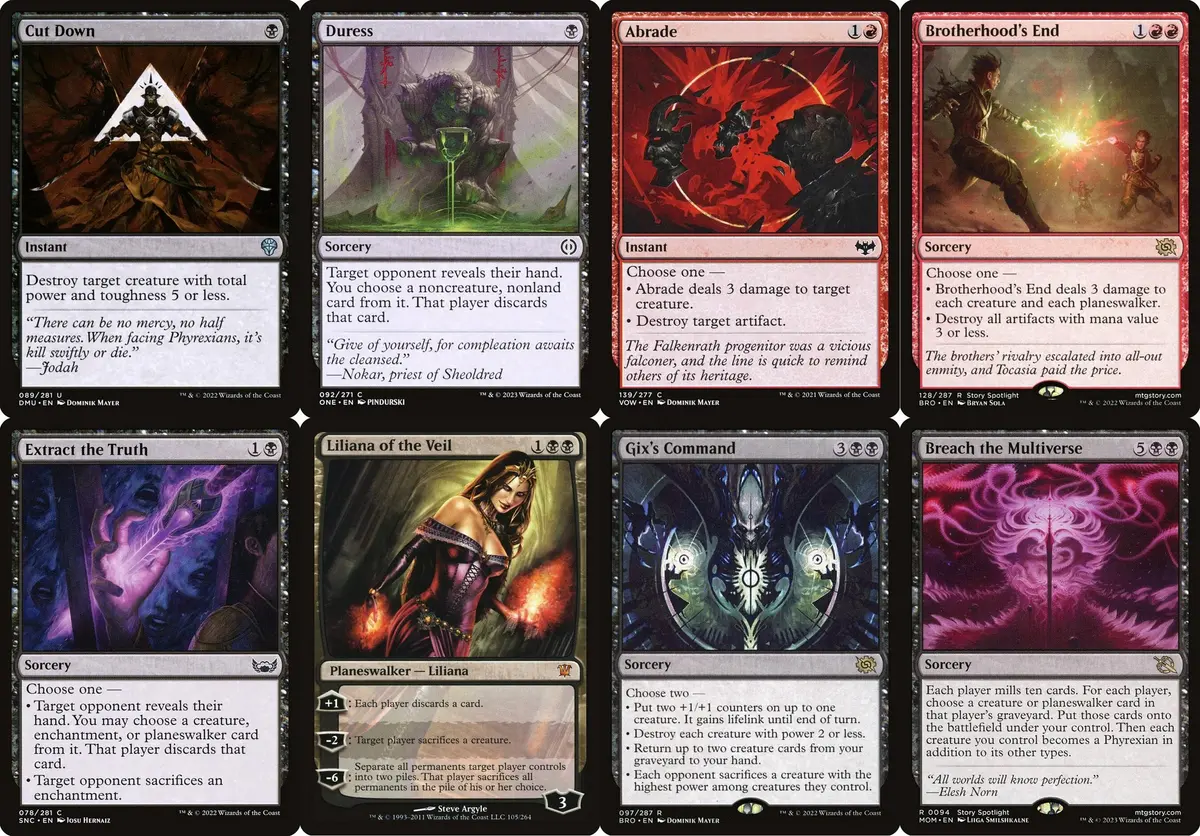
- Cut Down: Weak in the mirror, against Golgari, and against Domain; excellent against aggro, Dimir, and Esper. I think main deck plus sideboard should total at least 3 copies.
- Duress: A targeted card against Domain; basically you swap it in for Cut Down.
- Abrade: Decent as creature removal, but mainly we want its artifact removal to deal with some troublesome artifacts.
- Brotherhood’s End: Nearly the same as Abrade, except it goes from single-target removal to a sweeper. Another benefit is that against Domain you can trade it for Herd Migration.
- Extract the Truth: Excellent against Golgari, Domain, and Esper. Besides being hand disruption itself, it gives us a way to handle enchantments, which exactly covers a weakness of the Rakdos color pair.
- Liliana of the Veil: Excellent against the mirror and Domain, and has a good chance of winning the game by itself as a single card, but its versatility is too low, and it has a natural enemy in Obstinate Baloth.
- Gix’s Command: Performs well in midrange and aggro matchups. Being able to one-for-many is very strong in midrange matchups, and the sweep and life gain are also excellent against aggro.
- Breach the Multiverse: Any deck that focuses on the late game can play it. It’s a card that can decide the game by itself: against the mirror, digging up one Trumpeting Carnosaur is strong enough, and against Domain you can even dig up Atraxa, Grand Unifier.
Other Playable Cards
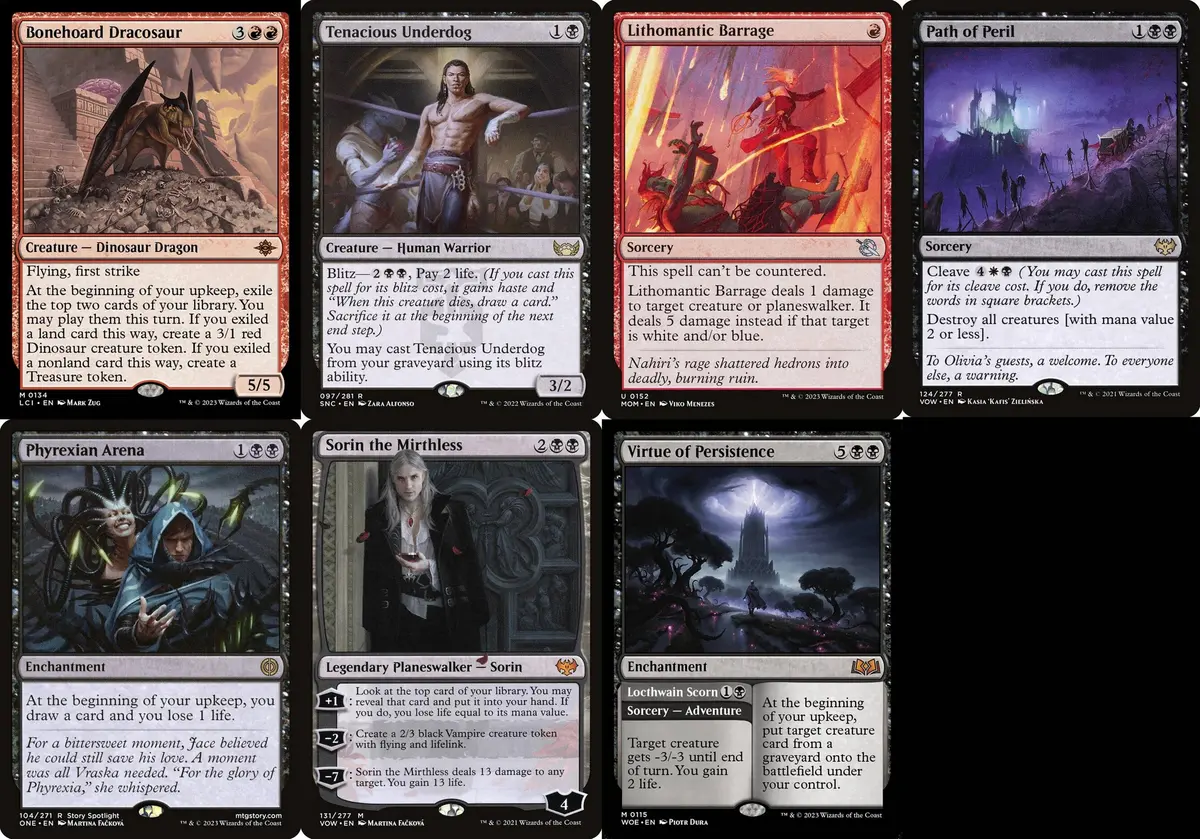
- Bonehoard Dracosaur: An excellent five-drop. Compared with Aclazotz, Deepest Betrayal, it is better at attacking and generating resources, but it lacks life gain and recursion. For these reasons it is more afraid of removal, and since nearly every deck now plays some removal, Aclazotz is better in the current environment.
- Tenacious Underdog: A two-mana, three-power creature that can be recovered in the mid to late game for extra resources. This card strengthens your ability to race in life totals against Domain, but beyond that I don’t think it’s better than other flexible cards.
- Lithomantic Barrage: An excellent targeted card against white-blue, and it can also kill the bat. Apart from being useless against Mono-Red, it may perform even better than Cut Down in sideboarded games. If your local metagame has a lot of Dimir, Esper, and Toxic, it might be worth including.
- Path of Peril: A sweeper, though most of the time Brotherhood’s End can do the same thing.
- Phyrexian Arena: A strong card for midrange and Domain. Lose one life and draw one card each turn; you could call it an unkillable Gix?
- Sorin the Mirthless: A solid four-mana planeswalker; I don’t think its priority exceeds Geological Appraiser or Sheoldred.
- Virtue of Persistence (Black Virtue): Life gain and removal plus a powerful late-game enchantment, but the -3/-3 nearly overlaps with Cut Down, and the enchantment half doesn’t take effect immediately. Overall it’s a card that is middling in every respect: not weak, but not outstanding either.
Common Matchups
Mirror
The old saying applies to the mirror: “whoever draws better wins,” though of course player skill and deck construction matter somewhat. Whoever can land a turn-two bat and a turn-three Gix has almost the winning formula for this matchup. If neither deck gets stuck on lands, the matchup can be extremely long, so when you gain an advantage you have to find ways to expand it. In sideboarded games Liliana of the Veil performs well; the opponent has almost no answer to it, and it also gives you the option to protect Liliana and win with her ultimate.
Domain
A very bad matchup, but you still have a chance. In game 1, all we can do is apply enough life-total pressure, disrupt with the bat and The Cruelty of Gix, and find a way around their removal, sweepers, and Atraxa, Grand Unifier. Note that a turn-two Bloodtithe Harvester is better than Deep-Cavern Bat, because a body with 3 power helps the early racing plan far more than one with 1 power, and we can wait until turn four to start using Deep-Cavern Bat for disruption. After sideboarding our chances are better: we lose the removal we can’t use and some expensive, useless spells, and gain more hand disruption and Breach the Multiverse. Our game plan stays the same: steadily deploy creatures and win the game together with hand disruption. If your opponent draws exactly what they need, then all you can do is throw up your hands and let them win…
Mono-Red Aggro
A favorable matchup; we have a lot of removal and our creatures are strong enough. As the environment shifts, Mono-Red will put a certain amount of removal and cards for the mid-to-long game into the main deck, so I don’t think purely playing defense is the right choice. Once your life total and the board stabilize, you should switch from the defensive role to the attacking role. Preacher of the Schism holds a crucial position in this matchup, because while attacking it also makes a 1/1 lifelinker to play defense. After sideboarding, we take out some useless or expensive cards and bring in more removal and sweepers. I think there are two things we need to watch out for: Urabrask’s Forge and planeswalkers. For the former we have artifact removal, and the latter can be dealt with by creatures, but as I said, they have quite a few cards aimed at the mid-to-long game, so please don’t just play defense.
Esper Midrange
Today’s Esper midrange comes in two versions. One is a pure midrange deck that uses Virtue of Loyalty (White Virtue) and Wedding Announcement as its finishers; the other is a tempo deck built on blue-black with a splash of white, adding Raffine, Scheming Seer and Destroy Evil.
Against the former, it is a midrange mirror-style matchup where nobody has a particular edge. Our Trumpeting Carnosaur and Aclazotz, Deepest Betrayal can easily end the game and generate resources, although the opponent also has some over-the-top cards, especially enchantments, and we may fall behind because we have no answer to enchantments. Still, we have room to maneuver (since White Virtue buffs creatures, just kill all the creatures). After sideboarding, we have enchantment answers and more removal and lose some useless cards, but so does the opponent, so what we do is minimize mistakes and press the advantage when ahead.
Against the latter it is more of a tempo matchup: their early offense is stronger, and in exchange their late-game threats are weaker. This is good for us, because we have lots of creature removal and our late-game threats are stronger than theirs. As long as we carefully play around counterspells, we have a very high chance of winning. This is even more true after sideboarding: we have more removal and fewer dead cards. Simply put, it’s a favorable matchup.
Bant Toxic
The opponent is basically a more extreme Mono-Red; we have a lot of removal and our blockers are big enough. Watch out for the opponent’s noncreature spells, especially March of Swirling Mist. The most common way you lose is that they land creatures on turns one and two and then use only sorceries and instants to maneuver against us and take us down. Just remember that this is how they beat us, and don’t let them get away with it. Also note that, as with Mono-Red, their late-game win condition is mostly to poison us out with proliferate spells, so don’t let the game drag on too long either; once the board stabilizes, start attacking.
Golgari Midrange
The concept of this matchup is almost exactly the same as the mirror, but this time we have a bit more of an edge, because they don’t gain advantage as much as we do. The only variable is their planeswalkers: we lack ways to deal with planeswalkers, so if a planeswalker stays on the battlefield too long, we are very likely to lose the game. After sideboarding, we have ways to deal with planeswalkers and more cards that help in this matchup. Unlike the mirror, Liliana can’t do much in this matchup, because with the opponent’s Mosswood Dreadknight around, Liliana is merely a one-sided drain on our resources.
Dimir Midrange
Their early offense is strong, but they lack late-game threats. All we have to do is defend until we have enough mana to deploy our threats. We may struggle in game 1, since we have too many clunky spells that will be gone for good after hitting a counterspell, but after sideboarding we can fix that problem.
Sideboard Strategy
Mirror
| Side Out | Side In |
|---|---|
| -2 Cut Down | +2 Liliana of the Veil |
| -1 Anoint with Affliction | +2 Gix’s Command |
| -2 Trumpeting Carnosaur | +1 Breach the Multiverse |
Cut Down and Anoint with Affliction cover too little, so they come out. Besides being clunky, Trumpeting Carnosaur risks being discarded and recovered by the opponent’s The Cruelty of Gix, so two copies come out.
Domain
| Side Out | Side In |
|---|---|
| -1 Aclazotz, Deepest Betrayal | +2 Duress |
| -4 Trumpeting Carnosaur | +2 Extract the Truth |
| -2 Cut Down | +1 Brotherhood’s End |
| -1 Anoint with Affliction | +2 Liliana of the Veil |
| +1 Breach the Multiverse |
The removal is useless, so no need to elaborate. The bat god and the dinosaurs come out mainly because they are too clunky and don’t help with early racing or gaining an advantage. Bringing in Brotherhood’s End is an awkward decision: if it’s used to trade with Herd Migration, it will also kill most of our creatures, and using it on the opponent’s Incubator tokens may not be quite worth it, but we don’t have anything better.
Mono-Red Aggro
| Side Out | Side In |
|---|---|
| -2 Gix, Yawgmoth Praetor | +2 Cut Down |
| -3 Trumpeting Carnosaur | +1 Abrade |
| -3 The Cruelty of Gix | +1 Anoint with Affliction |
| +1 Go for the Throat | |
| +1 Brotherhood’s End | |
| +2 Duress |
Basically, take out the spells that cost life and the expensive ones, and bring in more cheap spells. Some people like to take out all the dinosaurs, or even cut one more land, to keep a few Gix as blockers, but I think the dinosaur’s ability to act as removal is crucial in this matchup, and Duress performs well here, especially now that Mono-Red adds planeswalkers after sideboarding.
Esper Midrange (Enchantment Version)
| Side Out | Side In |
|---|---|
| -2 Trumpeting Carnosaur | +2 Cut Down |
| -1 Molten Collapse | +1 Anoint with Affliction |
| -3 The Cruelty of Gix | +2 Extract the Truth |
| +1 Go for the Throat |
Dennick shuts off chapter three of The Cruelty of Gix, so it comes out. Trumpeting Carnosaur is a bit clunky and also risks being countered by Tishana’s Tidebinder, so two copies come out, keeping only two as late-game threats. In this matchup Go for the Throat is better than Molten Collapse, because an instant is more flexible than a sorcery.
Esper Midrange (Blue-Black with a White Splash)
| Side Out | Side In |
|---|---|
| -2 Trumpeting Carnosaur | +2 Cut Down |
| -1 Molten Collapse | +1 Abrade |
| -3 The Cruelty of Gix | +1 Anoint with Affliction |
| +1 Go for the Throat | |
| +1 Brotherhood’s End |
Since the opponent has no enchantments (or not as many as the enchantment version, if any), Extract the Truth isn’t good enough, and we can instead bring in more artifact removal against Subterranean Schooner.
Bant Toxic
| Side Out | Side In |
|---|---|
| -1 Aclazotz, Deepest Betrayal | +2 Cut Down |
| -4 Trumpeting Carnosaur | +2 Duress |
| -1 Go for the Throat | +1 Abrade |
| -3 The Cruelty of Gix | +1 Anoint with Affliction |
| +1 Brotherhood’s End | |
| +2 Gix’s Command |
The swaps are similar to those against Mono-Red. The difference is that the opponent doesn’t deal damage and doesn’t have as many creatures as Mono-Red, so we choose to take out the bat god and some of the weaker removal, and bring in better removal and Duress to stop the opponent’s noncreature spells.
Golgari Midrange
| Side Out | Side In |
|---|---|
| -2 Cut Down | +2 Extract the Truth |
| -1 Anoint with Affliction | +2 Gix’s Command |
| -2 Trumpeting Carnosaur | +1 Breach the Multiverse |
Almost the same swaps as the mirror, except Liliana is replaced with Extract the Truth, because, as mentioned in the matchup section, Liliana is weak in this matchup and we need a way to deal with the opponent’s planeswalkers.
Dimir Midrange
| Side Out | Side In |
|---|---|
| -2 Trumpeting Carnosaur | +2 Cut Down |
| -1 Molten Collapse | +1 Abrade |
| -3 The Cruelty of Gix | +1 Anoint with Affliction |
| +1 Go for the Throat | |
| +1 Brotherhood’s End |
The swaps are the same as against Esper Midrange (blue-black with a white splash).
Conclusion
I never expected to qualify the very day after I submitted this article, lalala! I faced Domain three times and won all three~
I’ll share what happened at that day’s RCQ in episode 26 of the podcast “龍尊與荒野騎士的玄境之談”, which you can now listen to on Spotify and Apple Podcast! If you have more questions, you can also search Facebook for “夢續工作室 DreamOn Studio” and send us a private message, and we can answer them there.
- Title
- Rakdos Discover: King of Midrange
- Author
- ClarkShih
- Created at
- January 29, 2024
- License
- This work is licensed under CC BY-NC-SA 4.0 .