Analyzing the Evolution of Standard's Threat Structure Through Cut Down and Disfigure

Note: This article was translated from Chinese by AI and may contain errors. Read the original Chinese version.
Before We Start
Among Standard’s current one-mana black removal spells, those whose cost does not include X and whose range exceeds -1/-1 are only two: Cut Down and Disfigure. The former has long been the benchmark for one-mana black removal in Standard, while the latter is a completely different story, and many people may not even remember it is in the Standard card pool. Card prices reflect this perfectly. Going by MTGGoldfish prices (USD) at the time of writing, Cut Down is $3.5, which is a ceiling-level price for an uncommon one-for-one removal spell; by comparison Disfigure is only $0.15, which is negligible.
However, these two cards have been in Standard for about two years, going through one Standard rotation in between, and the threats in the environment have long been reshuffled. Is Cut Down really still the superior option to Disfigure?
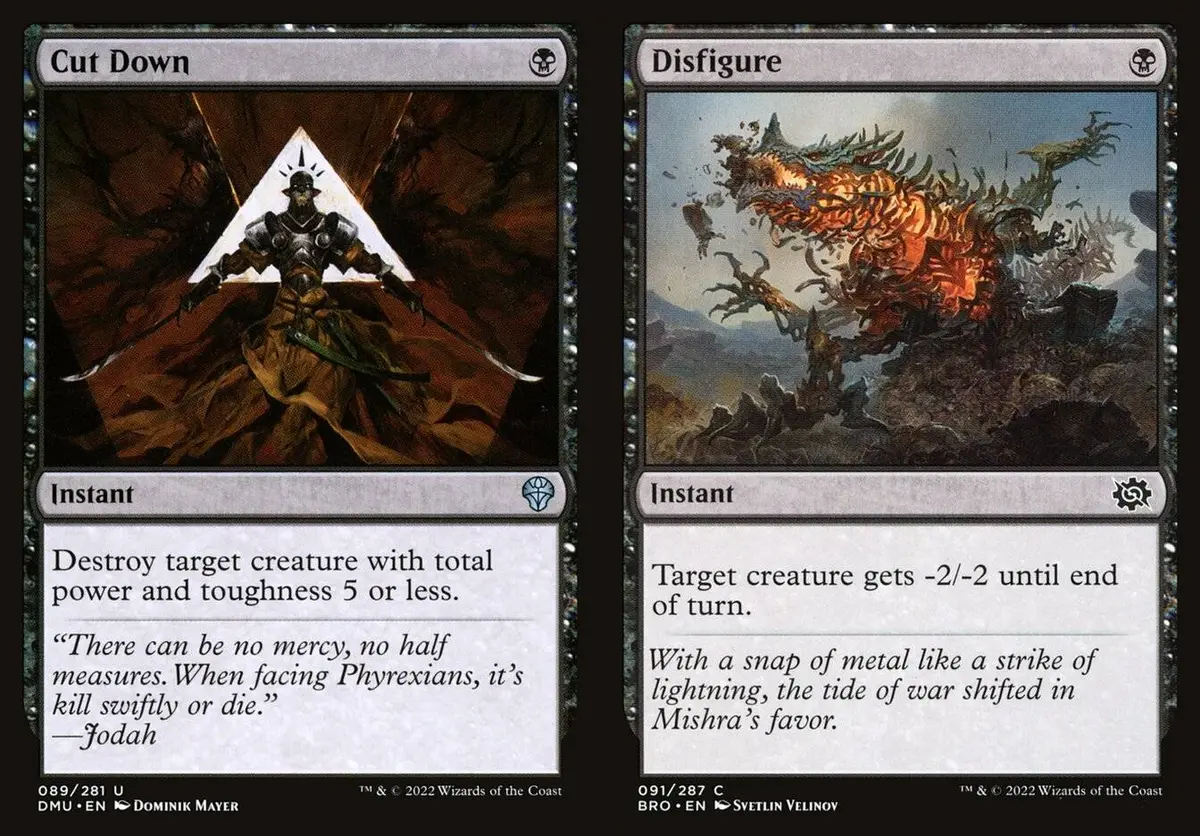
The Difference in Range Between Cut Down and Disfigure
The two cards are actually not far apart in range. Let’s set aside the cases where both kill or both fail to kill, and look at which specific threats only one of the two removal spells can handle.
Cut Down: Its main advantage is that it can handle 2/3 creatures, and a few high-level threats at 1/3 and 1/4 are also left to it.
Disfigure: No matter how high the power, anything with toughness 2 or less dies to it. If we want to find the difference from Cut Down, it can handle creatures starting from 4/2 or 5/1.
Standard’s two-mana black removal is currently very powerful, nearly kill-spell level. With that as the premise, investing in a one-mana removal spell means this removal is positioned as very tempo-oriented, requiring that you can interact with your opponent’s threats early enough.
The choice of removal is certainly tied to the threats in the environment, so next we want to clarify which prominent threats in the current environment make a real difference in choosing Cut Down versus Disfigure.
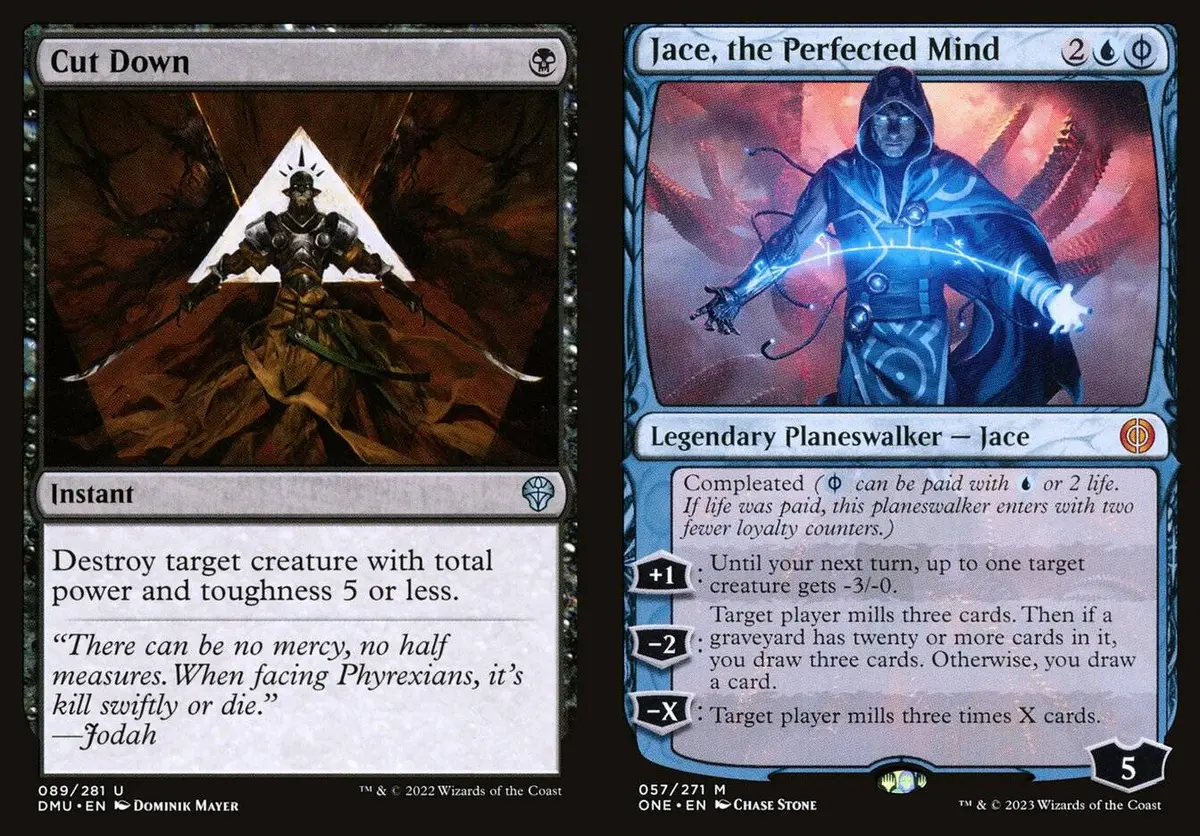
Of course, here we first rule out the premise that your own deck has extra synergy. Suppose your deck’s main configuration includes Jace, the Perfected Mind: then Cut Down’s range ceiling is undoubtedly higher than Disfigure’s, the two removal spells are not at the same level, and there is no need to hesitate.
Why Was Cut Down Strong Back Then?
First, let’s analyze why, until the BLB Standard rotation, everyone used Cut Down and gave Disfigure no consideration at all. In fact, a single image says it all:
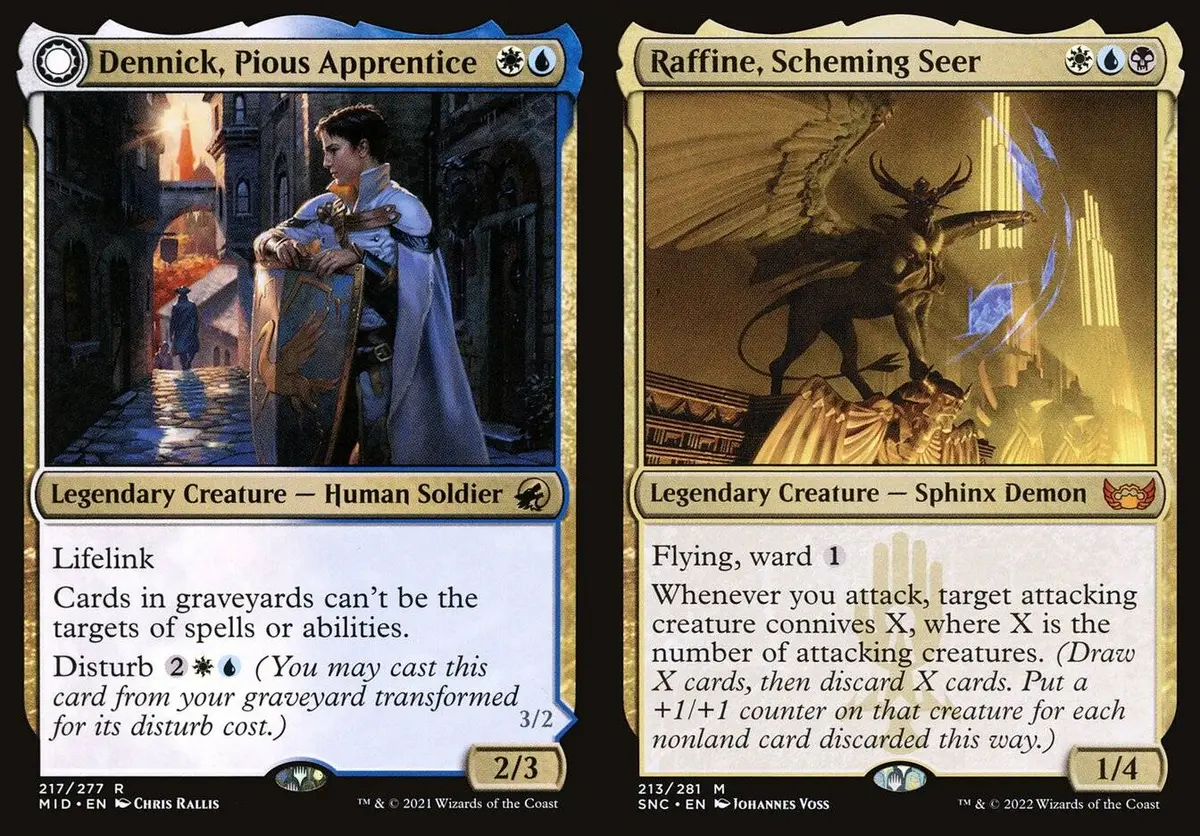
When MID through SNC were still in Standard, the Esper-based decks led by Raffine, Scheming Seer were always the absolute mainstream of the environment. Raffine is a super powerful creature with good tempo and MAX threat level that had to be removed right away, and because of ward 1, two-mana removal might not even come in time, so Cut Down became the only choice for one-mana black removal at the time.
Dennick, Pious Apprentice was also a regular in the environment back then, often showing up alongside Raffine. It too is something Cut Down can remove but Disfigure cannot, though this was not the main selection pressure for one-mana removal. After all, once you casually remove it, it just disturbs back onto the battlefield and starts generating cards, so you would deal with it in a more roundabout way depending on timing anyway. With a lower need for tempo, the pressure is also lighter.
In summary, one of the main defining cards of the pre-rotation environment was Raffine, and no other threat of the same level could be handled only by Disfigure, so Cut Down really was the optimal choice at the time.
What Makes Up Today’s Threats?
Back to the present, with DSK just joining the Standard card pool, so the theory in this article also includes the author’s predictions about DSK’s influence on Standard.
As usual, creatures that die to both Cut Down and Disfigure, or that survive both, are outside our discussion; we only focus on which creatures make a difference when using different removal.
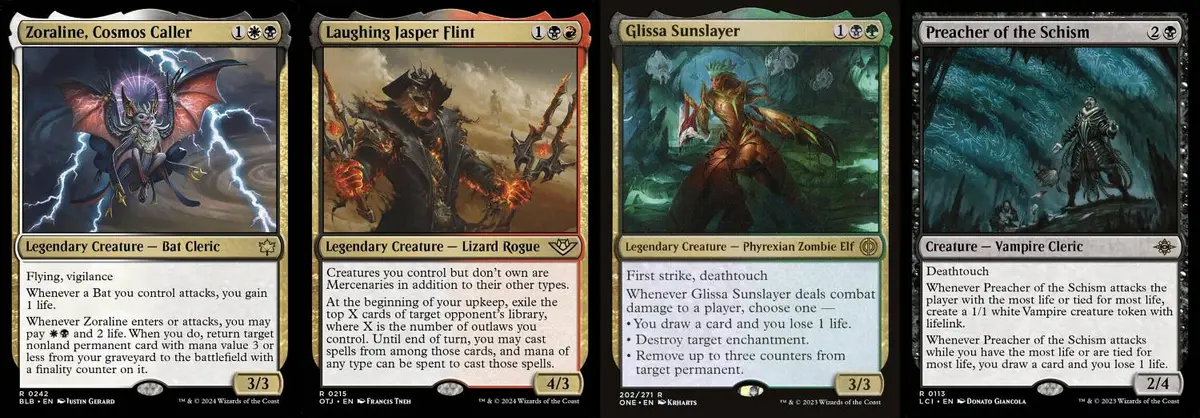
Cut Down’s Advantage
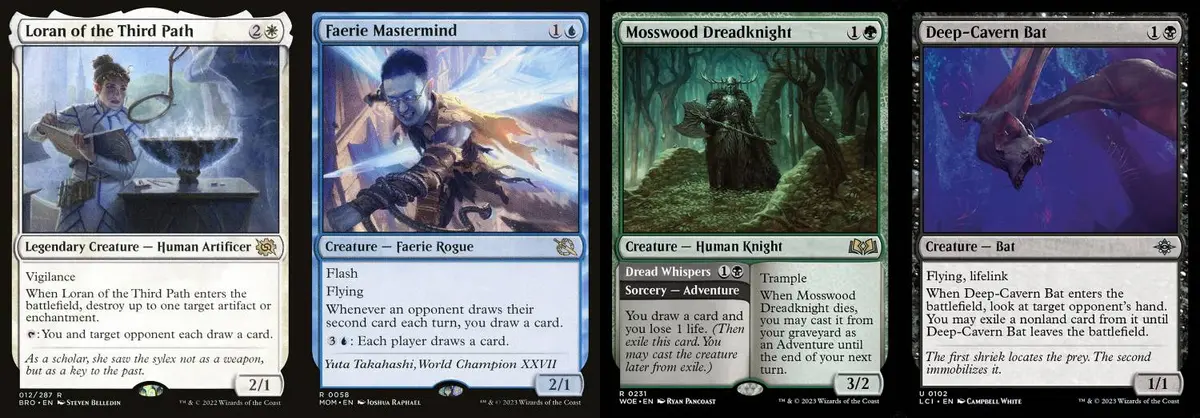
Let’s start from Cut Down’s perspective. If you think Cut Down is still the better option, that means there are enough high-value target creatures with 2/3, 1/3, and 1/4 bodies. Pause for a moment and ask yourself: which options come to mind?
Below are the qualifying creatures being played, sorted by deck usage rate from high to low according to MTGGoldfish metagame statistics at the time of writing, searched over 7 days, 14 days, and 30 days, though honestly the results are almost unchanged, with only some rankings swapping. In addition, I add an honorable mention that has no data at the moment but is included because DSK is an enchantment environment, Zur, Eternal Schemer:
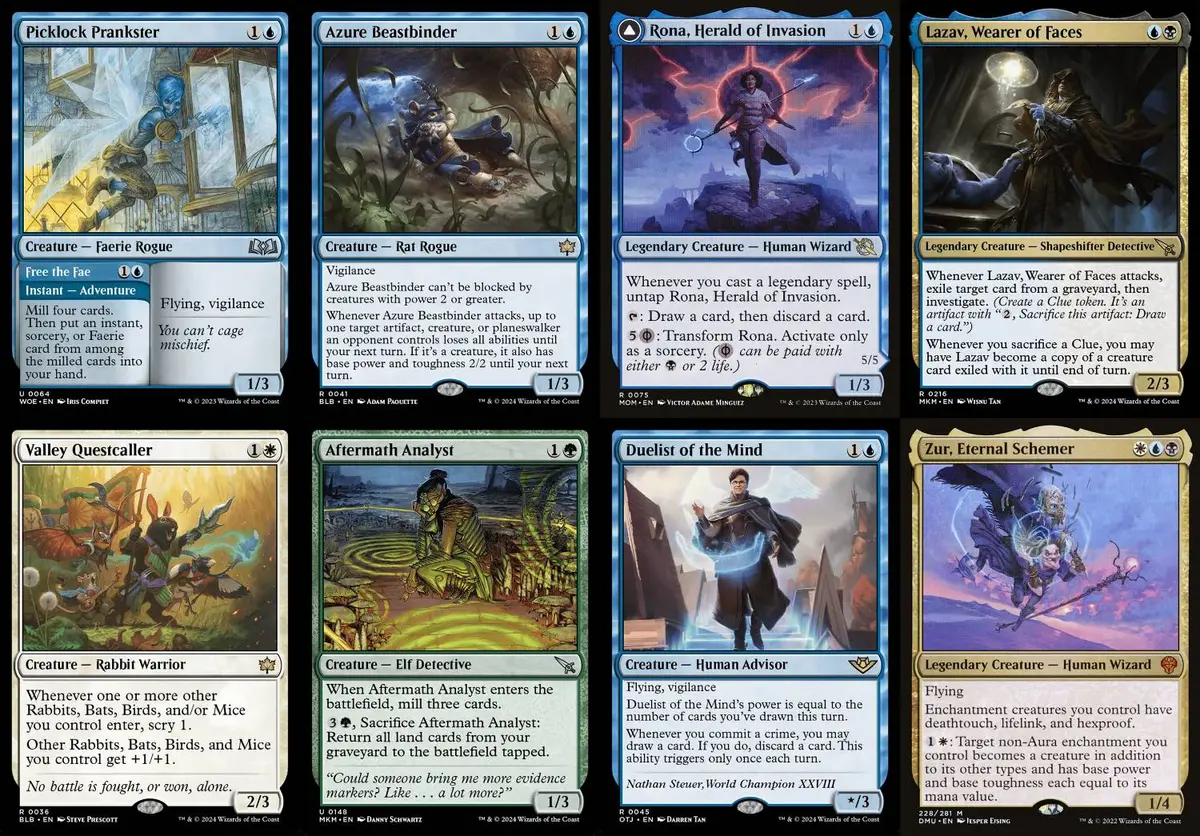
Don’t these guys seem pretty uncommon, or show up only in matchups where you shouldn’t be stacking short-range removal anyway?
Right. In fact, none of the decks these cards belong to has more than 2% of the meta, and just to pick out seven cards, I had to go down to decks with 0.2% of the meta. As for DSK’s new cards, perhaps Unstoppable Slasher, Broodspinner, Entity Tracker, and Inquisitive Glimmer may be seen in scattered decks, but I believe they will not reach a very mainstream share either. The honorable mention Zur should be the most promising of the cards listed above.
PS: The author’s personal favorite Kitesail Larcenist is also on the list of Cut Down-exclusive range. When first making the image I gave it a spot without thinking, and only when searching the data did I discover that blue tempo decks using it all returned no records. Still, I remain confident in my decision to use Kitesail Larcenist, because repeated deck testing has confirmed that Kitesail Larcenist really does play a key role in how my deck functions.
In practice, in the current environment the creatures that best demonstrate Cut Down’s relative superiority over Disfigure are, instead, Monastery Swiftspear and Warden of the Inner Sky, under compound conditions: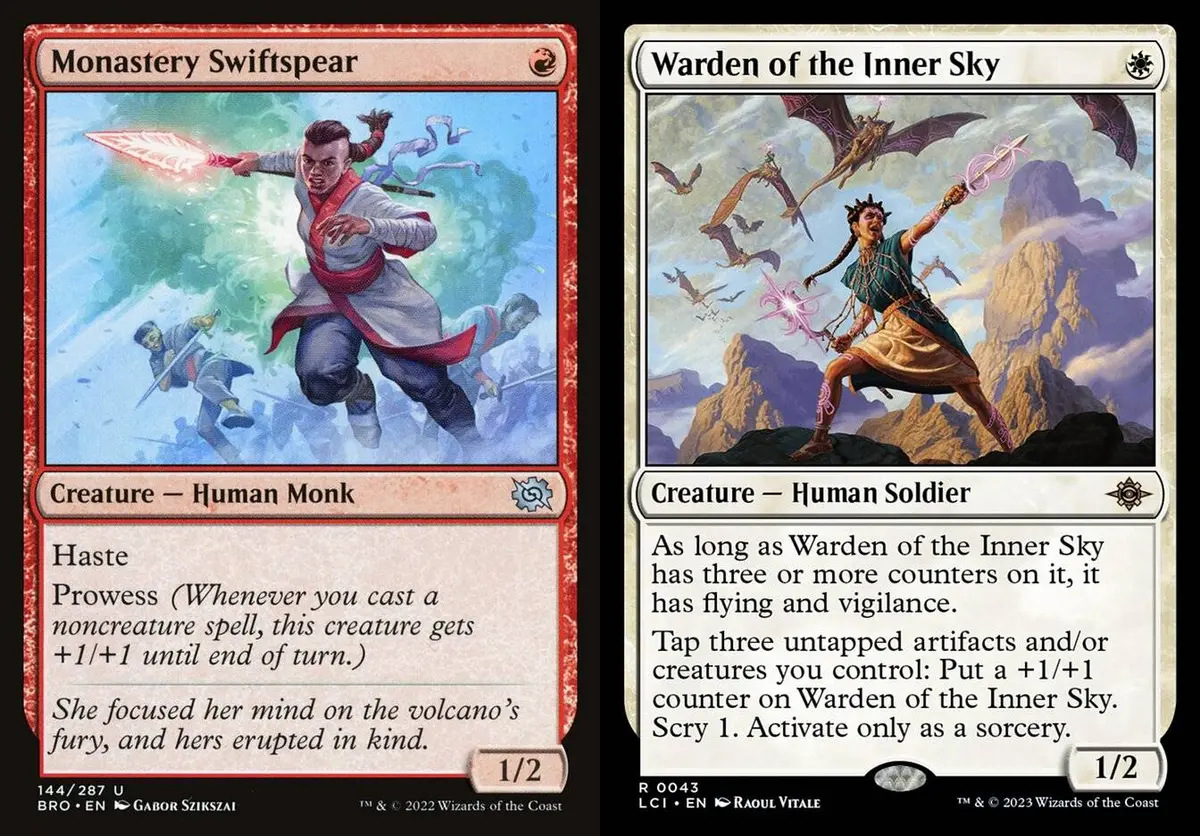
Once Monastery Swiftspear triggers prowess even once, it goes completely beyond Disfigure’s range, but as long as the spell that triggered prowess is not a pump spell cast on Monastery Swiftspear itself, it is still within Cut Down’s range. However, this problem is somewhat diluted by the argument about the new environment later.
Warden of the Inner Sky comes with its own pumping ability, and pumping once puts it beyond Disfigure’s range while Cut Down can still remove it. Also, decks with it often carry Warleader’s Call, which makes the windows where Disfigure can handle it very limited.
Overall, you can see that in the current Standard environment, Cut Down has no very clear high-payoff targets, though as a one-mana removal spell it really is good enough.
Disfigure’s Advantage
Since Cut Down’s advantages over Disfigure all show up in some seemingly trivial, scattered situations, does Disfigure have any advantage that shows major gains in the environment?
In fact, the situations where Disfigure has the advantage can roughly all be classified under the same kind of opponent, one with a presence that is hard to ignore in the current environment: the red-based aggro decks built around valiant and led by Heartfire Hero.
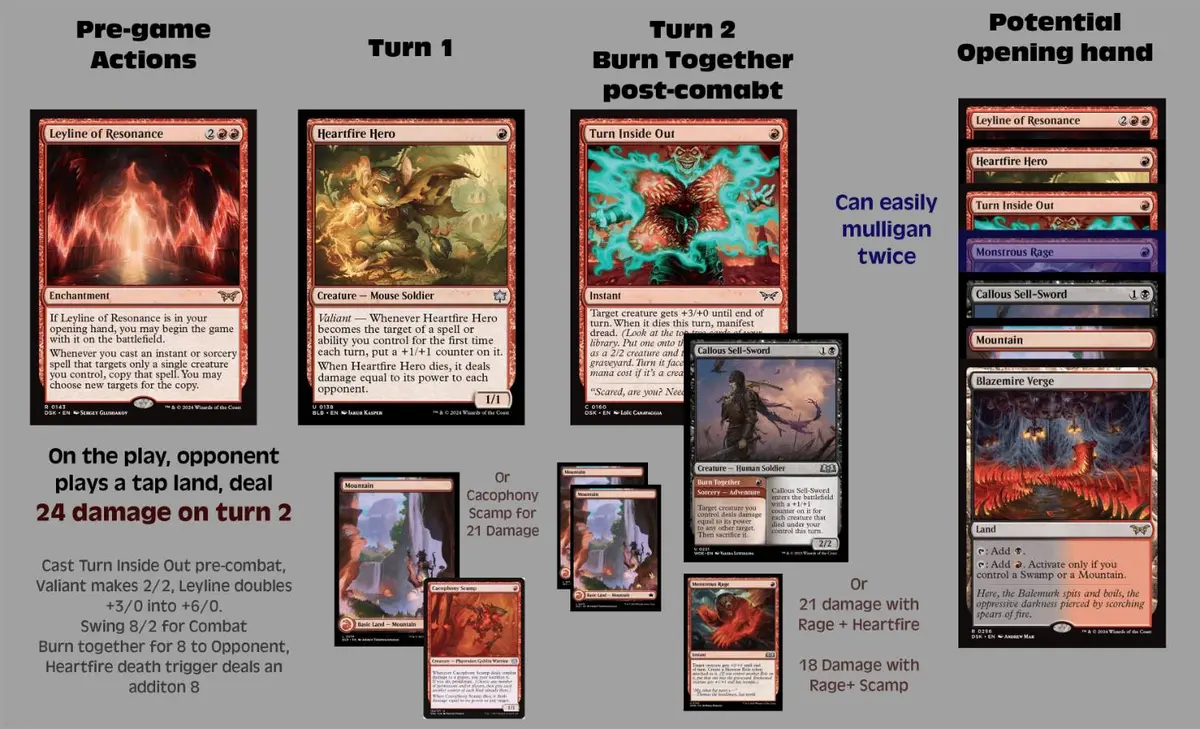
Heartfire Hero is undoubtedly the benchmark of red one-mana threats right now. Even the more traditional red aggro decks that emphasize burn like Shock and Lightning Strike include a certain number of valiant support pieces to make use of Heartfire Hero, to say nothing of the extreme decks using Leyline of Resonance. So why does Disfigure perform better against red-based aggro decks?
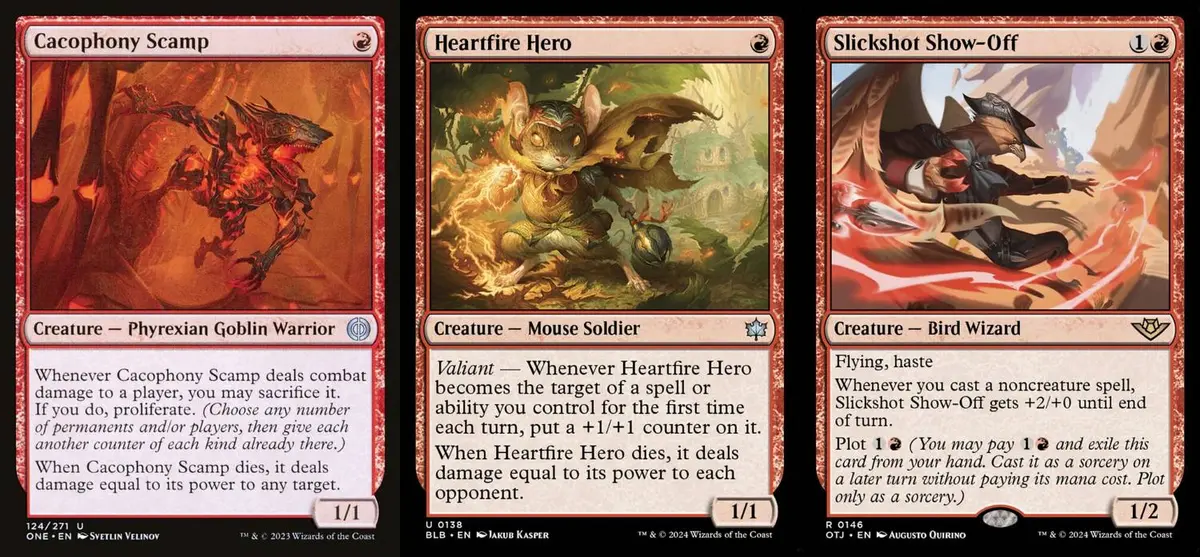
Start with the root of all evil, Heartfire Hero. Every kind of red-based aggro deck has it, and when it dies it deals damage equal to its power, which alone already widens the gap between Disfigure and Cut Down. When you use Disfigure to remove Heartfire Hero, you can gain a 1 to 2 point life swing, and against an aggro deck that has to count its life total carefully, this may be the difference between life and death. In an extreme deck of Leyline of Resonance + Callous Sell-Sword throwing with its Adventure, a one-mana Cacophony Scamp with a death ability nearly equivalent to Heartfire Hero’s is added, and Disfigure has even richer situations to shine in.
Next is the strongest two-drop curve play right now, Slickshot Show-Off. Its pump ability lets it easily exceed Cut Down’s range, and since these trigger sources are all instant-speed spells, it is not easy to catch it precisely at a weak moment, but because Slickshot Show-Off’s ability only boosts power, Disfigure is instead the more reliable removal choice.
Perhaps some red Leyline builds that pursue extreme opening hands have given up on two-drop creatures, but that is only the personal choice of some players. Overall, Slickshot Show-Off still sees a certain amount of play, to say nothing of the traditional aggro decks that are not Leyline-based, which certainly feature it.
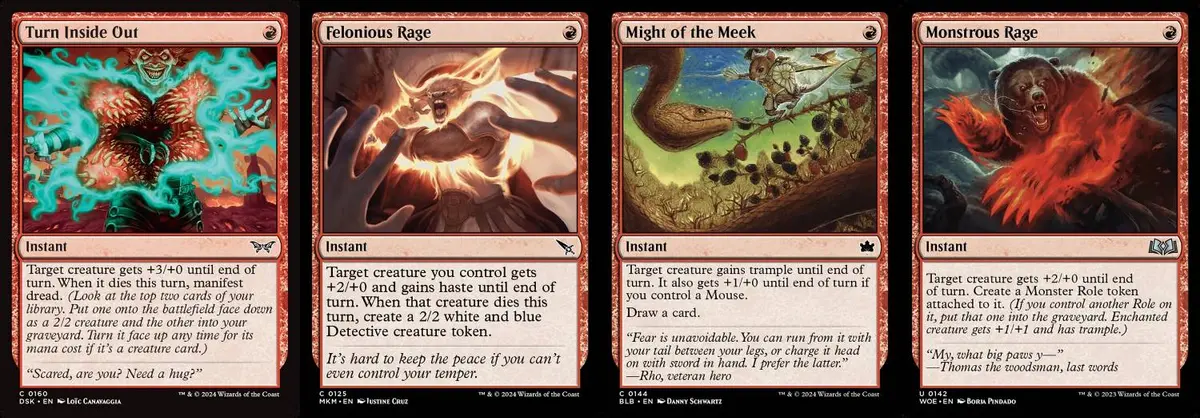
In the prowess-style red aggro decks of the past, the pump spell might be just a Monstrous Rage and that was about it, with the rest of the spells still mainly burn. After entering the Heartfire Hero era, valiant support spells like Might of the Meek and Rabid Gnaw gradually entered builds, and now Leyline pushes the burst of the valiant archetype to the limit, with builds already seen replacing traditional burn with Turn Inside Out and Felonious Rage, with a game plan of the most extreme One-Punch Man style burst.
Looking closely at these pump spells, you will find that apart from Monstrous Rage, the other spells only boost power and not toughness, just like Slickshot Show-Off’s ability. So in situations where you have the ability to respond, Cut Down is very likely to have its target become illegal because the opponent responds with a pump spell, while Disfigure’s risk is much smaller.
Also, these pump spells are the reason the difference was somewhat diluted when I mentioned Monastery Swiftspear above. As long as the opponent’s response is a pump spell that enlarges Swiftspear, neither Cut Down nor Disfigure can kill it, though Disfigure can at least reduce some damage. Of course, when dealing with Swiftspear, Cut Down is still stronger, as it can at least restrict the type or target of their spell, instead of letting any spell they toss out dodge the removal.
Disfigure’s Other Small Perks
Disfigure has these small perks relative to Cut Down, but they are truly better-than-nothing added value and do not form a basis for choosing removal.
Combining multiple copies to hard-kill a big creature
Against something like a 3/3 Glissa Sunslayer, Cut Down is simply useless, whereas you can use two Disfigures to kill it. Although it is card disadvantage, it beats a dead card.Using it as a combat trick
When two 4/3 Hostile Investigators fight, casting a Disfigure on the other one lets you trade one-sidedly. Of course, for non-aggro Standard decks, this kind of combat-trick use is very inefficient, but it still beats a dead card.Buying time against the Forge
As time accumulates, the tokens produced by Urabrask’s Forge will exceed Cut Down’s range, but are always within Disfigure’s range, and none of the red pump spells listed above can pump high enough to dodge Disfigure. But after all, the root of the problem, the Forge, still exists. All you can say is that surviving one more turn is one more turn, and if you cannot remove the Forge, you are still on a dead-end road.
Conclusion
Cut Down and Disfigure differ little against most kinds of decks today, but against red-based aggro decks of the Heartfire Hero archetype, Disfigure shows a huge advantage, and this hypothetical enemy happens to be the number one target in the current environment.
- Title
- Analyzing the Evolution of Standard's Threat Structure Through Cut Down and Disfigure
- Author
- Jru
- Created at
- October 1, 2024
- License
- This work is licensed under CC BY-NC-SA 4.0 .