Finding a Way Out: Standard Sultai Creature Control

Note: This article was translated from Chinese by AI and may contain errors. Read the original Chinese version.
The Control Deck’s Plight in the Current Format
Today’s Standard is, you could say, tied with the Ikoria era as the hardest time for control in the past ten years. And unlike last year, there is no clear format-warping deck waiting to be hit by the ban list. If you sort the current Standard by deck name and look at win rates and metagame share, everything sits in a balanced state, which also means the existing matchups will not die off on their own any time soon (and if one really does die, it only means a stronger opponent has shown up). You have to face these problems head-on.
So why is it so hard for control to survive right now? Simply put, modern threats are both efficient and tricky. Many decks are blazing fast while still generating plenty of resources, and the types of threats are very broad too. Yet compared with how quickly threats have inflated, answers have grown only a tiny bit. If you try to keep up with the threats’ tempo, your removal runs into range problems and many boards become unanswerable; if you make your answers broad enough, they may be too clunky and your removal comes too late to use.
The interaction design of traditional control was basically to stuff the main deck with enough counterspells and creature removal to get decent versatility. Lots of non-creature threats used to be uncommon, and the main-deck counterspells could handle them to a degree, so that was a problem you could leave to the sideboard. That mindset no longer applies today, for two reasons:
1: Key non-creature cards have increased a lot. In many mainstream decks you can see non-creature cards that kill you outright.
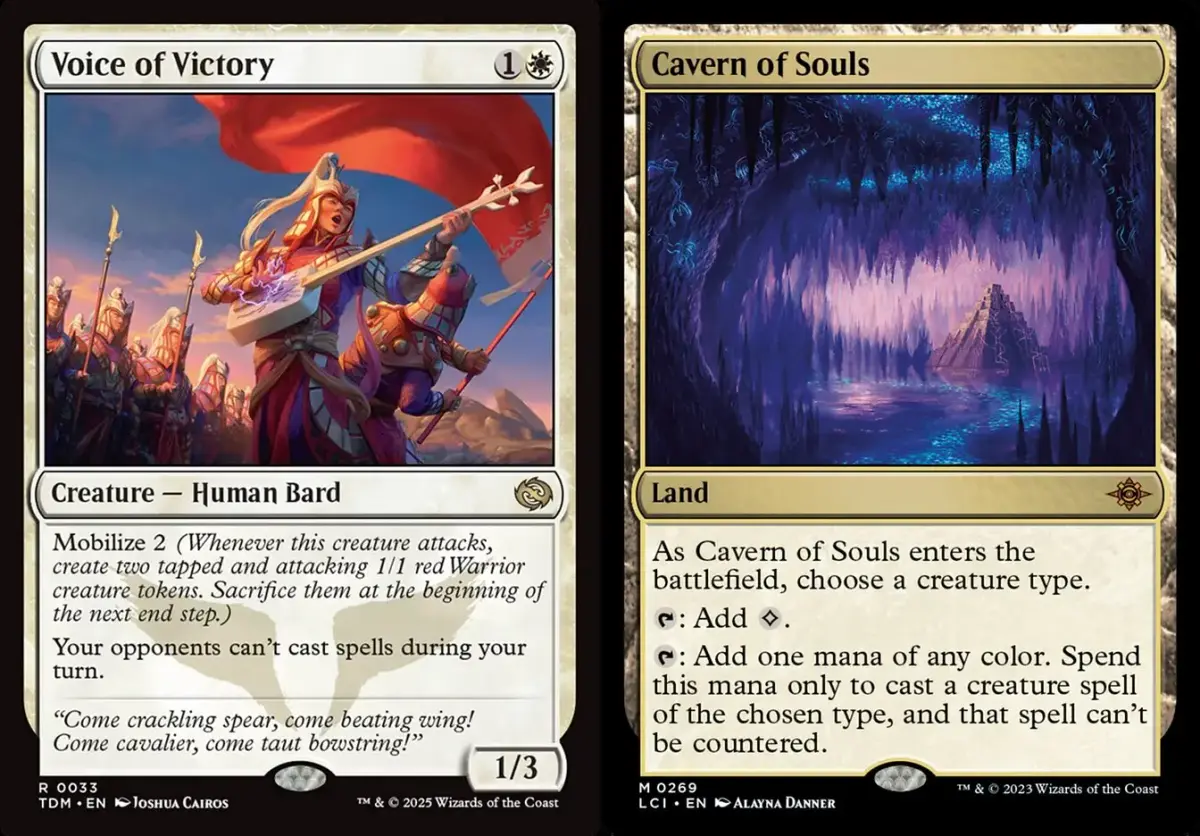
2: The format keeps speeding up, while versatile counterspells have basically not improved in the past two years. A one-for-one 3-mana Counterspell is completely unplayable now, and even 2-mana counters are often too slow on the draw. The strongest counterspell in Standard, Three Steps Ahead, also trades tempo for resources, so it works only as a late-game finisher rather than a way to hold off early pressure. Not to mention that the format has Voice of Victory and Cavern of Souls, great counterspell-killers. So pure counterspells can no longer serve as the main defensive plan; they are only a supplementary tool for specific problems.
Analyzing the Needs
Let’s first re-analyze which key threats in the common matchups of the current metagame deserve attention, and what answers they demand.
- Primary answer needs: the deck’s top design priorities
- Secondary answer needs: nice to cover as well, but not mandatory
If a deck’s key plan already falls within the scope of a traditional control deck’s main-deck interaction (for example, red aggro), then regardless of the matchup I won’t discuss it in this section, and will cover it together with the sideboard plans later.
PS: For readability, some individual cards are referred to by nicknames or short names rather than their full translated names.
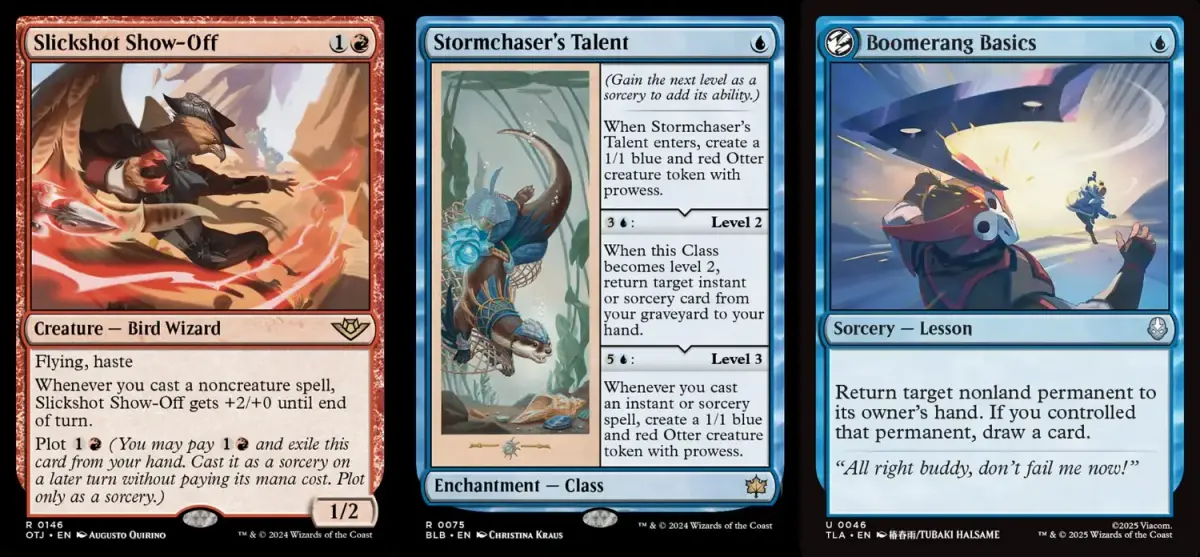
Izzet Prowess: Stormchasers’ Talent + Boomerang Loop
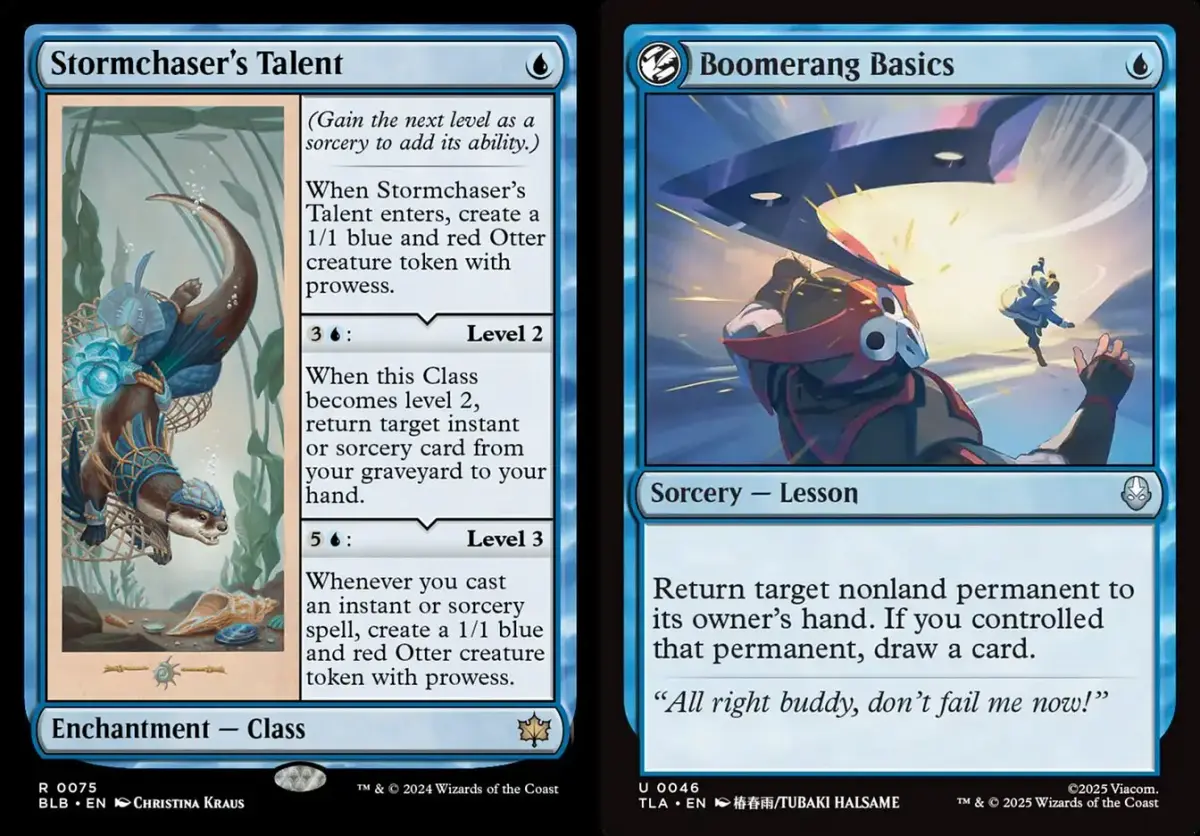
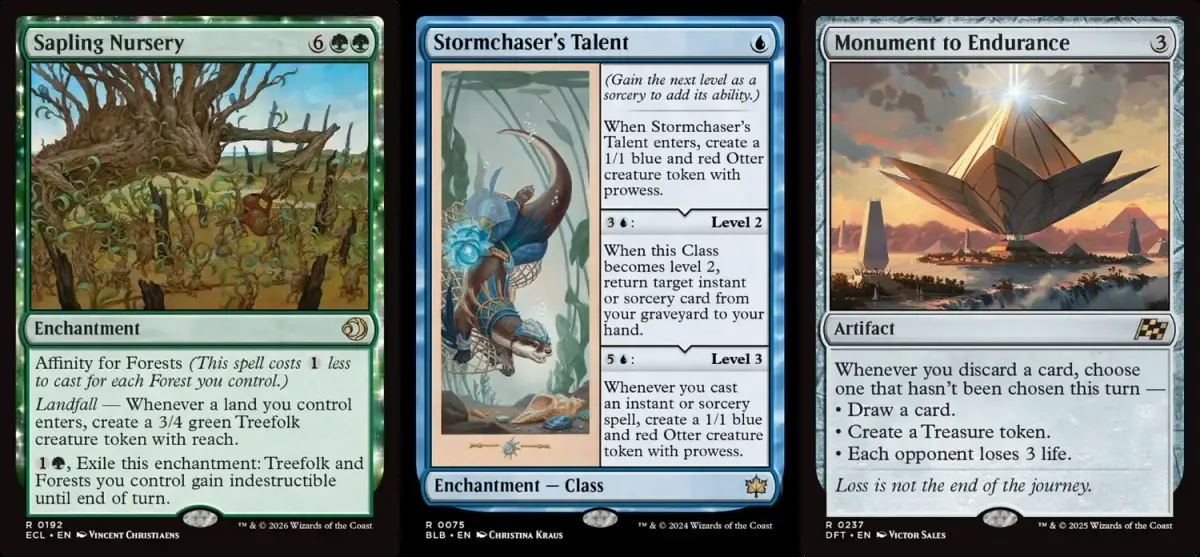
The prowess deck’s creature damage is not much of a problem for control by itself. The key is the loop of Stormchasers’ Talent + Boomerang Basics, which lets it quickly generate a huge amount of resources without running out of follow-up ammunition. Compared with a high-powered threat that can be answered one-for-one without losing card advantage, a threat that keeps supplying staying power like this is what gives control the biggest headache.
So enchantment removal is absolutely necessary, and ideally at instant speed. Otherwise, if the opponent has enough spare mana and enough caution, they can choose to cast Stormchasers’ Talent only on their own turn, bounce it back with Boomerang Basics, and just hold it in hand. Also, instant-speed enchantment removal can destroy Stormchasers’ Talent in response to the opponent declaring a level up, wasting a lot of their mana and breaking their tempo. Instant-speed graveyard exile can also stop Stormchasers’ Talent’s level 2 graveyard recursion, but that is more hit-or-miss: as long as Stormchasers’ Talent is still on the battlefield the risk remains, let alone that it has the option of reaching level 3 and winning off a single card. At control’s pace, games going that deep are quite common.
Also, in matchups against prowess, High Noon has the destructive power of a game-winning single card, and since prowess is popular enough to deserve special respect, being able to play High Noon is an effective bonus.
Since this Stormchasers’ Talent + Boomerang Basics package appears in many blue decks, every deck that has invested in Stormchasers’ Talent + Boomerang Basics has the same needs, so I won’t list them again below.
- Primary answer needs: instant-speed enchantment removal
- Secondary answer needs: graveyard exile, High Noon
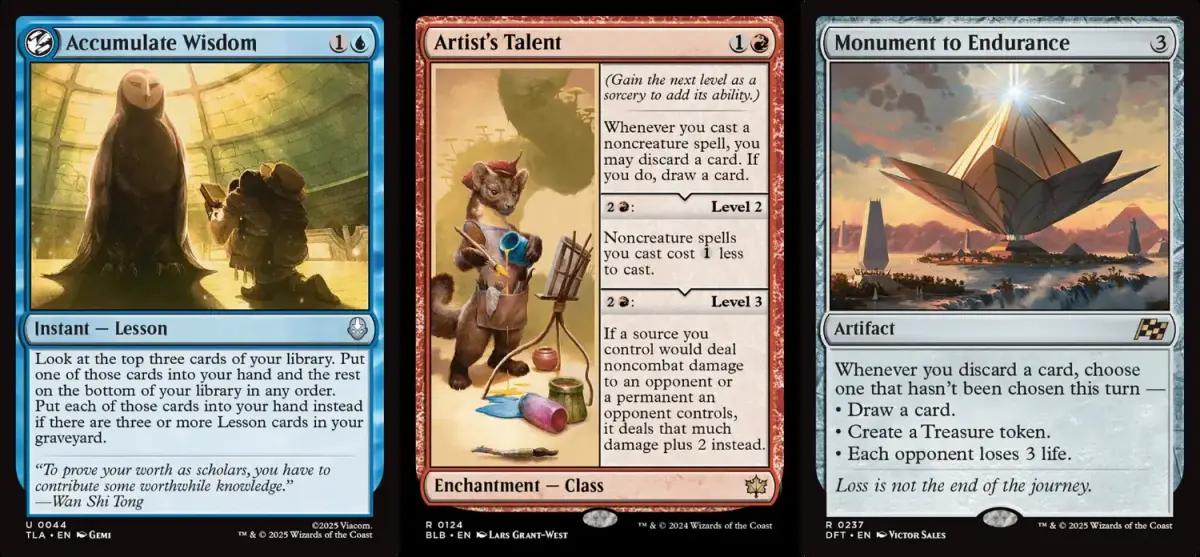
Izzet Lessons: Monument to Endurance
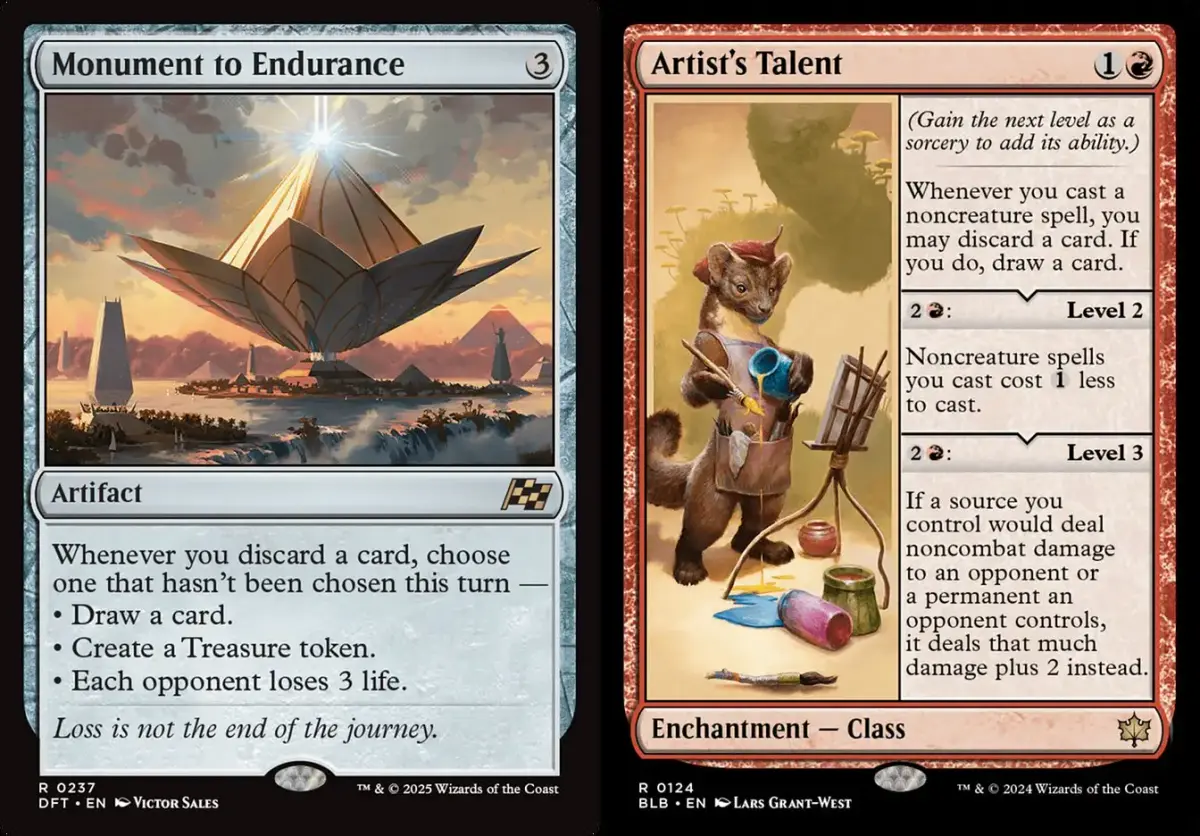
The current mainstream Lessons deck wins mainly through Monument to Endurance, with the Stormchasers’ Talent + Boomerang Basics package providing some extra support, so the key is having an answer to Monument to Endurance. On top of that, Monument to Endurance’s discard triggers come largely from Artist’s Talent, so although enchantment removal is less direct than artifact removal that just destroys Monument to Endurance, it can still hold it back considerably.
The Lessons package itself also relies on stuffing the graveyard to work, so exiling the graveyard causes some trouble for Lessons too. But honestly, for control, no matter how much Combustion Technique’s removal range improves it makes little difference; the only thing that really matters is Accumulate Wisdom’s one-time card draw, so the pressure to watch the graveyard is not that heavy.
- Primary answer needs: artifact and enchantment removal
- Secondary answer needs: graveyard exile
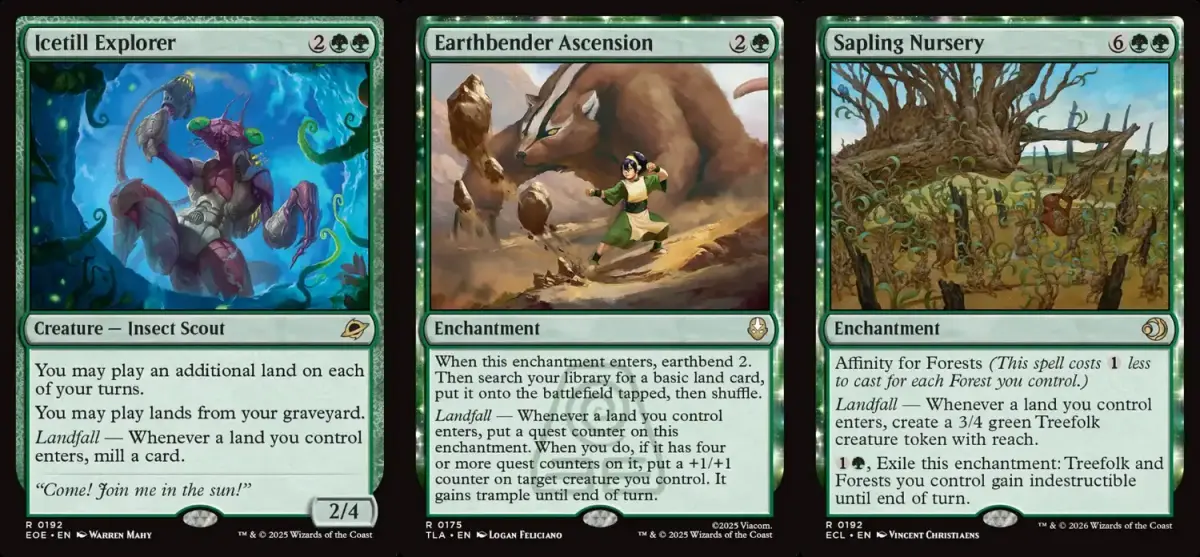
Green Landfall: Sapling Nursery + Ba Sing Se
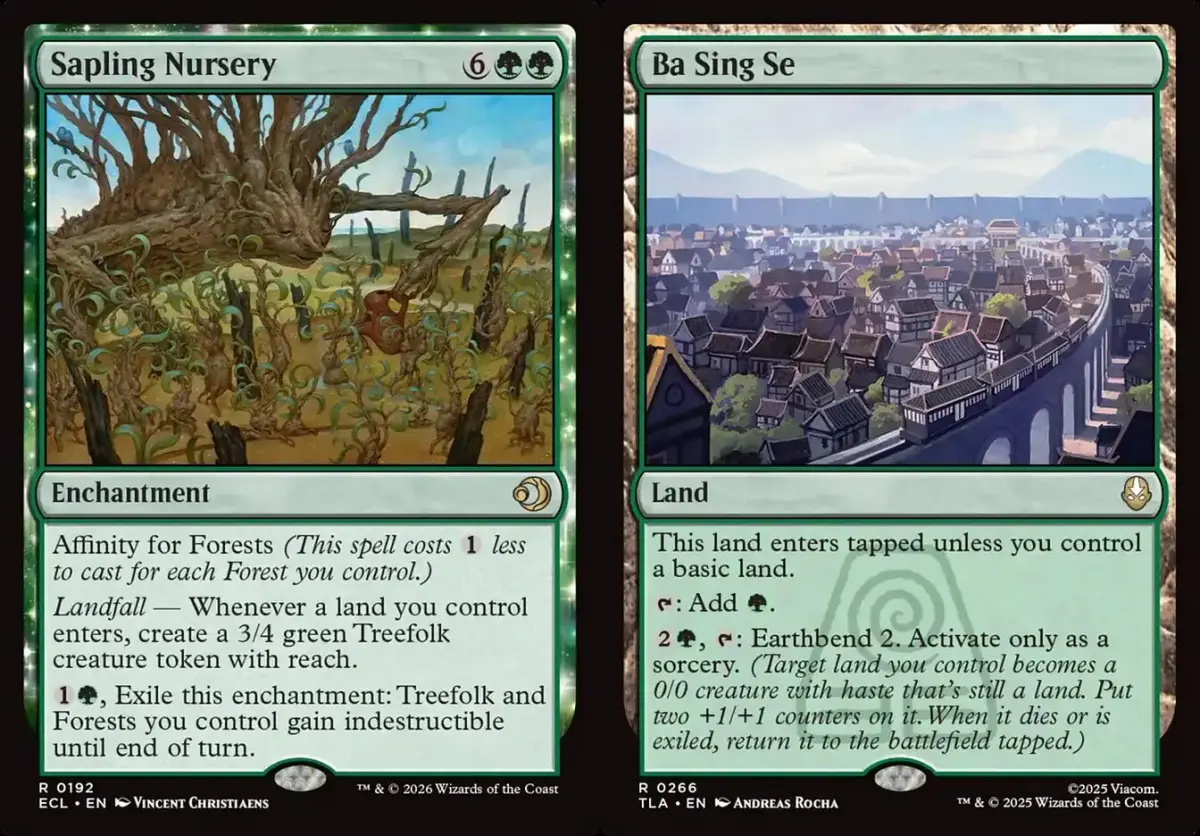
The Landfall deck I mean here is specifically the version that runs Sapling Nursery. For control, whether or not it has this card calls for two completely different answer plans. If the Landfall deck relies on its creature cards themselves for damage, that is exactly what a traditional control deck’s removal should handle. Once Sapling Nursery is added, enchantment removal becomes an absolute must.
Speaking of powerful enchantments, there is also Earthbender Ascension. Its destructive power shows mainly when racing other proactive decks, or against decks like White Token Control that build a blocking plan by laying out lots of small chump blockers. For ordinary control, dealing with it is not much different from dealing with any other strong threat.
Another big feature of the Landfall matchup is how to answer earthbend. Just the share of Landfall decks and the special nature of earthbend are enough to determine that you must run either Ultima or Deadly Cover-Up as your sweeper slot. The biggest killer among the earthbend cards is Ba Sing Se, which for control is a genuine one-card nightmare. And because it is a land that never becomes a creature on its own, it is harder to remove than any threat, so you need a dedicated answer to it.
Further reading: A Few Things About Earthbend
Instant-speed graveyard exile like Ghost Vacuum can also suppress the revival of earthbent creatures after ordinary destroy-based removal (Rest in Peace cannot). However, its greater value here is mainly in suppressing Icetill Explorer’s ability to generate resources. Then again, that is also a creature that removal can handle, so graveyard hate does not reach the level of a primary need.
- Primary answer needs: enchantment removal, Ultima or Deadly Cover-Up, an answer to Ba Sing Se
- Secondary answer needs: graveyard exile
Dimir Tempo: Ninjutsu Kaito + Enduring Curiosity
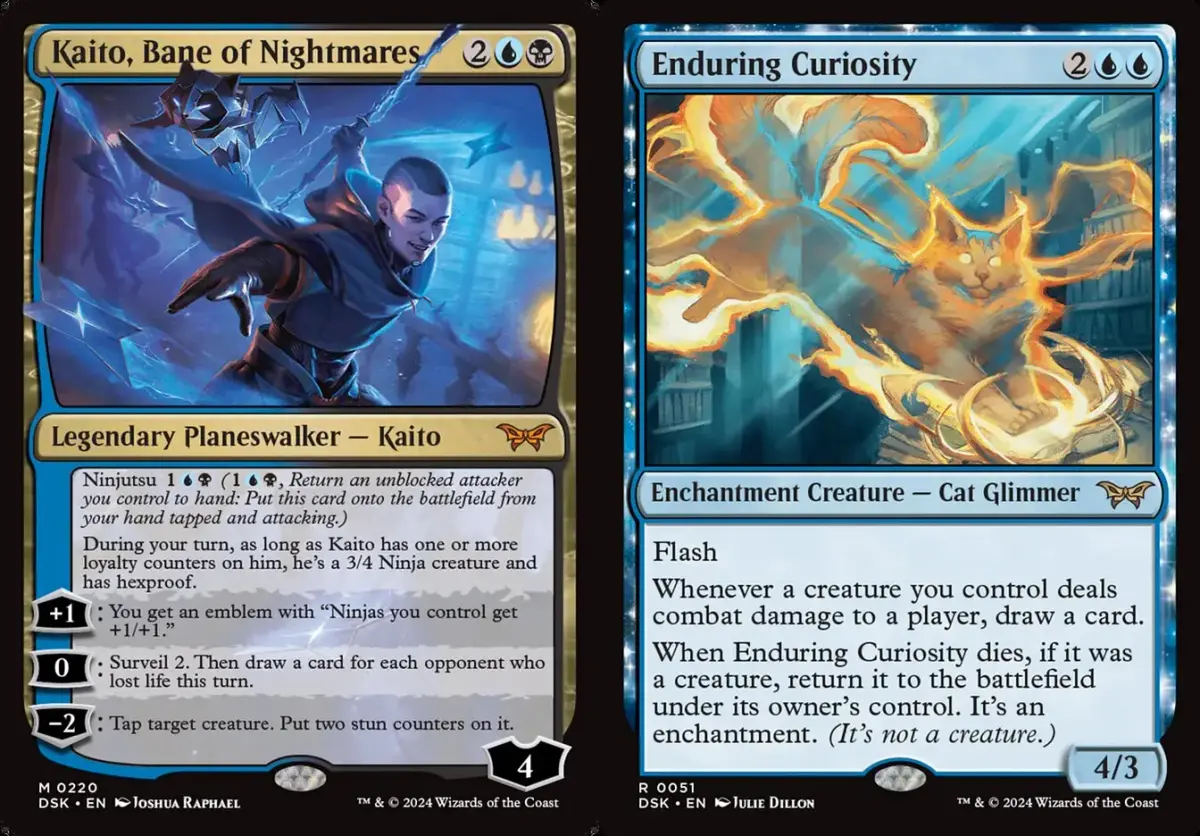
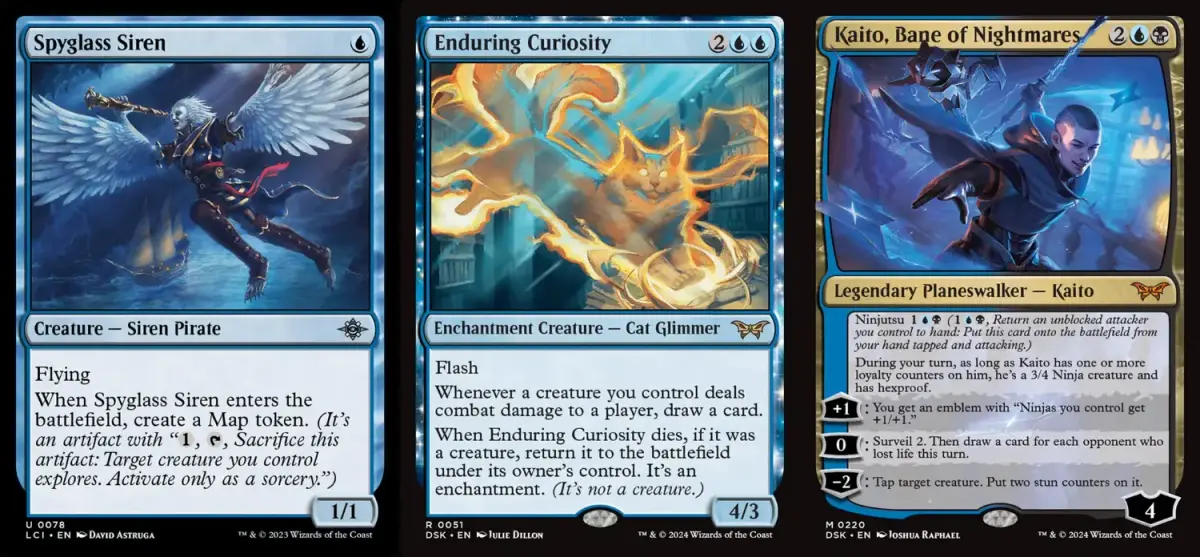
The main pressure in this matchup basically comes from Kaito, Bane of Nightmares. The design of this thing is just plain broken, so planeswalker removal is definitely a must.
Another best answer to Kaito, Bane of Nightmares, and to planeswalkers in general, is always creature-to-creature combat, even with a vanilla creature that has only power and toughness. This idea applies to Enduring Curiosity as well: Enduring Curiosity’s existence makes every instance of combat damage an unacceptable wound. Taking a hit from two 1-power creatures is no problem, but falling two cards behind is a big problem. Although control can use removal to keep its life total safe, against lots of cheap, flexible threats, expecting to kill every single one is still too much of a dream, so building your own wall of creatures is ultimately the more direct answer. So if possible, you would like to be like White Token Control: it follows control logic, but keeps some creatures on the board.
Speaking of answering Enduring Curiosity, graveyard exile can do it, but the opponent’s entire deck has only one Enduring Curiosity that cares about the graveyard, so you can’t specifically watch for it. It is best if the removal itself resolves the problem cleanly. For sweepers, again rely on Ultima or Deadly Cover-Up, both of which perform very well against Dimir Tempo, and exile-based kill spells are also a way. A second-choice answer is to kill it a second time with enchantment removal, but that basically loses card advantage already, so it is not the default plan.
- Primary answer needs: planeswalker removal, Ultima or Deadly Cover-Up
- Secondary answer needs: ability to deploy creatures
Dimir Demons: Mass Discard + Mill Combo
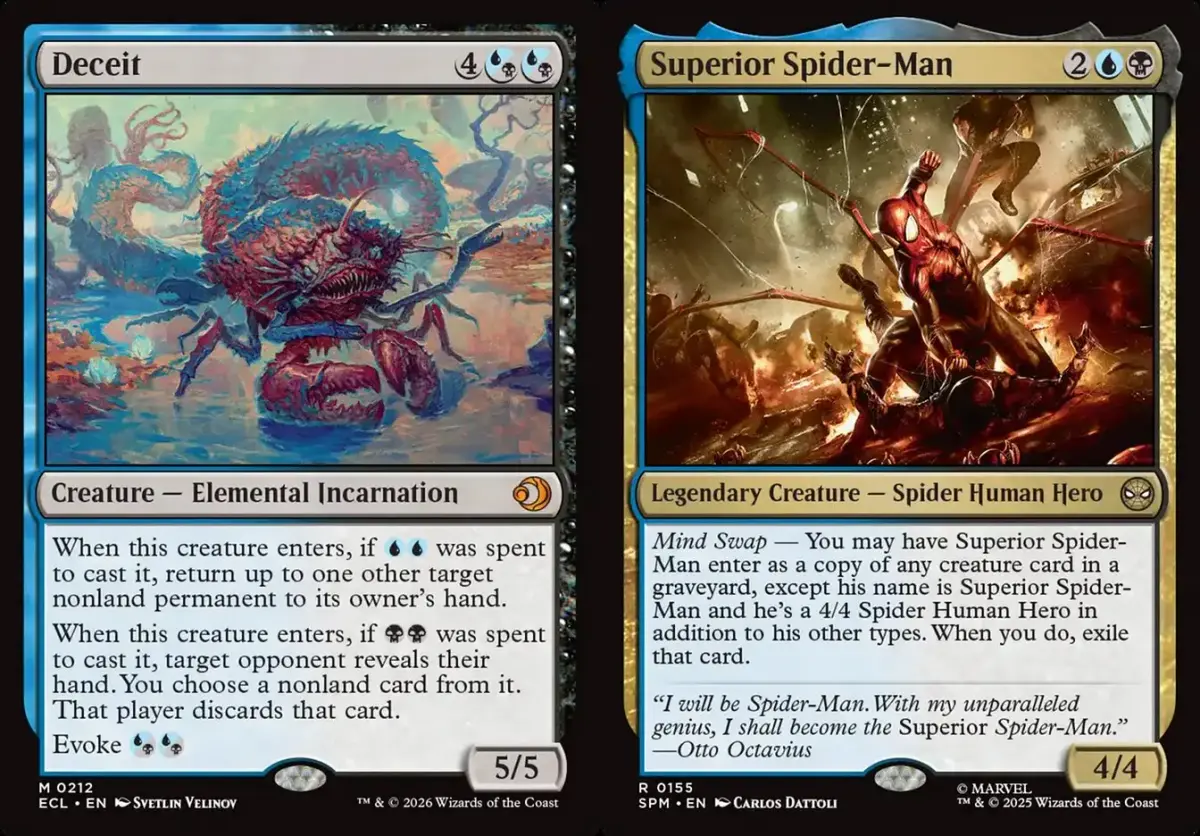
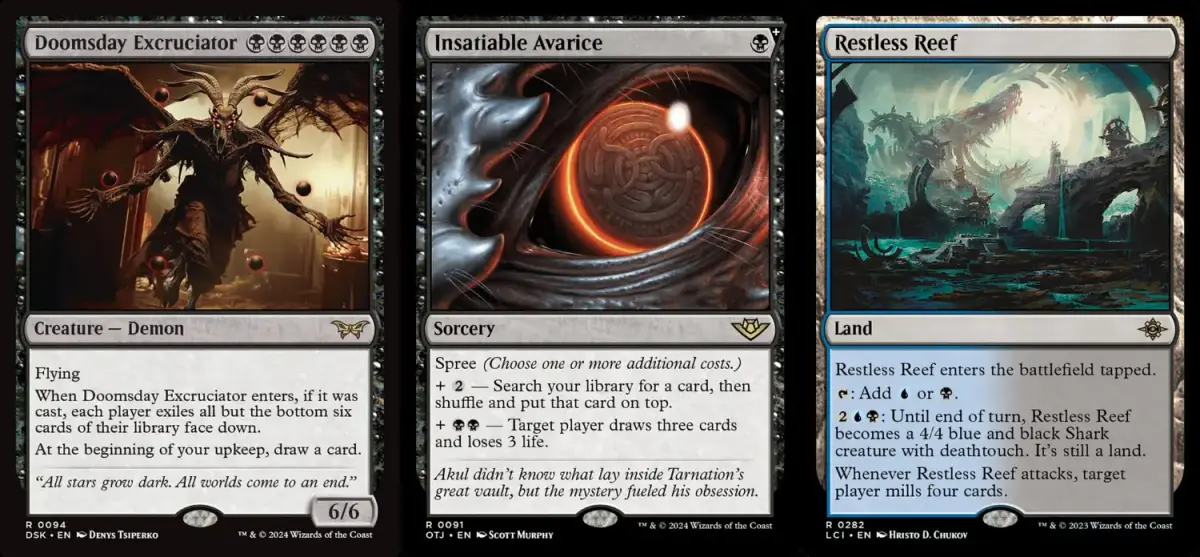
Honestly, this Dimir Demons deck is essentially a control deck with a combo attached, but it is also the biggest killer of traditional control, and it happens to be one of the most popular matchups in the format. You could say it is the greatest source of trouble, but also the source of inspiration for the final breakthrough.
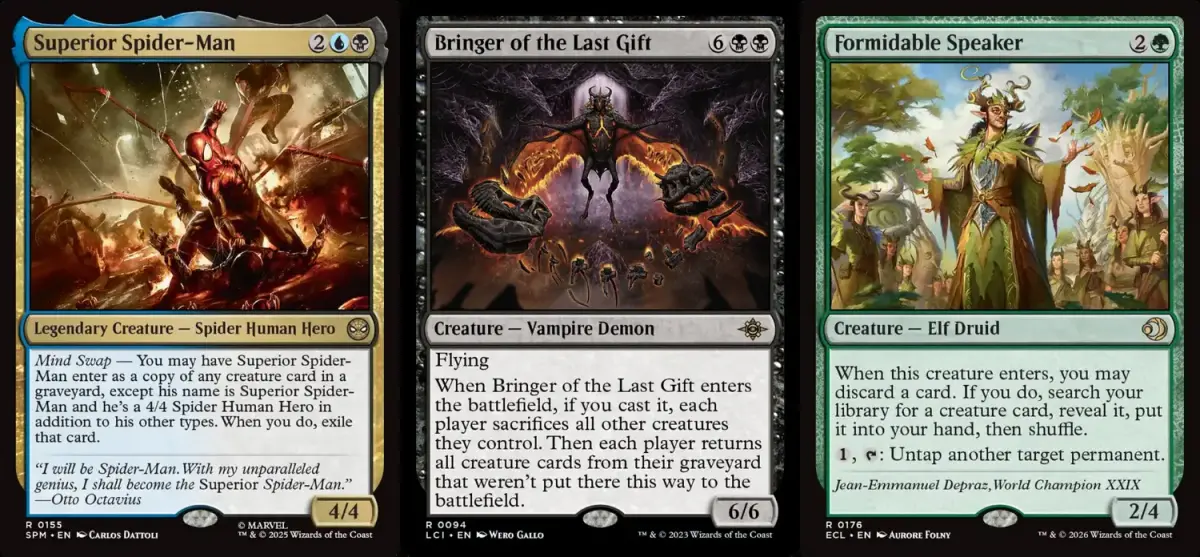
First, the most lethal threat is that this deck has far too much discard. The combination of Deceit + Superior Spider-Man is enough to keep any reactive deck from carrying out its defensive plan. And it is not simple one-for-one discard: after discarding, it can leave behind a creature that wins the game. For ordinary control, that alone is already unplayable.
Against the Deceit + Superior Spider-Man discard combination, the most direct method is to shut off its ETBs. Cards that can do this are Torpor Orb and Doorkeeper Thrull. Although a Deceit under Torpor Orb becomes a 2-mana 5/5 threat, which is still quite strong, for control a vanilla body is always better than getting hit by the discard. As for graveyard hate, it only covers half of it: it does stop Superior Spider-Man from reusing Deceit, but unless you are Rest in Peace you may not cover it completely, and the suppression from Deceit as a single card still exists.
(Making the player hexproof would actually be a way too, but the current Standard card pool has no sufficiently practical options.)
The other decks mentioned above essentially only differ in their choices of removal range, but the Deceit + Superior Spider-Man combination directly makes control’s old reactive defensive logic impossible, so how to get past this is the final real decision point in the deck. (Of course, if you are confident enough in your matchups against the rest of the format, giving up this matchup outright and focusing on dodging it is also a line of thought.)
Second, the Demons combo is very hard to interrupt. Attacking the library is what control fears most, because with so much discard beforehand, even if you have the answer cards you often can’t hold them until the moment you need them against the combo. The combo has two stages, and you must have an answer to at least one of them.
Stage one is Doomsday Excruciator’s ETB exiling your library until only 6 cards remain. Countering the creature spell itself, or messing with its ETB ability, both work. Stage two, after your library is down to 6 cards, is using extra library-attack methods to make your library evaporate faster. Since Doomsday Excruciator itself makes its controller draw extra cards, what you need to do is withstand its library attacks and let the opponent deck themselves first. Restless Reef can be handled with removal, but if it is Insatiable Avarice making you pay 3 life and draw 3, or the Outrageous Robbery that may be added after sideboarding, that is somewhat impossible to stop, and only counterspells can handle it. Alternatively, you can have your own ways to attack the opponent’s library, making them deck themselves faster.
- Primary answer needs: the deck’s very structure itself
Spider-Man Reanimator: Mass Discard + Graveyard
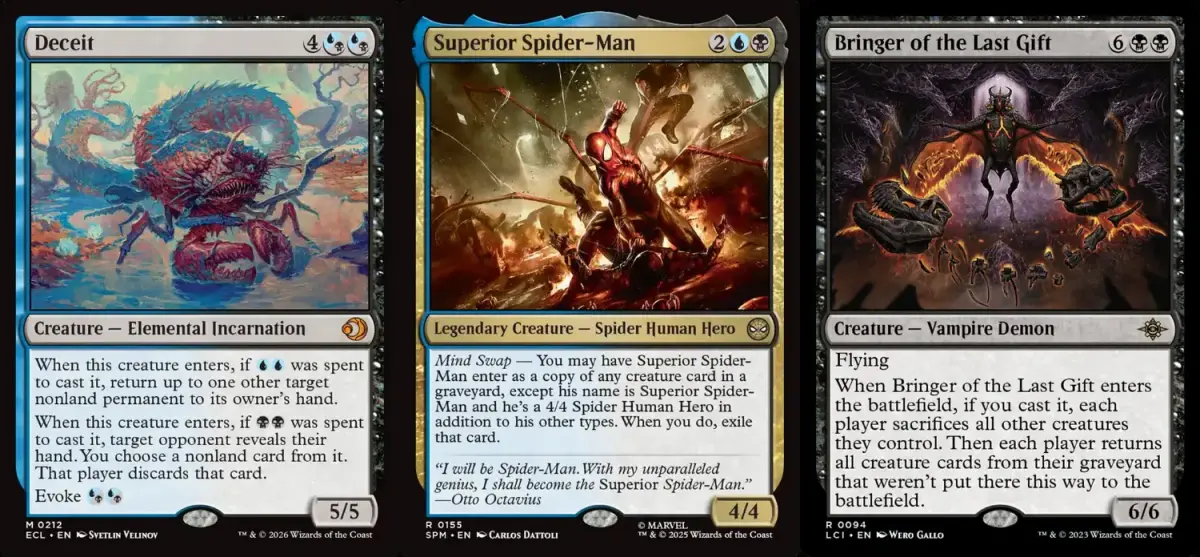
The biggest problem is actually the same as the Dimir Demons above: what is truly lethal is Deceit + Superior Spider-Man. As for the graveyard plan as the finisher, it is relatively a smaller problem for control. After all, even if you fail to watch the graveyard in time, a sweeper can still save you, unlike other proactive decks where, once the opponent overextends onto the board, you can’t recover.
Also, in this matchup most of the opponent’s operation relies on creature ETB abilities, so Torpor Orb is also a usable answer card.
- Primary answer needs: graveyard exile, an answer to the Deceit + Spider-Man combination
- Secondary answer needs: Torpor Orb
Others
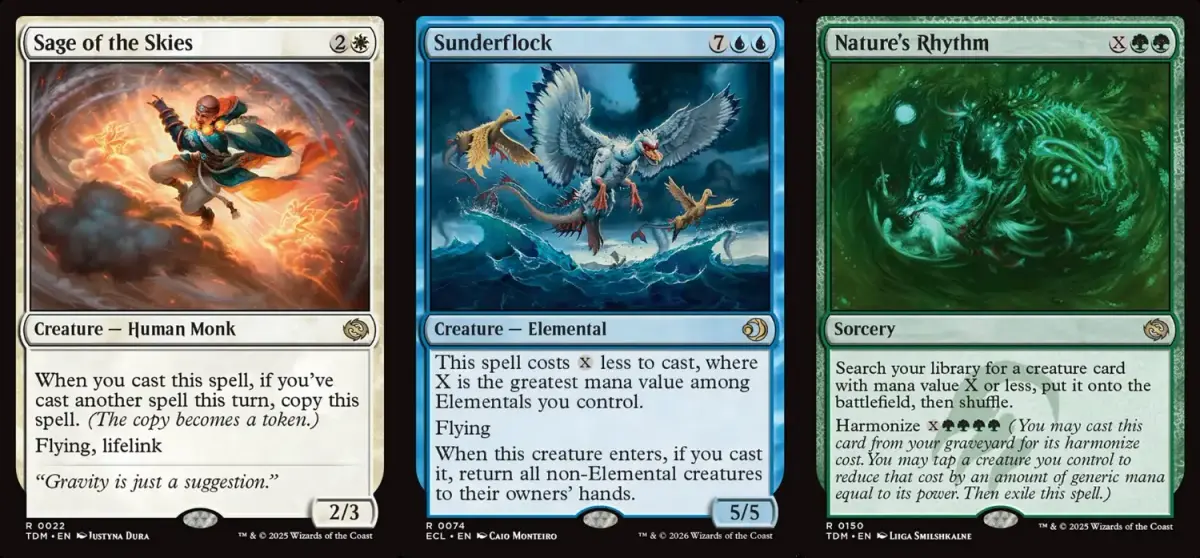
Finally, a few decks that are not bad matchups for control, but have a big enough share of the field that you should still remember them:
- White-based spell chain
- Izzet Elementals
- Simic Snakes, or the Simic-based multicolor toolbox decks derived from it
Summary
Looking at the decks listed above, you will find that besides lots of creatures to kill, the demand for enchantment removal is extremely high, and it is something that has to be respected in the main deck. There is also a need to answer planeswalkers and artifacts, so effectively you need removal that reaches permanents in general.
Graveyard hate, on the other hand, while it can disrupt many decks, is rarely against a deck that builds its entire plan on the graveyard, so the pressure does not need to be this heavy.
Because the format has plenty of decks that run on creature ETB abilities, or cast chains of spells in a single turn, being able to play Torpor Orb and High Noon can also be a bonus.
Rebuilding the Deck Structure
If the main removal needs are creatures and enchantments, then the white-based control deck’s Get Lost seems to fit the requirements perfectly. It also has Ultima, Rest in Peace, Kutzil’s Flanker, and other answer cards that meet the criteria above. On top of that, High Noon can watch the prowess and spell-chain decks, and finishers that dodge your own Torpor Orb to lock the opponent out one-sidedly are easy to find. It all looks so natural, as if traditional Azorius or Jeskai control is still a reasonable answer… and then you discover that you can indeed answer everything, but you run out of answers before the opponent’s threats are all dead.
This is a good moment to go back and introduce two important elements that make up a game: resources and tempo.
- Resources: Anything you can use is a resource, including cards in hand, life, mana, and so on. When resources are mentioned below, unless specifically stressed, they refer specifically to the number of usable cards, which is commonly called card advantage.
- Tempo: Tempo is the efficiency with which the game shifts toward your deck’s game plan. When we discuss efficiency we normally use time as the unit; in MTG this unit can be converted into number of turns, or the mana you need to invest.
For example, for a race-the-life-total aggro deck like red aggro, tempo is the speed at which the opponent’s life goes down. Winning on tempo means that even if you have more resources than I do, I finish executing my game plan before you can convert them into an impact on the game. The reverse, a resource advantage, is easier to understand: when both sides have enough mana to cast whatever they like, the player who can cast more cards has an obvious advantage.
Generally, the more proactive a deck is, the more it values tempo, while control usually has no tempo requirements of its own, and even sacrifices tempo in exchange for a resource advantage. When one player holds the advantage in a game, they usually lead in at least one of tempo or resources, and possibly both.
Control’s Tempo and Resources
Let’s first look at what attributes control’s usual tools have.
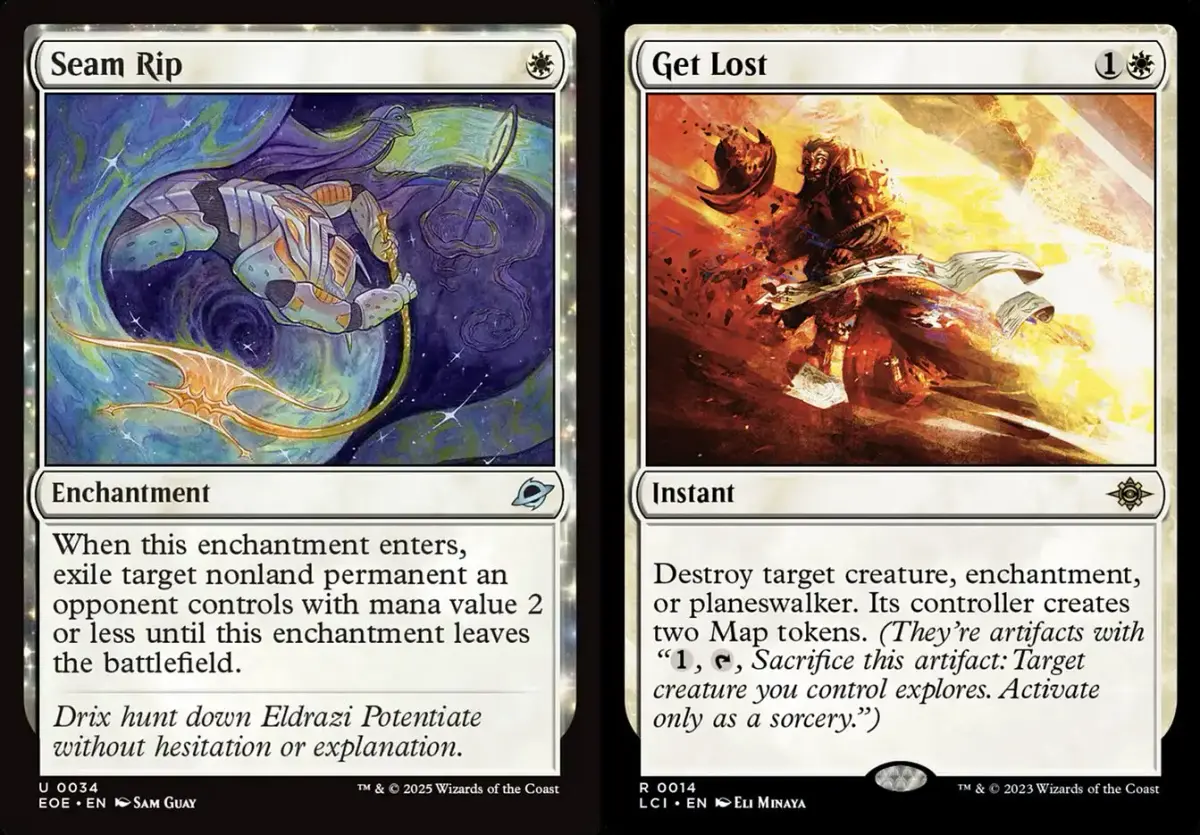
Flexible, long-range removal is control’s capital for wrecking the opponent’s tempo, but note that no matter how wide the range of this removal is, the card advantage is always 0: you trade one card for one of the opponent’s. One-for-one counterspells follow the same logic as these single-target removal spells.
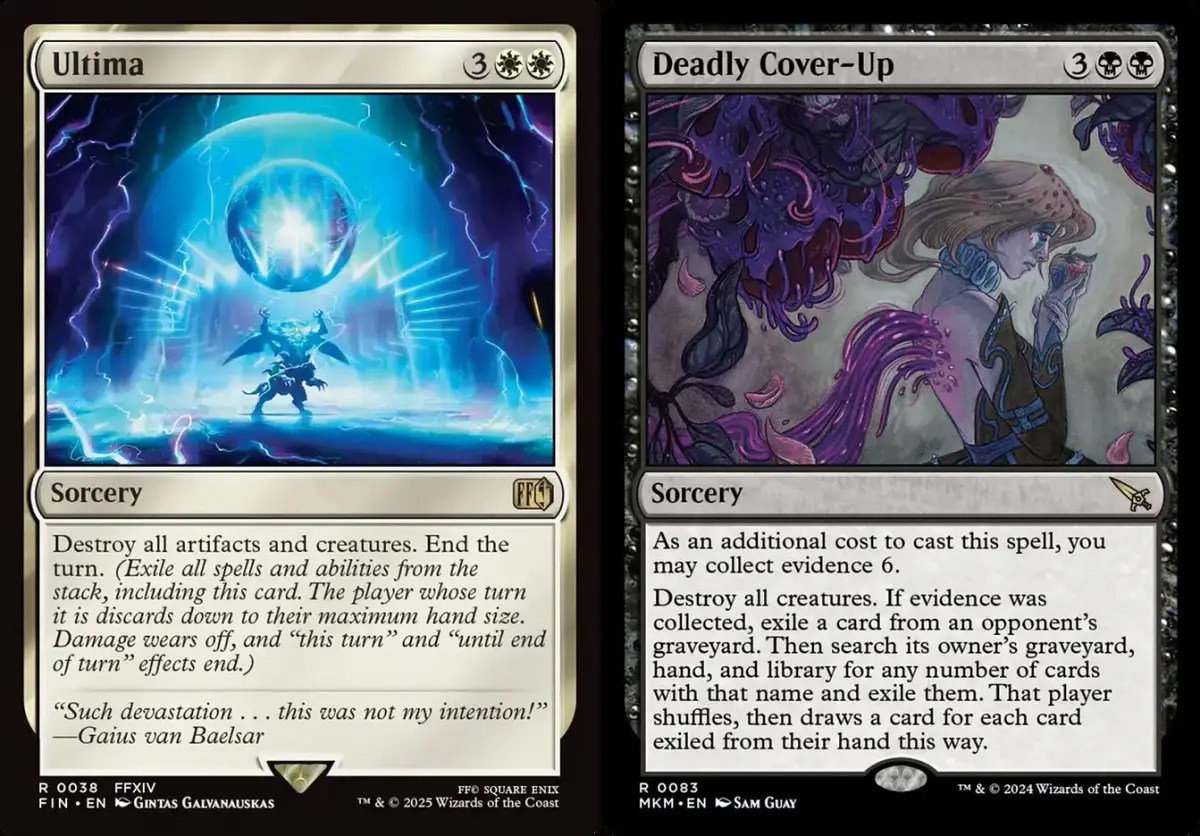
Sweepers are the key reason control works at all. These are what truly let control break the opponent’s tempo while gaining card advantage for itself. Conversely, if a sweeper cannot even interrupt the opponent’s tempo, then our game plan already has a problem.
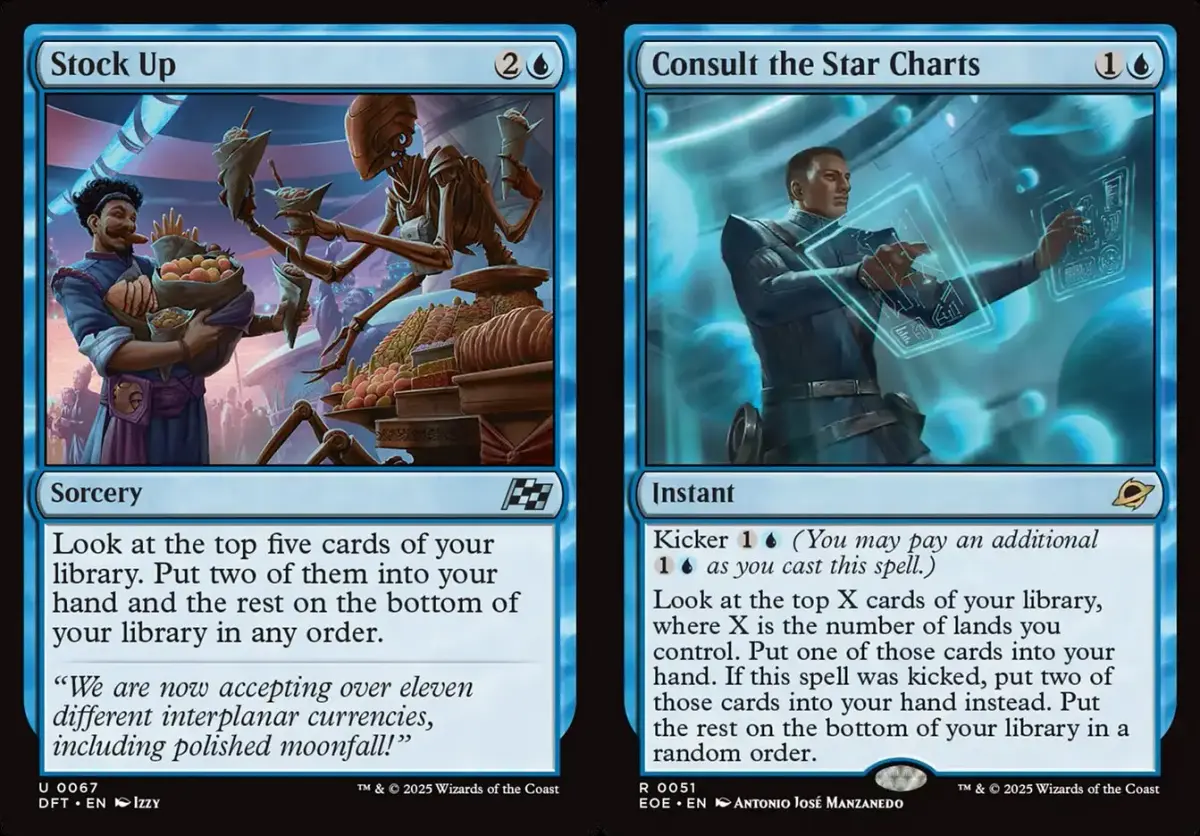
These two card-draw spells can be counted among the strongest in the past ten years of Standard. But note that although their look depth is very high, the card advantage is still only +1. You must make good use of this depth to find the cards that precisely counter the opponent or widen your advantage, and that is what lays the foundation for creating more card advantage later.
Another important concept is that simply drawing cards has no effect on the battlefield, so when the opponent has already established a threat on the board, this is the standard case of selling off tempo to buy resources.
The Opponents’ Tempo and Resources
Now let’s briefly look at what the matchups introduced above actually look like:
Tempo: All of it is 1-mana cards.
Resources: The first Boomerang Basics returning Stormchasers’ Talent creates +1 card advantage, and after that, once the level 2 loop of Stormchasers’ Talent starts, the card advantage is capped only by when it draws out its library.

Tempo: Effectively a 3-mana curve, and on the turn it enters via ninjutsu it is nearly unanswerable. You usually have to wait until your next turn to deal with it, which indirectly compresses the tempo budget available to us. Choosing to make an emblem can keep pushing the damage-racing tempo.
Resources: On the ninjutsu turn it guarantees +1 card advantage, and every following turn it can keep drawing cards and snowballing.

Tempo: Although it costs 4, flash lets it appear at exactly the right time to maintain its own game plan, so its attacking tempo is hard to interrupt.
Resources: It draws so many cards I can’t be bothered to count. And the fact that it comes back as a noncreature enchantment after dying once is itself an extra resource.
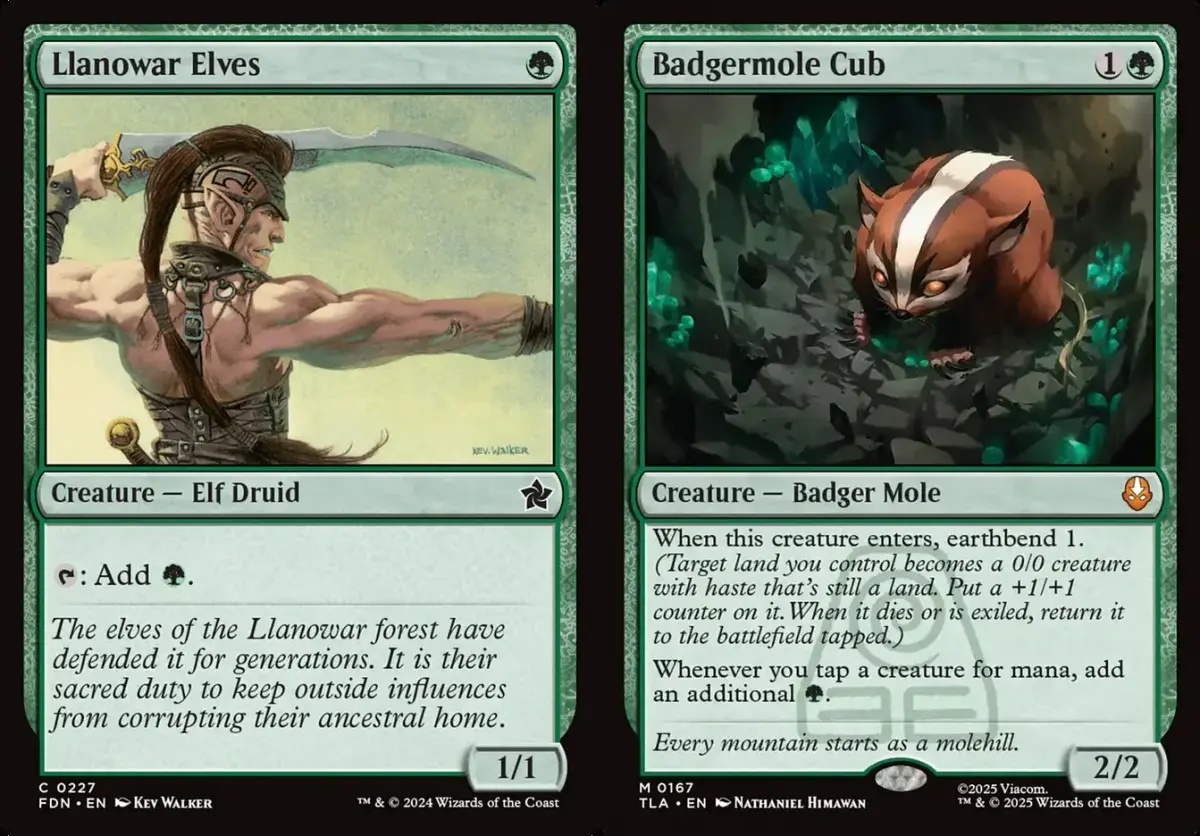
- Badgermole Cub decks:
Tempo: Having 6 mana on turn 3 is a common sight, and with a good hand it can even reach 10 mana on turn 3, so there are all kinds of possibilities for the deck to blow up its tempo to the extreme.
Resources: Although it does not provide card resources itself, it contributes far too much mana, and that mana can easily be converted into any resource you want. Also, earthbending a land when it enters counts as providing a resource in the number of creatures on the board.
Comparing Threat and Removal Performance
After actually comparing them, you find an interesting problem. Although the attackers’ tempo is getting more and more out of control, in terms of removal range and cost alone, answers can still barely keep up. The opponents’ advantage is tempo, but that is not what kills us. Rather, even in the amount of resources, which control is supposed to be good at, we can’t match the opponents.
Look at the various threats listed above: with strong proactive tempo as a given, their resource totals are no less than those of control decks that focus on card-draw spells. Of course, because control looks deeper into its library, each card control draws has a higher expected value at the same +1 card advantage, but once the card advantage gap widens further, that expected-value edge is meaningless. After all, looking at 4 and taking 2 can never beat just drawing 4.
And don’t forget that these threats already exist on the battlefield for real, while the cards you draw have no effect on the board. So even if both sides are +1 in card advantage, the opponent has conjured a battlefield tempo advantage out of thin air, and when you want to deal with the threats on the battlefield, you must invest even more tempo and resources. Going back and forth like this, control has lost who knows how much.
You could say that in this era, playing a purely reactive deck is truly thankless.
Why Do Dimir Demons Survive?
Among the top-tier decks right now, Dimir Demons is the only one built on a control framework. So why is it, despite having a control base and lacking the many excellent white removal and hate cards, that its win rate is better across the board than traditional Azorius or Jeskai control?
Having a hard-to-interact-with winning combo is of course one reason, but the components for this combo have existed in Standard for a long time already, so the real key is not the finisher but the ability to survive long enough to go for the win.
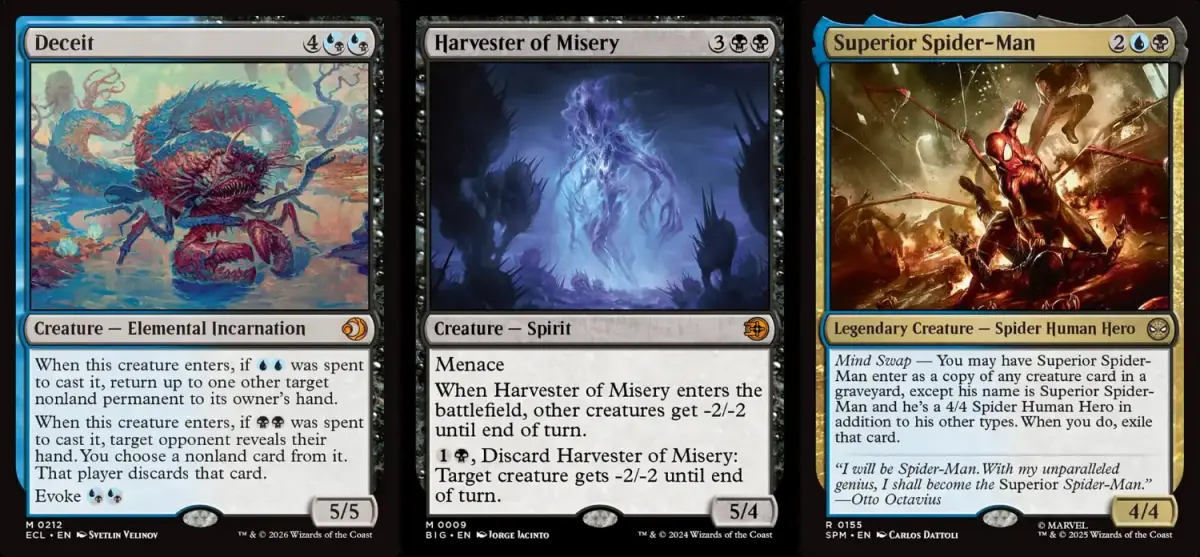
Deceit is a groundbreaking powerhouse (honestly, I think it’s a bit too strong…). This kind of flexible function, giving a high-cost finisher another low-cost way to be used, is exactly what control wants, equivalent to getting a free finisher slot without sacrificing the low end of the curve. Both of Deceit’s ETBs fit control’s needs very well, and when they trigger together they are effectively a universal answer to any nonland permanent (bounce it, then discard it). This already somewhat breaks the color pie: it gives Dimir, which originally struggled against artifacts and enchantments, an ability equivalent to white’s universal removal. Once paired with Superior Spider-Man, the destructive power changes qualitatively, as I have mentioned many times above.
Harvester of Misery should not be underestimated either. Although -2/-2 range at 2 mana looks lousy, the creatures in the current metagame are developing toward two extremes, and against the fast end, -2 range is actually enough. And like Deceit, it is a low-cost play that can also be a high-cost finisher, and it can be copied by Superior Spider-Man. The foundation built from these three cards gives the whole deck no shortage of creatures that stay on the board, plus a high density of low-cost answer cards, plus a wide enough range of answers.
Among these three advantages, which is the most crucial? Actually it is no shortage of creatures that stay on the board, and the qualitative change starts from that point. Having creatures means the opponent has to deal not only with the plays we make from hand but also with the creatures on the board, and we gain the options of blocking and trading in combat as well. Even though all of our cards are configured to meet control’s needs, we gain the option of a midrange game against the opponent.
The biggest breakthrough that Dimir Demons brings to the control framework is not how much more it has grown in resources, but that, with the same amount of resources, it gained a proactive tempo capability that control never had before.
Absorbing the Strengths
A framework based on Superior Spider-Man + Deceit + Harvester of Misery is a good starting point, so next comes the question of how to expand it.
First, the direction is clearly creature-based control. Since the positioning is still control rather than combo, we don’t need Doomsday Excruciator, and among the card-draw spells we need not consider Insatiable Avarice or other components specialized for the combo. Instead we pursue creatures with enough disruption, board-clearing, and staying power. Since the creatures themselves are win conditions, there is no need to separately think about who the finisher will be.
The original Dimir Demons gained broad board-clearing ability through Deceit, but there are far too many weird permanents in the format now, and relying on Deceit alone is pushing the limit. This is the time to consider adding a color, and when I reviewed the answer needs listed above (a format of creatures with enchantments attached), I suddenly realized that after adding green, Fangkeeper’s Familiar perfectly satisfies all my needs! It happens to be an answer card that handles creatures and enchantments at the same time. What’s more, Sultai itself is a color combination with high board-clearing range, so finding all kinds of answers later is easy.

Choosing the Deceit + Spider-Man package also brought another benefit: it solves the earlier question of how to beat Dimir Demons. Since we are both on Deceit + Spider-Man, we are on even footing, with no matchup problem. Even better, because I also have Restless Reef, if the opponent dares to cast Doomsday Excruciator without leaving mana up, they could die to their own combo.

Creature-based control is also half an answer to the Landfall deck’s Ba Sing Se. Originally, as long as control couldn’t answer Ba Sing Se, it would be freeloaded to death by the threats it conjures from nothing, but now that I have a board presence, I have more capital to fight it out in both offense and defense.
Deck Introduction
Decklist Link
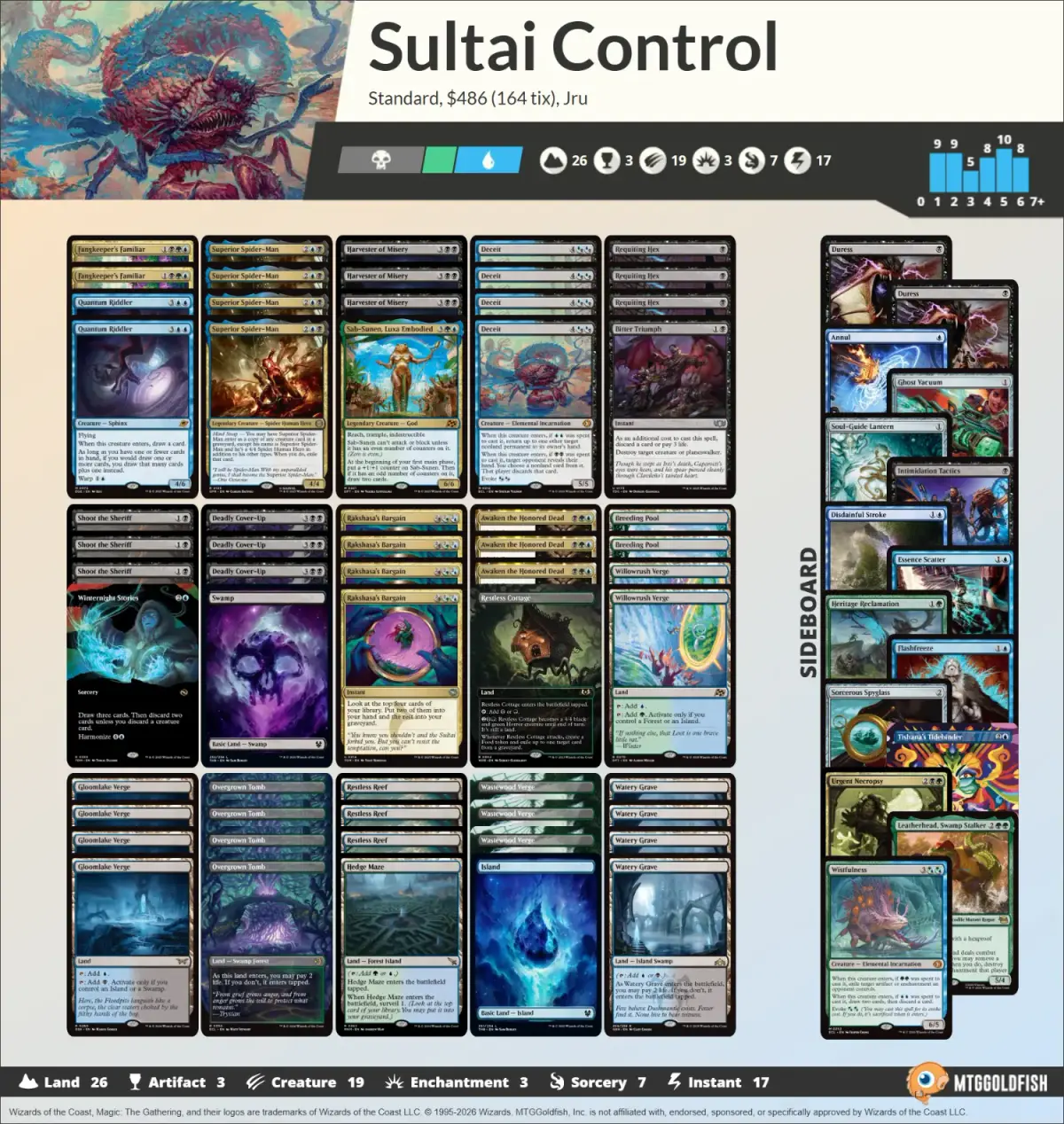
Creatures
I’ve already spent a great deal of ink on this core trio above, so I won’t belabor it, but there are still a few details worth mentioning.
- Deceit (4):
The two ETB abilities, bouncing and discarding, trigger separately. Suppose the opponent responds with an ability counter such as Tishana’s Tidebinder or Spider-Sense: one card can only counter one ability. And because these are two independent triggered abilities, you can put things on the stack between them. Suppose you choose to resolve the bounce first on an opposing creature with flash, and then the discard. Before the discard resolves, the opponent has a chance to flash it back onto the battlefield.
If you run into Torpor Orb, none of Deceit’s ETBs will trigger, including the sacrifice trigger on entering when you cast it with evoke.
- Harvester of Misery (3):
It is very important against opponents who tend to field lots of small creatures, such as Izzet Prowess and Dimir Tempo. Often you kill one on turn 2, then on turn 4 copy it with Superior Spider-Man and sweep again, and the opponent’s offense will crash completely. However, the -2 range is still a bit short, and 3 copies is the limit; any more and it gets stuck far too easily.
- Superior Spider-Man (4):
When you cast it, you don’t need to declare what you plan to copy, nor choose any creature card in a graveyard as a target. Only once it is confirmed to enter the battlefield do you choose which creature it enters as a copy of.
Also, although Superior Spider-Man’s copy effect keeps the name Superior Spider-Man and modifies a bit of the creature subtypes and power/toughness, everything else is overwritten with the copied creature’s information, including whether it has the legendary supertype. So as long as you don’t have two Superior Spider-Man both copying legendary creatures, you won’t hit the legend rule problem; one legendary and one nonlegendary creature with the same name are not subject to the legend rule.
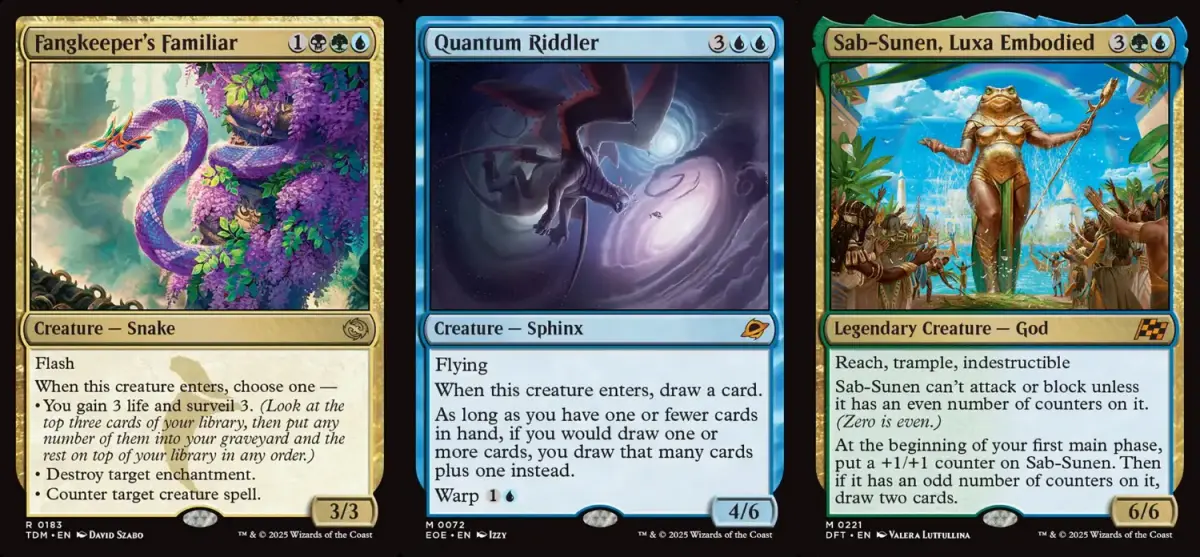
Its three abilities fit the current format perfectly. Almost every opponent runs on creatures and enchantments, and many creatures do their work as soon as they enter, so being able to counter them outright is the cleanest answer. Although I did say earlier that a defensive plan relying on counterspells can’t be the main plan now, adding a few as support is still very useful, and this isn’t a plain one-for-one reactive card but a play that can gain card advantage.
Because it also has the option of surveil 3 and draw 3, this guy will never be a dead card, and when you want to be proactive it can provide proactive tempo as well. Surveil 3 is also no small depth, and may even pair with other graveyard-using cards in the deck to effectively gain cards.
In fact, I originally conceived the deck around a full playset of Fangkeeper’s Familiar, but since Superior Spider-Man also takes up the 4-mana curve slot, and this deck’s Draw-Go ability is not as strong as traditional control’s, always leaving 4 mana up is not realistic for me, so I weighed the balance and settled on 2 copies.
- Quantum Riddler (2):
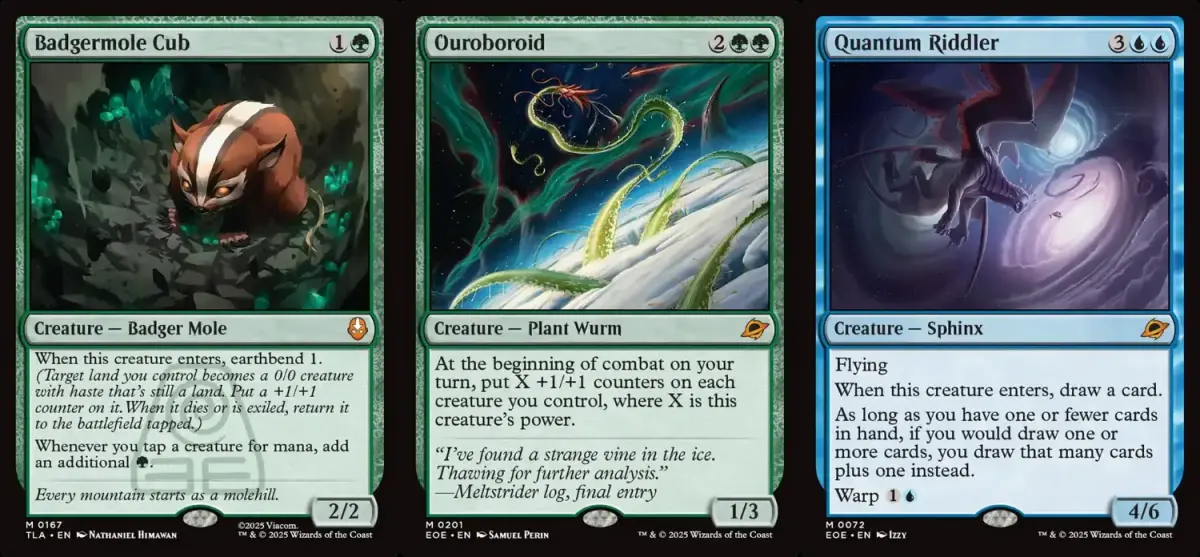
A powerhouse in every format; its strength needs no further comment. Originally the configuration was 1 Quantum Riddler + 1 Wistfulness, but after testing for a while I found that the main deck seemed to respect artifacts and enchantments a bit too much, so I changed it directly to more stable card draw.
Almost every opponent will pick this card up and read it for ten seconds.
Its role is essentially the same as Quantum Riddler: both are 5-mana creatures with a built-in resource engine. But Sab-Sunen, Luxa Embodied is nearly unanswerable for many decks, and even if they have answers, there may only be a few cards. Meanwhile, by repeatedly playing Deceit plus other regular discard spells, I may be able to discard more than three times the number of the opponent’s answers. With indestructible, it also leaves me with a powerful finisher after I finish sweeping.
Note, however, that Sab-Sunen, Luxa Embodied can declare an attack or block only when it has an even number of counters, which sometimes opens a hole in your defenses, but overall the pros outweigh the cons. The Blight from Requiting Hex can be used at instant speed to adjust the number of counters on Sab-Sunen, Luxa Embodied.
Card Draw
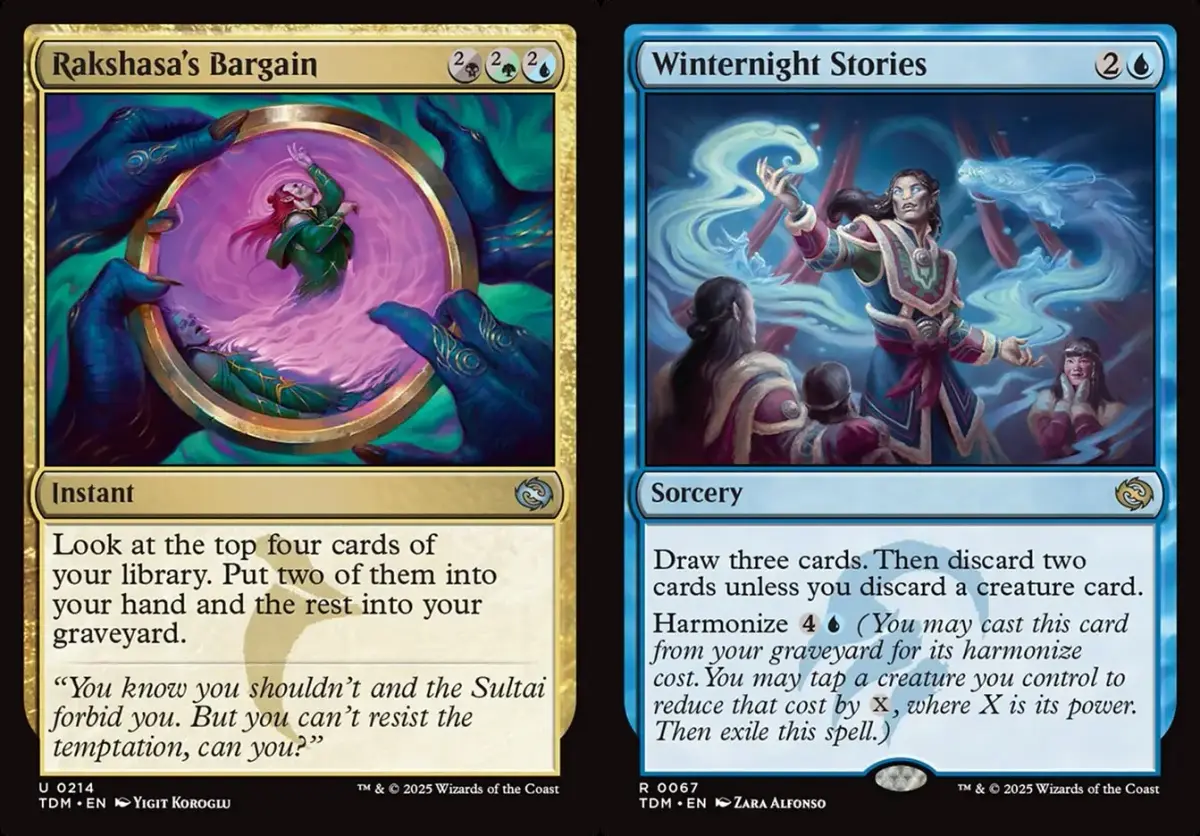
Although this is creature-based control, relying entirely on creatures to draw cards would be a bit too clunky, so I did include a few card-draw spells.
- Rakshasa’s Bargain (4):
Using the control staples Stock Up and Consult the Star Charts in this slot is also viable, but in my view Rakshasa’s Bargain’s 3-mana instant nature better fits this deck’s requirements. First, because the deck packs so many creatures, its Draw-Go ability has already dropped, so I want the remaining spells to raise the instant-speed share as much as possible. This deck’s 4-mana curve is rather heavy as well, and especially an on-curve turn-4 Superior Spider-Man is often the most dominant play, so Rakshasa’s Bargain lets you stagger the curve. The graveyard filling that Rakshasa’s Bargain comes with may even conjure copy targets for Superior Spider-Man out of nothing.
Also, although Rakshasa’s Bargain can be cast for 3 mana, a hybrid mana cost is counted by its higher side when calculating mana value, so this is a 6-mana-value card, and a single card can satisfy Deadly Cover-Up’s collect evidence requirement.
- Winternight Stories (1):
The deck is full of high-power creatures and graveyard-filling abilities, so Winternight Stories has plenty of room to perform, and it is especially wonderful with a Warped Quantum Riddler. But there are really no slots left, so one copy is about right.
Removal
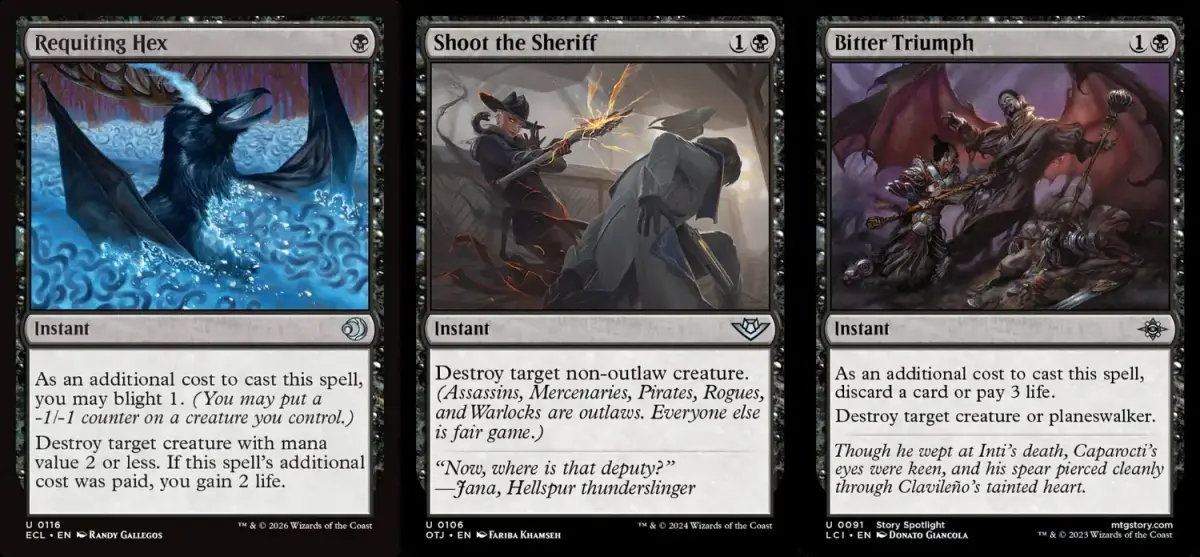
- Requiting Hex (3):
The strongest 1-mana removal in Standard black. Although its range only reaches 2-mana-value creatures, in the current format a full playset would be perfectly fine, it’s just that the slots are a bit hard to squeeze out, and 3 copies seems sufficient for now.
- Shoot the Sheriff (3):
Although you now bump into Outlaw creatures all the time, overall Shoot the Sheriff is still the most elegant-range 2-mana black removal with no drawback, and most of the Outlaws you see now are ones Requiting Hex can handle, so the two cover each other’s blind spots, more or less.
- Bitter Triumph (1):
In the past, when building control I basically couldn’t accept Bitter Triumph’s cost, but since this deck has a need to use the graveyard, it’s another story. And I really do want to give Kaito, Bane of Nightmares a bit more respect.
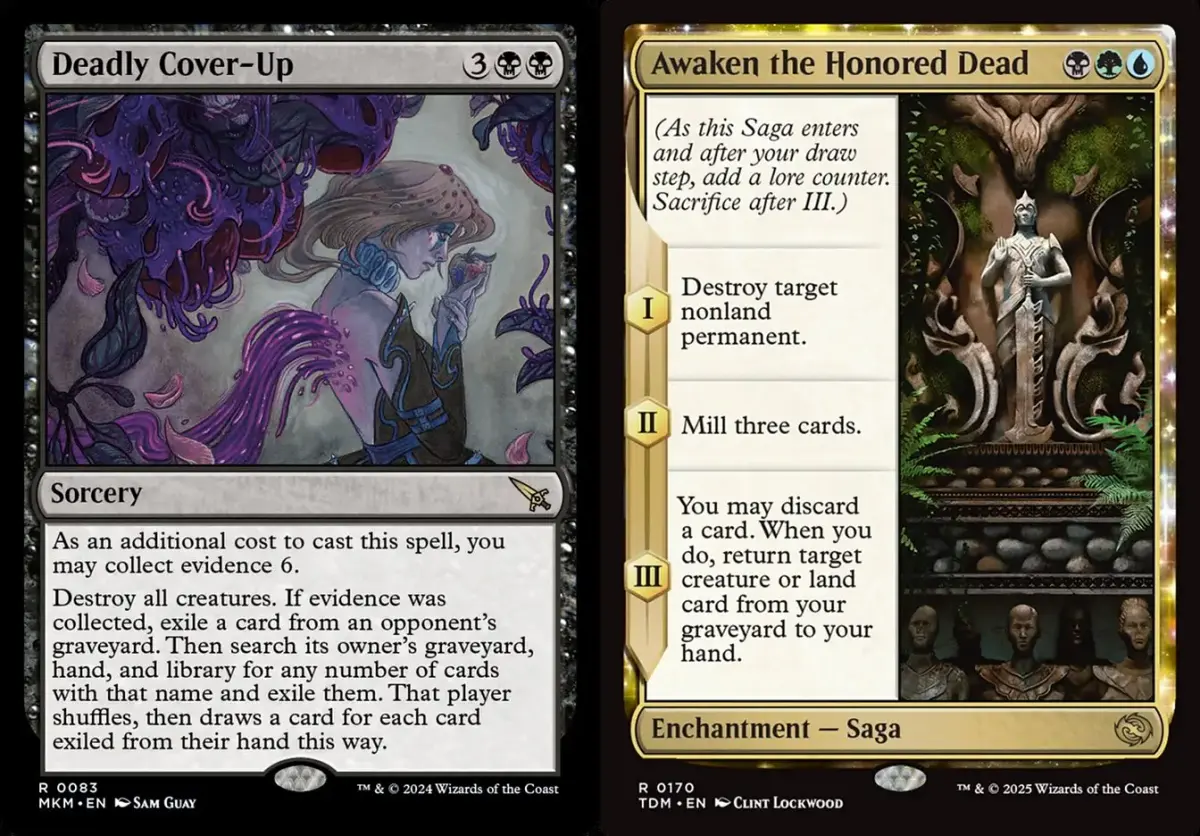
- Deadly Cover-Up (3):
Black sweepers now come in two choices, Deadly Cover-Up and Day of Black Sun. Each has its own advantages and neither is the absolute right answer; many Dimir Demons decks also mix both in the main deck.
Here I went with all Deadly Cover-Up, partly out of personal preference, since I have always loved using the library-cutting effect. Another reason is that I also run an indestructible Sab-Sunen, Luxa Embodied and stuffed in a pile of cards that can quickly supply collect-evidence ammunition, which makes Deadly Cover-Up feel a bit more in line with the deck’s main idea.
That said, Day of Black Sun’s advantage against fast decks is obvious too, and it has a high enough return on investment in the current format, so readers can adjust the ratio according to their own preferences and understanding of the metagame.
Although it is a clunky card to cast, the stability it brings is excellent. In this age where the permanent types you need to handle are all over the place, I very much want a universal permanent removal in the main deck, and Awaken the Honored Dead does that very well. Its ability to move creatures around in the graveyard also raises the flexibility of my deck, which uses creatures as spells.
Also, with Awaken the Honored Dead added, this deck has a dream curve: turn 2 Deceit to discard => turn 3 Awaken the Honored Dead to clear the board => turn 4 Superior Spider-Man copying Deceit, discarding a card from the opponent and bouncing Awaken the Honored Dead to hand, keeping one more universal removal for later.
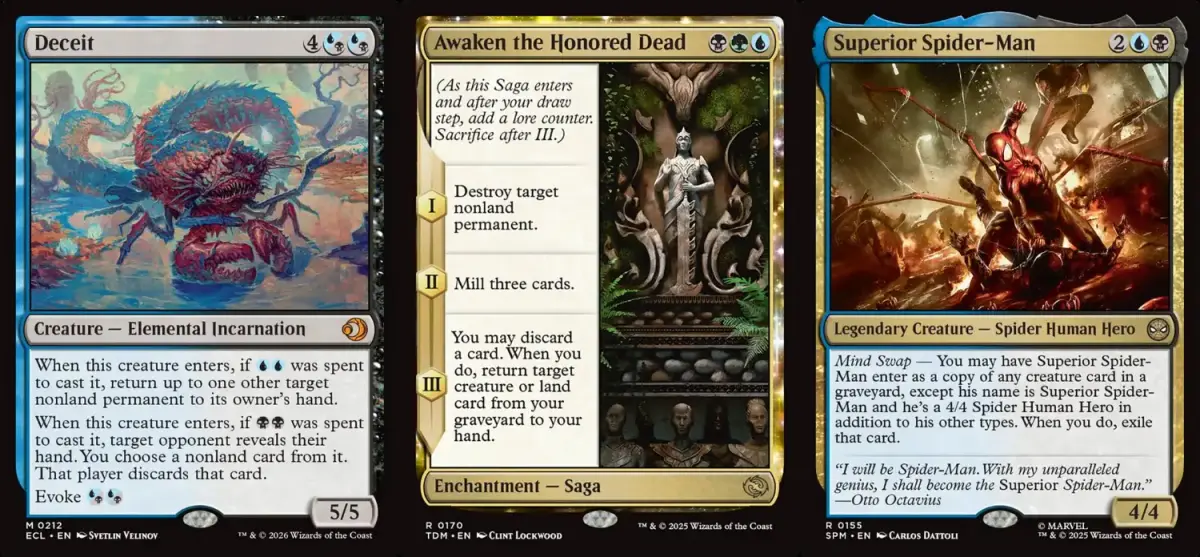
Still, it is after all the clunkiest single-target removal, so in the sideboard it is easily swapped out for other, better-targeted sideboard cards.
Lands
Because this is a three-color deck with extremely heavy color requirements, the mana fixing needs are very demanding. I could only squeeze in 4 creature-lands (or utility lands), and the remaining slots must be filled entirely with typed dual lands + Verges.
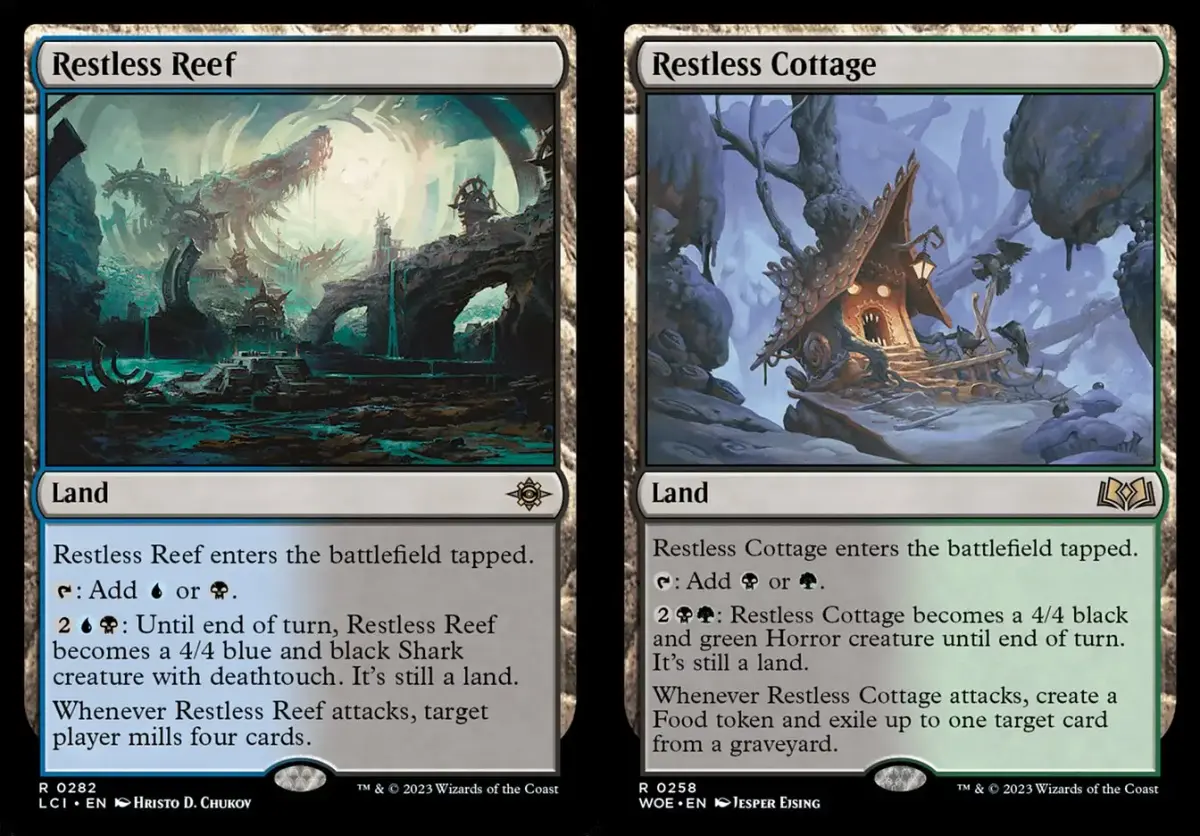
- Restless Reef (3):
The key to fighting Dimir Demons. Normally the opponent isn’t dumb either; knowing you can mill them, they won’t recklessly cast Doomsday Excruciator without an answer in hand, but being able to forcibly hold back their combo is already a big contribution in itself. What’s more, Restless Reef’s overall quality is among the best of Standard’s two-color creature lands, and its raw card strength is beyond reproach.
By the role it plays, it should really be a full playset, but doing so would make balancing the overall fixing needs somewhat troublesome later.
- Restless Cottage (1):
Since running all Restless Reef would skew the mana fixing a bit, the fourth creature-land slot goes to Restless Cottage. Its strength is also beyond reproach, and having one more graveyard-hate tool is quite useful in the current format.
- Verges:
- Gloomlake Verge (4)
- Wastewood Verge (3)
- Willowrush Verge (2)
The three Sultai Verges have an extremely awkward point: without a typed land, none of them can produce black, so once you keep a hand with a Verge but no typed land, it is very easy to die outright. After testing, 9 Verges seems to be a relatively safe number; if you go Verge +1 and typed land -1, you feel the rate of mana accidents rise considerably.
- Typed lands:
- Watery Grave (4)
- Overgrown Tomb (4)
- Breeding Pool (2)
- Hedge Maze (1)
- Basic Swamp (1)
- Basic Island (1)
Black is the color with the highest color requirement in this deck, and there is often a need to cast Deceit on turn 2 using {B}{B}, so all shock lands with black must be maxed out.
Hedge Maze is not essential; swapping it directly for a third Breeding Pool is fine too. I just figured that with so many shock lands you can’t always afford to pay the life and will often choose to have them enter tapped, so I’d rather play a land that still gives some benefit when it enters tapped. Considering there are already 4 creature-lands, I habitually keep truly tapped-only lands to 5 or fewer, which is why I run one Hedge Maze.
Finally, since I may still run into Demolition Field, and shock lands cannot unconditionally enter untapped, I also included a few basic lands. This deck’s need for green is very low and it is mainly Dimir overall, so I don’t run a basic Forest.
Sideboard
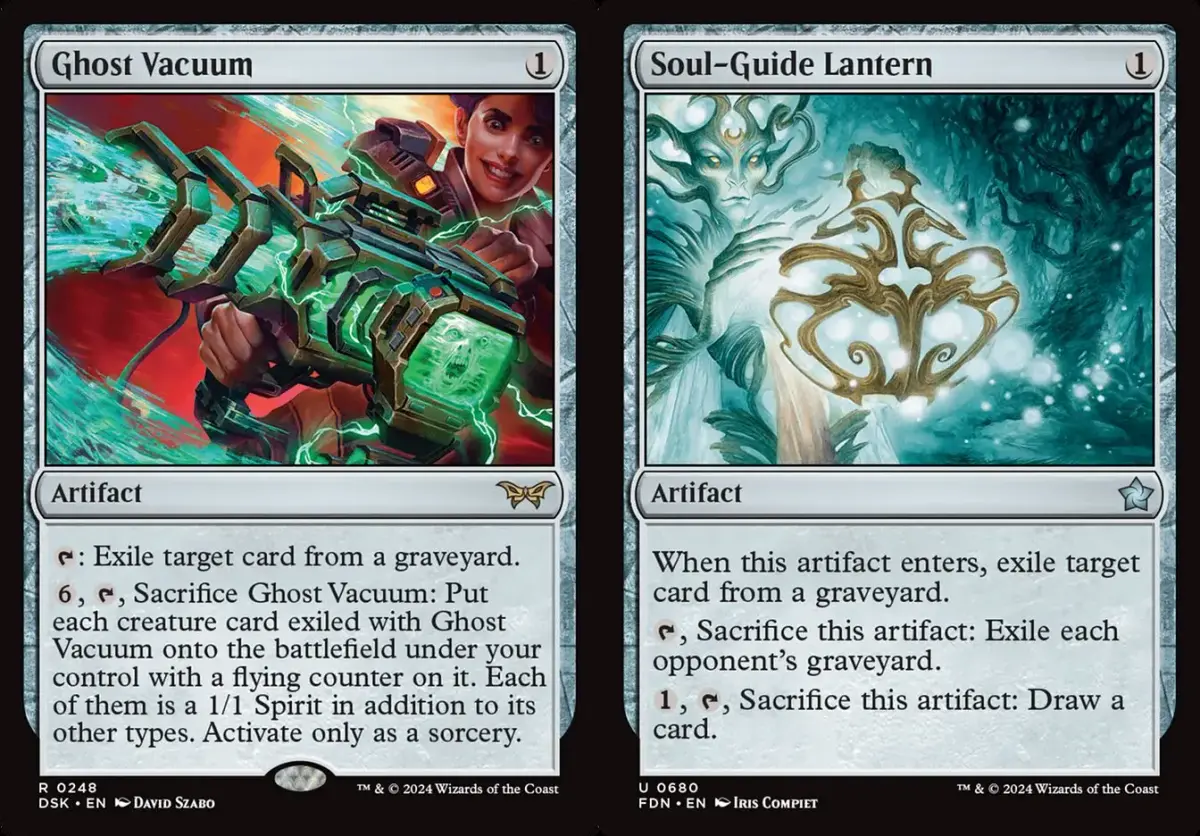
- Ghost Vacuum (1) & Soul-Guide Lantern (1):
In the current format each has its pros and cons, so I run one of each for full functionality.
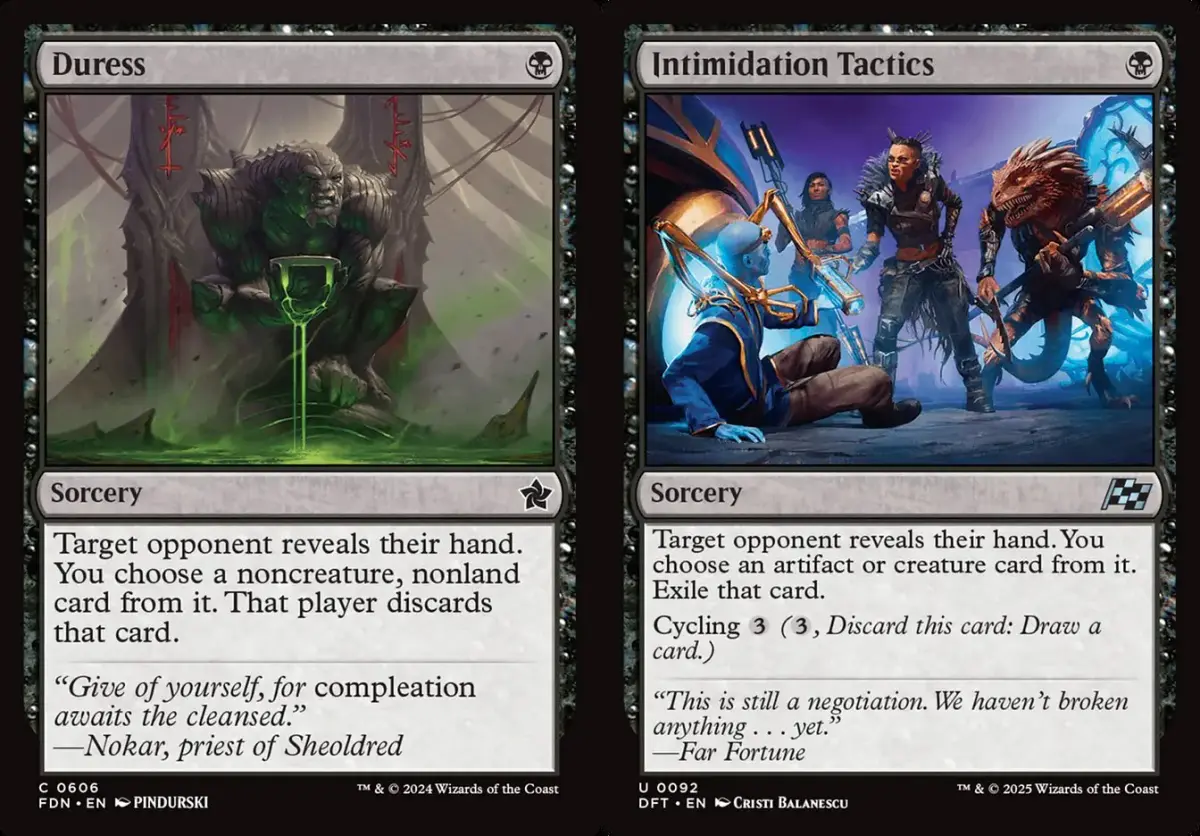
- Duress (2) & Intimidation Tactics (1):
Since the main deck already has Deceit for mass discard, the sideboard doesn’t need that many discard slots, and a small number gives enough benefit.
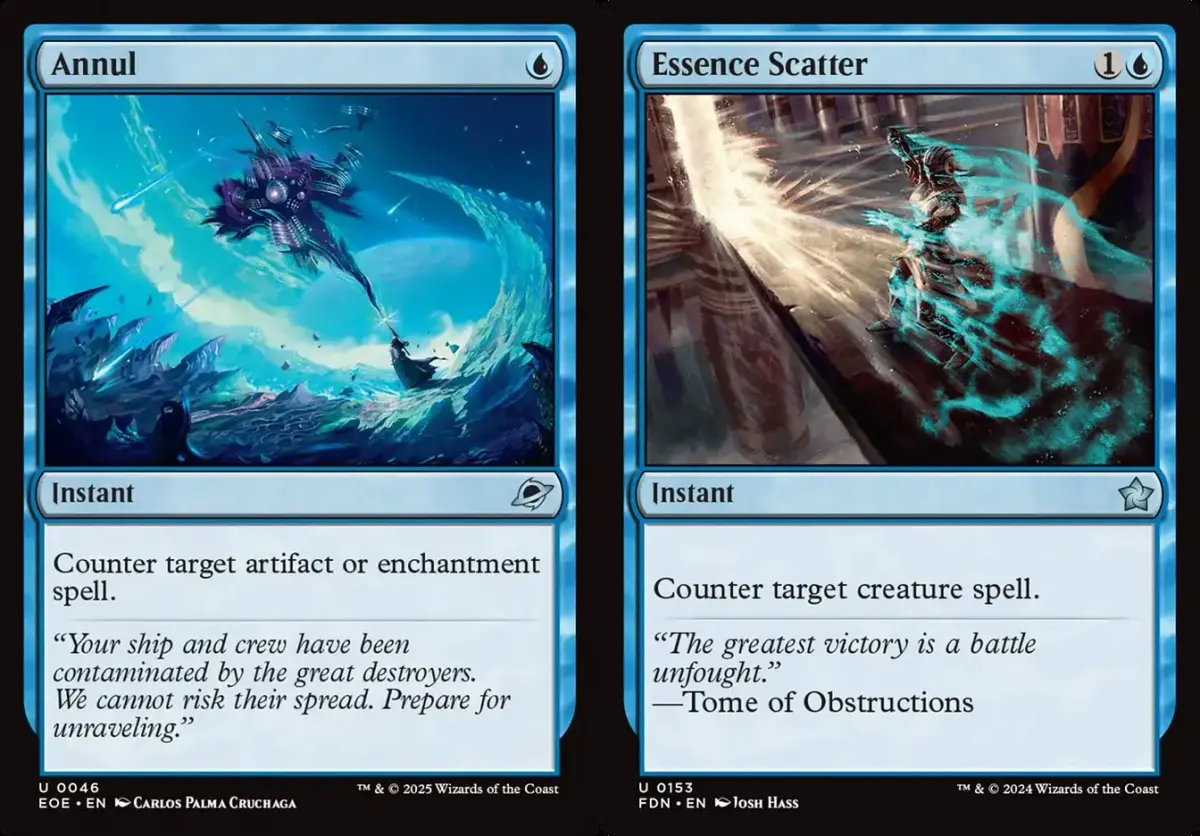
- Annul (1):
Mainly aimed at Izzet Lessons and Green Landfall, but with so many artifacts and enchantments around these days, it can be useful in plenty of non-metagame matchups too.
- Essence Scatter (1):
Honestly, with Essence Scatter’s current range, it would be fine going straight into the main deck, but the main deck slots are just too crowded, so it stays in the sideboard. In terms of function there is also a strictly better Get Out, but I really don’t dare raise the color requirement on turn 2 any further.
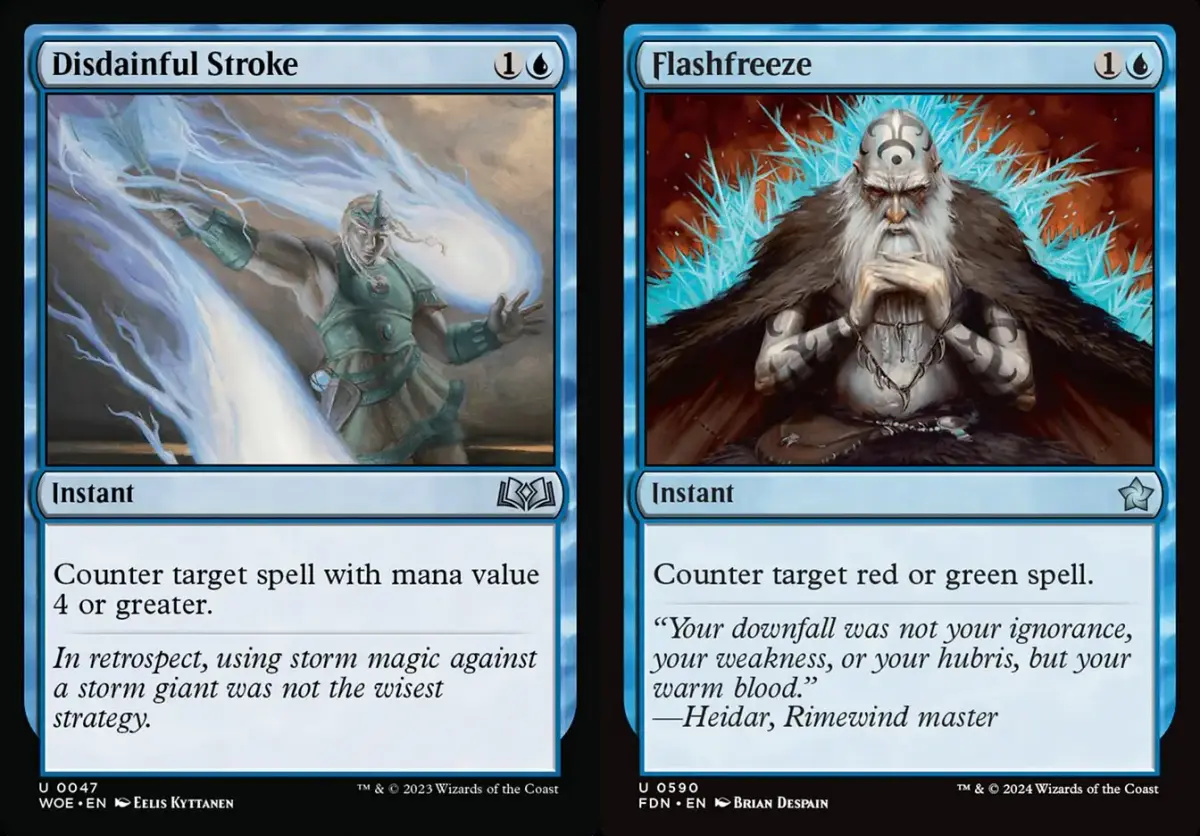
- Disdainful Stroke (1):
Also a popular pick among regular sideboard counterspells. Remember that this can counter an evoke-cast Deceit.
- Flashfreeze (1):
The most controversial of the sideboard counterspells. It is used almost solely to respect Landfall plus the other Badgermole Cub decks, but just considering the share of Landfall, that is enough to be worth respecting, and since it is at least a color-hate card, it can still catch some non-metagame decks from time to time, so its versatility isn’t truly terrible either.
In fact, looking only at the Landfall matchup, besides Earthbender Ascension, most of the remaining key cards can be handled by Disdainful Stroke. But just being able to counter Earthbender Ascension is, I think, worth enough, and Landfall is a deck relatively short on resources to keep up its threats, so after its threats are used up its tempo may break. Many times, as long as I can keep my resource staying power, Flashfreeze as a universal one-for-one has a high enough payoff.
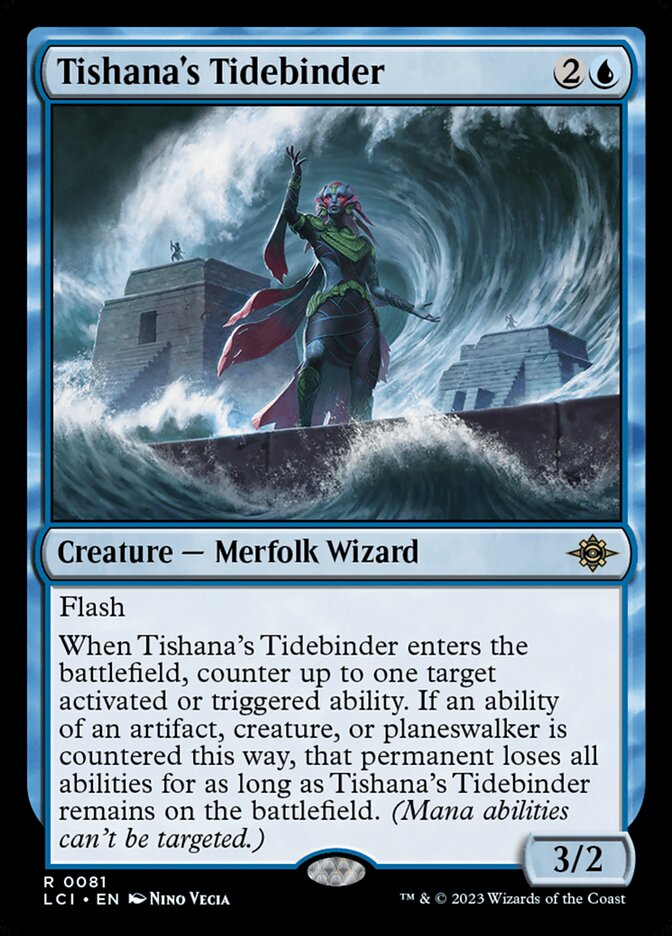
- Tishana’s Tidebinder (1):
A very flexible card, and it can also somewhat handle creature ETBs under the protection of Cavern of Souls. And because I am also a deck with creature-combat ability, the tempo gain from Tishana’s Tidebinder is better than in traditional control.
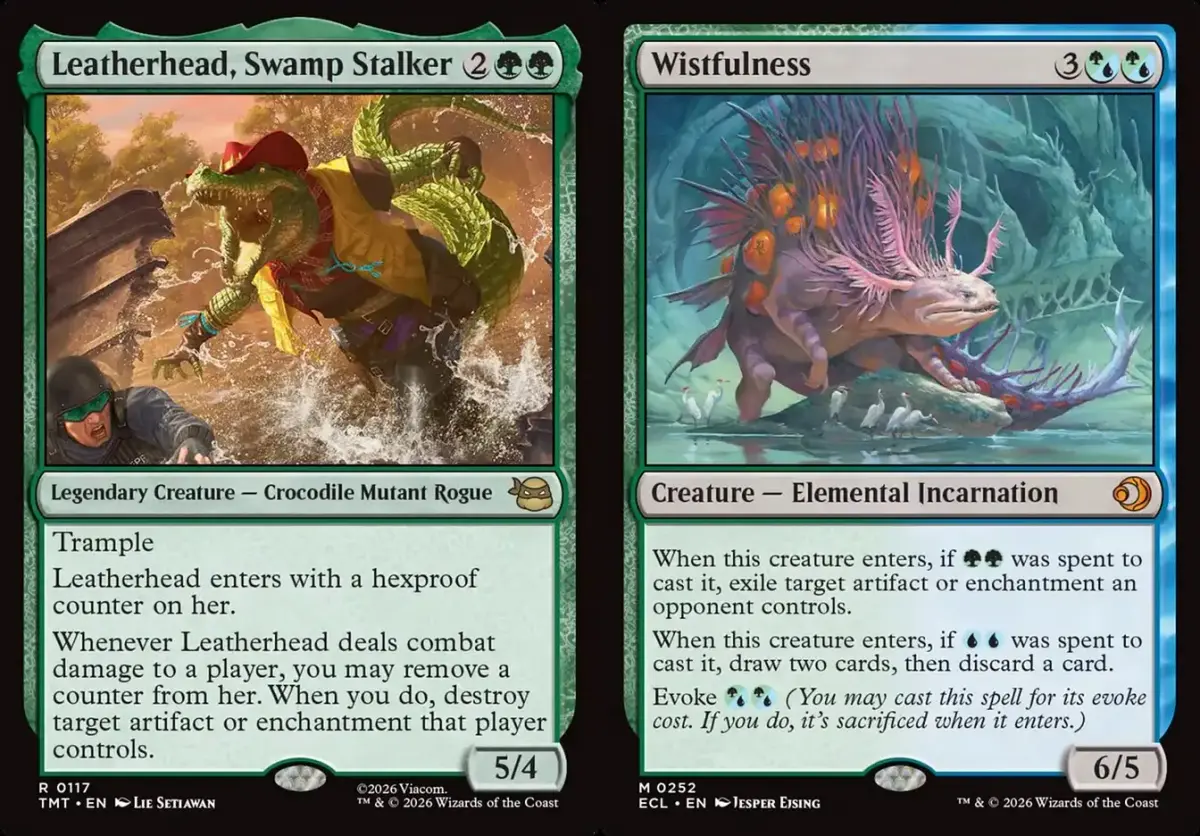
The one true god of the Ninja Turtles; that ninja and that turtle can both go sit in the corner.
A 4-mana 5/4 with trample and hexproof is already a war god by itself. Control without a sweeper may just stare at her with no ideas, and Izzet Lessons really has no idea what to use against this thing. We can also choose, depending on the situation, whether to race the life total or tear apart their artifacts and enchantments.
Also, we can use Requiting Hex to put counters on her ourselves; if the board conditions are right, we may keep the hexproof counter while also tearing apart the opponent’s board.
- Wistfulness (1):
It was originally in the main deck but later moved to the sideboard. It has built-in card filtering, so it is never a dead card; just bring it in with confidence whenever the opponent has even slightly important artifacts or enchantments.
Note, however, that when copying with Superior Spider-Man, since you can’t possibly pay {U}{U}{G}{G} to cast Superior Spider-Man, the ETB can only do one of its two options.
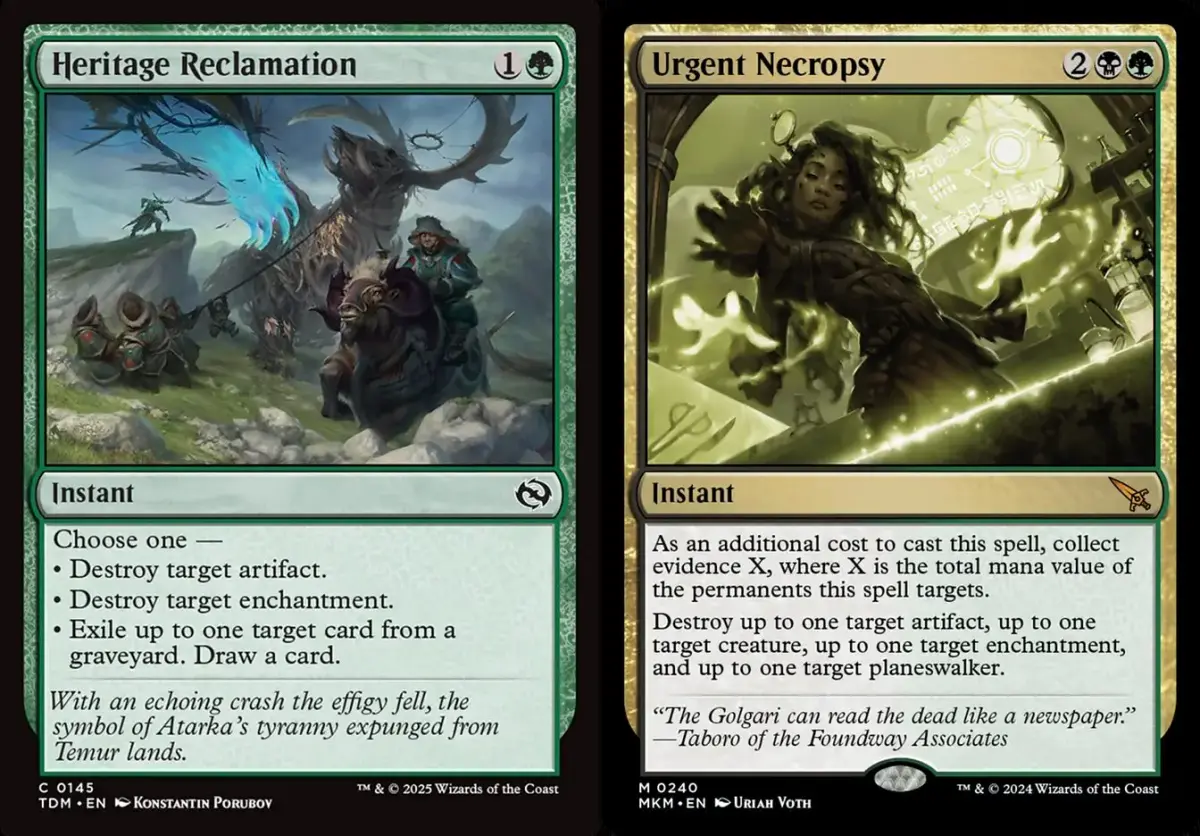
- Heritage Reclamation (1):
A green versatile sideboard card. Considering the recent metagame, switching to Pawpatch Formation to catch fliers is also a good option, but I still lean toward respecting Monument to Endurance and the graveyard a bit more.
Author’s inner monologue: Can I have my Tranquil Frillback back?
- Urgent Necropsy (1):
A one-for-four at best, and by the way this deck calculates mana value, as long as the graveyard is still around, collecting evidence is a breeze. Whenever the opponent lays out cards of multiple types at once, this card can be swapped in.

- Sorcerous Spyglass (1):
I believe many people don’t even know this guy has been reprinted in current Standard, and in more than one set at that.
This is a relatively free slot, and I’ve been so obsessed with watching Landfall that it is basically here just to target Ba Sing Se. After all, my mana base doesn’t allow me to run Demolition Field, and even if I did run Demolition Field or Assassin’s Trophy, I couldn’t possibly destroy all of the opponent’s Ba Sing Se. After thinking it over, besides laying out my own creatures and fighting head-on, this is the only way to hold it back.
However, since Landfall decks rely on land-fetching lands to operate, and Sorcerous Spyglass looks at the opponent’s hand before you name a card as it enters, there might be a chance to jam it by naming Fabled Passage or Escape Tunnel. Of course, I have never actually met a situation where naming a fetch land was truly appropriate.
Anyway, I admit this Sorcerous Spyglass is somewhat crazy. If you find it makes no sense, you can bring back some more conventional versatile sideboard cards.
Cards Not Included
Finally, let’s talk about some cards that are reasonable options but that I did not include in the build and have not mentioned above.
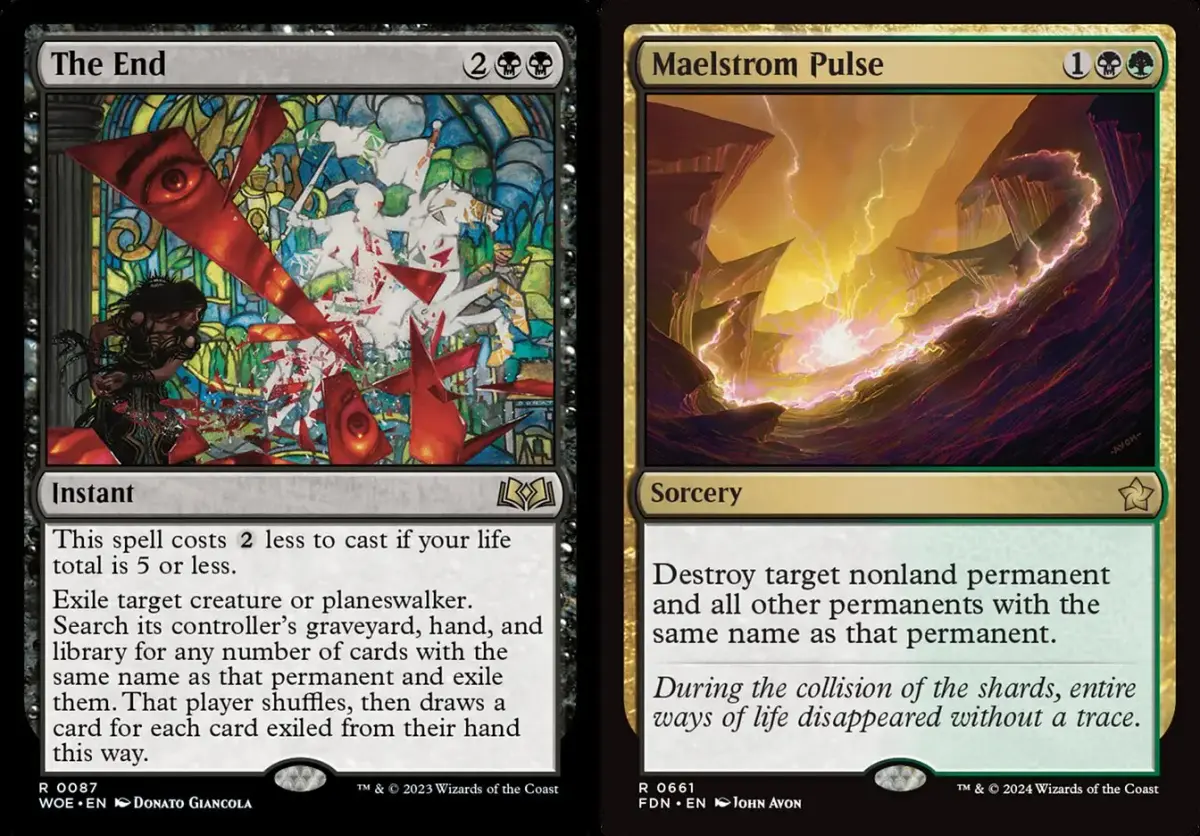
Both are essentially high-cost, strong-function spot-removal slots just like Awaken the Honored Dead. Right now all the slots are taken up by Awaken the Honored Dead, so I can’t run them, but I do wish the sideboard could fit one more The End.
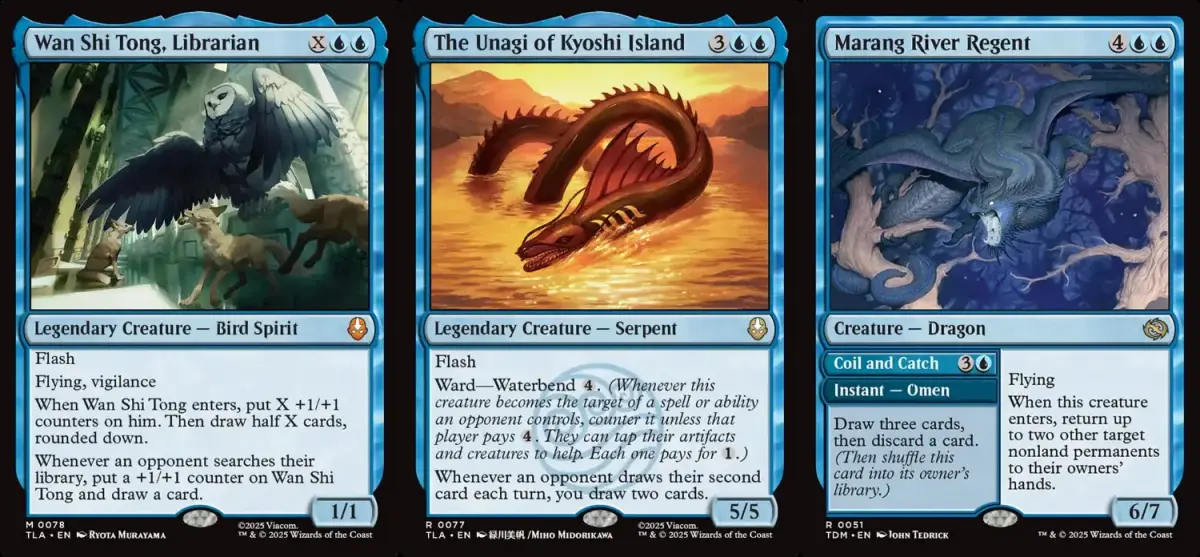
If they went into the main deck, they would essentially take the slots of Quantum Riddler and Sab-Sunen, Luxa Embodied, but I currently feel the existing configuration runs more smoothly.
Wan Shi Tong, Librarian is also shut down by Torpor Orb, and copying it with Superior Spider-Man is of little use, so if I did run it, it would lean toward being a sideboard specialist against Landfall and control.
The Unagi of Kyoshi Island has a role very close to Sab-Sunen, Luxa Embodied, but in self-preservation and card draw, Sab-Sunen, Luxa Embodied is more stable. Only choose The Unagi of Kyoshi Island if you truly want more Draw-Go ability.
Marang River Regent // Coil and Catch and Quantum Riddler are indeed interchangeable to a certain degree; I chose Quantum Riddler because its early curve is smoother. If you want to play this deck but can’t afford Quantum Riddler, Marang River Regent // Coil and Catch is a viable replacement.

Judging by how well this card fits the deck, never mind the sideboard, it would be fine going straight into the main deck. It’s just that although Oildeep Gearhulk is very versatile, with Deceit already in the deck it is not a must, so I used that slot for more artifact and enchantment removal and Landfall-specific hate.
But in fact, my artifact/enchantment removal and Landfall-specific hate are indeed a bit excessive, and some of those slots could be changed to Oildeep Gearhulk.

Its graveyard-hate function is lovely, but my mana base is mainly Dimir splashing green, so putting in a card whose cost is all green is a bit awkward. I’d rather obediently use the safer Ghost Vacuum.

Honestly, I simply didn’t think of it when building the deck, and only remembered I had overlooked this card when I looked back while writing the article. This deck has more spells with mana value 4 or higher than even the Spider-Man Reanimator deck, so as an extra resource engine it is completely fine.

Ba Sing Se’s function is also perfectly capable of filling the control finisher slot, but given our mana base, it can almost only be treated as a pure tapped land, and since our mana needs lean especially heavily on Dimir, stuffing in a tapped land that can only produce green is especially awkward. If you really want to play it, it would basically replace the Restless Cottage slot.
Matchups and Sideboard Plans
Izzet Prowess
| Out | In |
|---|---|
| Quantum Riddler -1 | Duress +2 |
| Bitter Triumph -1 | Heritage Reclamation +1 |
| Awaken the Honored Dead -1 | Wistfulness +1 |
| Winternight Stories -1 | Urgent Necropsy +1 |
| Deadly Cover-Up -1 |
Tempo is extremely important in this matchup, and Harvester of Misery is the key piece that is both offense and defense. Fangkeeper’s Familiar also doesn’t have to be held in hand the whole game as a counterspell/discard; sometimes when the opponent hits a tempo break, you can flash it in directly, surveil 3 and draw 3, which gains life and puts an extra creature on the board, and that is enough to give the opponent a headache later. When necessary, simply flashing it in as a chump blocker is also fine. Not every hit of prowess is equal in value, and if you can withstand the hit that cost it the most spell resources to set up, you may throw its tempo plan into disarray.
It’s true that Stormchasers’ Talent’s long-game resource ability is very strong, but usually once we begin building a creature defense we are able to intercept the opponent’s offense. So sometimes in the early-to-mid game, when the opponent has Stormchasers’ Talent plus the Otter token it makes on the board, Deceit can first target Stormchasers’ Talent, choosing to bounce the Otter token and discard a card from the opponent. This wave of disruption usually seriously interrupts the opponent’s tempo, and catching the opponent in the gap while they rebuild after the damage lets you further solidify your defenses and begin dealing with the opponent’s real source of resource staying power.
The answer to Stormchasers’ Talent + Boomerang Basics is to tear down Stormchasers’ Talent directly with enchantment removal, so there’s no need to bring in graveyard hate especially.
The reason for taking out Bitter Triumph is that in this matchup Bitter Triumph’s cost is a bit too painful. That said, the Izzet sideboard may show Ral, Crackling Wit, and if you feel the current removal struggles too much against Ral, Crackling Wit, you can instead keep Bitter Triumph and cut a Shoot the Sheriff.
Izzet Lessons
| Out | In |
|---|---|
| Harvester of Misery -3 | Ghost Vacuum +1 |
| Requiting Hex -3 | Soul-Guide Lantern +1 |
| Rakshasa’s Bargain -1 | Duress +2 |
| Deadly Cover-Up -3 | Annul +1 |
| Tishana’s Tidebinder +1 | |
| Heritage Reclamation +1 | |
| Leatherhead, Swamp Stalker +1 | |
| Wistfulness +1 | |
| Urgent Necropsy +1 |
Although the opponent does a lot of things, there are actually few win conditions, so just find a way to keep an eye on them.
Leatherhead, Swamp Stalker is the god of this matchup.
Izzet Elementals
| Out | In |
|---|---|
| Harvester of Misery -3 | Soul-Guide Lantern +1 |
| Requiting Hex -3 | Duress +2 |
| Awaken the Honored Dead -1 | Disdainful Stroke +1 |
| Essence Scatter +1 | |
| Tishana’s Tidebinder +1 | |
| Wistfulness +1 |
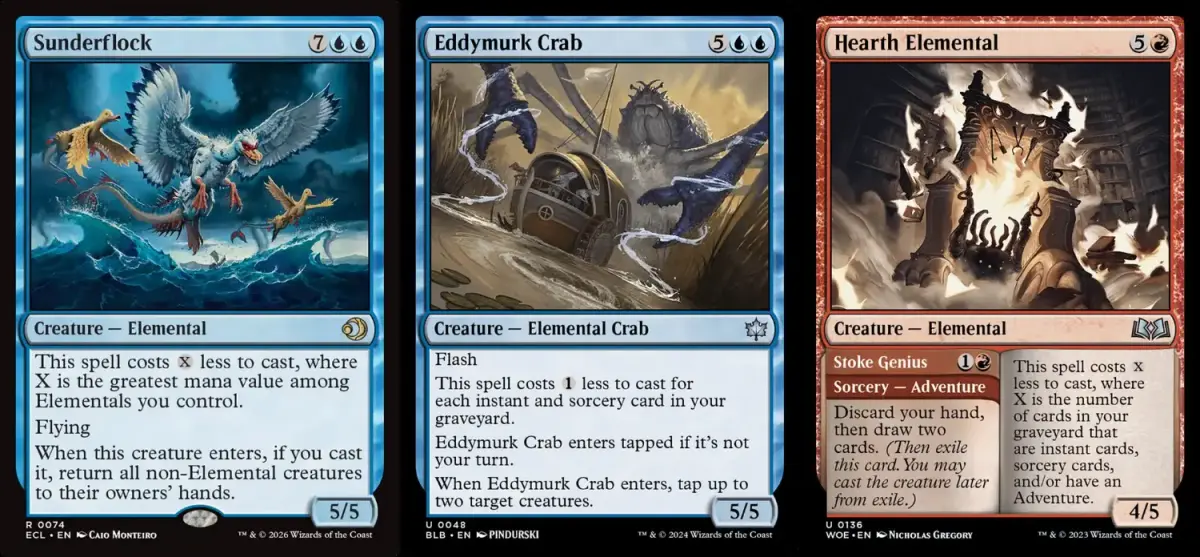
The Elemental Sunderflock board-control plan does nothing against us; we have plenty of Elementals too, or creatures that can repeatedly generate ETBs, and by the time the opponent starts fighting over the board, the game has entered the midgame that suits control better. Moreover, the opponent’s main wins all come from three groups of creatures, and after a Deadly Cover-Up sweeps with a library-cut, how many win conditions are left in the deck is anyone’s guess.
Spider-Man Reanimator
| Out | In |
|---|---|
| Harvester of Misery -3 | Ghost Vacuum +1 |
| Requiting Hex -3 | Soul-Guide Lantern +1 |
| Shoot the Sheriff -1 | Intimidation Tactics +1 |
| Disdainful Stroke +1 | |
| Essence Scatter +1 | |
| Tishana’s Tidebinder +1 | |
| Wistfulness +1 |
This is going to be a super-grindy prison of a matchup, far worse than playing against control.
Deadly Cover-Up and graveyard-hate artifacts are the key to this matchup. Since we also evoke every now and then, or use some methods to pile creatures into the graveyard, in the short term our graveyard doesn’t necessarily have fewer creatures than the opponent’s, so we can slightly suppress the timing of Bringer of the Last Gift’s arrival. Still, we can’t outdo a dedicated graveyard deck, and as the game drags on the opponent’s graveyard will certainly be stronger, so try your best to keep Bringer of the Last Gift in exile.
Dimir Demons
| Out | In |
|---|---|
| Harvester of Misery -3 | Duress +2 |
| Requiting Hex -2 | Intimidation Tactics +1 |
| Awaken the Honored Dead -3 | Disdainful Stroke +1 |
| Essence Scatter +1 | |
| Tishana’s Tidebinder +1 | |
| Leatherhead, Swamp Stalker +1 | |
| Wistfulness +1 |
With both sides on Deceit + Spider-Man canceling out that part of the matchup, this actually becomes a favorable matchup for us, especially once the sweeper slots start leaning on Day of Black Sun, because we have more creature attackers while the opponent’s key mill win condition is awkward and restrictive to use. If they dare to cast Doomsday Excruciator without leaving enough room, their own library may evaporate first, but holding it forever makes it a dead card, and they can only keep taking hits passively.
The very key to winning this matchup is how to turn the opponent’s Doomsday Excruciator against them. Since Doomsday Excruciator comes with forced card draw, as long as it isn’t about to kill you, you don’t have to rush to kill it. Based on this, how many multiples of 6 your own life total is becomes a key parameter. While watching the opponent’s library-attack methods, you can let Doomsday Excruciator cut the opponent’s library once or twice first, then remove it, and after that just wait to see the opponent deck themselves.
The opponent’s library attacks mainly come from these:
- Restless Reef: Not hard to handle if you hold instant-speed removal. The reason I kept one Requiting Hex is also to watch the opponent’s Restless Reef.
- Insatiable Avarice: If you get the chance to see it earlier with Deceit, it is actually a fairly high discard priority, and as long as Insatiable Avarice may still remain in the opponent’s library and hand, Deadly Cover-Up can choose to pull every Insatiable Avarice out. After sideboarding there may be an extra Outrageous Robbery, but usually at most one is run, so discard it if you can; if it is really hiding in the library there’s not much you can do, and you can only see whether your Disdainful Stroke can hold it.
Also, in this matchup whoever does more Deceit ETBs has an overwhelming advantage. So when we currently have no Superior Spider-Man to cast but Deceit is already in our graveyard, Deadly Cover-Up can choose to over-collect evidence and pull all the creatures in our graveyard that the opponent’s Superior Spider-Man could use. If we can’t use them, at least we avoid giving them to the opponent.
Dimir Tempo
| Out | In |
|---|---|
| Fangkeeper’s Familiar -1 | Duress +2 |
| Winternight Stories -1 | Tishana’s Tidebinder +1 |
| Awaken the Honored Dead -2 | Urgent Necropsy +1 |
Tempo decks have an easier time the more reactive their opponent is, but tempo is not good at handling an overly large board, so as long as it doesn’t clash with the timing of your own sweeper, apply board pressure to the opponent as proactively as possible.
Always respect Kaito, Bane of Nightmares first, then Enduring Curiosity. If you can stop these two key threats, the remaining pressure won’t be too great.
Azorius Tempo
| Out | In |
|---|---|
| Harvester of Misery -2 | Duress +2 |
| Winternight Stories -1 | Intimidation Tactics +1 |
| Awaken the Honored Dead -3 | Essence Scatter +1 |
| Wistfulness +1 | |
| Urgent Necropsy +1 |
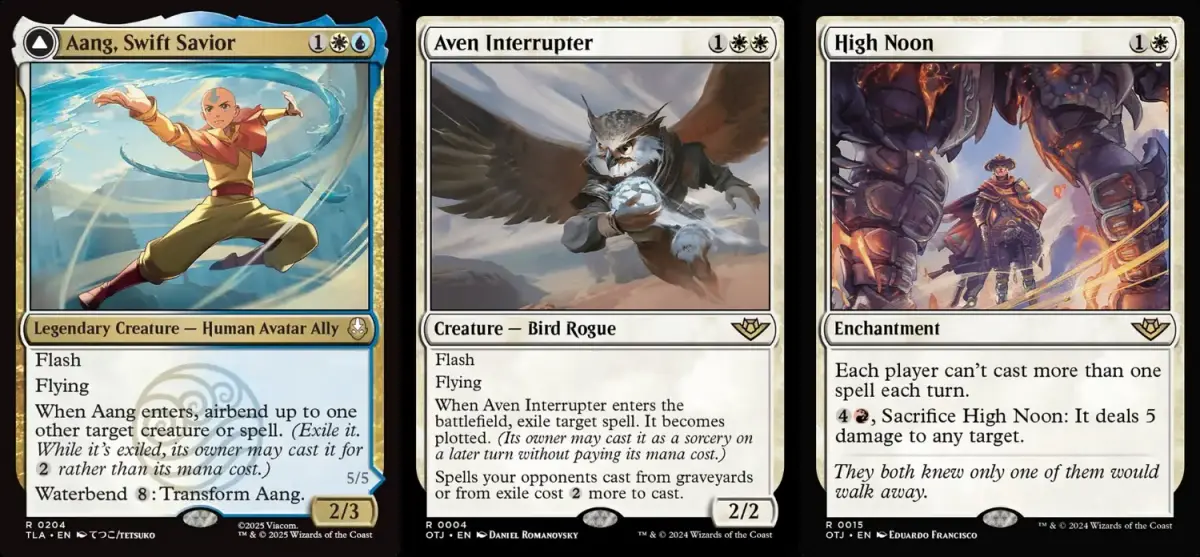
A hugely favorable matchup. Azorius Tempo is a very reactive counter-based deck, and facing mass discard is already unpleasant for it. And if you dare to use plot or airbend to exile my evoke-cast Deceit or Wistfulness, next turn I just cast the real body for 2 mana, which doesn’t sacrifice itself and has one ETB. If the opponent doesn’t have a perfect answer, once they leave a hole for a turn it is a chain collapse afterward. High Noon doesn’t affect us much either: in the early game we mostly only do one thing per turn anyway, and there are plenty of ways to get around it.
White-Based Spell Chain
| Out | In |
|---|---|
| Superior Spider-Man -1 | Intimidation Tactics +1 |
| Winternight Stories -1 | Essence Scatter +1 |
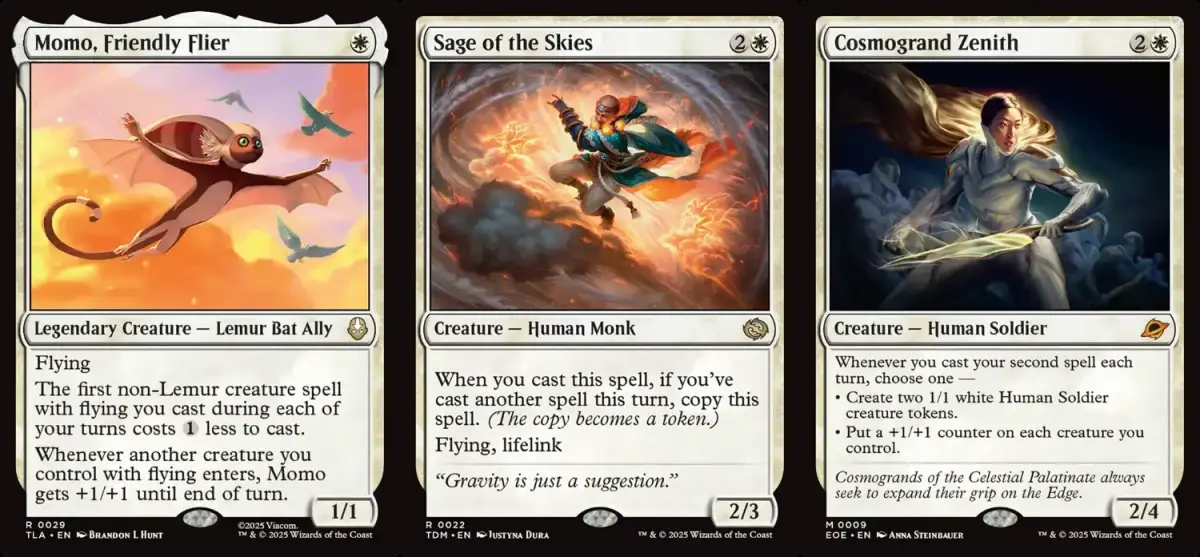
Any deck based on Momo, Friendly Flier + Springleaf Drum can count in this category, including the various versions that mix in a second supporting color.
As long as you don’t have a land accident, this is basically a free win. This deck’s biggest blind spot is control.
Green Landfall
| Out | In |
|---|---|
| Superior Spider-Man -1 | Ghost Vacuum +1 |
| Harvester of Misery -3 | Sorcerous Spyglass +1 |
| Bitter Triumph -1 | Annul +1 |
| Winternight Stories -1 | Disdainful Stroke +1 |
| Rakshasa’s Bargain -1 | Flashfreeze +1 |
| Awaken the Honored Dead -2 | Essence Scatter +1 |
| Heritage Reclamation +1 | |
| Wistfulness +1 | |
| Urgent Necropsy +1 |
The sideboarding changes quite a bit depending on how many Sapling Nursery the opponent runs. This is the swap plan assuming the most extreme case of the opponent running a full playset of Sapling Nursery.
Against Landfall there are a great many offensive and defensive decision points to think about. Because of Ba Sing Se, unless Sorcerous Spyglass has already pinned it down, you must keep applying attacking pressure; you have no chance in a long game against Ba Sing Se. But at the same time you can’t forget to solidify your defenses, especially since you must also account for the opponent being able to make haste creatures with earthbend, and for Earthbender Ascension and Mightform Harmonizer making their creatures’ power change dynamically.
Deadly Cover-Up’s library-cut covers an unlimited number of cards with the same name. As long as the opponent dares to turn their own basic land into a creature, Deadly Cover-Up can make all their basic lands that are not on the battlefield vanish. (The End can do the same.)
Simic Snakes
| Out | In |
|---|---|
| Superior Spider-Man -2 | Intimidation Tactics +1 |
| Harvester of Misery -1 | Disdainful Stroke +1 |
| Winternight Stories -1 | Flashfreeze +1 |
| Essence Scatter +1 |
Multicolor toolbox decks based on blue-green that add creatures of other colors also count here. The specific sideboard details should be fine-tuned depending on how the opponent’s creature toolbox is designed.
This matchup is basically an all-out board development versus all-out board clearing, but our pressure to control the board will be enormous, because even if the opponent’s board is all small chaff, as long as there are enough of them, Craterhoof Behemoth ends the game instantly the moment it enters. When using Deadly Cover-Up to cut cards, the highest-priority target is Nature’s Rhythm, the universal enabler.
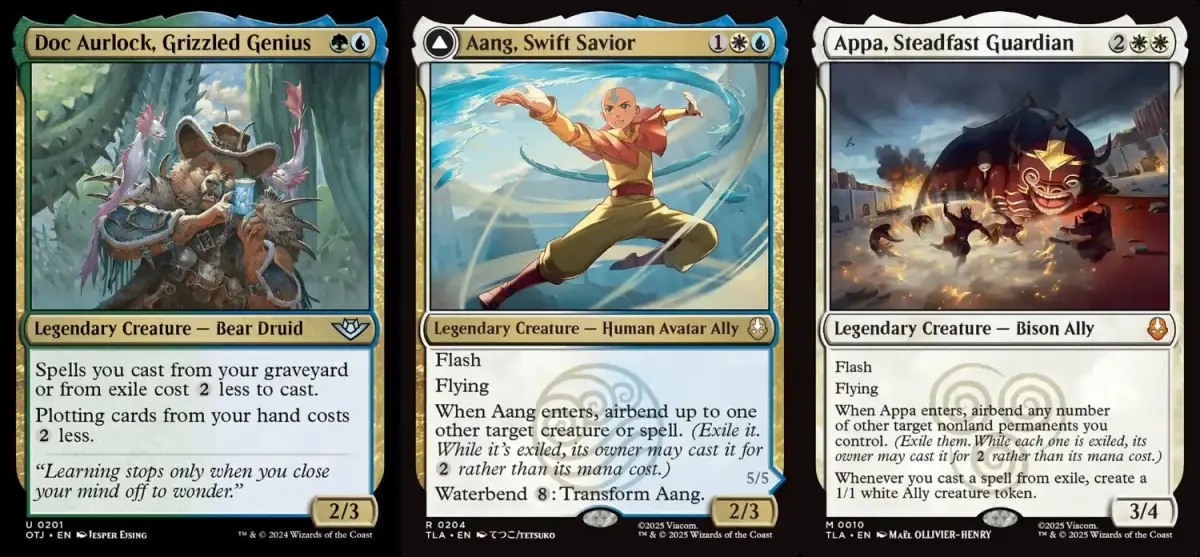
Airbend Avatar Combo
| Out | In |
|---|---|
| Harvester of Misery -2 | Intimidation Tactics +1 |
| Awaken the Honored Dead -2 | Flashfreeze +1 |
| Essence Scatter +1 | |
| Tishana’s Tidebinder +1 |
In essence, this is also one of the branches of the Simic Snakes system above, but with a more clearly specialized structure and an infinite combo, so I listed a separate sideboard plan.
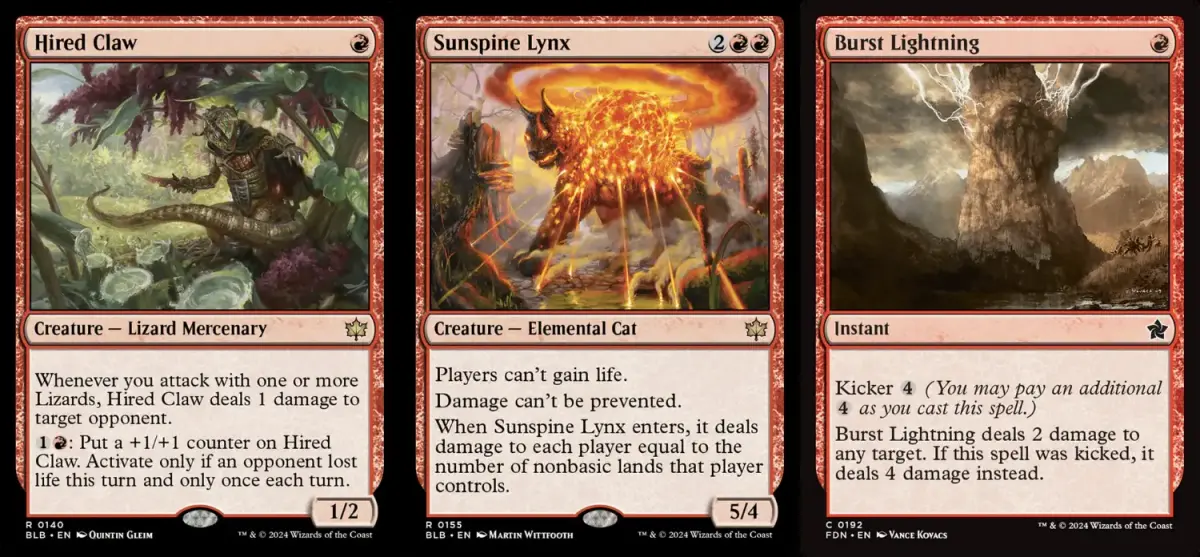
Red Aggro
| Out | In |
|---|---|
| Bitter Triumph -1 | Flashfreeze +1 |
| Winternight Stories -1 | Essence Scatter +1 |
| Awaken the Honored Dead -1 | Tishana’s Tidebinder +1 |
A disastrous matchup. With a bunch of shock lands, hardly any basic lands, and a control deck that doesn’t lean on counterspells, seeing Sunspine Lynx already makes you feel like a dead man, and if the opponent also runs Zhao, the Moon Slayer, all I can say is the next opponent will be better.
The disadvantage against red aggro is the kind that has no hope from the deck’s very foundation. Fortunately, red aggro’s share is not high now, so giving up just this matchup is still acceptable in terms of expected value.
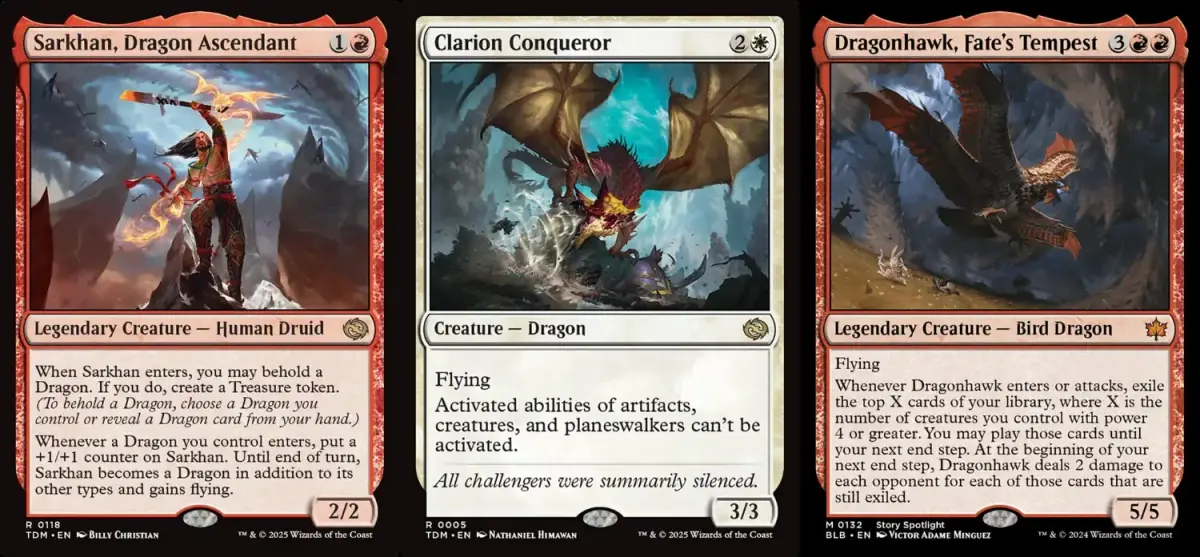
Boros Dragons
| Out | In |
|---|---|
| Fangkeeper’s Familiar -1 | Intimidation Tactics +1 |
| Harvester of Misery -1 | Tishana’s Tidebinder +1 |
Boros Dragons is a deck I can see on the metagame list but have never actually played against myself, so honestly I can only wing it.
Although the sideboard has quite a few counterspells with the right range, the opponent has both Voice of Victory and Cavern of Souls, so most of them can’t be used. Still, there are quite a few creatures whose ETBs I really don’t want to let trigger, and Voice of Victory isn’t that hard to answer, so I brought in Tishana’s Tidebinder for now.
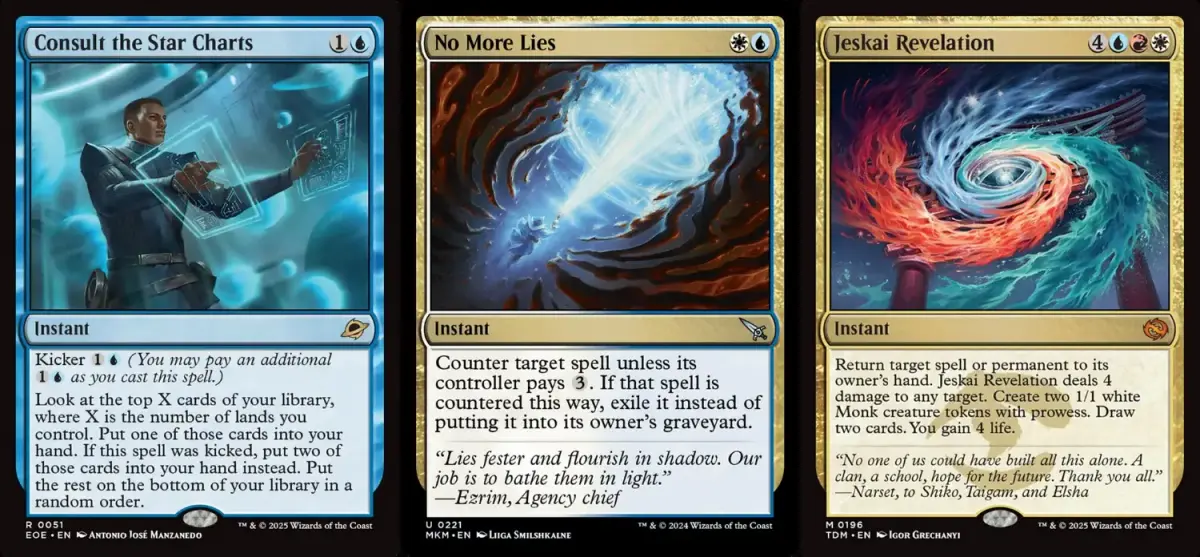
Jeskai Control
| Out | In |
|---|---|
| Harvester of Misery -3 | Duress +2 |
| Requiting Hex -3 | Disdainful Stroke +1 |
| Awaken the Honored Dead or Deadly Cover-Up -1 | Flashfreeze +1 |
| Tishana’s Tidebinder +1 | |
| Leatherhead, Swamp Stalker +1 | |
| Wistfulness +1 |
Old-style traditional control basically only wants to curse when it sees Deceit + Superior Spider-Man.
Depending on how its small number of finishers is configured, you can decide which kind of removal to take out.
Conclusion
Although this deck is named control, and the cards were chosen following control thinking, in essence it is already approaching midrange. Having Deadly Cover-Up in the main deck is almost the last reason the deck can still be positioned as control.
This also reflects the design characteristics of cards in this new era (the problem). In the past it was hard for a card to have the best of both resources and tempo, so control, even giving up tempo entirely, could still be a viable way to win on resources alone. But now that there are all kinds of cards that can seize excellent proactive tempo while also gaining plenty of resources, control that exhausts all its effort to gain resources no longer has an advantaged position. You could even say that over the past year, control’s relatively standout results came roughly when the format had been poisoned by a few cards that wouldn’t survive the next ban list, to the point where no card could compare with their proactive plans, and that is what gave a control deck focused on answering them a relatively decent record.
So for the current game environment, if you still insist on playing control, my final solution is to turn it around and increase your own proactive board-establishing ability.
- Title
- Finding a Way Out: Standard Sultai Creature Control
- Author
- Jru
- Created at
- March 23, 2026
- Updated at
- March 23, 2026
- License
- This work is licensed under CC BY-NC-SA 4.0 .