Sultai Midrange: Greatness at Any Cost

Note: This article was translated from Chinese by AI and may contain errors. Read the original Chinese version.
Introduction
Hi everyone, I am Patrick. As a Standard player who has played Magic: The Gathering for nearly 10 years, and for over 95% of that time has played only the Sultai color combination, I am very happy to have earned a spot in MIT#9 at the 20241229 MITQ at 桌遊侍. I am honored to be invited by cephille to share some of my deck and thoughts. I will first share the deck that earned me the qualification, and the story of why I have always stuck with this color combination. Because I have always played the same colors, there is no question like “why this deck instead of another, more meta deck,” which also spares me a lot of the trouble of deck selection.
Deck Introduction
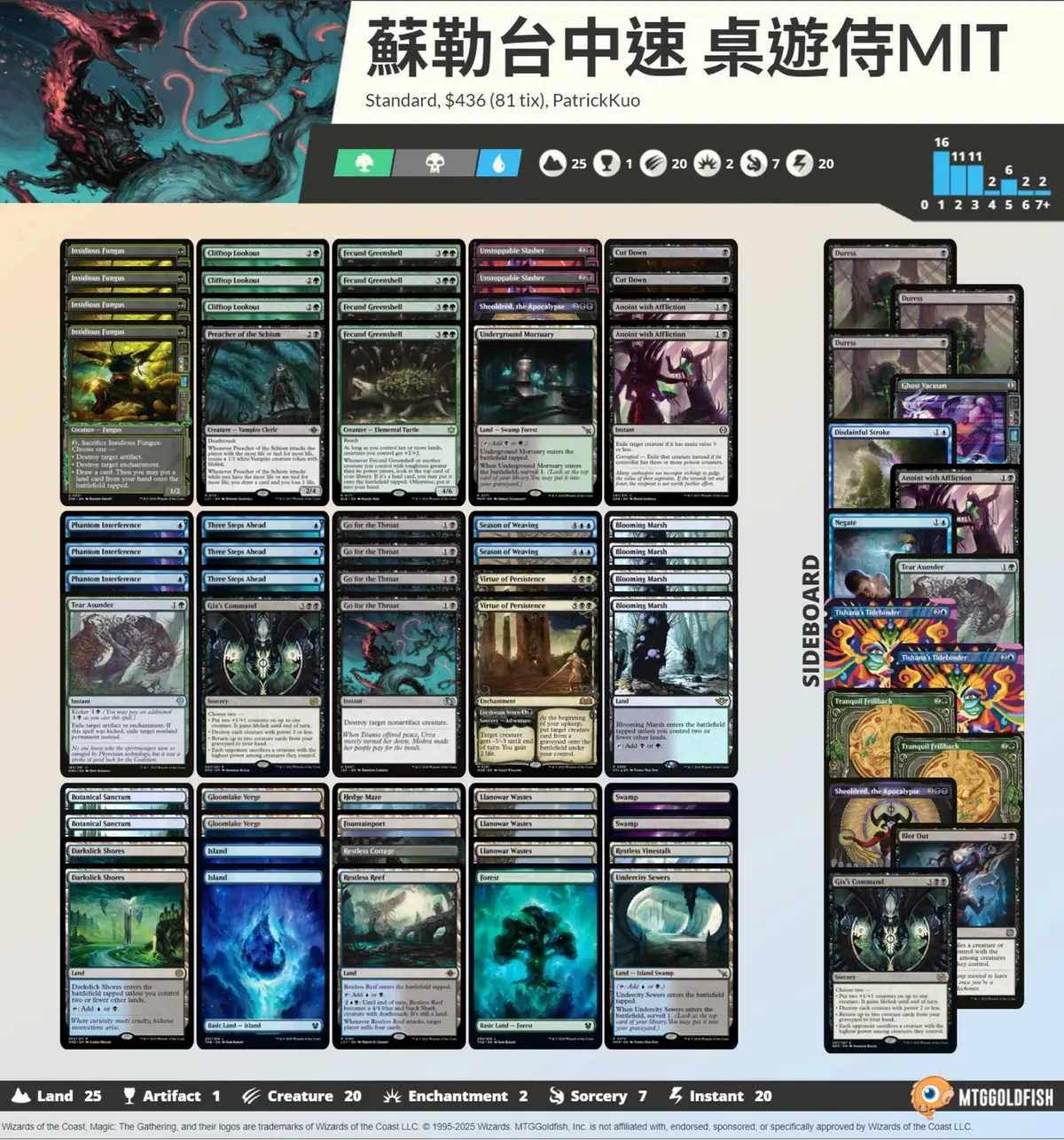
Core key creature: A turtle? What is that?

Excellent stats paired with Reach can defend against the vast majority of creatures in today’s environment. As long as the enter ability resolves successfully, at worst you get a card, and if it is a land you also expand your mana advantage. Note especially that because it is not drawing, it also sidesteps the effects of Sheoldred, the Apocalypse and Faerie Mastermind, two creatures that are heavily played right now. Finally, when you have more than 10 lands, each of your small creatures becomes a fearsome monster, which is practically unanswerable for midrange decks without a proper answer. The later creature choices were also made to maximize the enter ability of Fecund Greenshell, so I deliberately chose creatures with high toughness.
Late-game finisher: You did not expect it, this card is not just for Commander!

Commonly known as the blue Season (Season of Weaving), to many people it is a Commander toy, but in this deck it can be said to be the straw that breaks the back of many opponents. Because the core creature Fecund Greenshell is nonlegendary, it becomes the top priority target to copy with the second mode. The six-mana spell can draw a card while making two copies of Fecund Greenshell, and if it succeeds we get two extra blockers with excellent stats and 5 enter abilities in total! That equals an extra 5 cards of card advantage, and if that expands us to 10 lands, all creatures get a fearsome +6/+6. And when there is no board, simply drawing five cards also helps us quickly pull back a resource advantage, or when behind on board, the third mode can also buy us a turn while drawing two cards.
Various solid three-drop creatures: The cornerstones of the deck
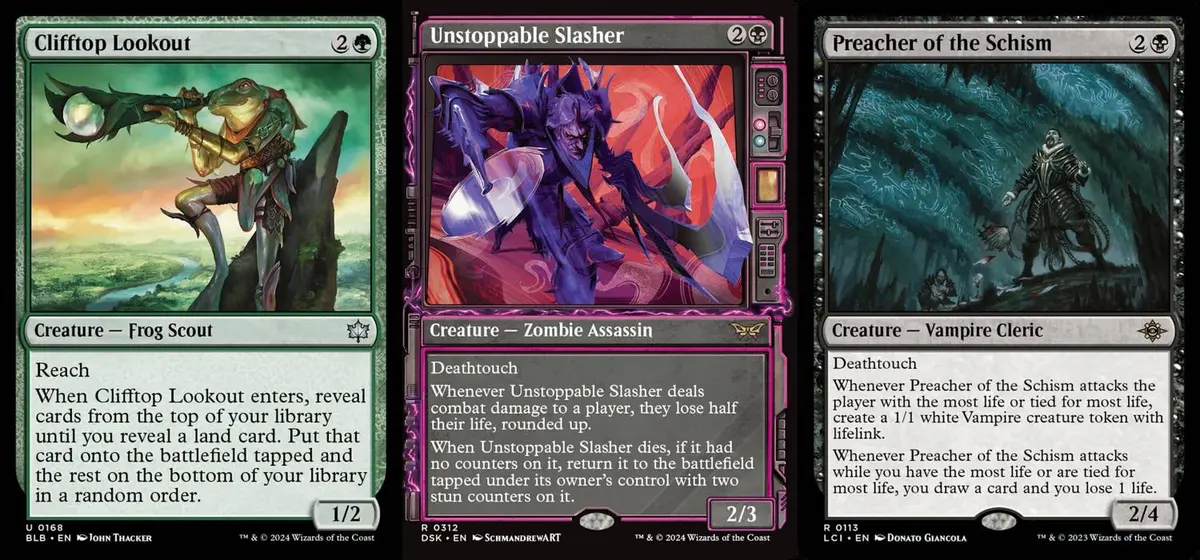
When Clifftop Lookout enters, it ensures a ramp to a land, and because it does not search for basic lands, even a 3-color deck like ours does not have to compromise by playing many basic lands, and if all goes well, the next turn we can play our core creature, Fecund Greenshell. A 1/2 body basically cannot trade with anything in an age full of creatures with big stats, but what is the most meta deck right now? That is right, Dimir midrange! The plan of getting through with lots of small fliers is entirely blocked by a single frog. Whether it is Faerie Mastermind, Floodpits Drowner, Deep-Cavern Bat, or Spyglass Siren, creatures whose stats are not great but that keep sneaking damage in with Flying and that feel wasteful to trade a removal spell for, none of them can get past its defense.
Unstoppable Slasher, nicknamed Chainsaw Man, deals huge damage on offense as long as it hits a player, and on defense it can trade with opponents without hesitation thanks to its death ability, with Deathtouch also ensuring it can trade with an opposing creature. For these three reasons it became one of the choices, and do not forget that when it dies, if Fecund Greenshell is on the battlefield, you get another enter trigger.
One Preacher of the Schism makes up for Unstoppable Slasher’s weakness against token decks. Continued attacks, regardless of life totals, get us a small amount of resources, and its 4 toughness also dodges the range of red burn and black Cut down.
Others such as Sentinel of the Nameless City and Glarb, Calamity’s Augur are also good choices, but due to time constraints I could not test them all thoroughly, so they can be adjusted further later.
The last piece of the puzzle: Removal, ramp, and value rolled into one

To cope with the current environment flooded with artifacts and enchantments, corresponding removal is indispensable. As the last creature the author added, I had always kept an eye on it but never actually used it. In most cases it is just a 3-mana answer to artifacts and enchantments, which is not good enough in the current Standard environment. But because of Fecund Greenshell, everything is different: while retaining its functionality it becomes our lowest-cost trigger source, as a 1-mana creature can help you expand a card of advantage, and late in the game with more than 10 lands, it can also be a threatening creature. In addition, because it is cheap enough, casting it on turn 1 can put pressure on the opponent so they cannot play important enchantments such as Up the Beanstalk, Caretaker’s Talent, and Unholy Annex // Ritual Chamber. Finally, if you already hold a late-game spell in hand, you can also sacrifice it without hesitation to ramp.
Besides the animals, I also do some magic
Other regular removal such as Go for the Throat and Cut Down need no special mention, as basically every deck with black plays them. Worth noting is that Three Steps Ahead usually shows up in control decks, used for countering and filtering, but because we have a large number of nonlegendary creatures, the second mode of copying sometimes even has higher priority than drawing or countering, especially the huge resource advantage from copying Fecund Greenshell with flash to block.
Sideboard choices
I want to specifically mention Blot Out, which I think is one of the best removal spells today, providing the most needed exile and the missing answer to planeswalkers. Since our creatures have no trample and are small early on, planeswalkers often cause us quite a bit of trouble. If I were to adjust, I would add 1 more copy in the sideboard.
I will not specifically explain the rest, as they are basically very regular sideboard choices.
How the Overall Deck Works
Overall, this deck is more of a control-leaning midrange deck with ramp. Early on, various small removal spells such as Go for the Throat, Cut Down, and Phantom Interference disrupt the opponent’s offense, and in the mid game Clifftop Lookout, Unstoppable Slasher, and Preacher of the Schism ramp or stall until we play our core creature Fecund Greenshell and Season of Weaving,
and thereby gain a resource advantage. More often, you need to match the opponent’s type to judge whether you should lean toward clearing the board or gaining resources, rather than the traditional “123, just play on curve, the game is so easy,” so there is also more flexibility to choose a build with more creatures or more removal.
Conclusion: The Power of Faith

Actually, when I first joined Magic: The Gathering, I just hoped to play a control-style color combination. I really like the feeling of having more resources than my opponent in the late game. I want more cards in hand than my opponent, I want a stronger board than my opponent, I want enough lands to do more each turn than my opponent, and I enjoy that greedy feeling. And Sultai fits my tastes perfectly: it has the best removal (black), the best card draw (blue), and the best creatures (green), and they are also the top three colors of the five at generating resources. Besides, I do not like having “weaknesses” in my deck, such as black being unable to answer artifacts, red being unable to answer enchantments, and green and blue having a hard time dealing with creatures; Sultai happens to be able to answer every threat from all angles with no blind spots. To me, this mindset of using everything I can, whether graveyard, library, lands, or hand, is the core philosophy that best represents Sultai, just like the flavor text of Dark Confidant: “Greatness at any cost.”
Later, this became a way of increasing my enjoyment of the game. Magic: The Gathering is, after all, a 1-on-1 competitive game, and wherever there is competition, of course some people want to win, and the most efficient way is to copy the most mainstream decks. But to me that method is simply too boring, because I might have to play decks I do not like in order to win, or never think through every possibility of deck building, just imitating those decks and plays without any personality of my own in them.
So I set a restriction and a vow: however each Standard environment changes, I can only play this color combination, in exchange for familiarity with the color combination’s cards in the environment, and in order to build decks, I have to keep searching for all the possible card synergies. For example, in recent years I have loved the explosive boards made by Invasion of Amonkhet with Gruff Triplets, the fast infinite turns from Nexus of Fate and Underrealm Lich, and the method of using the Cat-Oven combo with Parcelbeast to cheat Parcelbeast in without paying its mana cost (Note 1); in a red aggro environment full of unblockable creatures (such as Ahn-Crop Crasher and Earthshaker Khenra), using Thorn Lieutenant to send out new blockers to stall for time; or, when everyone was using sweepers to target token decks, my sideboard idea of using Tendershoot Dryad to fight the opponent for the board, all the way to the current deck build, are all interesting combinations I could only discover by continually polishing the same color combination. And this end result has also become something like a faith. It is fair to say that insisting on building Sultai decks is now my motivation for playing Magic: The Gathering.
Note 1: About the interaction between the Cat-Oven combo and Parcelbeast: the principle is based on 702.140b, when a mutating creature spell begins resolving, if its target is illegal, it ceases to be a mutating creature spell and continues resolving as a creature spell, and is put onto the battlefield under the control of that spell’s controller. Therefore, we can choose to mutate Parcelbeast onto the cat, then in response sacrifice the cat with the oven, allowing Parcelbeast to enter the battlefield directly.
Finally, I hope to appeal to some beginners or players who lack motivation: continuing to build your own decks does not always pay off, and more often the decks I built could not compete with the mainstream at all, but if you succeed later, the sense of achievement is completely incomparable to winning with someone else’s deck. The times do not always suit you, but your time will eventually come, and firm faith will be your greatest motivation. Thank you all for reading this article, and I hope we meet again in the future.
- Title
- Sultai Midrange: Greatness at Any Cost
- Author
- Patrick
- Created at
- January 5, 2025
- License
- This work is licensed under CC BY-NC-SA 4.0 .