The Evolution and Outlook of Standard UW Soldiers

Note: This article was translated from Chinese by AI and may contain errors. Read the original Chinese version.
Before We Start
After MIT Season 2’s Standard event ended in March 2023, I saw champion Lin Cheng-Han’s UW Soldiers journey posted on his Facebook page 鳥不喇基 and was deeply inspired. Anyone interested is very welcome to go back and read it too, since its reasoning about deckbuilding and its understanding of individual cards basically still apply today. Since then I have mainly played UW Soldiers in Standard, for half a year now.
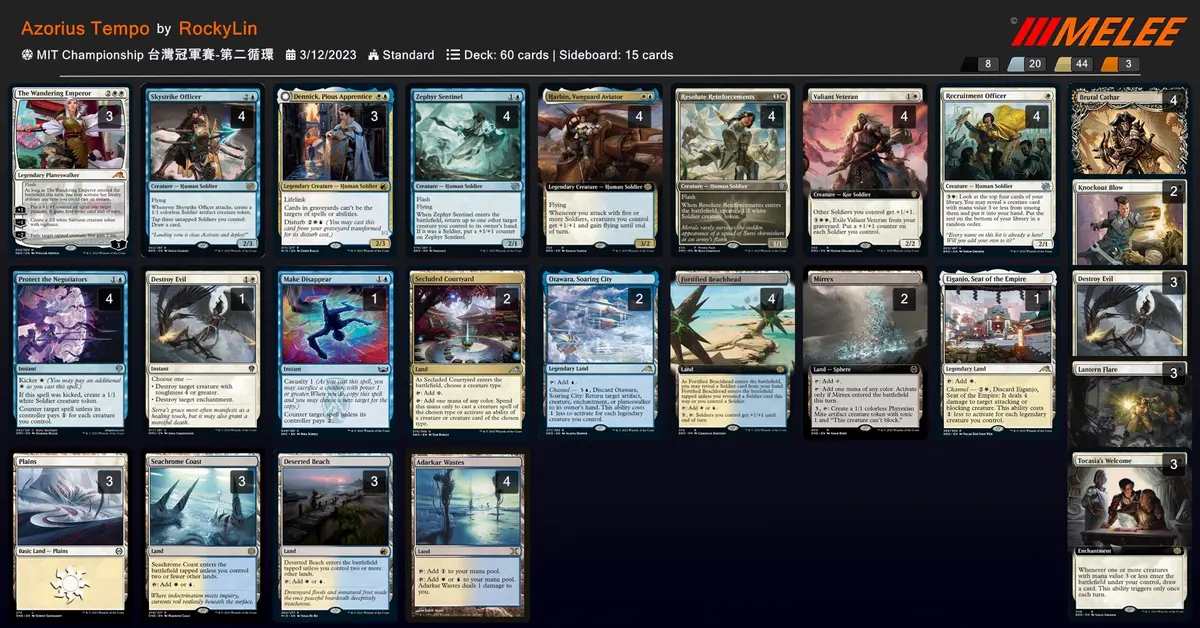
Throughout this process I have continued to believe that UW Soldiers is an excellent deck that combines tempo, going wide, and the ability to come back from a disadvantage when on the draw. Basically, UW Soldiers is a favorable matchup against any midrange deck, with the exception of the Grixis midrange deck that had Fable of the Mirror-Breaker and Reckoner Bankbuster before the 2023 Standard bans. The vast majority of midrange decks, including those after the WOE update, are relatively good matchups, especially when facing Domain-based decks.
The matchups that are relatively poor for UW Soldiers now are decks with better creature quality like Esper Legends, or decks like Mono-Red Aggro that are full of cheap removal and haste creatures. Both types of decks can be handled by raising your win rate with the sideboard or with small main deck adjustments to the meta.
Deck Introduction
Go Wide or Tempo? Which One?
Note: After these past two weeks and the turnover at Worlds, the lists and archetypes of UW Soldiers have changed significantly. The two builds listed here are only to illustrate how the Soldier deck evolved after MIT Season 2. If you want to play it, please refer to the latest meta or do your own research. I don’t recommend copying the lists below directly.
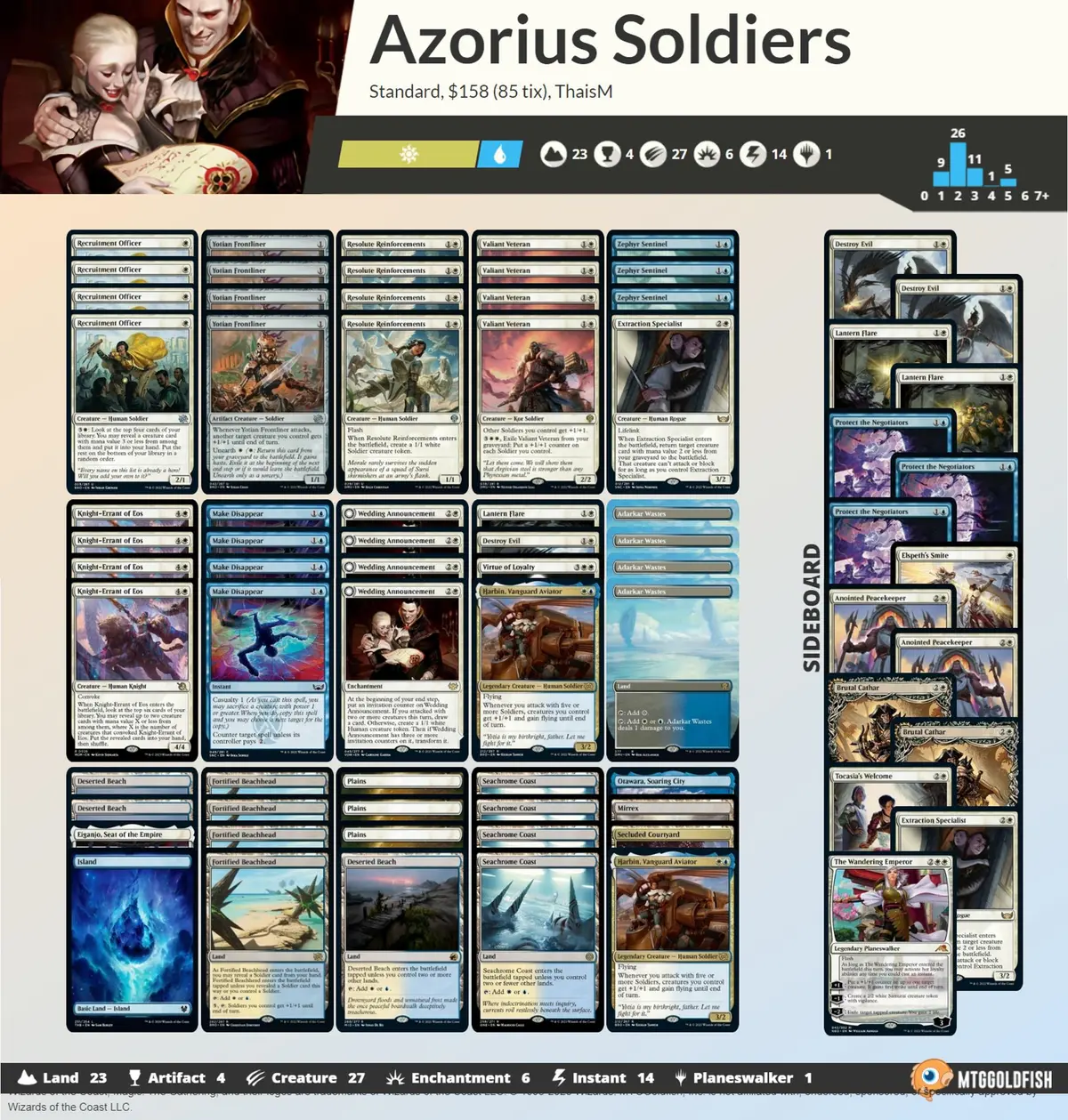
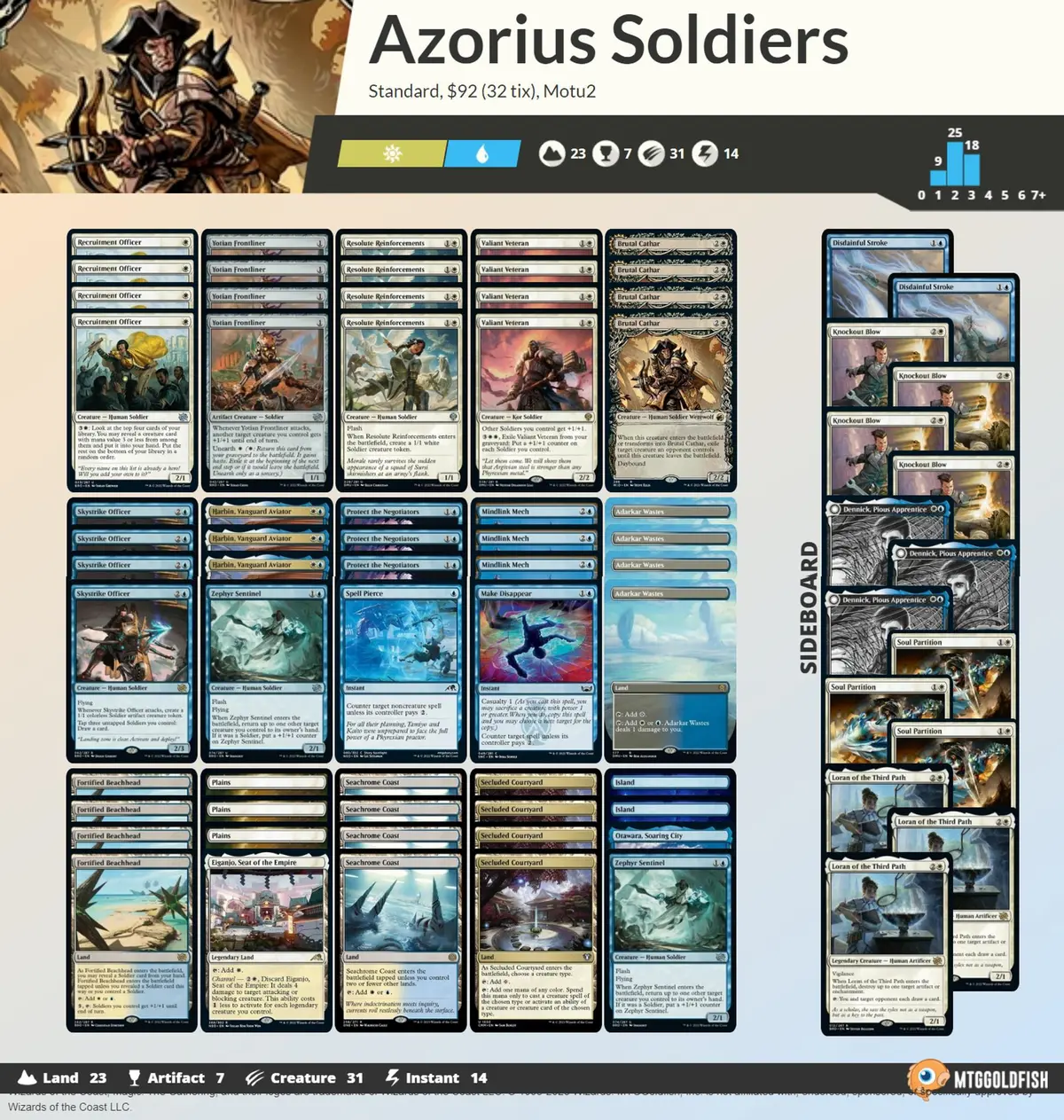
UW Soldiers builds can roughly be divided into go-wide builds and tempo builds. First, the reference lists:
The Main Structure of UW Soldiers
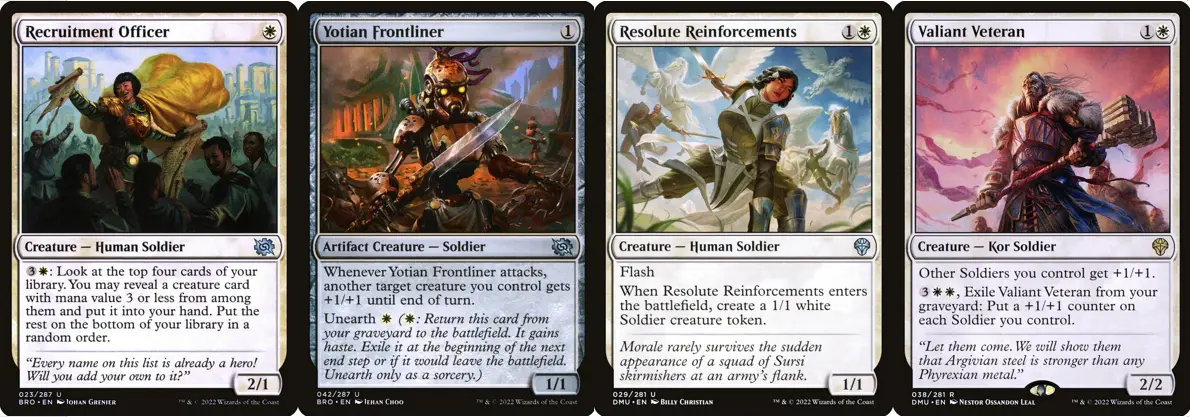
Two one-drop Soldiers played at full playsets: Recruitment Officer is a 2/1 that can still earn resources in the mid-to-late game; Yotian Frontliner is one I found essential in testing, since with only four one-drops it is easy to be unable to build a more aggressive board early, and once midrange drags the game out it is hard to win. When Yotian Frontliner is played it gives another creature +1/+1. Although that is a very small advantage, on attack it often forces the opponent to trade or fail to block the grown creature and take extra damage. And Resolute Reinforcements has many benefits as a flash two-for-one, which I’ll explain more below, and it is the core of the go-wide Soldier build. Finally, the Soldier lord Valiant Veteran is the single card whose qualitative change turned UW Soldiers from a fun deck into a mainstream deck worth playing, and its tribal bonus also makes two-for-ones like Resolute Reinforcements even better.
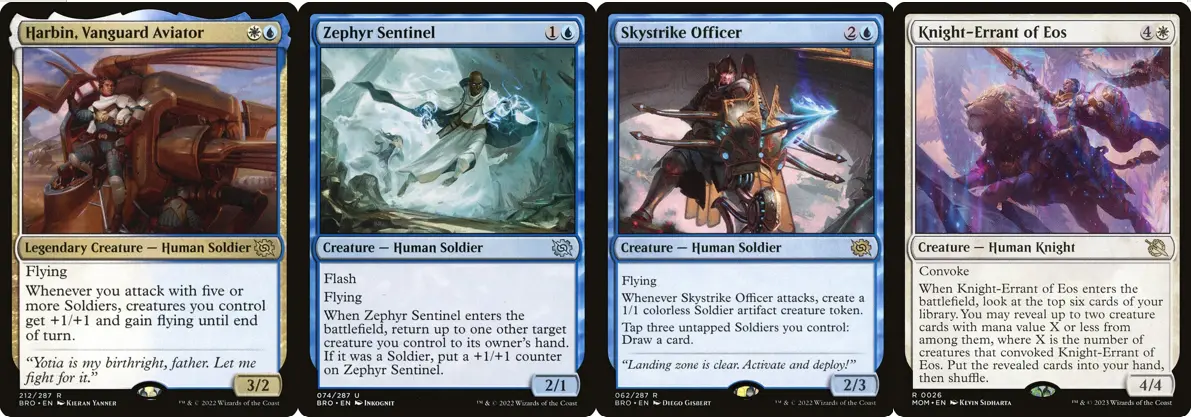
Next is Harbin, Vanguard Aviator. Basically, if Harbin plus Resolute Reinforcements jumps in at two mana and the opponent has no timely removal, they will soon face an army of Soldiers taking flight. I feel Harbin in some ways fills the gap of a second two-mana Soldier lord, which makes the Soldier theme more complete, and the +1/+1 and flying it gives is even deadlier. However, although Harbin’s attacking power is strong, it is vulnerable to any common cheap removal, so some appropriate escorting is necessary.
The Zephyr Sentinel that follows is a good partner for escorting while maintaining the board and offense, and it is an even bigger gain if what gets bounced is a card with an enters effect like Resolute Reinforcements. It is also a good tempo card on its own as a two-mana flash 2/1 flier, and when necessary you can pass with two mana up and follow with a three-mana play on turn three. But we need to decide in advance whether to use the Sentinel as a trick to defend or as a creature to attack, adjusting for the board and how the next few turns will develop.
The two groups above are cards that both the go-wide and tempo Soldier builds play, differing only in how many copies they run. The next two cards, however, formally reveal the fundamental difference between these two builds.
First is Skystrike Officer, which the tempo build plays at a full playset. It is a three-mana 2/3 flying Soldier that makes a 1/1 Soldier token with the artifact type whenever it attacks, and another ability lets you tap three Soldiers to draw a card. If you flashed in Resolute Reinforcements for a two-for-one on turn two, on turn three you can play Skystrike Officer and, after blockers, respond by drawing a card, which is excellent tempo. Skystrike Officer also serves as a two-in-one of making Soldiers and drawing cards, playing a very important role in mid-to-long games, and basically apart from the lords and Harbin, the opponent’s removal will all be pointed at it.
However, naked-casting Skystrike Officer on three mana inevitably risks giving up tempo, and its 2/3 body getting hit by the opponent’s Cut Down without a lord bonus or pump is the thing people complain about most.
The other is the go-wide build’s core single card, Knight-Errant of Eos. Although it doesn’t benefit from the Soldier bonus, it uses the speed from convoke while refilling your hand, which sounds like it could also patch the possible mid-to-late-game gap for Soldiers. However, I also have experience playing Pioneer Boros convoke, and in testing, even in a Boros convoke deck with thirty-some creatures, flipping six cards can still whiff or hit only one card, and in a Standard UW Soldiers deck with only twenty-some creatures the chance of hitting a creature is naturally lower still. Even if you hit, you may not be able to cast it because you don’t have enough creatures to convoke with. And when you are able to convoke, whether you should convoke out the Knight to gamble on gaining cards or use your existing board to push more damage, and whether convoking will get you swept immediately, and so on, are all points you need to watch when using it.
By the way, remember that after this Knight’s reveal, the remaining cards don’t go to the bottom of the library but get shuffled. If many of the non-creature cards among the six revealed are ones you need, don’t feel too sad, since after the shuffle you still have a chance to draw them (
whether you actually draw them is another matter).
Other Three-Drops and Flexible Slots
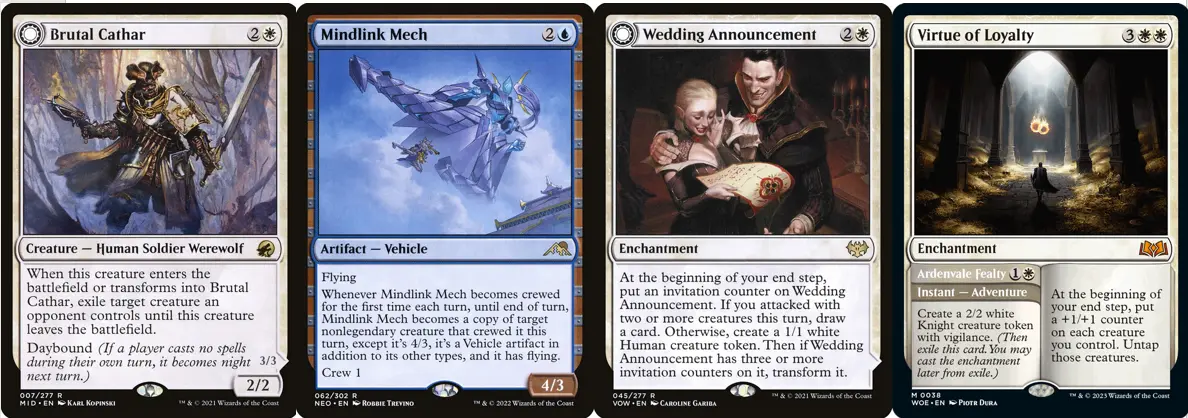
The tempo Soldier build chose Brutal Cathar and Mindlink Mech. Cathar and the Vehicle have opposite functions. Cathar entering to exile a creature suits an aggressive game plan, and using it on defense to exile a creature and then getting hit by the opponent’s removal loses a lot of tempo; the Mech suits a defensive game plan better, and the best crew source is a lord, since instantly having two lords on the battlefield is very strong, but other creatures are less special, and this deck has no creatures with attack triggers. I personally feel running 3 Vehicles in the tempo build is not very good, with a bit of a win-more feeling.
The go-wide build chose a full playset of Wedding Announcement, plus one WOE Virtue of Loyalty to carry out the go-wide strategy; it also runs one Extraction Specialist as a way to pull back creatures with mana value two or less from the graveyard in the mid-to-late game.
Choosing Counterspells
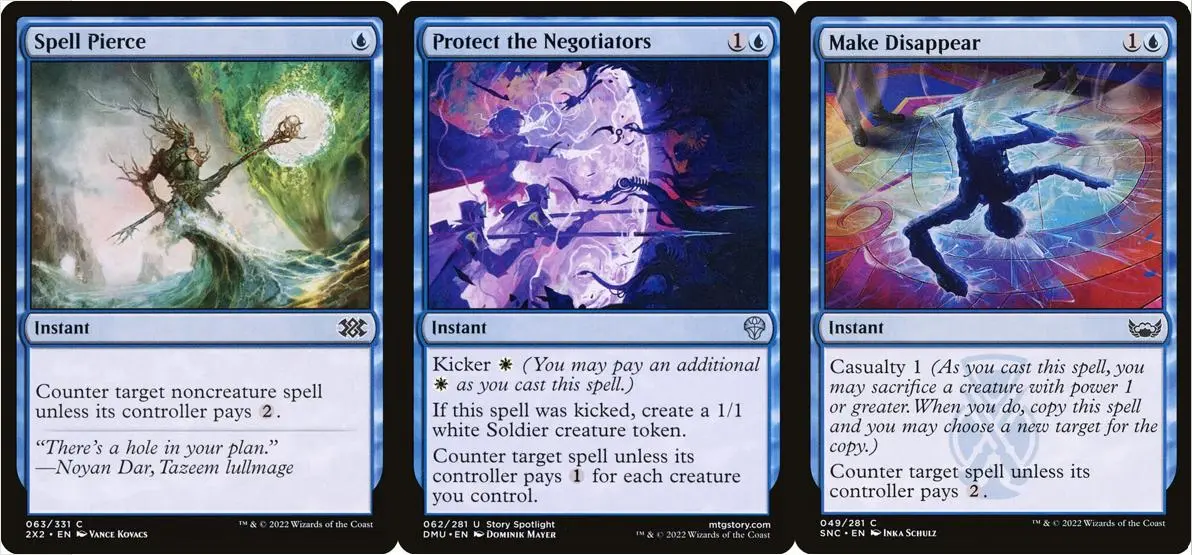
The tempo build runs more Protect the Negotiators, with one extra Spell Pierce; the go-wide build runs a full playset of Make Disappear and moves Protect the Negotiators to the sideboard. Make Disappear can basically hold off the mid-to-high-cost spells the opponent is trying to resolve, while Protect the Negotiators, when you are ahead on the board or at the right moment, can make a Soldier plus a counterspell. Spell Pierce is a sneaky card that can snuff out the opponent’s hope of resolving an important spell when they are careless. However, Spell Pierce is a very bad card in the matchups that are disadvantageous for Soldiers, Mono-Red Aggro and Esper Legends, and its deterrent effect is probably stronger than actually using it. Unless it’s an event with public decklists like MIT or an RCQ, I personally wouldn’t use Spell Pierce in a Soldier deck.
Land Configuration
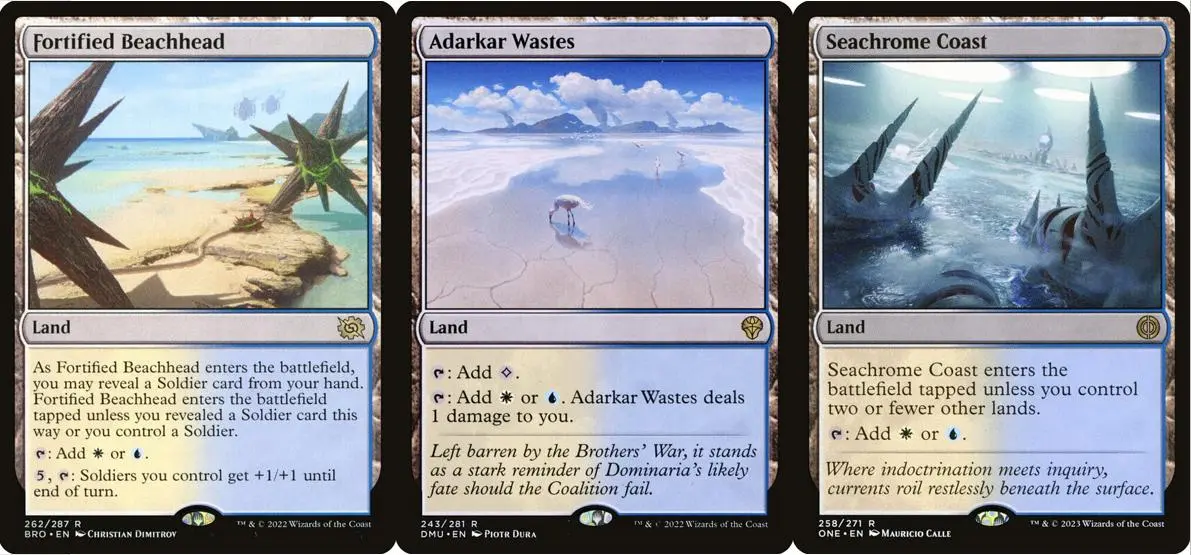
Lands that can produce both blue and white and enter untapped before turn three must be played at full playsets. UW Soldiers is a deck that pursues tempo intensely, and you don’t want any land to block your development in the first three turns.
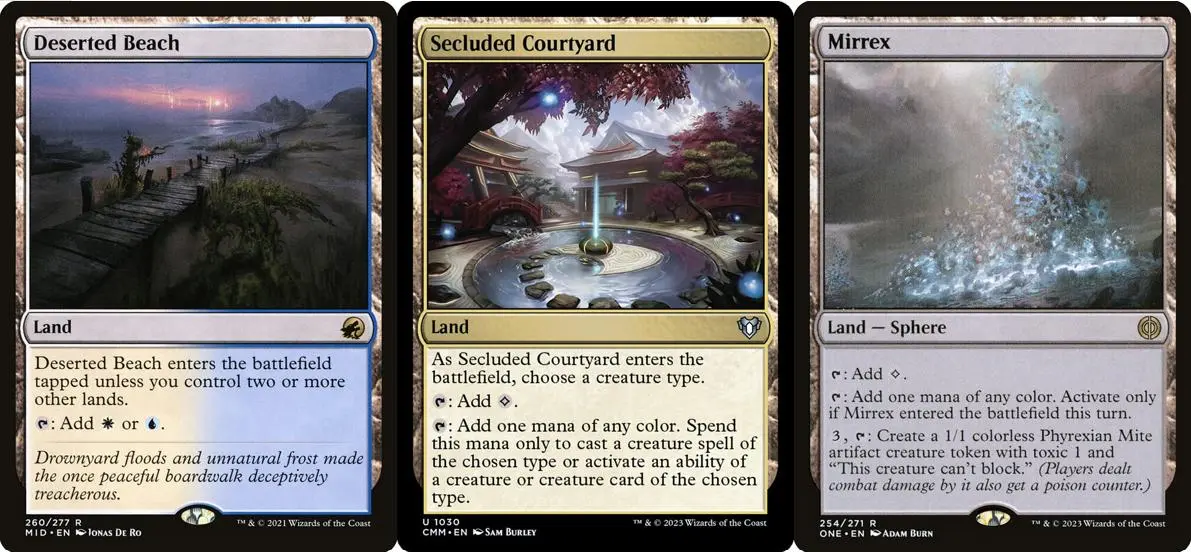
Interestingly, the go-wide build ran two Deserted Beach, while the tempo build ran no slow lands at all and played a full set of Secluded Courtyard. In addition, of the two builds only the go-wide one used a Mirrex, to go with the sideboard Tocasia’s Welcome.
However, I personally think running all four Secluded Courtyard is completely wrong. Once I was holding a counterspell with only a Courtyard and Plains on the battlefield, and I deeply regretted not having more lands that produce blue “normally”.
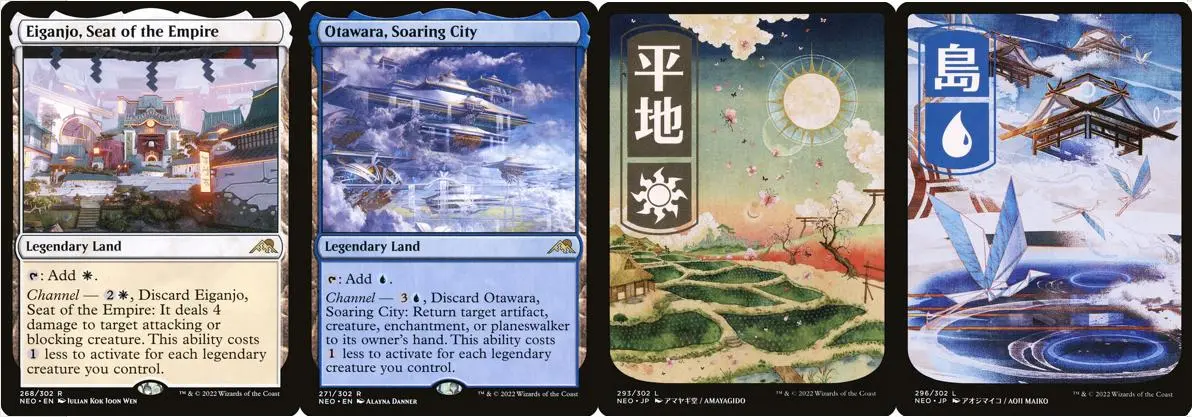
In the Standard environment, the cost of replacing a basic land with a channel land is very low, and drawing one in the mid-to-late game also gives an extra, almost uncounterable (except by Ertai Resurrected) spell to answer the board, with a very good return on investment. And considering that Standard still has both Field of Ruin and Demolition Field, which can destroy nonbasic lands, two-color basic lands are still necessary. Since white mana is relatively demanding in the main deck and sideboard, you’ll run three to four Plains, while Island, as an important mana source for activating counterspells, needs at least one or two.
Simon Nielson’s UW Soldiers
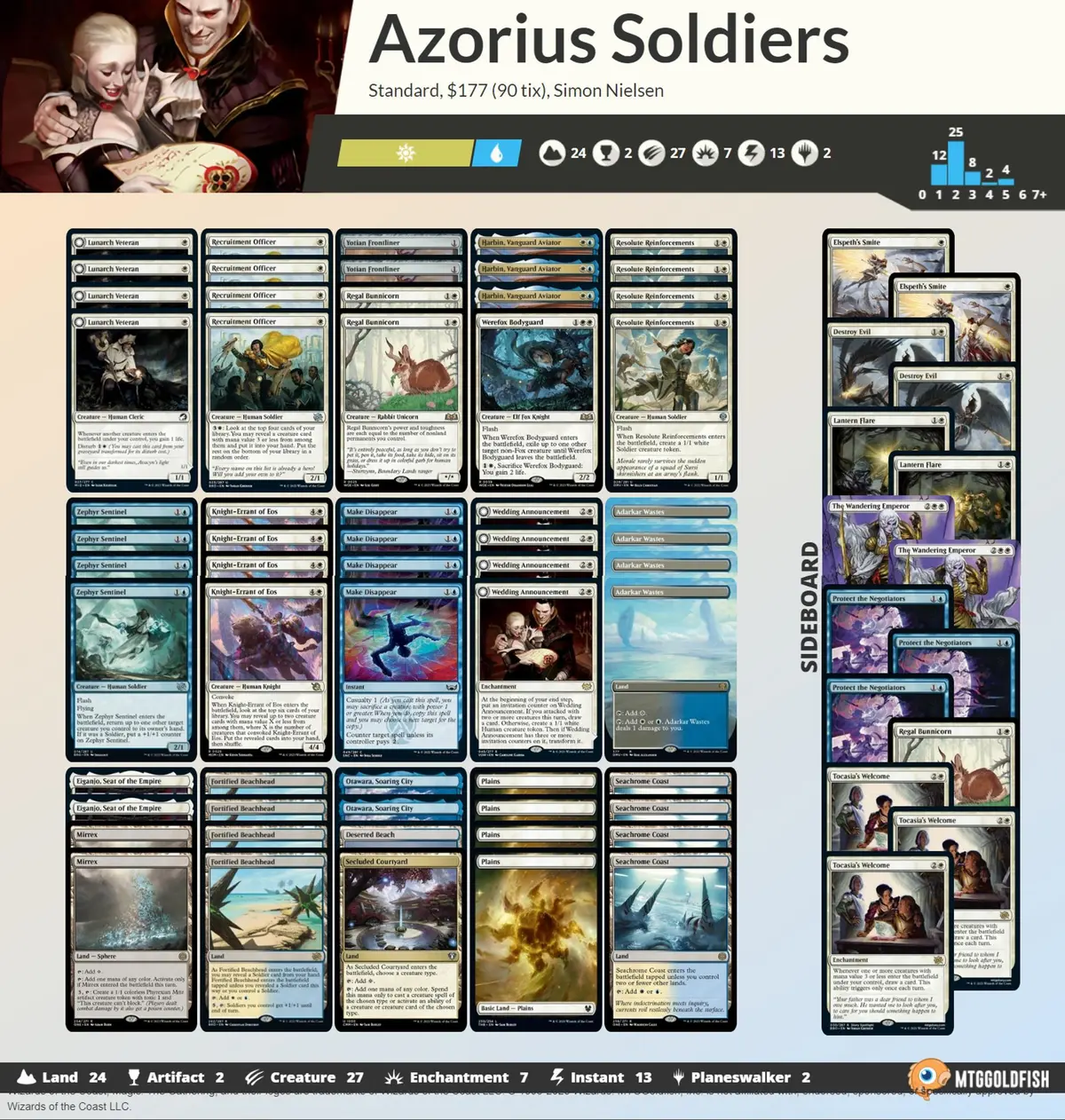
Having introduced the two previous types of UW Soldiers, let’s talk about the freshest UW Soldiers list this weekend, which took a great third place for Simon Nielson at the 29th World Championship (MAGIC WORLD CHAMPIONSHIP XXIX). Simon’s version cleverly combines the go-wide and tempo builds of UW Soldiers described above, blends the strongest parts of both, and discards the parts that were too clunky or poorly paired:
- It uses ten one-drops (including six Soldiers and a full playset of Lunarch Veteran) for maximum turn-one pressure. Lunarch Veteran’s life gain also makes your early life total safer against aggro decks like Mono-Red, and its disturb side lets you use it a second time, which is very nice.
- The two-drops are a full set of Resolute Reinforcements and Zephyr Sentinel, with 3 Harbin ensuring the explosive counterattack on turns four and five mentioned for the tempo build. The two Regal Bunnicorn reap payoff from the ten one-drops and the go-wide mindset, easily growing into a 3/3 or even bigger body, and mostly perform quite well against Esper Legends, a matchup where Soldiers were originally at a disadvantage.
- Apart from one Werefox Bodyguard and four Knight-Errant of Eos, there are no creatures above two mana (main deck plus sideboard use twenty-four two-mana-or-less cards), which lowers the chance of the Knight whiffing on convoke.
- The three-drops keep the go-wide configuration, not using the tempo build’s Skystrike Officer and Brutal Cathar, and use one Werefox Bodyguard in place of Extraction Specialist, which is more flexible to use.
- Because it runs more non-Soldier creatures, it dropped Valiant Veteran, and I believe there must have been quite a struggle over it. The three-drops now run a full set of Wedding Announcement. As long as it resolves and isn’t responded to and destroyed, it keeps adding board pressure on the opponent or earning cards, and the flipped Wedding is an anthem that adds another dimension to winning as midrange. In addition, Wedding also makes the opponent’s cheap removal that was originally quite good against Soldiers (Cut Down, Play with Fire, etc.) worse, which I think is quite important.
- It runs twenty-four lands with two each of the white and blue channel lands, increasing the chance of using them as spells, and having more lands also lowers the chance of being stuck on two lands (not discussing extreme situations here). Being able to reliably hit three lands on turn three is very important in this version of Soldiers.
From the way some matches went at Worlds, I think Simon’s version is currently the excellent culmination of UW Soldiers, and very suitable to extend further into the build you like. Here is also my own adjusted version that I currently use, for reference only.
My Choices
First, let me say that my winning formula for UW Soldiers looks roughly like this:
- Turn 1: a one-drop or a tapped land
- Turn 2: a flash two-drop or a counterspell
- Turn 3: Wedding Announcement, or a one-drop + a flash two-drop or a counterspell
- Turn 4: proactively cast Zephyr Sentinel to bounce Resolute Reinforcements then replay Reinforcements, or a two-drop + a counterspell
- Turn 5: slam Harbin and swing with all five Soldiers to win, or second Wedding + a counterspell
So basically what I hope for is that the opponent is dead by turn five, or half-dead while I hold a counterspell to protect against removal or a sweeper. If I have neither, I still have enough flash creatures to keep pressuring the opponent while keeping tempo, or to force the opponent to spend a counterspell or removal so that our more important spells can resolve. To achieve this, I add more flash creatures like Faerie Mastermind (the real Yuta Takahashi) and the white Virtue’s Adventure side, Ardenvale Fealty. And when the game is inevitably dragged into the mid-to-long game, we still have back-to-back Weddings and the white Virtue’s Adventure to earn chances for an army to bear down.
I again keep ten one-drops, but since I still very much hope to take off with Harbin and the whole family on time on turns four or five, I chose to play a full set of Yotian Frontliner and reduce the number of Lunarch Veteran. For counterspells in the main deck I use two Make Disappear + three Protect the Negotiators. With ten one-drops, in theory the odds of Protect the Negotiators being uncastable as a two-mana counterspell and becoming a dead card are lower, and at three mana it can be kicked to make a Soldier plus a counterspell, and when we can’t slam Wedding on turn three on time, or it isn’t suitable to force Wedding out when on the draw, we can also pass and wait for a chance to take back the tempo. Finally, I chose to use one of my favorite cards, March of Swirling Mist. The blue March is better at phasing out the opponent’s annoying blockers on attack and at preventing spot removal, and against a sweeper, as long as you have enough mana, it can also phase out the most critical creatures to earn a chance to hit back.
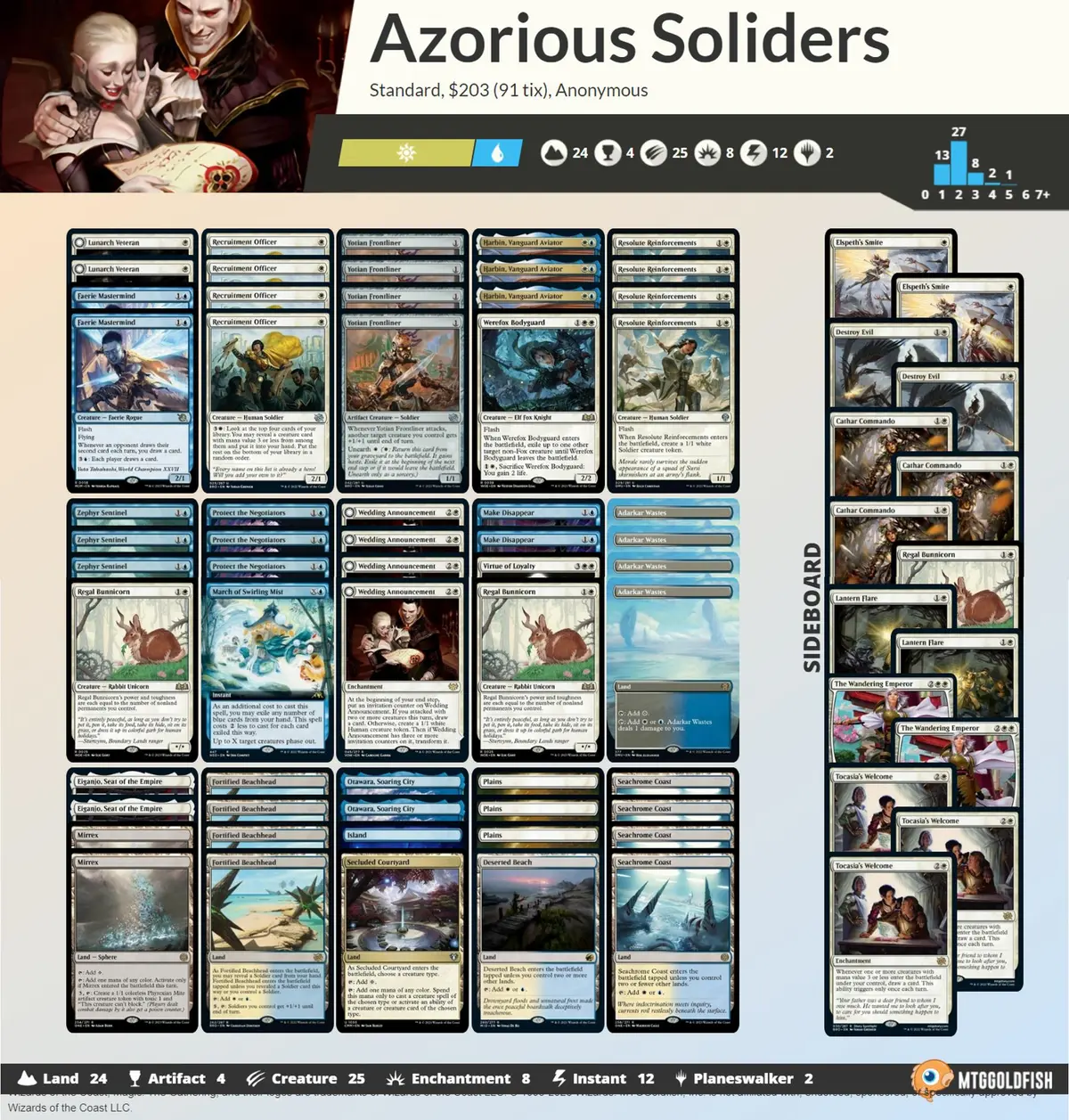
As for the sideboard, since the meta has only just changed, I keep the same sideboard as Simon’s version. With the space freed up by moving the three Protect the Negotiators to the main deck, and considering the current high usage of black-white Virtues and Leyline Binding, I would add three Cathar Commando to the sideboard to add ways to deal with these enchantments, and this also gives me more two-mana flash creatures, making offense and blocking more flexible.
Conclusion
To sum up, I think UW Soldiers is the best tempo deck in the current Standard format.
The pros and cons were covered above so I won’t repeat them, but Simon Nielson’s new build also frees the deck from the Soldier framework. With the missing lord replaced by Wedding Announcement while keeping Harbin’s burst, it plays more flexibly and variably than before. The sideboard here is only a reference, and still needs fine-tuning for the current meta. That is something every format and every archetype must do, and there is no fixed form. Of course, this also reflects each player’s preferences and unique thinking.
I hope this article helps players interested in this archetype, and you are welcome to tell me your thoughts and insights. See you next time!
- Title
- The Evolution and Outlook of Standard UW Soldiers
- Author
- cephille
- Created at
- October 2, 2023
- License
- This work is licensed under CC BY-NC-SA 4.0 .