Avatar: The Last Airbender (TLA) Limited Overview — Colorless, Lands

Note: This article was translated from Chinese by AI and may contain errors. Read the original Chinese version.
Avatar: The Last Airbender will hold its Prerelease events on November 14, 2025. Want a better understanding of individual card ratings and advice for Limited? Then check out this series of TLA Limited overviews!
- For an introduction to the mechanics, see this article: Avatar: The Last Airbender Mechanics Breakdown
Rating Scale
5.0: An unconditional must-pick that brings an almost game-winning advantage
4.5: An unconditional must-pick if you are in the right colors, bringing a huge advantage
4.0: First-pick value, with excellent synergy with the color pair’s theme, and a deciding card for splashing / switching colors or entering a color pair
3.5: Top uncommons and commons of the set and other sufficiently strong cards, with good synergy with the color pair’s theme, and a key card for entering a color pair
3.0: Important cards for the color pair’s theme and other above-average cards that you would want in your final deck
2.5: Average level, usually a decent curve filler
2.0 to 1.0: Below average; you generally prefer not to play them, and can use them as filler if necessary, but not too many
0.5 to 0.0: Unplayable; basically do not play them, as they will only help you lose
Ratings

Score: 2.5
Comment: In three-color decks without green, this card helps fix mana and also finds more Shrines along the way, so its function is not bad. However, it is slow overall with limited impact, and you would usually only consider it when you truly lack fixing.

Score: 1.5
Comment: Unless your deck needs to cast three-color spells, it is not really worth including this card just to filter. If your deck’s theme involves the graveyard or the number of Lessons, it can serve as acceptable filler.

Score: 3.0
Comment: The only downside is the high cost, but as a universal removal spell usable in every color, it is still a quite reliable sideboard choice. When your main deck lacks removal, you can also consider bringing it into the main deck. This set has no planeswalkers, which makes it one of the few universal answers that can deal with any creature, artifact, or enchantment.

Score: 2.0
Comment: If a non-green deck needs a third color, you can consider it as extra fixing, and in the late game it can serve as emergency removal, but it is not efficient.

Score: 2.5
Comment: A more stable non-green ramp option. It can untap on the opponent’s turn, making instant-speed plays smoother, and it can also provide a stable fixing source in multicolor decks. But its overall efficiency is still limited, so it is a viable choice when you need ramp or multiple colors.

Score: 3.0
Comment: The stats are usable on both offense and defense, and the Crew 2 condition is not hard to meet. When it dies it also leaves a clue to refill resources, so overall efficiency is stable and mobility is high. Although it is not an explosive threat, it is a practical filler in most decks.

Score: 2.0
Comment: As a two-mana curve filler, it brings out a 2/1. It is an acceptable choice for decks pursuing Allies or a noncreature theme. Although the boost is not large, it provides decent tempo; in a Waterbend theme, the cost reduction makes it more practical.

Score: 2.5
Comment: The Equipment version of Meteor Golem, which can directly remove any permanent when it enters, making it a late-game universal answer with a powerful impact. However, this set lacks cost-reduction options, which makes the seven-mana price quite heavy. If you can survive to cast it late, it still offers the dual value of removal and combat enhancement, and attaching it to an early creature can also bring some pressure.

Score: 4.5
Comment: The static ability looks the best fit for the blue-black color pair’s theme, but green-based decks that can ramp into it use it even more fiercely. Every turn you can put down an extra creature for free, and you will quickly overwhelm the opponent. And since it can be activated on the opponent’s turn, it is effectively tempo with flash.

Score: 1.0
Comment: This set has no clear theme of permanents leaving the battlefield or being bounced, leaving its self-return ability with little room to shine. In practice it is paying three mana and consuming a creature to temporarily TAP one of the opponent’s creatures, an effect that is weak and costs you tempo. It is hard to use unless you specifically need to trigger an artifact’s enter-the-battlefield ability.

Score: 1.0
Comment: A 0/30 body is indeed impressive, theoretically able to block any ground creature, and it also gives all your permanents indestructible, which sounds like the ultimate defense. In practice, though, its biggest problem is that eight mana is too slow and it has no immediate impact on the game. If your deck has clear ramp to cast it early, it can indeed bring the opponent’s offense to a complete halt, but other than that it will hardly change the pace of the game, and it is also hard for it to bring a win.

Score: 2.0
Comment: Unless you are a white-green Ally deck, this card has a hard time delivering its due value. It comes down at four mana and enters tapped, so it contributes nothing to tempo early, and the situations where it can produce a lot of mana are quite rare. If you can reliably assemble a large number of creatures of the same type, it can deliver a decent burst, but in most cases it is just low-efficiency ramp.

Score: 4.0
Comment: As long as your deck has white, this is almost a must-play. It reliably produces white, has lenient enter conditions, and in the late game can provide a permanent buff to all your creatures. Since the effect comes from a land, it does not take up space on the mana curve and does not fear removal, making it an excellent mid-to-late game resource converter.

Score: 3.5
Comment: A four-mana loot ability is quite valuable on a land, providing steady card selection while also supporting blue-black’s draw-two theme and the red-blue graveyard Lesson-count strategy. It has lenient enter conditions and flexible uses, the kind of quality land you can comfortably include even if your deck does not especially rely on the theme. When there is no stronger option, you can even consider first-picking it.
Score: 3.0
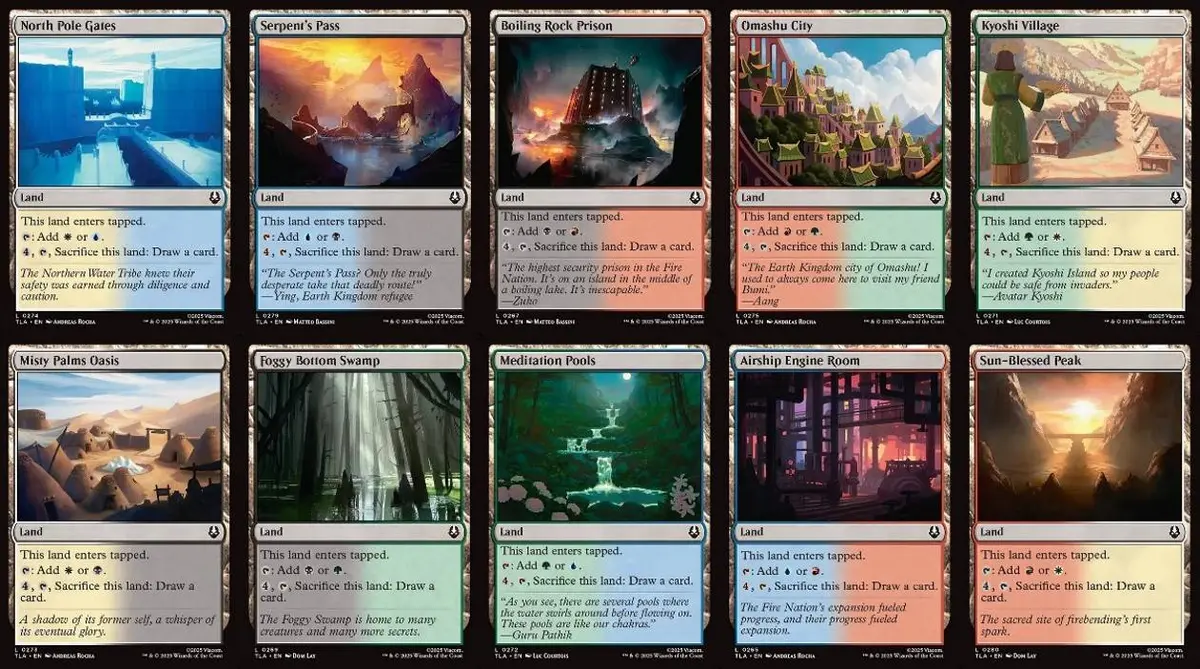
Comment: A stable two-color land, a fixing option any two-color deck is happy to have. Although it enters tapped, in the late game it can be converted into a card-draw resource, so it will not become a dead land in a long game. Its overall performance is middle of the road, practical and reliable.

Score: 4.5
Comment: Earthbend at such a low cost is actually printed on a land! For a total of four mana you can reliably make a land creature or strengthen an existing one, a huge threat in actual play. Even restricted to sorcery timing, it can still keep up the pressure. It is a pity that red-green cannot effectively use the extra mana from Firebending, but in any green deck it is still a very highly rated land, and can even be a reason to switch colors.

Score: 3.5
Comment: If you can make good use of the extra mana from “Firebending 4,” this land provides a very good ramp effect, equivalent to trading three mana for four. Although its range of application is limited, its activation cost is the lowest among the rare lands, and in specific decks it can significantly boost explosiveness. Note: Firebending effects stack.

Score: 3.0
Comment: In an Ally-theme deck, this land’s value goes up a bit more. Needing six mana to make a token is on the slow side, but it steadily provides late-game resources. Early on it can also help with fixing and support the activation of Ally spells or abilities, a stable and flexible choice.

Score: 3.5
Comment: The tokens it makes have an almost flying-like ability, and the creatures in this set that can block them are mostly uncommons and above, fewer than ten in total, making it a stable evasive attack option. As an extra resource source on a land it is quite excellent, and its activation timing is unrestricted, so it can be used flexibly on the opponent’s turn.

Score: 3.5
Comment: A universal land that every deck can use. The scry on entering improves consistency, and it can also serve as a fixing source. If used with Earthbend, it can both keep the land’s mana production after combat and flexibly support multicolor combinations. Stable and flexible overall, with no obvious drawbacks.

Score: 3.5
Comment: It makes two creatures of the same type unblockable, a quite good evasion option. It is also itself an excellent Earthbend target, and in an Ally-theme deck it can deliver its effect even more reliably, worth prioritizing.

Score: 2.0
Comment: Unless your deck has a clear Lesson or Shrine theme, this land is almost useless in ordinary situations. A non-green deck that truly needs a third color can use it grudgingly for fixing, but its overall impact is limited.
Conclusion
This set’s colorless Lesson cards remind one of Strixhaven back in the day, and also remind us that the day we return to that school is near. Until then, let’s take a few more classes here. Although this set’s colorless cards are not strongly thematic overall, they still hide quite a few interesting little toys. If anyone really wins a match with that 0/30, please be sure to tell me!
In addition, Earthbend gives lands many new tricks: there are lands with vigilance, and lands that cannot be blocked, and every rare land fits this Limited format’s theme well. Do not miss these lands. Resources from the earth are often the most stable and the hardest for the opponent to deal with.
This is XSBeeble, and I am off to sign up for the prep course at Strixhaven.
You all stay here and study hard. Haha!
- Title
- Avatar: The Last Airbender (TLA) Limited Overview — Colorless, Lands
- Author
- XSBeeble
- Created at
- November 13, 2025
- License
- This work is licensed under CC BY-NC-SA 4.0 .