Avatar: The Last Airbender (TLA) Limited Introduction: White

Note: This article was translated from Chinese by AI and may contain errors. Read the original Chinese version.
Avatar: The Last Airbender holds its prerelease events on November 14, 2025. Want to know more about individual card ratings and advice for Limited? Then check out this series of TLA Limited introductions!
- For the mechanics, see this article: Avatar: The Last Airbender Mechanics Explained
Rating Scale
5.0: Unconditional first pick, brings an almost game-winning advantage
4.5: Unconditional first pick in the right colors, brings a huge advantage
4.0: First-pick value, extremely synergistic with the color pair’s theme, can be the deciding card for splashing, switching colors, or entering a color pair
3.5: Top uncommons and commons of the set and other sufficiently strong cards, synergistic with the color pair’s theme, can be a key card for entering a color pair
3.0: Important cards for a color pair’s theme, plus other above-average cards you want in your final deck
2.5: Average, usually a decent curve filler
2.0 to 1.0: Below average, generally leave out, can be used as filler when necessary but not too many
0.5 to 0.0: Unplayable, basically don’t play it, playing it only helps you lose
Ratings

Score: 3.0
Comment: A four-mana flyer with 3 power has a decent offensive tempo, and many of this set’s Lessons are good enough to make the main deck in Limited, so this lifelinker has plenty of chances to be used. Its airbend targets nonland permanents, which leaves a lot of room for use.

Score: 3.5
Comment: A Banishing Light with flash, which is already the pinnacle of one-for-one removal in Limited. As for the self-sacrifice activated ability, treat it as a free flexible option, and sometimes it can be used as a makeshift Cloudshift.

Score: 3.0
Comment: Basically a cheaper Teleportation Circle that takes time to warm up the engine, and it is great as long as you have enough creatures with ETB effects.

Score: 3.0
Comment: Immolating Glare is a practical removal spell in Limited by itself, and it adds a flexible airbend option for free. Being a Lesson is also a big plus.

Score: 2.5
Comment: Although drawing a card gives it a higher floor, it is still a card that depends on the situation. Used as a Cloudshift or protection spell, it more easily generates card advantage. It can also serve as an “air wall” on defense, and as long as the opponent’s target has no troublesome ETB, you can proactively bounce the opponent’s creature to disrupt their tempo.

Score: 3.0
Comment: Although the cost is on the high side, its ability to force flyers through is also strong, and if you really run into a blocker that can intercept your flyers, you can use airbend to force a path.

Score: 4.5
Comment: The best payoff for airbend itself, and a four-mana 3/4 flash flyer is a super strong damage source on its own.

Score: 2.5
Comment: This set has quite a few Allies, and the expected value of growth is decent, but the starting body is a deficit, and you need to grow it at least once to catch up with a vanilla creature of the same cost.

Score: 3.5
Comment: Although it looks like a sweeper, in essence it leans toward being a finisher, because apart from tokens, airbend doesn’t truly clean up the problem, and may even let the opponent get an ETB again. To get positive value from this card, it is best to have a card on your own board with a good enough offensive tempo, and for the opponent to have few cards left in hand to use, so they are truly stuck for a whole turn by this card. There is also another use case: when you are confident in your resource capability but your defense can’t keep up with the opponent’s offensive tempo, you can use this card to readjust the tempo of the game. Of course, when operating it this way, it is certainly a much-inferior version of a real sweeper.

Score: 2.5
Comment: An ordinary two-mana curve filler, which gets a little extra benefit when you have waterbend.

Score: 2.5
Comment: Weak in combat by itself, but it has the value of removing artifacts and enchantments. Note also that its activated ability targets up to one, so you can also choose no target. In other words, this guy is actually also Food. (Indeed, the card art depicts nothing but food, no issue there)

Score: 1.5
Comment: At most it forcibly drags a losing game into an even one, but it is still hard to use. Being able to leave behind 4 power means that against the ferocious theme that cares most about power (power 4 or greater), it will leave behind something troublesome.

Score: 3.5
Comment: Creatures like Banisher Priest are all powerhouses in Limited. Although this one can’t exile permanents with mana value less than 3, those small things usually aren’t the key anyway, and in exchange you get a higher ceiling of being able to remove artifacts and enchantments, and the body itself is solid too.

Score: 2.0
Comment: Weak in combat by itself, and it can only protect Allies, so I recommend using it when playing the Ally theme.

Score: 2.5
Comment: A super versatile Lesson, with applications on both offense and defense.

Score: 2.5
Comment: Pumping two creatures by +2/+2 at once is usually hard to lose with, and is even a combat trick with a fair chance of generating card advantage. Also, being a Lesson is a plus.

Score: 2.5
Comment: A card with an extremely wild floor and ceiling: completely unplayable in three or more colors, a god in a single color, and in a normal two-color build the evaluation is quite delicate. You need to be able to make at least 4 to match the payoff of a five-mana card, so when your deck has this card, you can actively consider going mono-white, or heavy white with a light secondary color.

Score: 2.5
Comment: A filler with the right tribe.

Score: 3.0
Comment: Cheap flying plus stat-boosting Equipment is good in Limited, and the free airbend on entering has plenty of applications.

Score: 3.5
Comment: Decent in combat by itself, and since this set has a very high proportion of Allies, even if you don’t deliberately go for the Ally theme, you will still have a fair number of Ally cards, so the expected card advantage is very considerable.

Score: 3.0
Comment: A two-mana two-for-one on entering has basically never been weak in Limited, and both creatures have the right tribe.

Score: 2.5
Comment: Right tribe, and the flexibility of placing +1/+1 counters makes it more flexible to use.

Score: 3.0
Comment: Likewise a two-for-one with the right tribe, and a combined body of 4/4 fully matches the basic value of a four-drop.
Score: 3.5
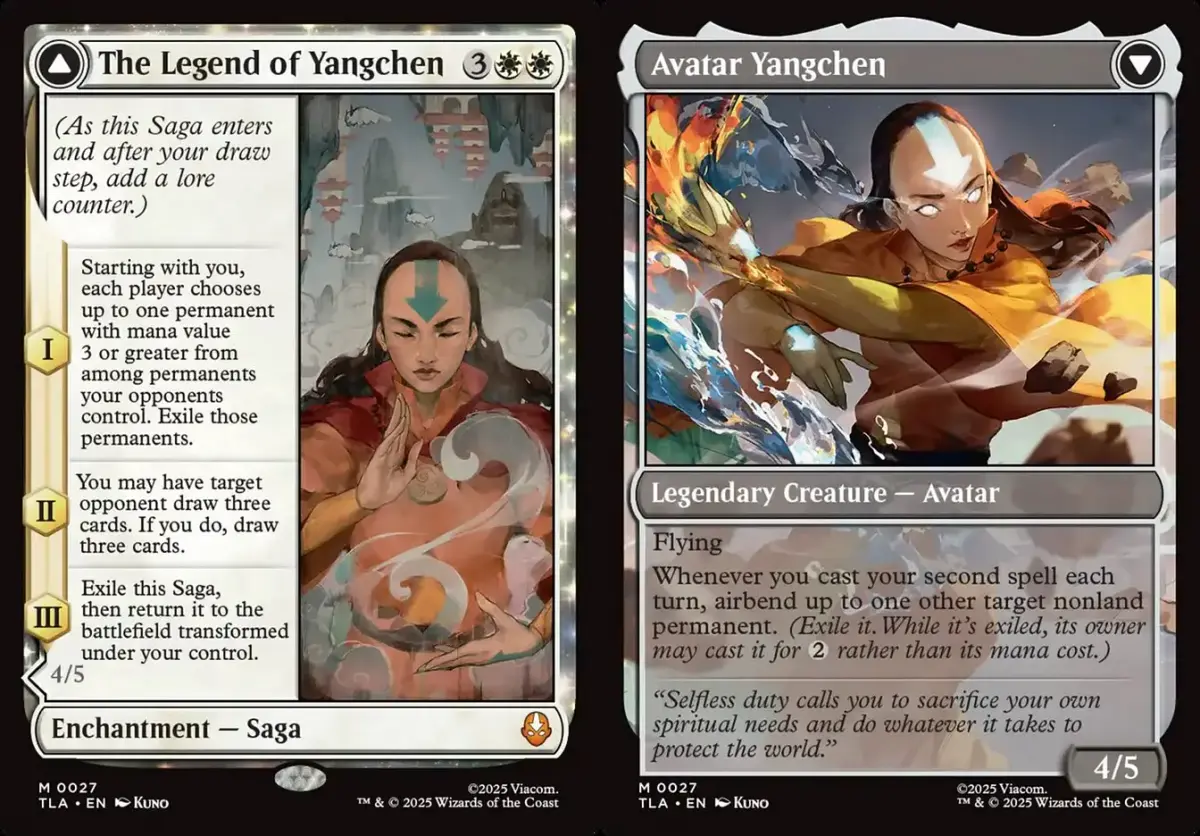
Comment: The first chapter’s effect is that each player chooses up to one permanent an opponent controls, so however you choose, your own permanents won’t suffer, while the opponent doesn’t need to exile one of their own permanents. For the second chapter you can freely decide whether to draw cards along with the opponent. Although it sometimes feels odd to draw for the opponent, in terms of card differential you don’t actually lose out, and you even start using these extra cards first. Also, after transforming, it relies on Flurry to do things, so everyone adding cards to hand together may give you extra positive value. In addition, airbending your own permanents is also a supporting plan for triggering Flurry.

Score: 4.0
Comment: A five-mana 4/4 first striker with extremely strong combat power that generates card advantage every time it attacks. Allies and Lessons are the most important types in this set, so the restriction is very loose.

Score: 2.0
Comment: Only valuable if it comes out on turn one and you have a lot of flyers. Otherwise, in most cases, dutifully playing a two- or three-mana filler is stronger.

Score: 2.5
Comment: Although it is a one-mana 1/1 flyer just like the card above, this one has slightly better general combat power and is an excellent supporting piece for airbend.

Score: 2.5
Comment: In the past, a Pacifism with extra functionality could be given a 3, but since this set has airbend, the opponent can very likely save themselves, and white isn’t short of real removal anyway, so the score is lowered to 2.5.

Score: 2.5
Comment: The creature’s own strength is slightly awkward, sitting right on the borderline of whether it is good to use, but the stability provided by the Plains cycling is a plus.

Score: 3.0
Comment: Dealing 4 damage for two mana is usually already efficient enough, and this card even has a chance to gain life.

Score: 3.0
Comment: The range of Smite the Monstrous is a bit unstable, but with the added option to proactively earthbend 3 to make a creature, the flexibility of covering both offense and defense is very appealing.

Score: 3.5
Comment: Super excellent in the Ally theme, but outside the Ally theme it is just a bear. This score is given on the premise that you can put together the Ally theme.

Score: 2.5
Comment: There are few Shrines to begin with, and even fewer whose function suits Limited. Although white’s Shrine effect of pumping all permanents is very practical in Limited, if you can’t assemble a Shrine theme, it will be like a sorcery with a rather delicate efficiency.

Score: 4.0
Comment: Team-wide attack boost plus continual token creation, so a single creature can push the whole team. Triggering the leave-the-battlefield effect is not hard: besides creature trades in combat, airbend is also a good method.

Score: 3.0
Comment: White’s strength in going wide can be turned into even more terrifying firepower through this card, and the removal option is also fairly practical.

Score: 4.5
Comment: Normally, as long as the opponent has no sweeper or counterspell, getting hit with one of these means you can pretty much stop playing.

Score: 3.0
Comment: The effect of tapping down the opponent when attacking means the offensive tempo should not be underestimated, and treat the extra sacrifice option as a freebie.

Score: 2.5
Comment: Basically a filler, and when mixed with red, having firebending gives it a better chance of turning on its activated ability.

Score: 3.0
Comment: Because waterbend has a cost-reduction mechanism, actually replenishing resources won’t be too clunky, and once the board enters a stalemate, she can roll out a huge amount of resources.

Score: 2.0
Comment: A weak combat trick. Use it only when you are really short of Lessons.
Conclusion
White has two main keywords: Airbend & Ally
However, the application of airbend is actually quite tricky. After all, when used to exile opponents’ permanents, it doesn’t clean up the problem, so in the end you still need to watch whether you have enough permanents suited to being cloudshifted.
Allies, on the other hand, are very simple and powerful. This set has an extremely high concentration of Ally creatures, and many regular curve creatures carry the Ally type, so when you see cards with Ally tribal payoffs you can use them with relative peace of mind. When playing white, there should be no shortage of Allies.
- Title
- Avatar: The Last Airbender (TLA) Limited Introduction: White
- Author
- Jru
- Created at
- November 10, 2025
- License
- This work is licensed under CC BY-NC-SA 4.0 .