
The Little Things That Affect a Game, EP 1: Fetching Lands

Note: This article was translated from Chinese by AI and may contain errors. Read the original Chinese version.
Before We Start
Recently, inspired by a post from 寬麵ㄉㄉ, I decided to write this series of articles. This one is about how to fetch: whether you should fetch, what to fetch, why you fetch, and so on.
This series is also expected to include, but not be limited to: why should you spend your tricks? How do you spend them? On whom? And the like.
Our games are always full of small details we haven’t handled well. These small details may not affect the result of a match, but in the long run your win rate always gets eaten away by them.
A card game does include some element of luck, but isn’t it strange to complain about luck before doing everything within your power well?

In this article we start with fetching, the area with the least impact, since it is something you do on your own initiative, and factors like your opponent’s board and hand don’t affect whether you should fetch.
Generally, we fetch for no more than the following reasons:
- Thinning: reduce the number of lands in your library and increase your chances of drawing your live cards
- Color fixing: ugh, I’m color-screwed, okay?
- Triggering Revolt / Landfall / reaching thresholds / enabling Delirium: Sheoldred, the Apocalypse ouch, Fatal Push / Unholy Heat save me
Thinning

Why are fetchlands so important in Modern? The main reason is thinning.
As everyone knows, most Modern decks can function with three or four lands, and with plenty of card filtering or mana cheating methods, we actually don’t need that many lands most of the time, and drawing a land in the mid to late game is always awkward.
But fetchlands solve this problem: while fixing colors they also thin the deck, and having two lands in your opening hand (not necessarily fetchlands) is enough.
A more extreme example is Murktide. Current Murktide builds only run 18 to 19 lands, because there is plenty of filtering (Preordain and Expressive Iteration, two real card-selection spells, plus the surveil from Dragon’s Rage Channeler and the free draw from Mishra’s Bauble) and Ragavan, Nimble Pilferer, which makes Treasures, and all the spells in the deck cost two mana or less. That means that with just three lands the deck can basically function completely.
The reason you need three lands is to leave one mana for extra uses. You can’t just hold a Counterspell and be unable to do anything else, right?
So in the usual case, we should fetch whenever we can, to reduce the risk of drawing lands, right?
But it actually depends on the current situation.
I won’t discuss whether to still fetch when you’re missing land drops here. If you’re already stuck on lands, worrying about reducing your chances of drawing lands is just silly.
The only exception is fetching a surveil land, since that really does filter the top of your library for you.
For example, suppose you have already used Opt or Preordain to scry a land to the bottom. Is it good to crack a fetchland now? (assuming you have other lands available)
Obviously not, because you paid some life to fetch but didn’t change your probability of drawing live cards. Unless some other effect shuffles, you shouldn’t be able to draw the card at the bottom of the library.
Never mind multiple scries putting even more lands on the bottom to dig for cards: the pile at the bottom of the library = cards you will probably never draw this game (without a shuffle). Since the things you put down there can’t be used, why shuffle them back up?
If someone has shuffled and can still guarantee those cards are all at the bottom of the library, I should be able to call a judge, right?
So whether to fetch is a matter that needs calculation: what is the probability of drawing the right cards before the shuffle? Which cards did I put on the bottom with my earlier scries? Can the shuffle help me draw the right cards?
Surveil Lands
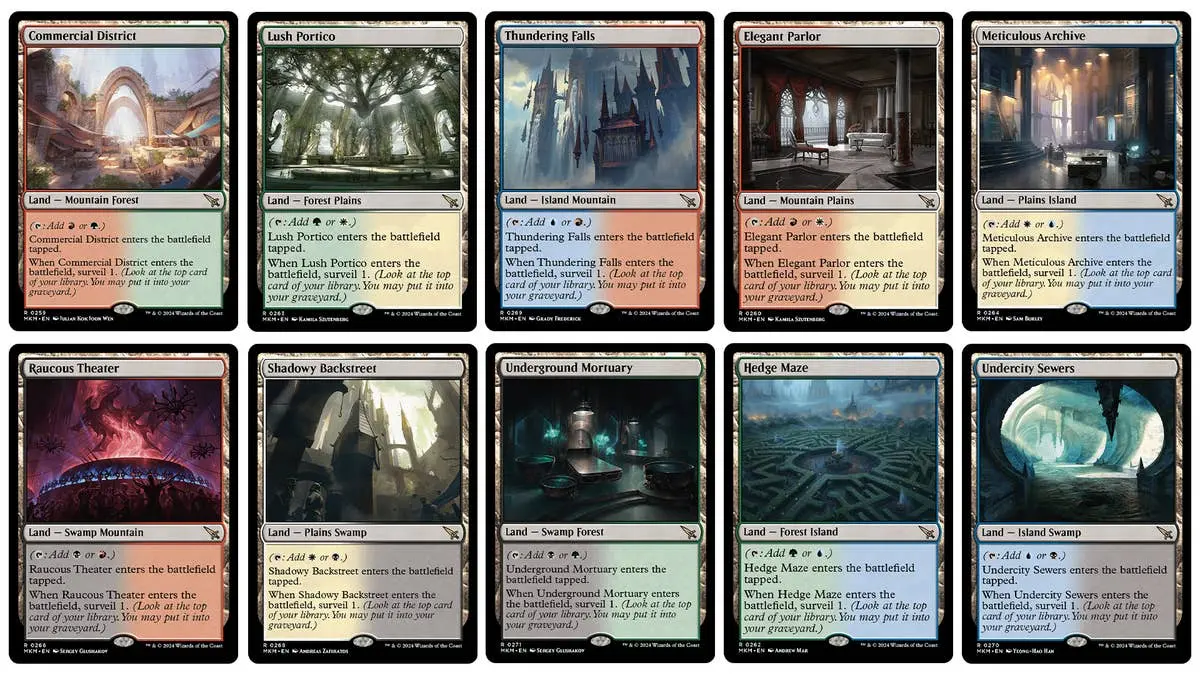
One extra word on surveil lands. The surveil land cycle released in MKM has land types, so they can also be fetched by fetchlands.
Because surveil lands can filter the top of the library, you can treat them as one fewer land card + filtering the top of the library; technically they thin two cards.
Color Fixing
In this section, lands are referred to by color plus the cycle’s name, to avoid difficulty in reading.
I believe most players, myself included, would say “Izzet shock” or “UR shock” rather than Steam Vents.
Another key point is color fixing: the order in which you fetch colors and how to split the colors of your lands.
In the environment at the time of writing, Domain Zoo and 4C Rhino should be the decks that most need to care about the order of fetching land colors.
I won’t discuss situations with Leyline of the Guildpact here.
For Domain Zoo, the common combinations are Savai Triome + Breeding Pool, or Zagoth Triome + Sacred Foundry, depending on the deck’s configuration and land setup. Both combinations let you:
- Play Territorial Kavu, Scion of Draco, or Dash Ragavan, Nimble Pilferer on turn two
- Assemble Domain
- Always have enough for Leyline Binding + Stubborn Denial
Another example is 4C Rhino, where the Rhino combination is usually Xander’s Lounge + Temple Garden.
Because your opening hand may have Crashing Footfalls that you want to suspend on turn one, while also wanting to keep the flexibility to make Leyline Binding on turn two, you choose the combination of Temple Garden + Xander’s Lounge, and this combination also supports all the required colors for Shardless Agent or Ardent Plea on turn three and Violent Outburst.
What Should I Fetch?
I also can’t avoid mentioning Field of Ruin.
If your opponent is a mill deck or a deck like Cabal Coffers that runs Field of Ruin, you basically fetch a nonbasic land with your eyes closed.
In those two matchups, in one your life total doesn’t matter and in the other the life pressure isn’t on your side, so keeping your nonbasics from getting blown up matters more.
Or consider whether your opponent has Blood Moon / Magus of the Moon / Harbinger of the Seas, and whether you need to fetch a basic land first to avoid being color-screwed.
And in the mid to late game, whether to fetch a Triome or keep it to cycle when you draw one later, and whether you will have enough mana to cycle it later, are also questions worth thinking about.
When to Fetch

Usually when using a fetchland, people like to crack it at the end of the opponent’s turn, which preserves the flexibility to fetch a tapped land and saves the two life a shockland costs.
But this changed after LCI. If your opponent plays blue, you also need to watch whether your opponent has enough mana to flash in Tishana’s Tidebinder, and getting a land blown up to save those two life is hardly worth it.

You also need to pay attention to whether your current situation suits fetching. Take a Murktide player holding (or bluffing to the opponent that they hold) Counterspell: suppose you leave two untapped lands and one of them is a fetchland. If the opponent is on Goryo’s Reanimator or another deck with instant-speed plays, at the moment you crack the fetch they may respond with Goryo’s Vengeance, since you don’t have two mana to cast Counterspell, the most common counter.
Of course you can also turn this action around to trap your opponent: when the opponent responds to our fetch with Goryo’s Vengeance, counter them in return with Force of Negation or Spell Pierce.
The same situation applies to Fatal Push and Searing Blaze. If your deck has these two cards, also pay attention to whether you need to keep a fetchland on the battlefield / in hand for now, and use it when needed.
Another example: when you are going to Grief scam, you can first put a fetchland on the battlefield, use Grief’s ETB to look at your opponent’s hand, and fetch afterward, avoiding some weird tricks such as Archive Trap, or Archive Trap, or also Archive Trap, and Archive Trap.
Also, if the land you want to fetch is one that doesn’t require paying life (such as Triomes or basic lands), you can keep it until your own turn to fetch, still thinning, while keeping your mana open to handle more situations (for example, if you get hit by Stifle or other weird things, you can counter in response).
Other Uses for Fetching
As everyone knows, fetching requires a shuffle, so there are also some additional applications.
Here again I’ll use Murktide as the example (I can’t help it, I can’t think of any other Modern deck that scries these days). Suppose our opening hand has one land and on turn one we cast Preordain without seeing a second land. Whatever we see, we put those two cards on the bottom, even if one is Expressive Iteration or Counterspell; we have to dutifully send them down.
When we need those cards in the mid to late game, we can use a fetchland to have them (have a chance to) get shuffled back up.
Another example is also Preordain. Suppose we are now facing Scam, and when scrying two we see a Subtlety and a random card, and we hold a Consider. We can leave Subtlety on top of the library and, when the opposing side does something, decide whether to draw it or shuffle it away with a fetchland (for example, if the opponent casts Fable of the Mirror-Breaker rather than a creature card).
So this also pairs with Brainstorm, shuffling cards in hand you don’t currently need back into the library.
Or it can be used to hide information / prevent your top card from being manipulated, for example against cards that change the order of the top of the library such as Jace, the Mind Sculptor and Portent, or cards that look at the top of the library such as Mishra’s Bauble.
Conclusion
This article was originally supposed to be at least three or four times its current length, and I had no plan to split it.
But after finishing the fetching section I got bombarded by one thing after another, and the section I was writing lost its thread halfway through and may need to be rewritten.
To keep myself from procrastinating any further, I decided to publish the part I have so far.
Depending on the situation, I’ll keep writing the next article, or write about the Blue Moon control deck that tested decently a while ago, or I might go back and write a complete Murktide guide, since someone on the site team told me Murktide is doing well right now.
- Title
- The Little Things That Affect a Game, EP 1: Fetching Lands
- Author
- MiohitoKiri5474
- Created at
- July 16, 2024
- License
- This work is licensed under CC BY-NC-SA 4.0 .
Related Articles

World Championship Player Interview: MIT Round 12 Champion, Second Interview with SamuelChang
November 5, 2026

World Championship Player Interview: MIT Round 11 Champion Lee Shi Tian
November 5, 2026

World Championship Player Interview: MIT Season 10 Champion 許碩恩
November 5, 2026

The Fish Is Huge: Forgetful Fish (Dandân)
September 4, 2026