What Can You Do When You Control Another Player?
Note: This article was translated from Chinese by AI and may contain errors. Read the original Chinese version.
Introduction
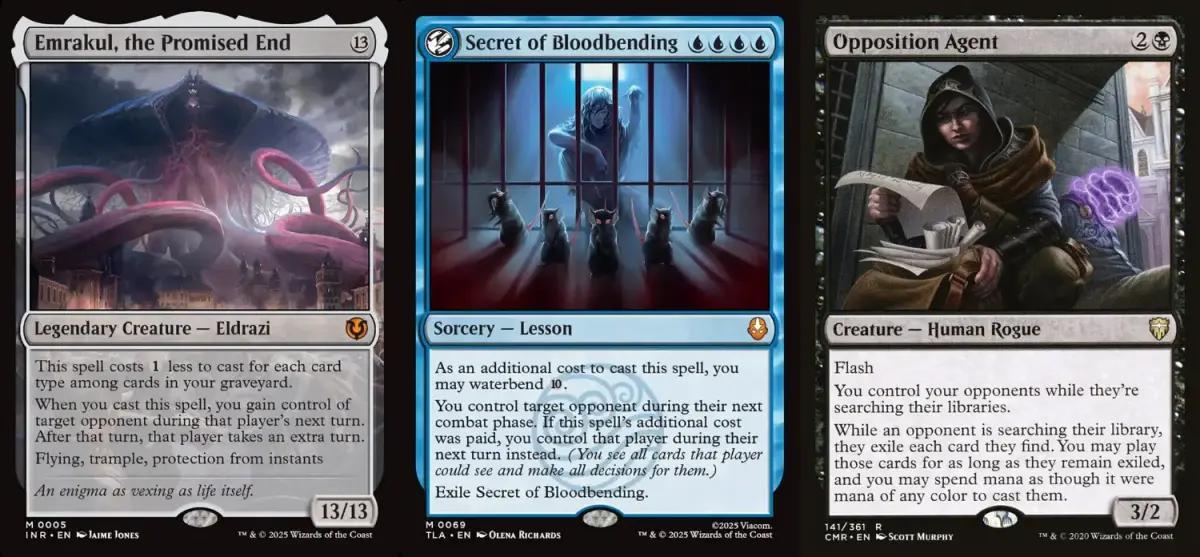
Controlling another player is a very rare and powerful class of effect. After Emrakul, the Promised End was banned in Standard, there was a long stretch with no new cards in Standard that control other players. This year, though, two new cards that can control opponents were printed back to back: The Dominion Bracelet and Secret of Bloodbending. Secret of Bloodbending is one of the toys I am quite interested in developing, and since MH3 massively boosted the Eldrazi theme, running into Emrakul, the Promised End in Modern tournaments is no longer rare. So what exactly can you do while controlling an opponent, and what can’t you do?
Basic Rules of Controlling Another Player
Effects that let you control another player always specify a time period (for example, the opponent’s next turn), and during that period you can control that player.
You can see all the in-game visible information the controlled player can see, and you can make all the choices that can be made in the game. The specific rules are as follows:
- 722.5. A player’s controller makes all choices and decisions that the rules or objects call for that player to make. This includes choosing what to play, and any choices and decisions required by spells and abilities.
- 722.5a A player’s controller can use only that player’s resources (cards, mana, and so on) to pay costs for that player.
- 722.5b A player’s controller can’t make choices or decisions for that player that the rules or objects don’t call for. Choices and decisions that the tournament rules require that player to make also can’t be made by that player’s controller.
- 722.6. A player’s controller can’t make that player concede. A player may concede at any time, even if another player is controlling them.
- 722.8. A player who controls another player still makes their own choices and decisions as usual.
Naughty things you can do while controlling an opponent include, but are not limited to:
- Attack with creatures that are outmatched by the opponent’s blockers, sending them to die.
- Counter their own spells.
- Aim removal spells at their own permanents.
- Activate a fetch land, look at the library, and then say you found no land.
- Tap all their lands or sacrifice all their Treasures for mana, even when there is no spell to cast.
- In EDH, after their commander is removed, choose not to return it to the command zone.
However, you can only control what the opponent does inside the game. Actions such as conceding, offering a draw, calling a judge, or going to the bathroom remain the opponent’s to exercise. You can’t force the opponent to concede. Conversely, if the opponent decides the game is hopeless and doesn’t want you to see any more extra information, they can concede at any time, even while you are controlling them.
If you are currently playing Two-Headed Giant or another format where players share turns, then controlling one player means controlling every player on that team.
Visible Information While Controlling Another Player
The explanation above kept saying “in the game”. In fact, the most common problem in actual play with effects that control other players is the question of visible information. The definition of visible information during control is as follows:
- 722.4. If the controlled player would be able to see information about an object in the game, both that player and that player’s controller can see it. If the controlled player would be able to see information about cards outside the game, only that player can see it, and that player’s controller can’t.
When you control another player, you can see all of that player’s in-game visible information, including their hand and face-down cards whose contents an effect lets the controller look at (see the examples below). The library’s contents, however, can only be seen when an effect has you search it (or some other effect that lets you see the library’s contents), just as you can’t casually pick up your own library and look through it.
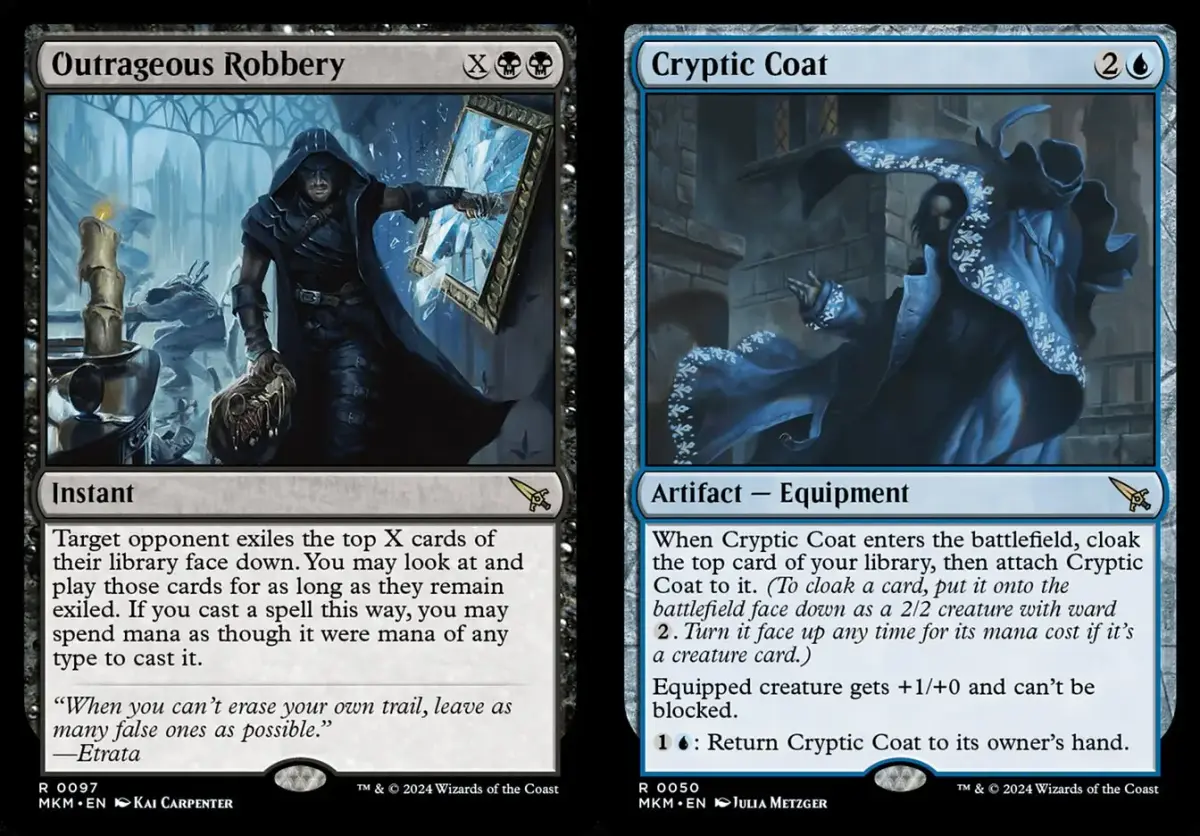
● Outrageous Robbery:
Target opponent exiles the top X cards of their library face down. You may look at and play them for as long as they remain exiled. If you cast a spell this way, you may spend mana as though it were mana of any type to cast that spell.
● Cryptic Coat:
When Cryptic Coat enters the battlefield, cloak the top card of your library, then attach Cryptic Coat to it. (To cloak a card, put it onto the battlefield face down as a 2/2 creature with ward {2}. If the card is a creature card, you may turn it face up any time for its mana cost.)
The other key issue is information outside the game, which in ordinary situations means the sideboard. Let us take Karn, the Great Creator as an example:

● Karn, the Great Creator:
[−2]: You may choose an artifact card you own from outside the game or in exile, reveal that card, and put it into your hand.
Suppose the opponent is under your control and you have the opponent’s Karn, the Great Creator activate [−2]. You can’t fetch an artifact from their sideboard, and you can’t even look at what their sideboard contains. But Karn’s effect also allows fetching an artifact from exile, so if there is an artifact in exile that you want, you can still grab it and make use of it. Of course, choosing to find nothing and just letting Karn lose 2 loyalty is also fine.
PS: Players can actually look at their own sideboard at any time. The relevant rule can be found in the MTR 3.16 Sideboard section.
Other Rules Examples
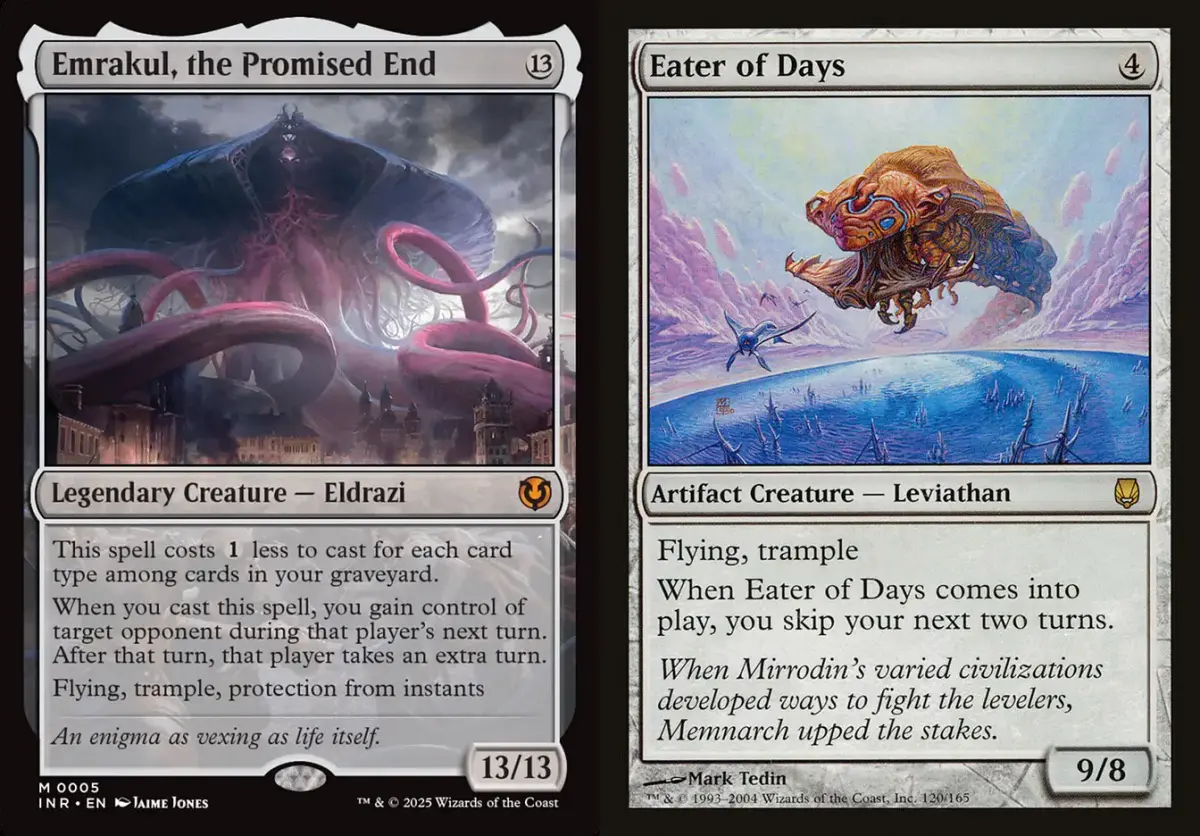
● Emrakul, the Promised End:
When you cast this spell, you gain control of target opponent during that player’s next turn. After that turn, that player takes an extra turn.
● Eater of Days:
When Eater of Days enters the battlefield, you skip your next two turns.
Suppose that on the previous turn Eater of Days entered under the opponent’s control, so they will skip their next two turns. Then it is your turn to cast Emrakul, triggering the ability to control the opponent’s next turn. Will this opponent still be controlled by you, and still get the extra turn?
Emrakul’s effect only takes control of the player when that player actually begins that turn. So in this scenario, the opponent first skips two turns, and when their turn comes around again, that turn is controlled by you, and only after it ends do they get an extra turn.
- 614.10. An effect that causes a player to skip an event, step, phase, or turn is a replacement effect. “Skip [something]” is the same as “Instead of doing [something], do nothing.” Once a step, phase, or turn has started, it can no longer be skipped; any skipping effect waits until the next time that thing would occur.
- 614.10a Any actions that would be taken in or during a skipped step, phase, or turn won’t be taken. Any “next” occurrence refers to the first occurrence that isn’t skipped. If two effects would each cause a player to skip their next occurrence, that player must skip the next two; skipping one occurrence satisfies one effect, and the other effect waits for another occurrence to be skipped.
- 614.10b Some effects instruct a player to skip a step, phase, or turn and then do something else. That action is treated as the first thing that happens in the next such step, phase, or turn that actually occurs.
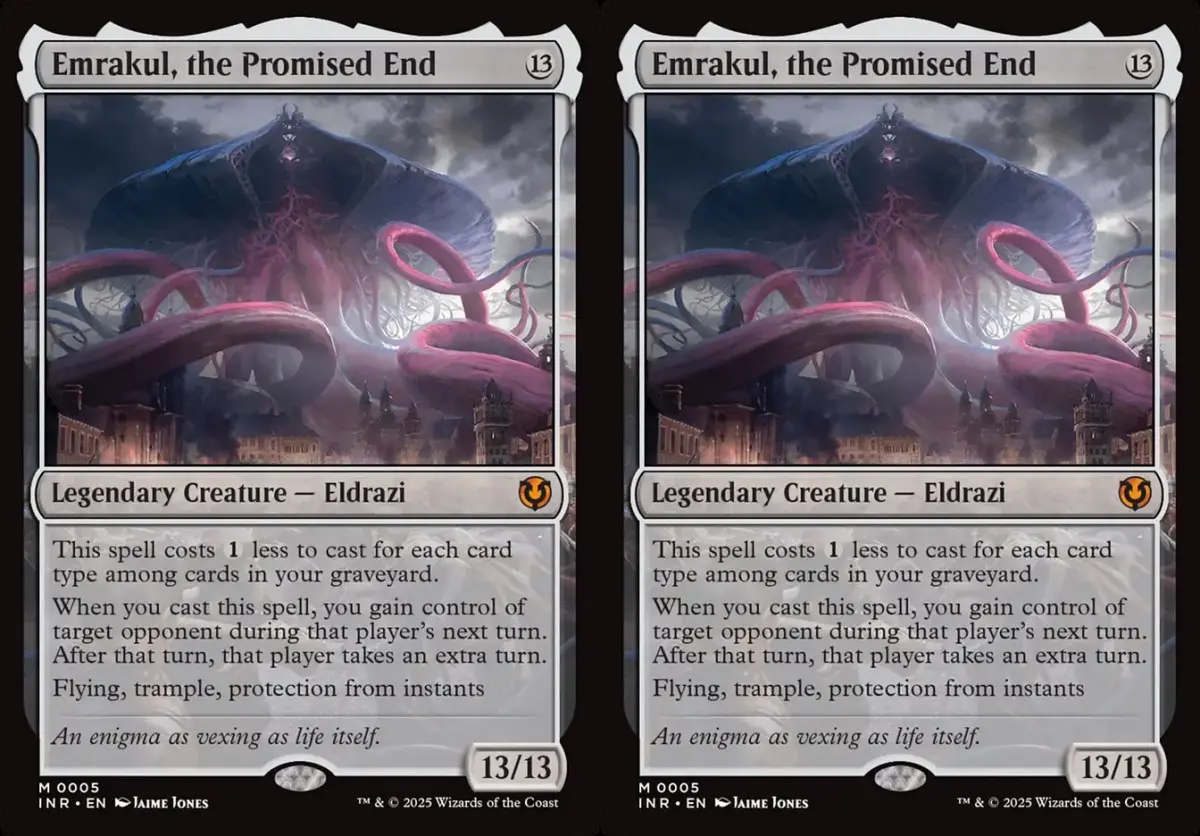
● Emrakul, the Promised End × 2:
When you cast this spell, you gain control of target opponent during that player’s next turn. After that turn, that player takes an extra turn.
In a multiplayer game, the turn order is A ⮕ B ⮕ C. Player A casts Emrakul and chooses to control player C’s next turn. Then it is B’s turn, and B also casts Emrakul, likewise choosing to control player C’s next turn. Then comes player C’s turn. Who controls this turn of C’s? How many extra turns follow? Will other players control C during those extra turns?
Both effects that intend to control player C apply to “their next turn”. When multiple effects try to control the same player at once, there is a dedicated rule for this case:
- 722.1a Multiple player-control effects that would affect the same player overwrite each other. Only the last one created has any effect.
So this turn of C’s is controlled by player B. B’s effect directly overwrites A’s effect, so although A’s Emrakul ability resolved normally, it ends up controlling no one.
Emrakul’s extra turn effect is different, though. Gaining an extra turn has no overwriting issue and instead stacks, so after the turn controlled by B ends, C still gets two more extra turns. Of course, C controls those two turns themselves.
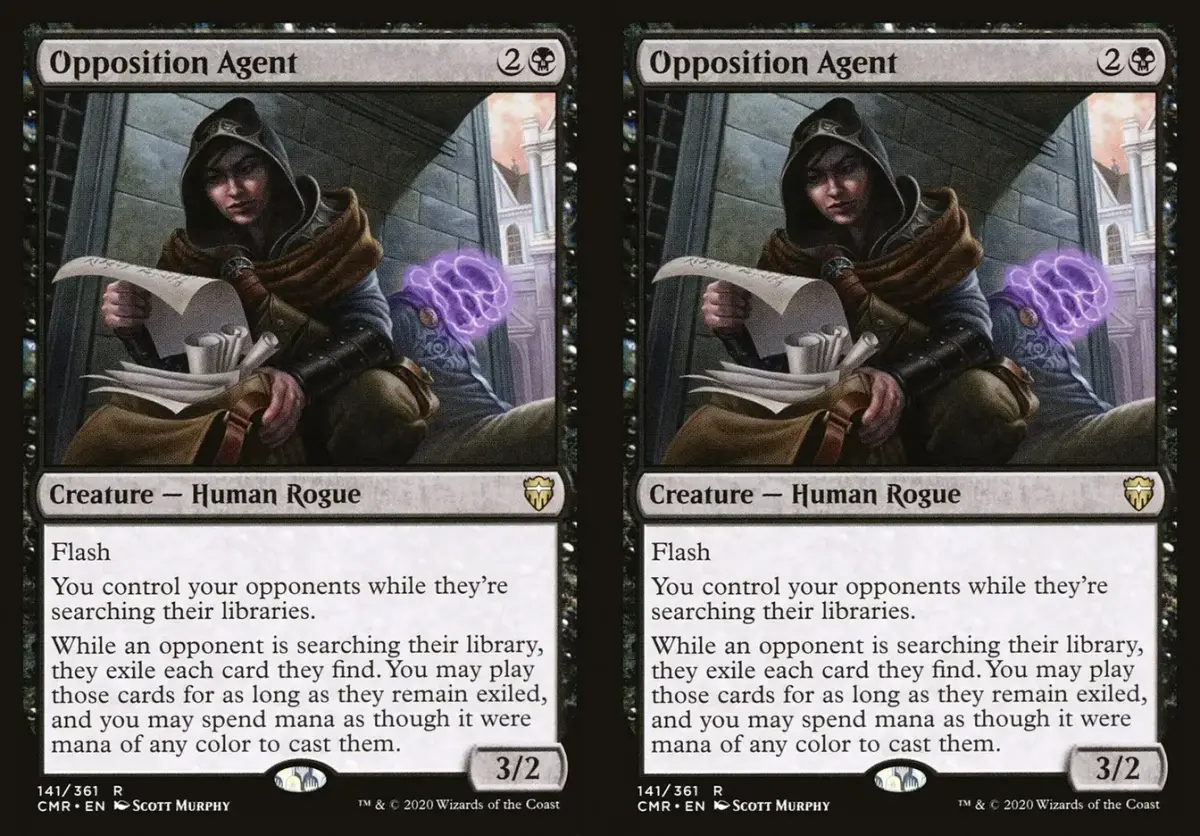
● Opposition Agent × 2:
You control your opponents while they’re searching their libraries.
While an opponent is searching their library, they exile each card they find. You may play those cards for as long as they remain exiled, and mana of any type can be spent to cast them.
Let us make player C suffer a bit more. Now player C activates a Wooded Foothills, and player A responds to the ability by flashing in Opposition Agent A. After A’s Opposition Agent resolves, B also flashes in an Opposition Agent B. Who controls C while they search their library? Which player’s Opposition Agent exiles the land that gets found?
Based on the principle from the previous example, we are already sure C will be controlled by B during the search, because Opposition Agent B entered last. So the land found by Wooded Foothills is exiled by Opposition Agent B, and afterwards B has the right to play it?
All we can say is that this is usually what happens in practice, but under the rules it isn’t the only possibility. Opposition Agent’s “exile each card they find” is also a replacement effect, so there are now multiple replacement effects trying to apply to the same land. In that case, the owner of the land decides which effect applies. But the land’s owner, C, is currently being controlled by B, so the one actually making the decision is B. Player B can decide that the land is exiled by either A’s or B’s Opposition Agent. Normally you would want the card for yourself, but if B wants, choosing to let A have the card is perfectly fine too. Maybe they reached some kind of diplomatic agreement?
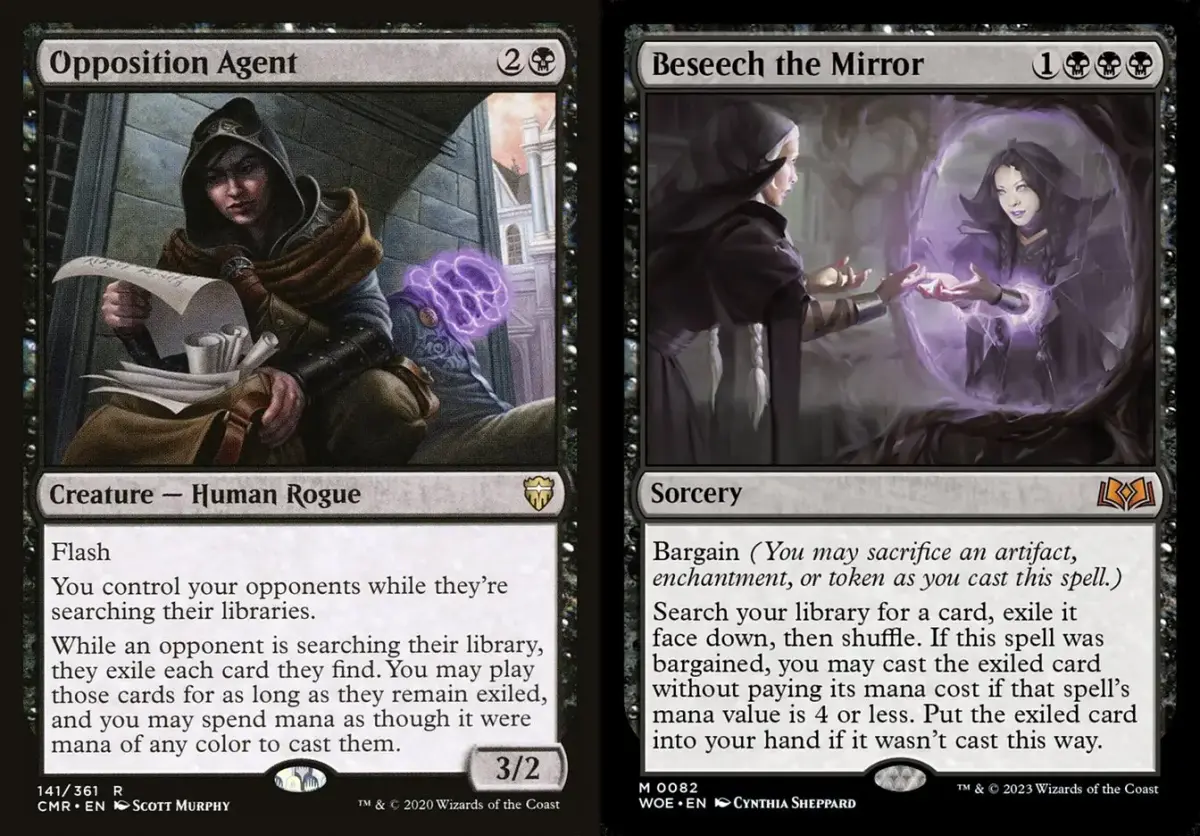
● Opposition Agent:
You control your opponents while they’re searching their libraries.
While an opponent is searching their library, they exile each card they find. You may play those cards for as long as they remain exiled, and mana of any type can be spent to cast them.
● Beseech the Mirror:
Bargain (You may sacrifice an artifact, enchantment, or token as you cast this spell.)
Search your library for a card, exile it face down, then shuffle. If this spell was bargained, you may cast the exiled card without paying its mana cost if that spell’s mana value is 4 or less. Put the exiled card into your hand if it wasn’t cast this way.
Suppose player A casts a bargained Beseech the Mirror, and player B responds by flashing in Opposition Agent. Then B certainly chooses which card this Beseech the Mirror finds. Suppose B chooses to search for a Lightning Bolt (a 1-mana spell). Who can cast this Lightning Bolt afterwards?
Exiling the card it finds is the original effect of Beseech the Mirror itself, while Opposition Agent uses a replacement effect to modify where the found card goes, so the card is exiled because of Opposition Agent’s effect, and afterwards B can cast this Lightning Bolt. I trust there are no problems up to here.
But Lightning Bolt was indeed exiled in the end, so why can’t it be cast for free with Beseech the Mirror’s effect after Opposition Agent’s interference?
Normally, when an object changes zones it becomes a new object with no memory of or link to its previous existence, losing its connection to other effects from the old zone. But then many effects that move cards to other zones in the course of operating would all stop working, so another rule says that an effect that moves an object to a different zone can track that object into the new zone.
- 400.7. An object that moves from one zone to another becomes a new object with no memory of, or relation to, its previous existence. This rule has the following exceptions:
- 400.7j If an effect causes an object to move to a public zone, other parts of the effect can find that object. If the cost of a spell or ability causes an object to move to a public zone, the effect of that spell or ability can find that object.
Because Lightning Bolt was exiled by Opposition Agent rather than by Beseech the Mirror itself, the latter half of Beseech the Mirror’s ability can’t find the card.
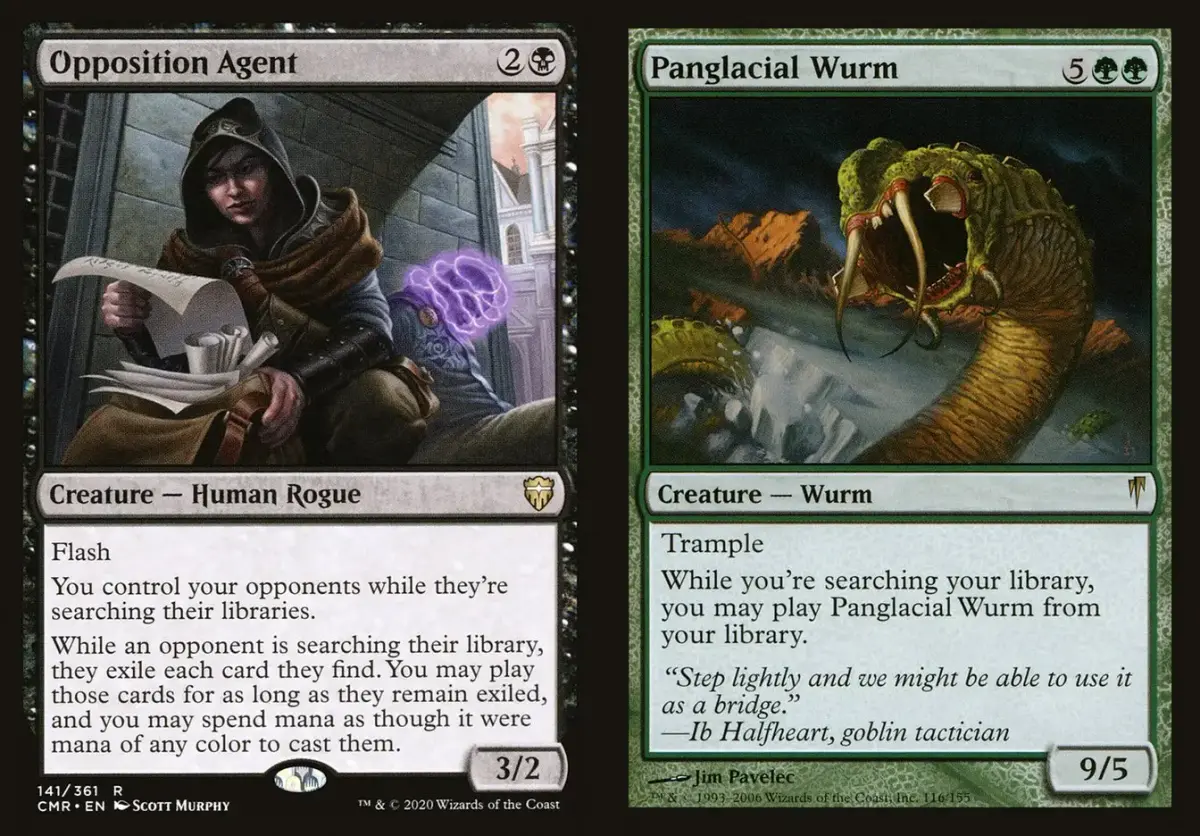
● Opposition Agent:
You control your opponents while they’re searching their libraries.
While an opponent is searching their library, they exile each card they find. You may play those cards for as long as they remain exiled, and mana of any type can be spent to cast them.
● Panglacial Wurm:
While you’re searching your library, you may cast Panglacial Wurm from your library.
If you ask which card in the Modern card pool has the highest rules complexity, I would say Panglacial Wurm. Its effect is extremely abstract, and the details of how it works aren’t even written in the MTG Comprehensive Rules themselves but in the card’s individual rulings. Magic’s head designer Maro has also clearly stated that Panglacial Wurm’s operation causes too many problems, so cards with similar effects will not be designed in the future.
To really explain Panglacial Wurm’s effect would take an entire article, so here is only a brief introduction to how it works:
When you are searching your own library, if Panglacial Wurm is in your library, then before you find the card you are looking for, you may announce that you cast Panglacial Wurm from your library. The game then pauses that library-search effect and first handles Panglacial Wurm’s casting process (this lets you bypass the usual timing and zone restrictions on casting creature spells). The casting process also includes the point at which you activate mana abilities. After you complete casting, Panglacial Wurm goes on the stack, but no player receives priority at this point. The game returns to where it paused and finishes the library-search effect, and only when that spell or ability finishes resolving does the cast-triggered ability go on the stack, after which players receive priority.
Diagram of How Panglacial Wurm Works
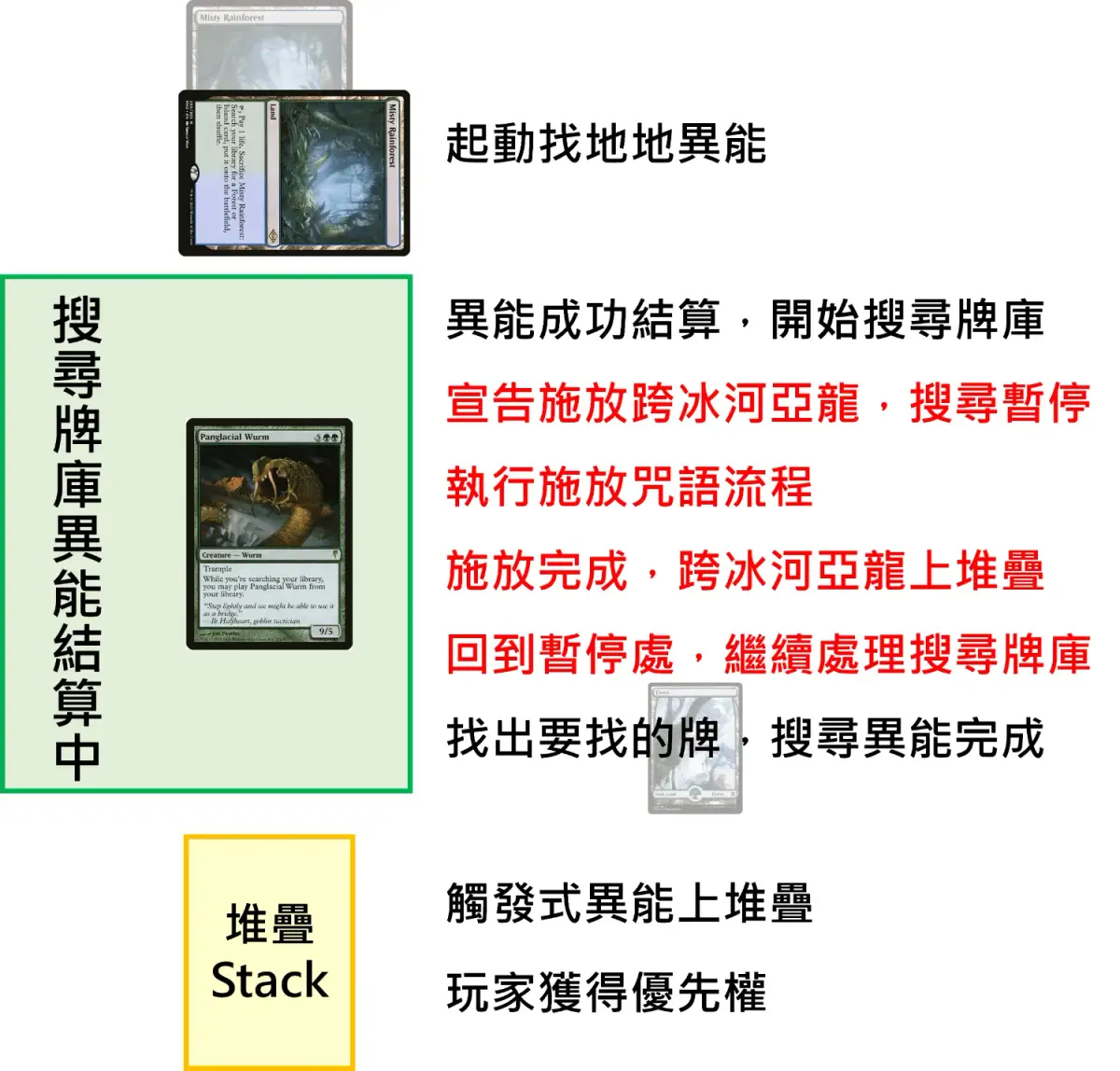
Suppose I control Opposition Agent, and the opponent has Panglacial Wurm in their library and can produce enough mana to cast it. When the opponent activates a fetch land to search their library, they are controlled by me during the search. Since both the card’s owner and the controller of the library-search ability are still the opponent, this satisfies Panglacial Wurm’s condition “While you’re searching your library”. I can have the opponent announce casting Panglacial Wurm and activate mana abilities to pay for it. Of course, since the opponent is the one casting the spell, control of the creature stays with the opponent, but the opponent may have just wanted to find a land, and their mana gets spent for no reason.
As for why this Panglacial Wurm isn’t exiled by Opposition Agent: it isn’t a “card they find” from the search effect, so it doesn’t meet Opposition Agent’s condition for exiling cards. Finally, don’t forget that the land found by the fetch land will be exiled by Opposition Agent.
PS: Panglacial Wurm has a functionality bug on MO, and the official side probably has no plans to fix it.
Conclusion
As an NTR enthusiast who is deeply devoted to my opponent’s deck, I was genuinely quite excited to see Secret of Bloodbending in the TLA previews. The cost is still very clunky, and I expect a deck built around it would not be terribly powerful, but compared with The Dominion Bracelet it is already much more realistic. I just still haven’t managed to tune a deck whose balance satisfies me. And although this article was prompted by Secret of Bloodbending, once I actually started writing I found that the main source of the problems was Opposition Agent.
For effects that control other players, the key point remains “what counts as visible information”. The most important thing to remember is generally that “you can’t see the opponent’s sideboard while controlling them”.


- Title
- What Can You Do When You Control Another Player?
- Author
- Jru
- Created at
- December 24, 2025
- License
- This work is licensed under CC BY-NC-SA 4.0 .