What Is a CUBE - Your First Cube

Note: This article was translated from Chinese by AI and may contain errors. Read the original Chinese version.
Defining CUBE
Hello readers of Guildmages’ Forum, I am dalance. I am sure you all know that Magic: The Gathering offers many ways to have fun within its framework, and today I want to introduce CUBE.
A CUBE is a custom draft format, traditionally with a few features:
- The CUBE designer picks 360 unique cards.
- It is played as a booster draft.
- Beyond that, there are no hard rules.
In practice, though, a CUBE can alter the details freely within this scope.
For example:
- Card count: it can be adjusted to the number of players, anywhere from 90 to 450 cards.
- Format: Vintage CUBE is powerful but expensive, so you can use a single set, Standard, Pioneer, or Modern.
- Rarity: all rares, all mythics, an all-common budget version (Pauper), or all common plus uncommon (Peasant).
- Draft method: if you don’t like booster drafts, you can use other draft methods.
- Card pool: the cards don’t have to be unique; duplicate cards can be used too.
Summary
CUBE is a way of playing built on a Limited foundation and is also an excellent tool for promoting drafting. Making a CUBE out of your favorite cards and drafting it is the fun of CUBE.
By designing it yourself, testing it with friends and then improving it, you let your CUBE grow together with MTG.
The flexibility in design and a fresh draft experience are the biggest features of CUBE.
Why Should You Play CUBE
Because CUBE drafting is a lot of fun
I believe every type of gamer can find enjoyment in CUBE. Here are several player types:
- MTG beginners: Starting with a draft right away is a bit too intense, but a CUBE draft designed for beginners lets you experience several kinds of decks from the same card pool, and feel the charm of MTG’s Limited design.
A teacher can also draft a teaching deck on their behalf so that beginners can experience different kinds of decks. - Draft beginners: There are a few reasons why people want to get into drafting but dare not try:
- Cost: Opening three packs and ending up with a 0-3 is not a great experience, but in a CUBE the cost is amortized, so there is no such cost barrier.
- Learning curve: A normal booster draft is different every time, and for a beginner, having to keep the three elements of drafting (signals, curve, and synergy) in mind is easily dizzying. In a CUBE, with a fixed card pool and adjusted mechanics, you are less likely to pick the wrong card. You can learn drafting in a relatively pressure-free environment. After repeated play, you can also self-review and broaden your Limited horizons.
- Player count: A booster draft may run into the problem of not having enough people to fill a table. With CUBE, different draft methods let you break free of the booster limitation and have a good Limited deck experience at different player counts.
- No chance to get in: MTG has lost quite a few players over decades of iteration, and CUBE is a chance for those players to return to the table and experience MTG again. You don’t need a deck or to buy packs; just show up.
- Understanding design: Every MTG set puts great effort into designing its Limited environment, and if you only play constructed you only see the tip of the iceberg of MTG. CUBE lets those designs shine again on this foundation.
- Veteran drafters:
- You feel a certain set’s balance was just terrible, and CUBE gives you the chance to rebalance it.
- You feel a certain set’s themes were just boring, and CUBE gives you the chance to reinvent them.
- On top of the current set booster drafts, CUBE offers a chance to try other design possibilities.
- A fun draft experience beyond the Master series, Remaster series, and MH series.
Why Should You Build a CUBE
Because CUBE building is a lot of fun
- The fun of deckbuilding: If you like building, a CUBE with a deeper card pool offers more challenges. What happens when theme OO meets theme XX? How do you make every card attractive to players? CUBE can turn your ideas into reality.
- Rediscovering MTG: CUBE design makes you look at every card of a new set with fresh eyes, and also gives you a chance to revisit cards from old sets because of deck themes, so you come to know the game better.
- A chance to balance mechanics: In drafts there are always themes that are too weak or too strong. Now you have the chance to redesign the supporting cards for that mechanic and let it get the attention it deserves.
- Understanding the design philosophy of MTG Limited: Understanding why set Limited environments are designed the way they are also increases your ability to fix problems when our CUBE has them.
- A great sense of achievement: When testing, seeing players enjoying themselves gives an incomparable sense of achievement.
A Real Game Example
Take the CUBE draft we played at a friend’s house over the New Year as an example.
The CUBE used was a 180-card Near Standard Peasant CUBE, 4 colors, with six themes in total (Signposts), namely:
- Black-Blue: Threshold control
- Black-Red: Sacrifice aggro
- Black-Green: Food, graveyard use
- Blue-Red: Affinity for artifacts
- Blue-Green: Collect evidence, manifest
- Red-Green: Delirium
Player L: Played a World Championship deck of gold-bordered cards around 2000, QUIT when the deck was confiscated, no draft experience
Player T: A veteran player who came back for a while with ONE
Player C: Unknown
The author: From Invasion to Mirrodin, Lorwyn, ALA, and NEO to DFT
Since the players had all been away for a long time, before the game began I laid out the two-color signposts to explain the mechanics, explained a few unfamiliar keywords, and then made the packs: I randomly split the 180 cards into 20 packs, so each person could open 5 packs of 9 cards each.
Final distribution
Player L: Black-Red sacrifice
Player T: Black-Green Food
Player C: Black-Blue threshold
The author: Blue-Green collect evidence
During the draft we saw plenty of red and green signals being passed along, and the other players at the table all felt it. The most common things heard between picks were “Is this card really okay like this?” and “Why is this card so strong!”, and similar remarks came one after another.
As for the games, because time was limited, my blue-green deck never got to make Chalk Outline , and in the end I lost 0-1 to Black-Red’s Junkyard Genius
 .
Player L’s feedback: I think you designed it very well; the deck has a bunch of tokens that feel like they can be used to gain an advantage through sacrifice. Also, please change Junkyard Genius to three copies for me.
At the next table, Black-Green Food and Blue-Black threshold shook hands after a 1-1 draw. Blue-black had less support in the design, so being able to withstand black-green’s onslaught was beyond my expectations.
As for me, I learned that blue-green collect evidence needs not only a stable graveyard but also enough mana value in the graveyard, so you don’t have a graveyard but can’t collect evidence, and I learned that Junkyard Genius in this CUBE is basically an idiotic card that wins the game as soon as it lands.
In addition, the red-green and blue-red color pairs did not provide enough incentive to attract players either, which you can tell from the many signal cards of those pairs being passed around during the draft, and these are all things to improve in the future.
This was also my first four-person paper draft, and being able to draft and trash-talk at the same time was truly enjoyable.
Building a CUBE — How to Make Your First CUBE
Linus Torvalds once said:
Talk is cheap, show me the code.
By now readers can’t help but ask, where is the CUBE? How do I make my first one?
Reference Other People’s Work
For reading convenience, let me insert an introduction to a website here
CUBECOBRA: An indispensable tool for CUBE design.
For finding decks there is the usual MTGGoldfish, and for finding CUBEs you can come to CUBECobra. Most of the tools you can think of that CUBE design needs can be found on this site, and you can also look at other people’s CUBEs. CUBECobra is powerful, so I will introduce it in detail later.
If you have no ideas and no experience, you can find a CUBE you like on CUBECobra and copy it as a starting point. This is a great start.
But the problems don’t end there. After copying a CUBE, the designer can consider the following questions:
- Budget: Can I afford these cards? Is there a budget version that can replace them? Or do I have cards with similar functions on hand to substitute?
- Theme: Do I like these themes? If not, or if the CUBE doesn’t have the themes I want, how can I replace them?
- Flavor: You can add flavor you like, such as werewolves and vampires, angels and demons, or fairy-tale style. When you like a flavor and the CUBE doesn’t have it, you can try adding it.
- Power level: This power level doesn’t match my expectations, and I want to make some adjustments. For power level you can refer to format tiers.
A simple tiering of card power:
Legacy > Modern > Pioneer > Standard, Master/Remaster > non-Master; JumpStart and Commander are also stronger than ordinary sets.
Advice for CUBE Makers Starting from Scratch
Copying cards won’t satisfy you, and neither will copying a CUBE.
For someone starting a CUBE from scratch, filling it with the cards it needs is a hassle.
Here are a few suggestions:
Fast, fast, and fast again: Refer to the tracer bullet principle of software development (from the book The Pragmatic Programmer) - this concept borrows from the military tracer bullet, which leaves a visible trail after firing to help the shooter aim.
The tracer bullet principle means building a simple but complete system, getting it running and providing feedback. This method lets developers test the system in a real environment, observe the distance to the target, and adjust. The process is iterative, approaching the goal step by step by continuously adding features.
Main characteristics:- A simple but complete system: The initial version need not include every feature, but it must work.
- Iterative development: Keep adding features and testing, adjusting based on feedback.
- Real-environment testing: Test in real usage scenarios to make sure it meets needs.
- Continuous improvement: As the system grows, keep evaluating and adjusting to make sure it meets the goal.
Build a prototype quickly and then test it, and only then can you truly understand the CUBE’s characteristics and player feedback.

Reference others’ designs: Through the designs of experienced designers, you can find what most people think of their CUBEs, and perhaps that will be your thinking too.
Narrow the constraints: Everyone has been in MTG for a different length of time, and a newcomer who has just entered a few sets has seen different cards from a 10 or 20-year veteran. So adding some limits to narrow the cards and sets is a good direction.
- Narrow the sets: Recent sets like Foundations and BLB have simple, easy-to-get mechanics, and you can start designing a CUBE from these sets.
- Narrow the card count: A 360-card CUBE is too hard to fill, and starting with 180 works too.
- Limit the number of two-color themes: If ten guild-color two-color themes are hard to come up with, you can also narrow the colors and start with two, three or four colors, or provide only the five allied guild colors or the enemy guild colors.
Support the themes:
“If you can’t find your two-color theme in the CUBE, then it is not your theme.”
If a theme that needs to fill the graveyard lacks graveyard-filling tools, the deck will struggle to function; or if you have an artifact theme but lack artifacts, that theme likewise can’t be played.
- Synergy cards and powerful standalone cards: In CUBE design, there are two ways of thinking when adding cards to the CUBE. One is “This card is so strong, I’ll add it!” and the other is “This card can support my OO theme, that would be fun!” The latter is the better design pattern, because if only strong cards are worth taking, many cards lose the chance to realize their potential.
Example: I know Counterspell
is good, but it has nothing to do with my theme, so I might pick another counterspell such as Refute
to support the theme.
- Cutting cards is easier than adding cards: When choosing cards you are often torn. I suggest adding every card you want to use first, then looking at the curve and mechanic distribution, and cutting the cards you don’t want, which is easier.
Note: CUT means removing a card from the card pool, and the same word can also be used for removing the cards you don’t want when building a Limited deck. Drafting valuable cards and CUTting valueless ones is the only way to win in Limited.
Cards you want to include but don’t own: Just stuff in a card with a similar mana cost or an unrelated card. A 360-card CUBE system won’t collapse completely because of one card that is too strong or too weak.
Enough fixing tools:
10-20% dual lands or fixing tools help players run more smoothly (it doesn’t need to be extremely smooth). The reference baseline is a regular set draft booster, where every pack gives you one nonbasic land, and you can also add colorless artifacts that fix colors.Enough creatures:
Magic is a cross between chess and playing-card games. - Reid Duke
MAGIC is a card game that combines features of chess, and creatures are your pieces; without pieces the game can’t run. There is no official creature count, but experience says that having at least 50% creatures makes the game run more smoothly.
10.Card count per color: First confirm the number of lands and two-color uncommons, then confirm colorless and each color; the middle is up to you, and the color counts can be aligned nicely, but it doesn’t matter if they are not.
Here is an example of a four-color 180-card CUBE (color/count):
- Two-color uncommons: 18
- Nonbasic lands: 18
- Colorless artifacts: 20
- Other four colors: 31 * 4 = 124
Card Selection and Themes
When picking cards, first understand the design logic of the official Limited cards in MTG.
For example:
Take Foundations: the two-color themes that include black are
- Black-Green: Morbid, which cares about creatures dying
- Black-Red: Sacrifice aggro
- Black-Blue: Threshold control
- Black-White: Lifegain and graveyard digging
So in black there will be
- Supporting black-green: cards that make both players sacrifice or cause creature deaths
- Supporting black-red: cards that trigger sacrifice and the payoffs from sacrifice
- Supporting black-blue: cards that stretch the game into a long one, graveyard-filling means and the payoffs of a full graveyard
- Supporting black-white: lifegain and graveyard digging
After picking the CUBE’s two-color themes, we shift our eyes back to single colors to find cards that can support the two-color themes.
So the next thought is: “What if one card could support two or more themes?”
In fact, single cards like this are everywhere.
Take FDN’s Gutless Plunderer as an example:
Creature | Skeleton / Pirate
Deathtouch
Raid - When this creature enters, if you attacked this turn, look at the top three cards of your library. You may put one of them back on top of your library. Put the rest into your graveyard.
- For black-blue, it can fill the graveyard and provide blocking,
- For black-red, you can get through with menace, or attack the opponent with multiple creatures, then play this card to get the Raid payoff.
- For black-green, after this creature causes casualties, it can enable Raid again, or Morbid.
The benefit of doing this is that the three players on black themes will all have some interest in this card, and fighting over valuable cards in pick order is also part of the fun of drafting.
Design Example
Here I share design experience using a Peasant CUBE as an example
Cube link
- Card pool size: Because the number of people in my card group is very limited (2-4), I designed a 180-card CUBE.
Experience: Although the card count is free, if you go by the booster draft card-count convention, the ideal number of cards should be greater than 45 x the number of players,
- Find the two-color mechanics: Two colors are the friendliest to players in the current MTG draft environment. Finding the two-color theme targets first is the first step in designing a CUBE.
Experience: As a newcomer, I picked BLB’s white, red, black and green. The reason I did not pick blue is that, besides blue in this set not being so easy to get into
, I can’t evaluate the value of blue cards.
So my prototype is
- Red-White: Valiant Mice
- Red-Black: Lizard aggro
- Red-Green: Expend ramp
- White-Black: Bats that drain life
- White-Green: Token Rabbits
- Black-Green: Food Squirrels
Because BLB has only one two-color theme uncommon, to add character to the themes I added another two-color uncommon for each pair
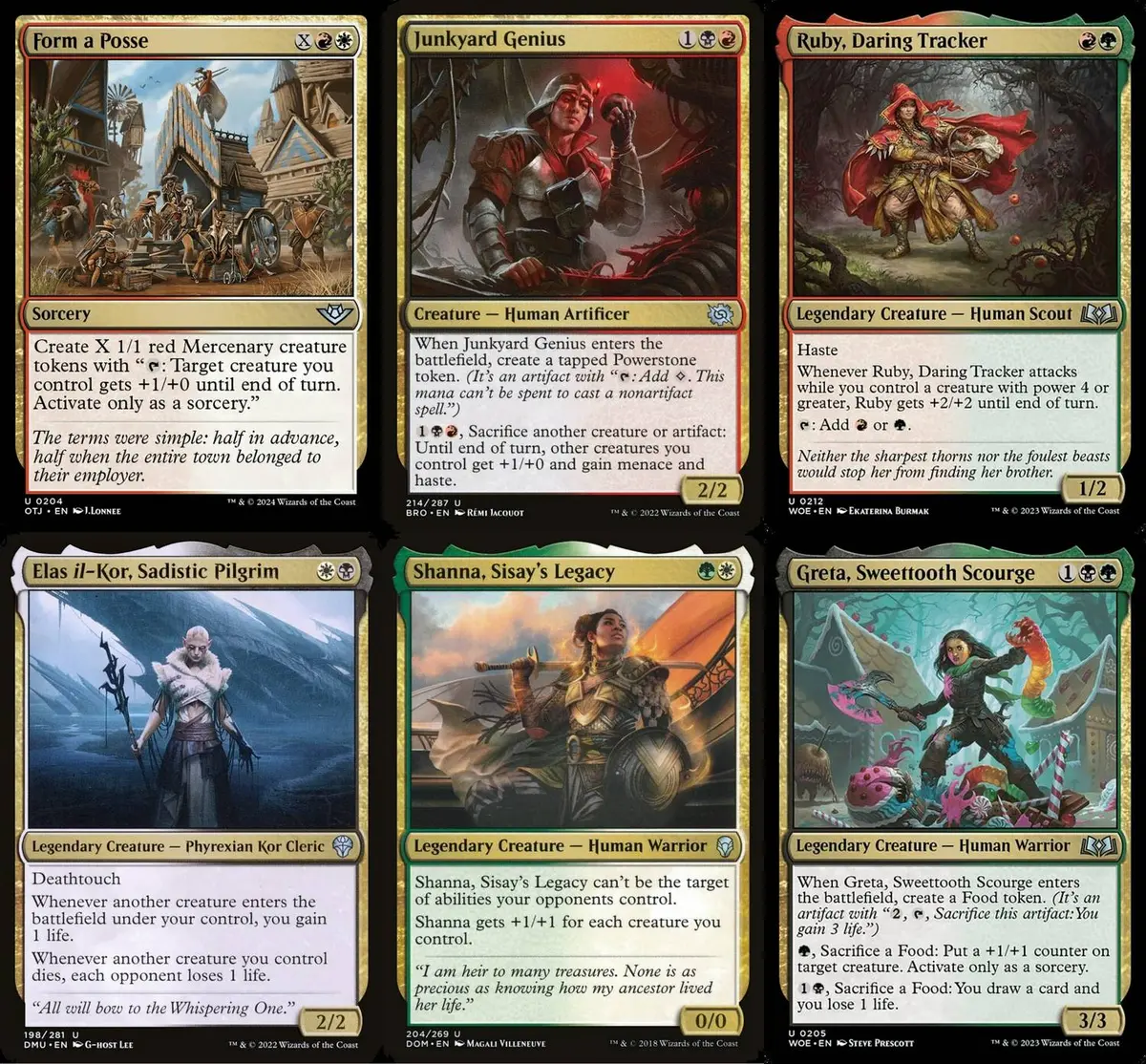
- Red-White: This pair likes being targeted by abilities and spells, so I thought of MKM’s Form a Posse
 making a bunch of Mercenaries to strengthen Red-White valiant
- Red-Black: When you think of aggro you can’t forget BRO’s Junkyard Genius
- Red-Green: Thinking of ramp, I also added WOE’s Little Red Riding Hood Ruby, Daring Tracker

- White-Black: A life-loss mechanic is interesting but BLB’s cards are more cautious, so I thought of DMU’s Elas il-Kor, Sadistic Pilgrim

- White-Green: Because there are so many tokens, I thought of DOM’s Shanna, Sisay's Legacy
 , but I don’t have it, so I used another card instead
- Black-Green: Added the other Food standard-bearer, WOE’s Greta, Sweettooth Scourge

And because both BLB and MKM have hybrid mana creatures, which give players great flexibility in drafting, I also put in the ones for the corresponding color pairs, and it ended up like this:


Next, let me describe the thinking for each color
- Style: I wanted my first CUBE to be something children would like too, so I started building from the small animals of BLB as a base, and also added the very popular Adventure cards from WOE. For other ideas please see the card list
- White:
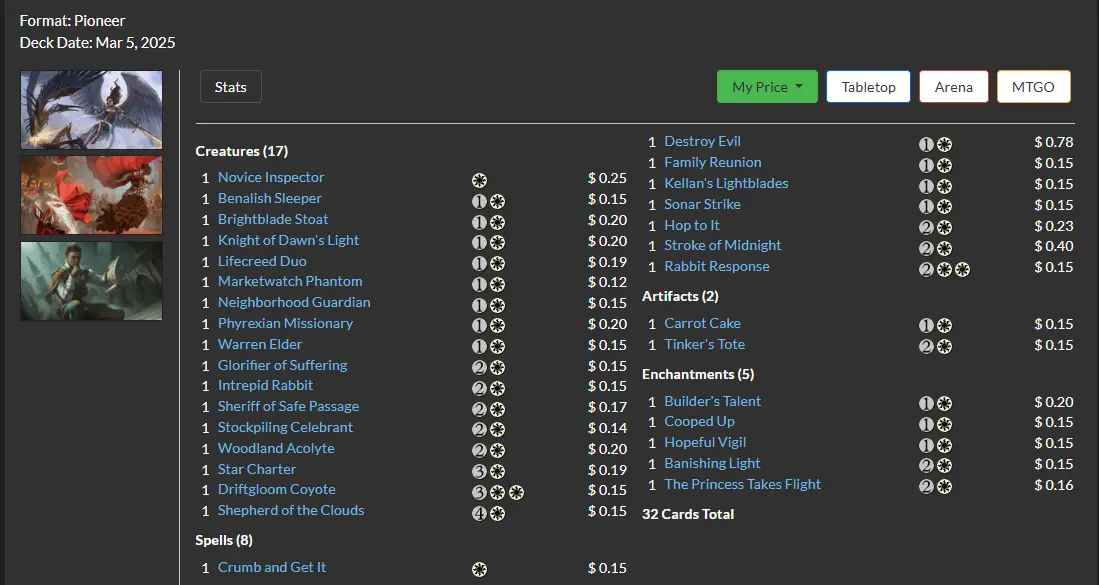
The direction is small creatures and tokens, and I also added MKM’s Marketwatch Phantom and the pony Neighborhood Guardian
 ; I also included Stockpiling Celebrant
 to reuse enchantments or ETB creatures.
- Black:
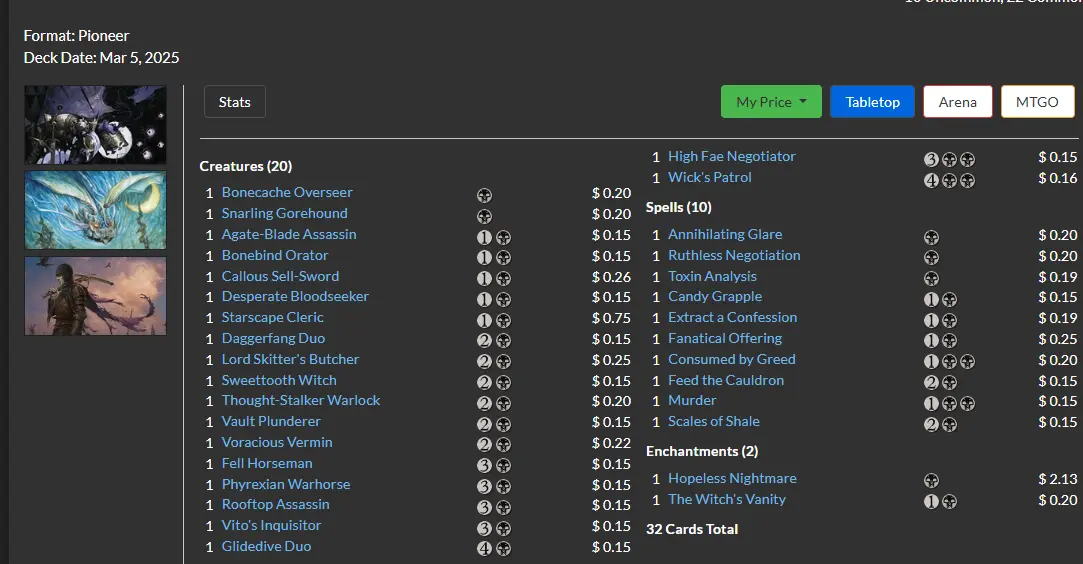
I added Phyrexian Warhorse to give black-white some menace; High Fae Negotiator
 and Wick's Patrol
 serve as finishers for blue-black.
- Red:
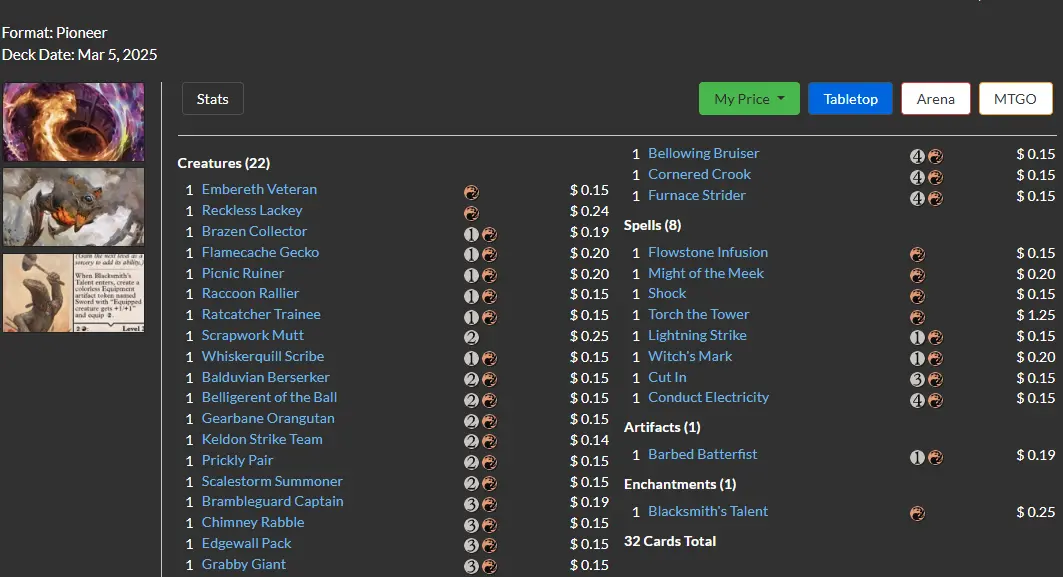
I added quite a few cards that bring two bodies: Chimney Rabble , Edgewall Pack
 , Prickly Pair
 .
- Green:
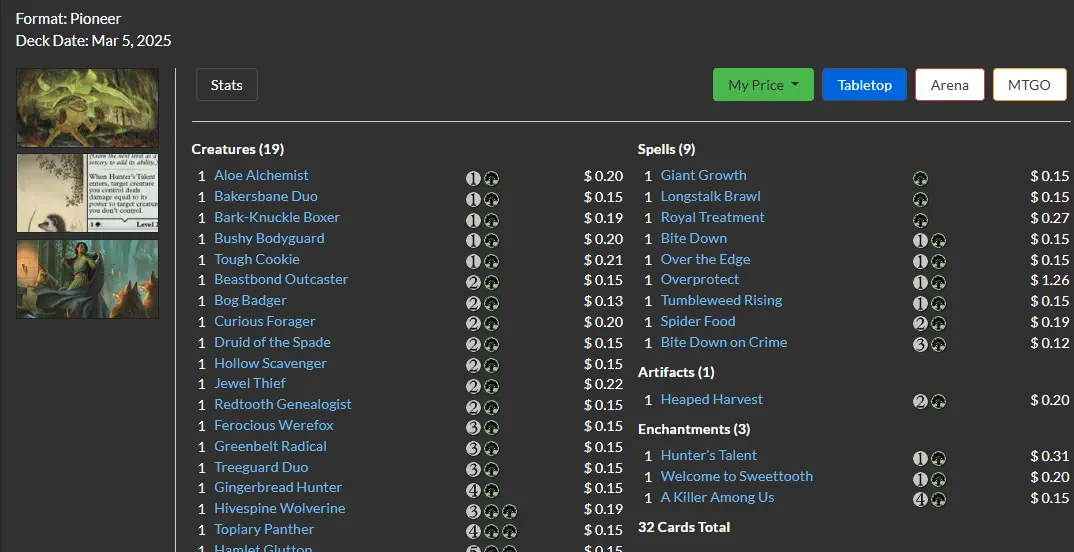
I added SNC’s gem Jewel Thief , and A Killer Among Us
 , a minigame I love in Limited. For green I built toward a board-advantage-heavy direction.
- White:
Done!! You can start testing!! Happy testing.
Design Tools
To do a good job, one must first sharpen one’s tools. Here are some useful tools:
CUBE Websites
- CUBECobra: An indispensable tool for CUBE design
- Scryfall: Card search site
- Scryfall Tagger: A tagging site for individual cards, used to find similar cards
- Lucky Paper: An index site for CUBECobra, with a regularly updated podcast
- CUBECon : A big CUBE gathering abroad; you can refer to its yearly featured CUBEs or tournament CUBEs
Handy Apps
- Android app ManaBox: A tool for organizing your collection and digitizing it
- Deckbox: You can use other sites too; I use this one’s inventory to organize my digital collection
Conclusion
Some time ago YouTube recommended me this video, which ignited my passion for introducing CUBE
CUBE is the Best Way to Play MTG
As the video title says, CUBE is the best way to experience MTG. Through CUBE we can see that even in 2025, paper Magic is still full of vitality. CUBE lets players experience the endless fun of drafting and try countless combinations within a limited number of people and budget. All over the world, many players can interact this way. CUBE also lets forgotten old cards be rediscovered in dark corners and become more valuable.
I hope readers will also try designing their own CUBE at home, then bring it to a card shop you are familiar with, play with friends, and enjoy the fun.
- Title
- What Is a CUBE - Your First Cube
- Author
- dalance
- Created at
- March 7, 2025
- License
- This work is licensed under CC BY-NC-SA 4.0 .