What Is a Timestamp?
Note: This article was translated from Chinese by AI and may contain errors. Read the original Chinese version.
Before We Start
Welcome to the third article of the Layer column (I pulled a Togashi and vanished for two months, but I finally have time to write again). This time we are going to introduce timestamps.
Besides being busy lately and getting held up for a while by articles about the new set, the main reason this one took so long is that I struggled with how to introduce timestamps. Unlike copiable values and characteristic-defining abilities, which were easier to introduce on their own, timestamps are a rule that depends heavily on the layer system, so starting with this article we will have to begin citing the layer rules.
A Brief Look at Timestamps and Layers
Since timestamps are part of the layer system, we first need to say a little about what layers are before talking about timestamps.
A Brief Look at Layers
Layers describe the components that make up an object. The layer system strictly splits an object’s attributes into seven layers, and a layer may contain finer sublayers. Every effect that modifies an object’s characteristics can be sorted into one of these layers. The layers are defined as follows:
- Layer 1: Rules and effects that affect copiable values are applied.
- Layer 1a: Copy effects are applied.
- Layer 1b: Rules about the characteristics of face-down spells and permanents are applied.
- Layer 2: Control-changing effects are applied.
- Layer 3: Text-changing effects are applied.
- Layer 4: Type-changing effects are applied. This includes effects that change an object’s card type, subtype, or supertype.
- Layer 5: Color-changing effects are applied.
- Layer 6: Effects that add abilities, keyword counters, effects that remove abilities, and effects that say an object can’t have an ability are applied.
- Layer 7: Effects that change power and/or toughness are applied.
- Layer 7a: Effects from characteristic-defining abilities that define power and/or toughness are applied.
- Layer 7b: Effects that set power and/or toughness to a specific number or value are applied. Effects that refer to a creature’s base power and/or toughness apply in this layer.
- Layer 7c: Effects and counters that modify power and/or toughness (but don’t set power and/or toughness to a specific number or value) are applied.
- Layer 7d: Effects that switch a creature’s power and toughness are applied.
When multiple effects try to modify an object’s characteristics, that is when layers come into play. Luckily, today we don’t need to fully understand how layers work, because the basic definition of this issue’s star, the “timestamp,” is “multiple effects applying in the same layer or sublayer.” You can also think of it as the principle for handling multiple effects that try to modify the same characteristic at the same time. This is why this issue’s examples stay fairly contained. As for what to do when multiple effects apply across several layers at once, that is the question the final chapter of this column will answer.
A Brief Look at Timestamps
Let’s quickly run through the rule entries related to timestamps (special mechanics like Dungeon and Attraction are omitted). If there are too many technical terms and you can’t get through it, don’t worry. We will cite the relevant rules again when we meet them in the examples later.
Timestamp Rules Text
- 613.7.
Within a layer or sublayer, determining which order effects are applied in is usually done using a timestamp system. An effect with an earlier timestamp is applied before an effect with a later timestamp. - 613.7a
A continuous effect generated by a static ability has the same timestamp as the object the static ability is on, or the timestamp of the effect that created the ability, whichever is later. If the effect that created the ability has the later timestamp and the object with the ability gets a new timestamp, each continuous effect generated by that object’s static abilities also gets a new timestamp, but the relative order between those timestamps stays the same. - 613.7b
A continuous effect generated by the resolution of a spell or ability receives a timestamp when it’s created. - 613.7c
Each counter receives a timestamp when it’s put onto an object or player. If an object or player already has counters of that kind, each counter of that kind gets a new timestamp, the same as the newly placed counter’s timestamp. - 613.7d
An object receives a timestamp when it enters a zone. - 613.7e
An Aura, Equipment, or Fortification receives a new timestamp each time it becomes attached to an object or player. - 613.7f
A permanent receives a new timestamp each time it turns face up or face down. - 613.7g
A double-faced permanent receives a new timestamp each time it transforms or converts. - 613.7m
If two or more objects would receive timestamps simultaneously, such as by entering a zone or becoming attached at the same time, their relative timestamp order is determined by the “APNAP” order (see rule 101.4). Objects controlled by the active player (or, for objects with no controller, owned by that player) have earlier relative timestamps in the order that player chooses, followed by objects controlled (or owned) by each other player in turn order. - 613.10.
Some continuous effects affect players rather than objects (for example, an effect might give a player protection from red). All such effects are applied in timestamp order after the characteristics of objects are determined. - 613.11.
Some continuous effects affect game rules rather than objects (for example, an effect might change a player’s maximum hand size, or say a creature attacks each combat if able). These effects are applied after all other continuous effects have been applied. Continuous effects that affect the costs of spells or abilities are applied in the specific order described in rule 601.2f. All other such effects are applied in timestamp order.
“An effect with an earlier timestamp is applied before an effect with a later timestamp” This statement itself captures the essence of timestamps. If we consider the problems you will actually run into in real games, there is also a more colloquial way to put it: “the latecomer overrides the early arrival.”
Timestamp Rule Examples
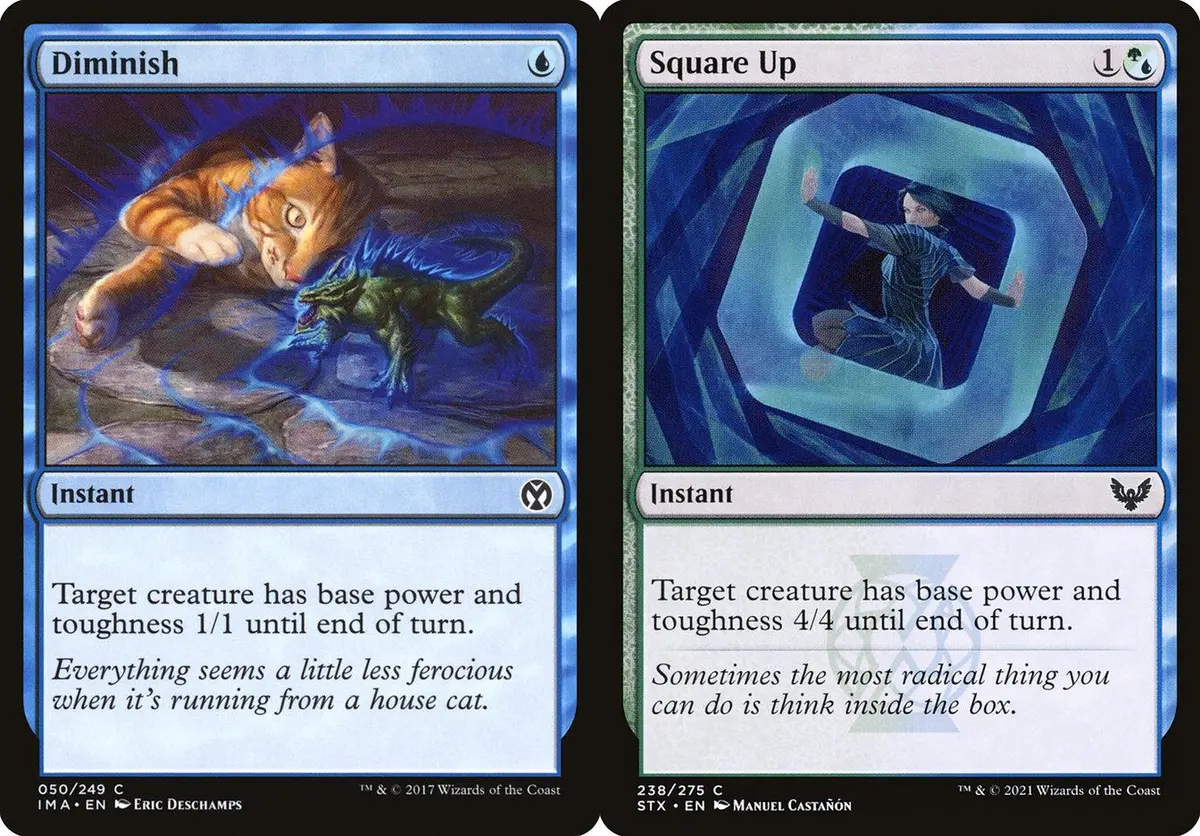
Diminish: Target creature has base power and toughness 1/1 until end of turn.
Square Up: Target creature has base power and toughness 4/4 until end of turn.
A vanilla creature is affected by both Diminish and Square Up in the same turn. Will the creature end up 1/1 or 4/4?
I believe even a newbie on their first day of learning MTG can answer this with confidence: “It becomes whatever power and toughness the last spell to resolve specifies.” That is exactly the core concept of timestamps.
- 613.7.
Within a layer or sublayer, determining which order effects are applied in is usually done using a timestamp system. An effect with an earlier timestamp is applied before an effect with a later timestamp. - 613.7b
A continuous effect generated by the resolution of a spell or ability receives a timestamp when it’s created.
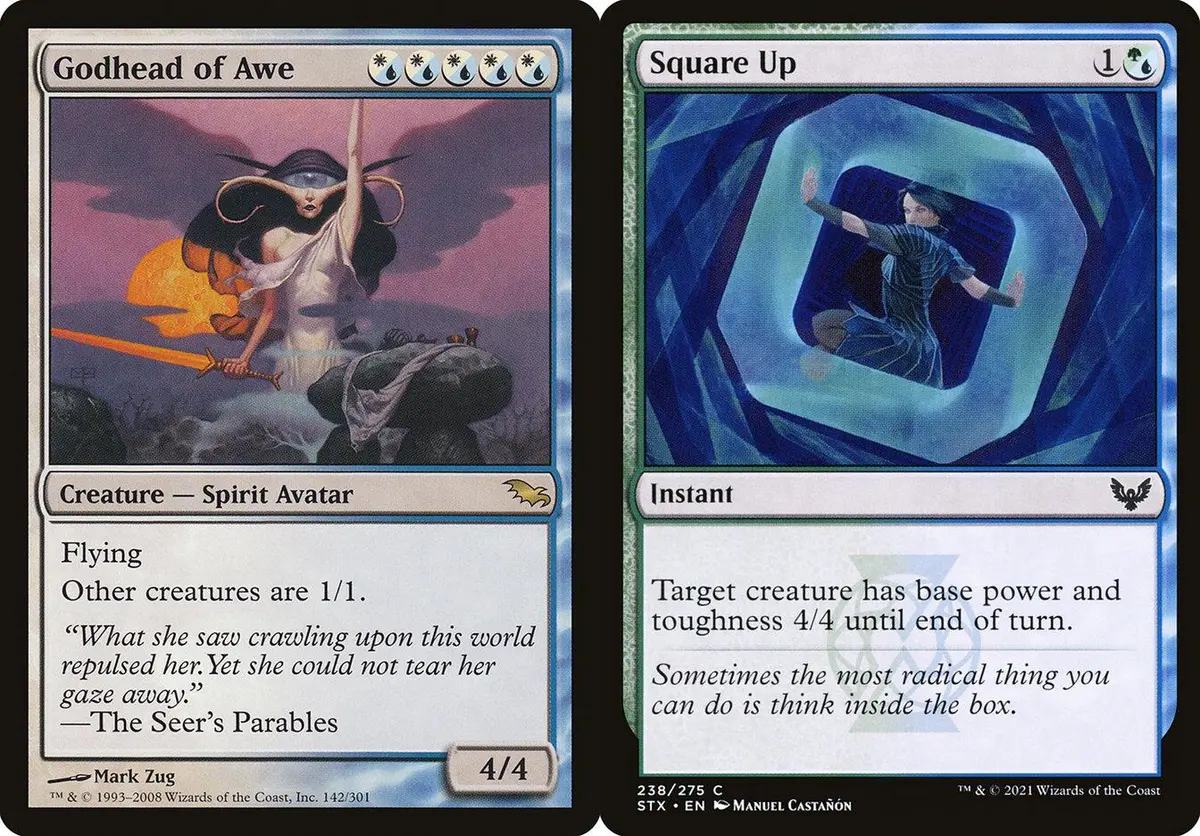
Godhead of Awe: Other creatures have base power and toughness 1/1.
Square Up: Target creature has base power and toughness 4/4 until end of turn.
Now let’s modify the previous question slightly. A creature on the battlefield has had Square Up resolve on it, and then Godhead of Awe enters the battlefield. Is that creature 1/1 or 4/4?
We already know Square Up’s timestamp clearly: it is the moment the spell resolves. Godhead of Awe’s timestamp is the moment that creature entered the battlefield. So if, this turn, Square Up first affected a creature and made it 4/4, and Godhead of Awe entered afterward, then the creature ends up 1/1.
- 613.7a
A continuous effect generated by a static ability has the same timestamp as the object the static ability is on, or the timestamp of the effect that created the ability, whichever is later. If the effect that created the ability has the later timestamp and the object with the ability gets a new timestamp, each continuous effect generated by that object’s static abilities also gets a new timestamp, but the relative order between those timestamps stays the same. - 613.7d
An object receives a timestamp when it enters a zone.
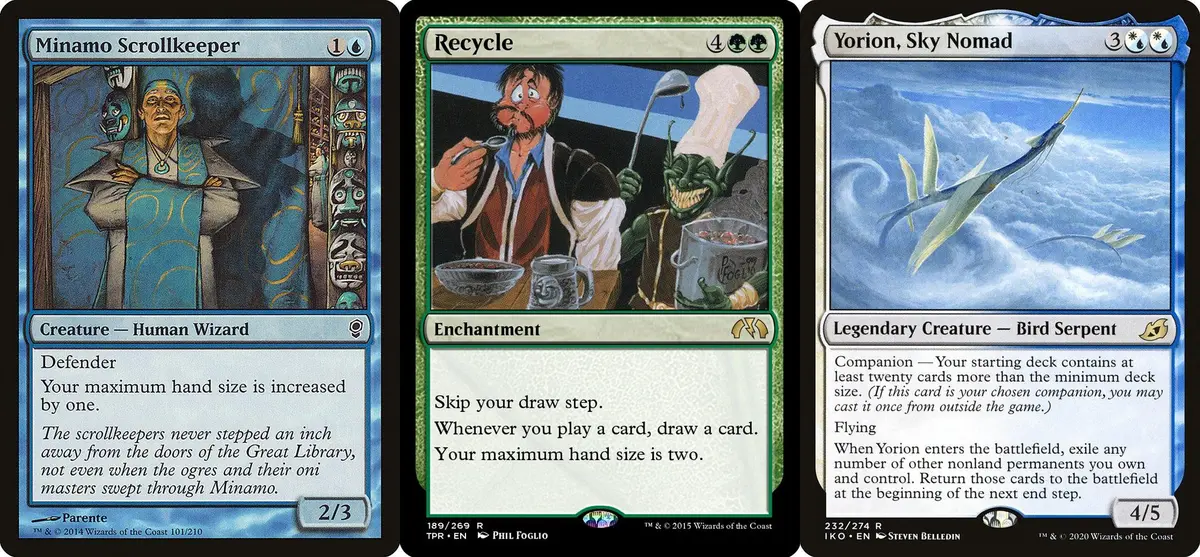
Minamo Scrollkeeper: Your maximum hand size is increased by one.
Recycle: Your maximum hand size is two.
Yorion, Sky Nomad: When Yorion enters the battlefield, exile any number of other nonland permanents you own and control. Return those cards to the battlefield at the beginning of the next end step.
This is exactly the kind of continuous effect mentioned in rule 613.11 that affects game rules rather than objects, and it is likewise handled by timestamp. If Minamo Scrollkeeper enters first and Recycle enters afterward, your maximum hand size is 2 (7+1, then changed to 2). The other way around, it is 3 (7 changed to 2, then +1). So what happens if both permanents enter at the same time (for example, because of Yorion’s ability)?
- 613.7m
If two or more objects would receive timestamps simultaneously, such as by entering a zone or becoming attached at the same time, their relative timestamp order is determined by the “APNAP” order (see rule 101.4). Objects controlled by the active player (or, for objects with no controller, owned by that player) have earlier relative timestamps in the order that player chooses, followed by objects controlled (or owned) by each other player in turn order.
Simply put, if they enter together, you decide the timestamp order of those objects yourself.
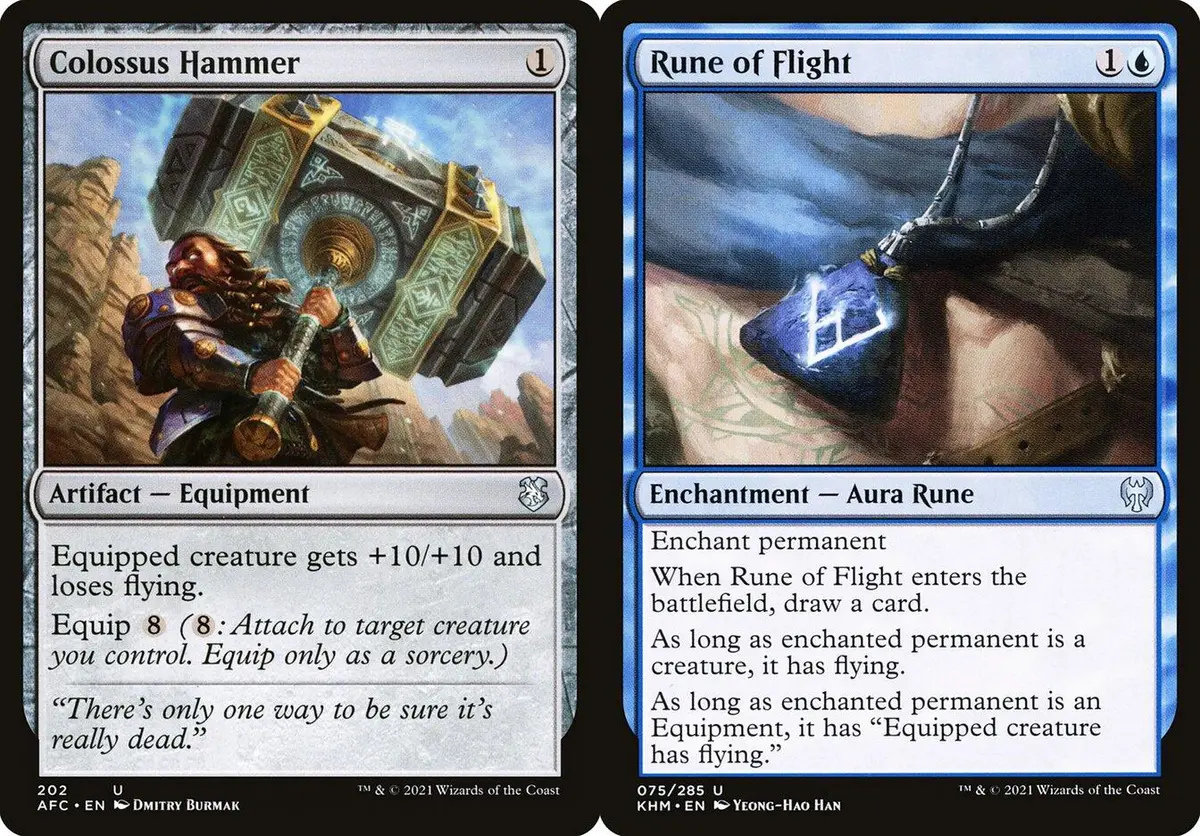
Colossus Hammer: Equipped creature gets +10/+10 and loses flying.
Rune of Flight: As long as enchanted permanent is an Equipment, it has “Equipped creature has flying.”
A Rune of Flight is attached to Colossus Hammer, and then a creature is equipped with that Colossus Hammer. Will the creature gain flying?
Attaching Rune of Flight to Colossus Hammer gives the Hammer “Equipped creature has flying.” The timestamp of this effect is that of Rune of Flight, which means it is later than the timestamp of the Hammer’s own effect (the equipped creature loses flying). Now, when the Hammer is attached to a creature, the timestamps for both gaining and losing flying are updated, but their relative order stays the same. So in the end the creature holding this Hammer gets +10/+10 and has flying.
- 613.7e
An Aura, Equipment, or Fortification receives a new timestamp each time it becomes attached to an object or player. - 613.7a
A continuous effect generated by a static ability has the same timestamp as the object the static ability is on, or the timestamp of the effect that created the ability, whichever is later. If the effect that created the ability has the later timestamp and the object with the ability gets a new timestamp, each continuous effect generated by that object’s static abilities also gets a new timestamp, but the relative order between those timestamps stays the same.
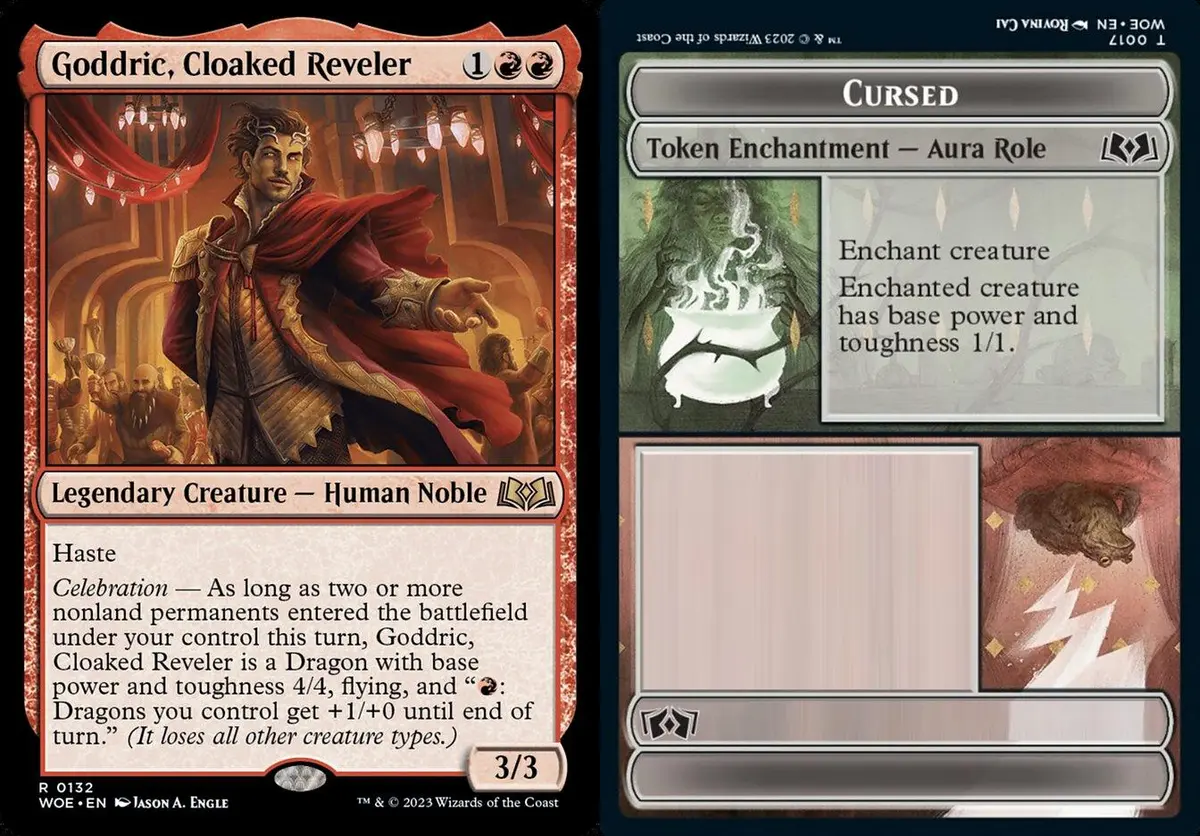
Goddric, Cloaked Reveler: Celebration — As long as two or more nonland permanents entered the battlefield under your control this turn, Goddric, Cloaked Reveler is a Dragon with base power and toughness 4/4, has flying, and has “{R}: Dragons you control get +1/+0 until end of turn.”
Cursed Role (Aura token): Enchanted creature is 1/1.
What happens when Goddric, Cloaked Reveler gets a Cursed Role attached to it? Does it make a difference whether the Role is attached before or after the celebration condition is met? This is a situation you can run into in WOE Limited. Because the Cursed Role only changes the base size and nothing else, here we only focus on Goddric’s ability to become a 4/4 during celebration, and ignore the other ability changes.
Since both belong to the layer 7b effects that set power/toughness, the result is decided by timestamp. The Cursed Role’s timestamp is obviously the moment it was attached to Goddric, so the question is how to figure out the timestamp of Goddric’s own ability that makes it a 4/4 during celebration?
- 613.7a
A continuous effect generated by a static ability has the same timestamp as the object the static ability is on, or the timestamp of the effect that created the ability, whichever is later. If the effect that created the ability has the later timestamp and the object with the ability gets a new timestamp, each continuous effect generated by that object’s static abilities also gets a new timestamp, but the relative order between those timestamps stays the same. - 613.7d
An object receives a timestamp when it enters a zone. - 613.7e
An Aura, Equipment, or Fortification receives a new timestamp each time it becomes attached to an object or player.
First, let’s take a careful look at how Goddric’s celebration ability is written. You will find that it is actually a static ability, not a triggered ability. When you meet the celebration condition, no ability triggers and goes on the stack to say that Goddric transforms. The instant the celebration condition is met, Goddric is already a 4/4. This static ability has actually been working since the moment Goddric entered the battlefield. It simply doesn’t rewrite any of Goddric’s characteristics while you don’t meet the celebration condition, but that doesn’t change the fact that the ability is continuously in operation.
In other words, the timestamp of Goddric’s celebration ability equals the time Goddric entered the battlefield, while the timestamp of the Cursed Role attaching to a creature is certainly later than the timestamp of the creature entering. So in the end, whether or not celebration is active, Goddric is a creature with base power and toughness 1/1.
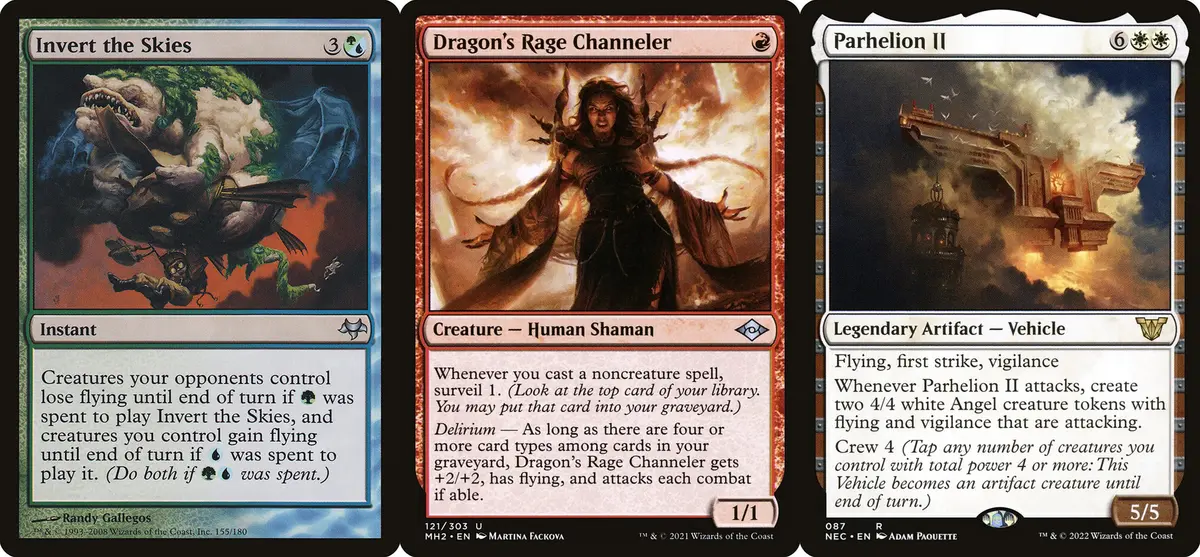
Invert the Skies: If {G} was spent to cast Invert the Skies, creatures your opponents control lose flying until end of turn. If {U} was spent to cast it, creatures you control gain flying until end of turn. (If {G}{U} was spent, both happen.)
Dragon’s Rage Channeler: Delirium — As long as there are four or more card types among cards in your graveyard, Dragon’s Rage Channeler gets +2/+2, has flying.
Parhelion II: A Vehicle with flying.
Suppose you paid {G} when casting Invert the Skies, which makes the creatures your opponent controls lose flying until end of turn. Your opponent has a Dragon’s Rage Channeler that has not yet reached delirium, and it reaches delirium only after Invert the Skies resolves. Will Dragon’s Rage Channeler have flying?
This question is actually handled by exactly the same rule as the Goddric example above. The difference is that the earlier example was about size, and now we are talking about gaining and losing abilities. The timestamp of Dragon’s Rage Channeler’s delirium ability equals the time it entered the battlefield. So as long as Dragon’s Rage Channeler was on the battlefield first and Invert the Skies resolved afterward, it doesn’t matter whether the delirium condition is met before or after Invert the Skies. Dragon’s Rage Channeler will not have flying.
What if the affected object on the opponent’s side is Parhelion II instead? If you look closely at Invert the Skies’ conditions, it only affects the opponent’s creatures. If Parhelion II is not yet a creature when Invert the Skies resolves, it is completely unaffected by Invert the Skies. If Parhelion II is already a creature when Invert the Skies resolves, just treat it like any ordinary creature with flying.
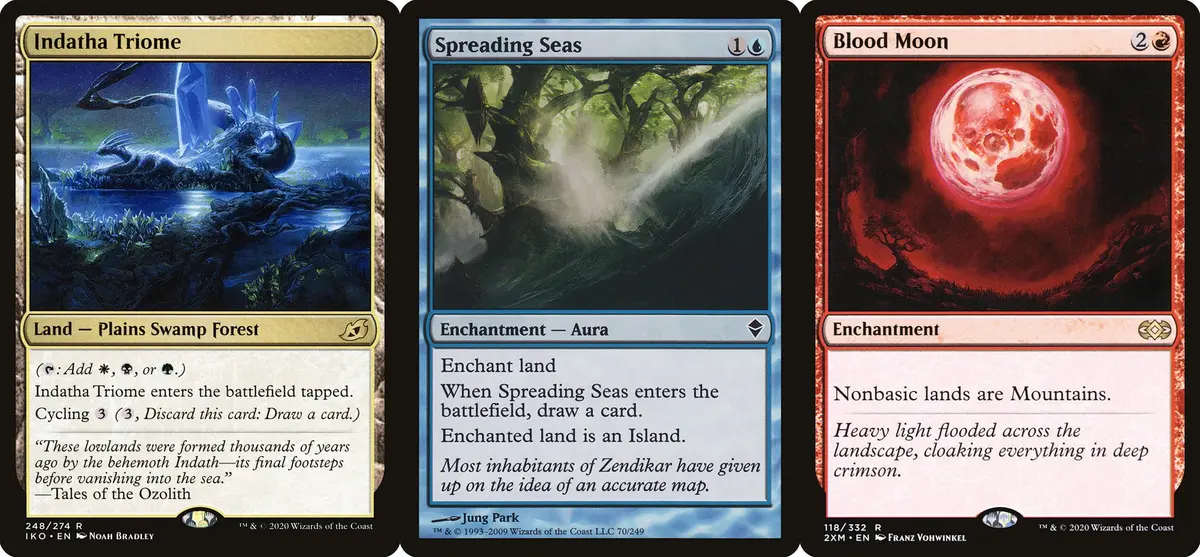
Indatha Triome: A nonbasic land.
Spreading Seas: Enchanted land is an Island.
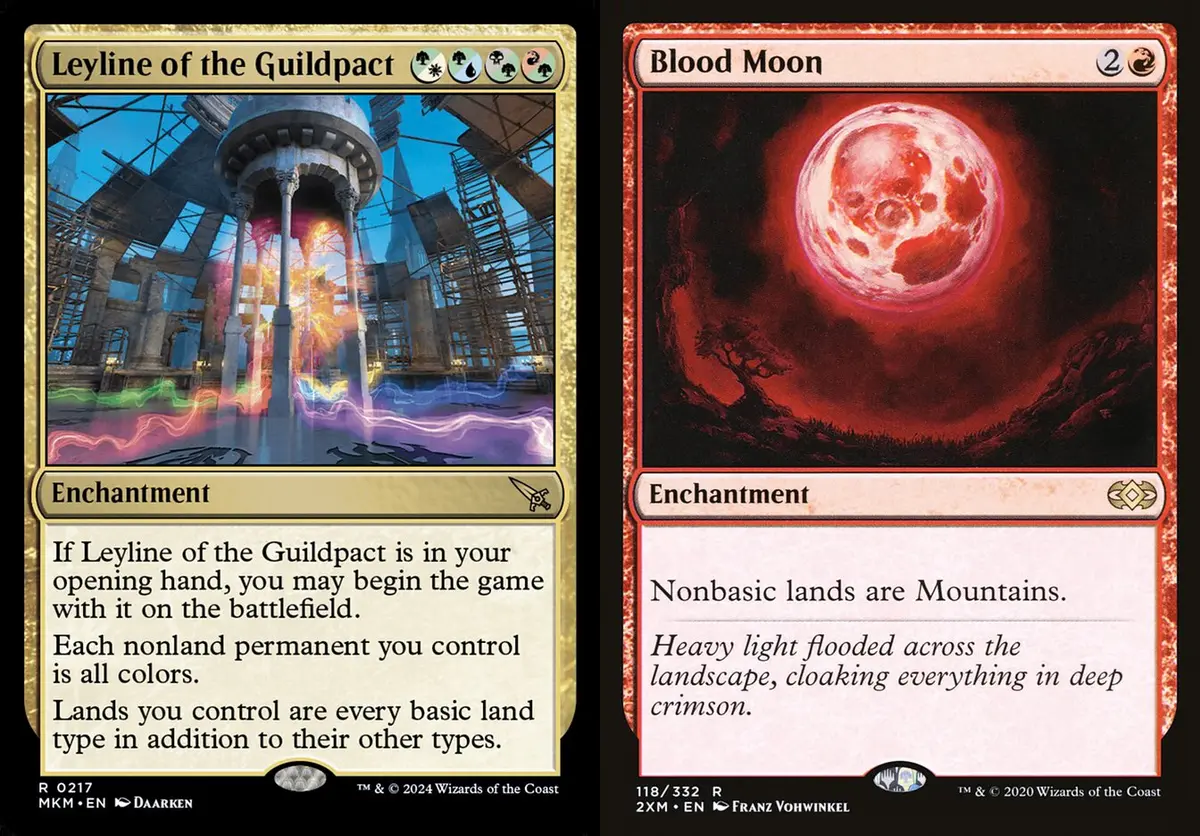
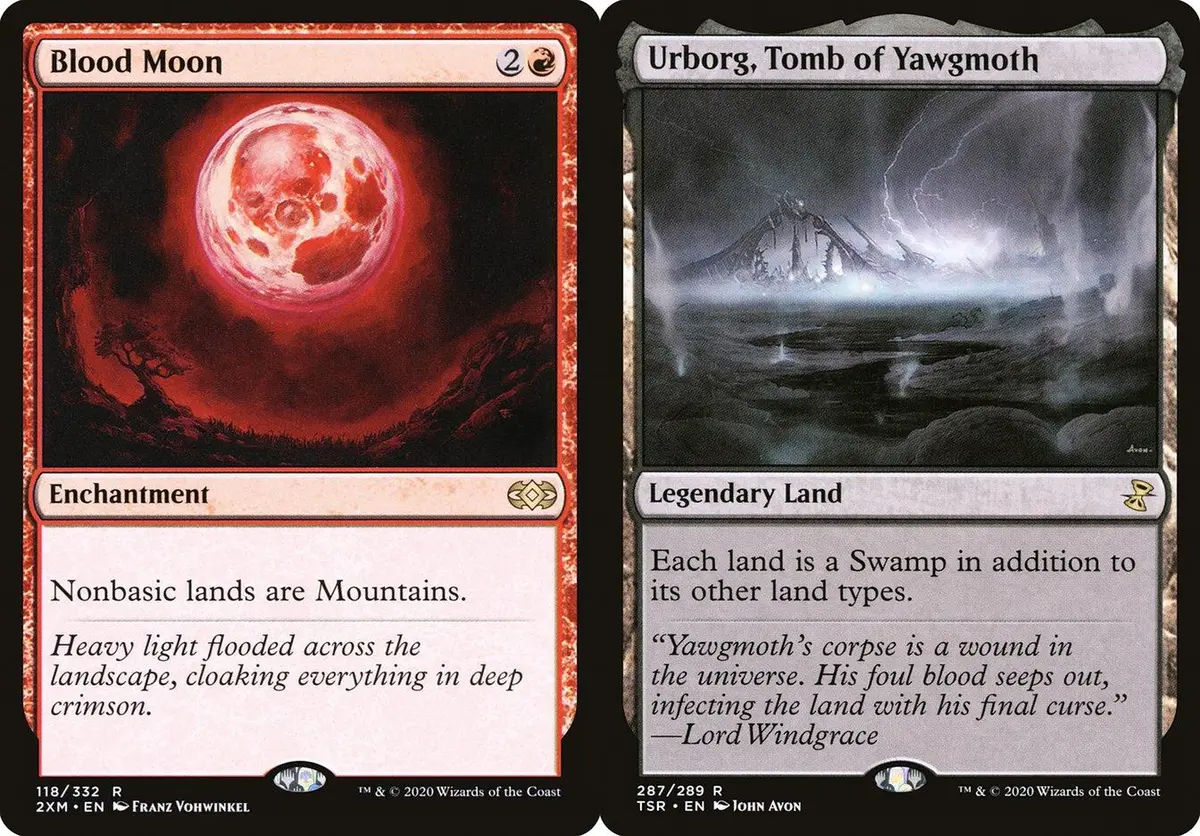
Blood Moon: Nonbasic lands are Mountains.
With Blood Moon on the battlefield, Indatha Triome is also enchanted with Spreading Seas. Is this land an Island or a Mountain?
Spreading Seas and Blood Moon are both type-changing effects, so you only need to compare their timestamps. The one that arrived later overrides the one that arrived earlier.
The effects of rewriting a land’s type are also worth an extra article of their own. To keep this article from getting too long, I won’t go into detail here. You can first refer to the cited rule text:
- 305.7. If an effect sets a land’s subtype to one or more of the basic land types, the land no longer has its old land type. It loses all abilities generated from its rules text, its old land types, and any copiable effects affecting that land, and it gains a mana ability corresponding to the new basic land type or types. Abilities granted to the land by other effects aren’t lost. Setting a land’s subtype doesn’t add or remove any card types (such as creature) or supertypes (such as basic, legendary, and snow) the land may have. If an effect adds a land type in addition to the land’s existing land types, the land keeps its land types and rules text, and gains the new land type and mana abilities.
Related article: Why Did Urza’s Saga Blow Itself Up
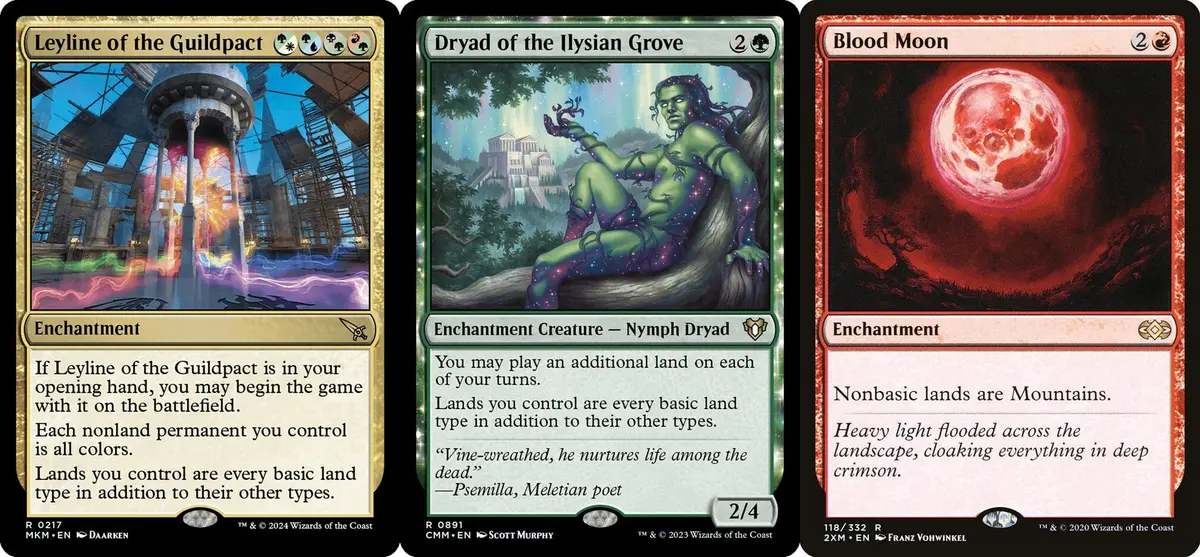
Leyline of the Guildpact & Dryad of the Ilysian Grove: Lands you control are every basic land type in addition to their other types.
Blood Moon: Nonbasic lands are Mountains.
In essence, this question is no different from the previous one, but this case happens far too easily in Modern, so it’s worth stressing once more.
If Leyline of the Guildpact (or Dryad of the Ilysian Grove) and Blood Moon are on the battlefield at the same time, will a land be a Mountain or every basic land type?
First, Blood Moon doesn’t affect basic lands, so basic lands simply have every basic land type in addition to their other types. For nonbasic lands, both effects want to change the type at the same time, so once again we compare timestamps. Note, though, that no matter what order Leyline of the Guildpact and Blood Moon take effect in, your nonbasic lands will lose their original types and abilities (because of Blood Moon).
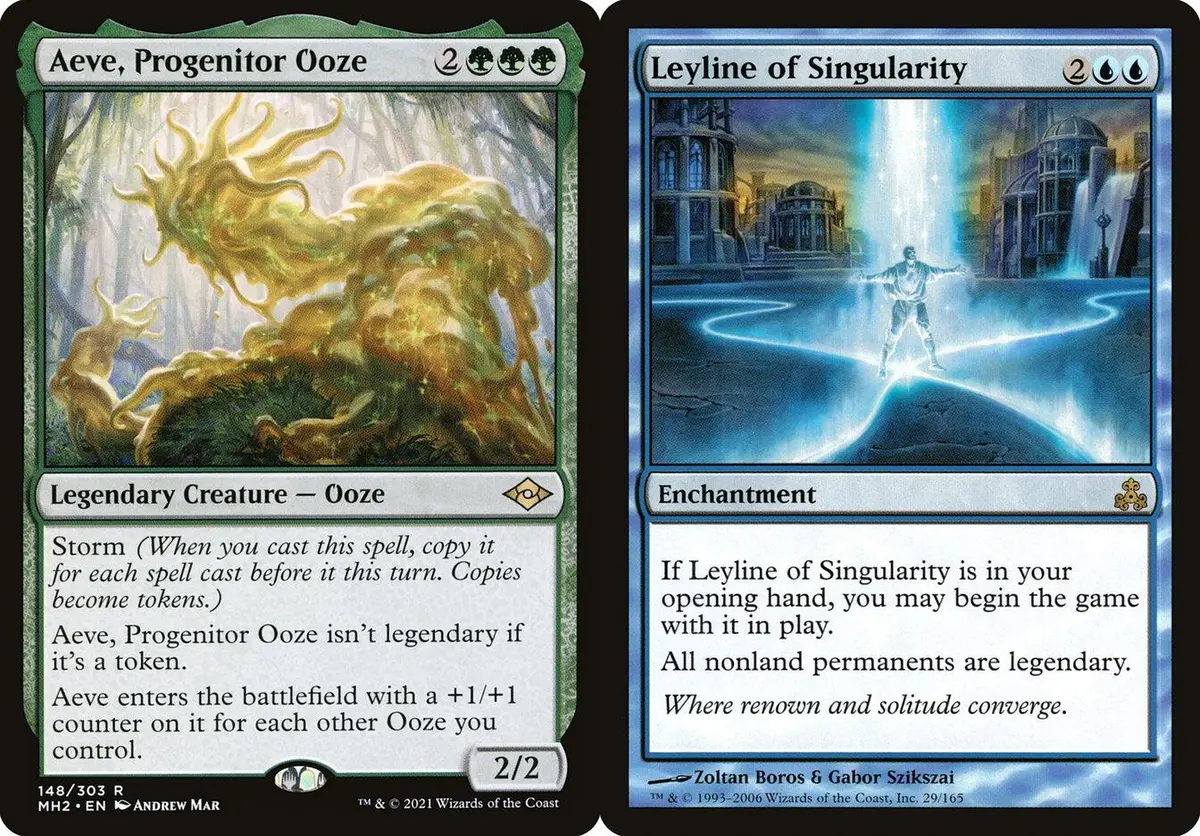
Aeve, Progenitor Ooze: Storm (When you cast this spell, copy it for each spell cast before it this turn. The copies become tokens.)
If Aeve, Progenitor Ooze is a token, it isn’t legendary.
Leyline of Singularity: All nonland permanents are legendary.
The ability that makes an Aeve, Progenitor Ooze token not legendary has a timestamp equal to its time of entering the battlefield. When there are multiple Aeve, Progenitor Ooze tokens and a Leyline of Singularity on the battlefield at the same time, whether those tokens are legendary depends on both timestamps. If the Aeve tokens were on the battlefield first and Leyline of Singularity entered afterward, then the instant Leyline of Singularity enters, the Aeve tokens become legendary and the legend rule applies to them.
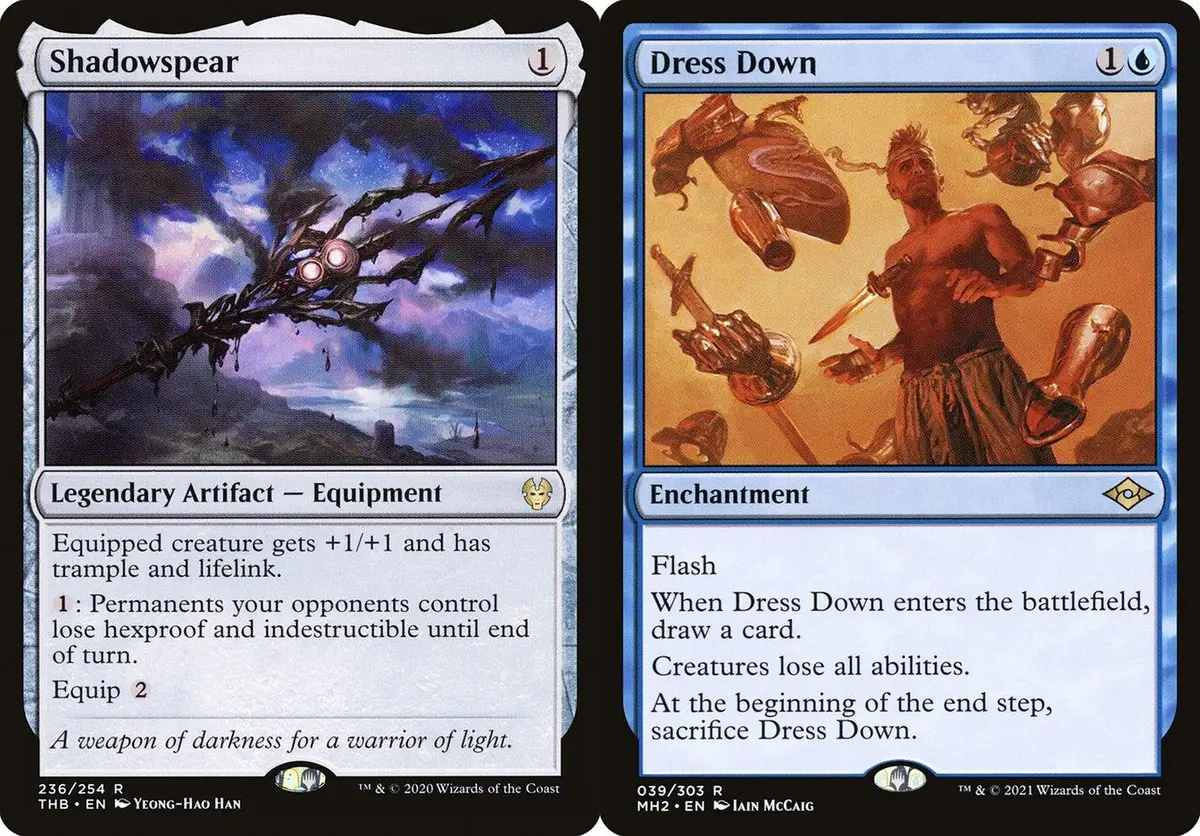
Shadowspear: Equipped creature gets +1/+1 and has trample and lifelink.
Dress Down: Creatures lose all abilities.
If a creature is equipped with Shadowspear and Dress Down is on the battlefield, does the creature have trample and lifelink?
Now there are two effects, one that wants creatures to gain abilities and one that wants them to lose abilities, so naturally we compare the timestamps of the two effects. Dress Down is simple: it is the time it entered the battlefield. Shadowspear is a bit more complicated. It is true that the Equipment has a timestamp from when it entered the battlefield, but when the Equipment becomes attached to a creature, it gets a new timestamp. So the answer to this question depends on the order of two events: when Shadowspear was equipped and when Dress Down entered.
If a creature is equipped with Shadowspear first and Dress Down enters afterward, the creature loses all abilities, including trample and lifelink. But if Shadowspear is unattached and then equipped again, the creature can gain trample and lifelink.
- 613.7e
An Aura, Equipment, or Fortification receives a new timestamp each time it becomes attached to an object or player.
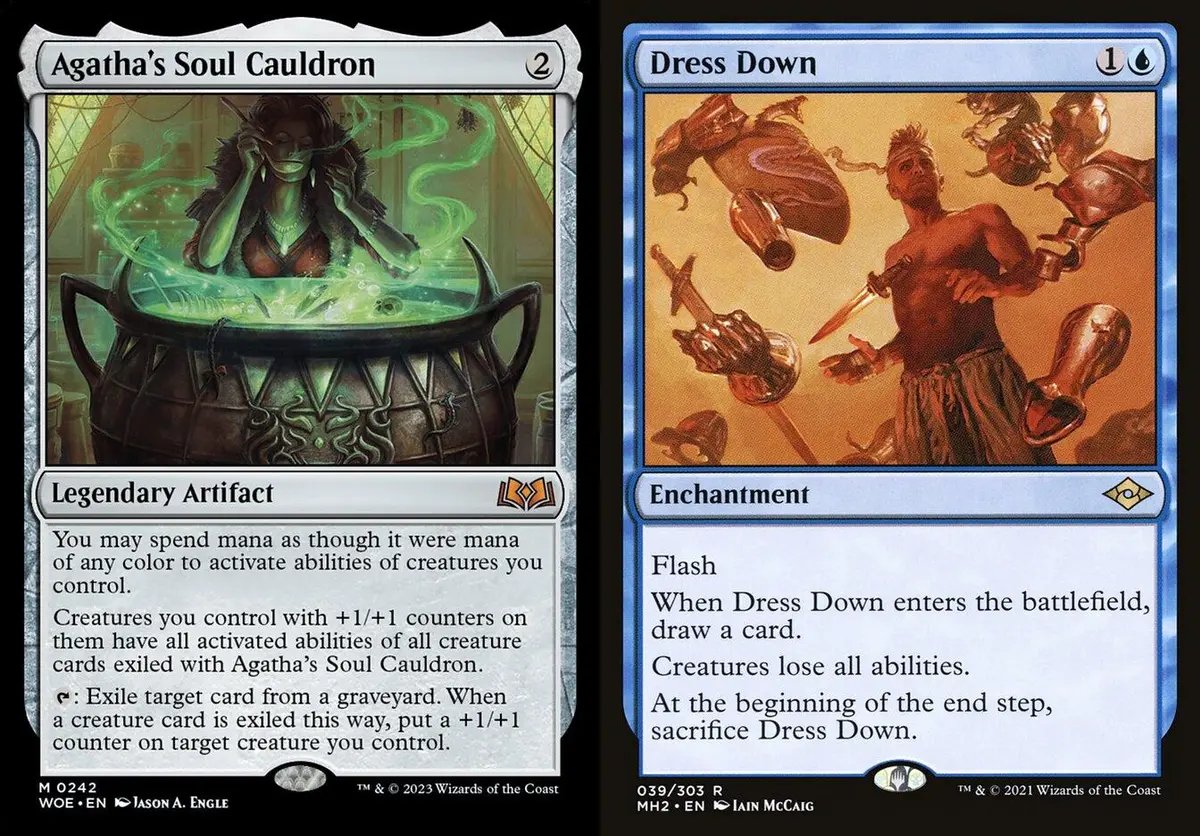
Agatha’s Soul Cauldron: You may spend mana as though it were mana of any color to activate abilities of creatures you control.
Creatures you control with +1/+1 counters on them have all activated abilities of all creature cards exiled with Agatha’s Soul Cauldron.
{T}: Exile target card from a graveyard. When a creature card is exiled this way, put a +1/+1 counter on target creature you control.
Dress Down: Creatures lose all abilities.
Agatha’s Soul Cauldron is hereafter called the “Cauldron.” Suppose the Cauldron has exiled a Birds of Paradise before. From then on, your creatures with +1/+1 counters will all have Birds of Paradise’s mana ability ({T}: Add one mana of any color).
The Cauldron is already on the battlefield first, then Dress Down enters, then a Young Wolf enters, and finally the Cauldron uses its ability to put a +1/+1 counter on the Young Wolf. Can this Young Wolf gain Birds of Paradise’s mana ability?
Now we have to ask a question: “How is the timestamp of the effect that lets a creature gain the Cauldron’s granted ability calculated?”
Is it the time the creature entered the battlefield? No!
Is it the time the creature got the +1/+1 counter? No!
The answer is: “The time the Cauldron itself entered the battlefield!”
For the principle, you can refer to the two earlier examples, Goddric’s celebration and Dragon’s Rage Channeler’s delirium. You will find that the Cauldron’s ability is a static ability that has been continuously working since the instant it entered the battlefield. The only difference is that it doesn’t affect your creatures while they have no +1/+1 counters. When your creature gets a +1/+1 counter doesn’t affect the timestamp of the Cauldron’s effect.
So, back to the original example: because the Cauldron entered before Dress Down, Dress Down has the later timestamp, so even after getting a +1/+1 counter, the Young Wolf will not gain Birds of Paradise’s mana ability. In this example, the time the Young Wolf entered is completely irrelevant. However, if you later slam down a new Cauldron and choose to sacrifice the old one to the legend rule, that new Cauldron can grant creatures abilities without being affected by Dress Down (of course, you have to exile a card from a graveyard again).
- 613.7a
A continuous effect generated by a static ability has the same timestamp as the object the static ability is on, or the timestamp of the effect that created the ability, whichever is later. If the effect that created the ability has the later timestamp and the object with the ability gets a new timestamp, each continuous effect generated by that object’s static abilities also gets a new timestamp, but the relative order between those timestamps stays the same.
Next: Dependency
In fact, timestamps are an intuitive rule in themselves, and the phrase “the latecomer overrides the early arrival” pretty much explains it. Occasionally some effects create their timestamps at a more counterintuitive moment (for example, the Agatha’s Soul Cauldron case above), but the main difficulty is actually in judging when the timestamp rule applies (or rather, judging whether these effects are in the same layer).
This issue kept the example questions as limited as possible to effects that affect the same layer, or ignored the effects those effects also have on other layers. When the layers are fully explained in the future, there will be many cases that affect multiple layers at once. By then the distractions multiply, and judging the influence of timestamps will no longer be so intuitive.
But layer problems don’t necessarily have to involve many layers to be hard. Even effects working in a single layer can leave people dizzy. Yes, I’m talking about you! The star of the next issue: Dependency
In the author’s subjective ranking, dependency is the hardest part of layers. In fact, among all the example questions in the database I have prepared, the most difficult one will appear in the next issue, so please look forward to it.

- Title
- What Is a Timestamp?
- Author
- Jru
- Created at
- March 23, 2024
- License
- This work is licensed under CC BY-NC-SA 4.0 .