What's Going On with Modern Lately?

Note: This article was translated from Chinese by AI and may contain errors. Read the original Chinese version.
Before We Start
Recently some people have started discussing “why Modern is no longer as fun as it used to be”. Especially after PT LTR, we’ve found that the competitive scene can be split into roughly three types of decks:
- Scam: strip two good cards from your hand on turn one, and enjoy
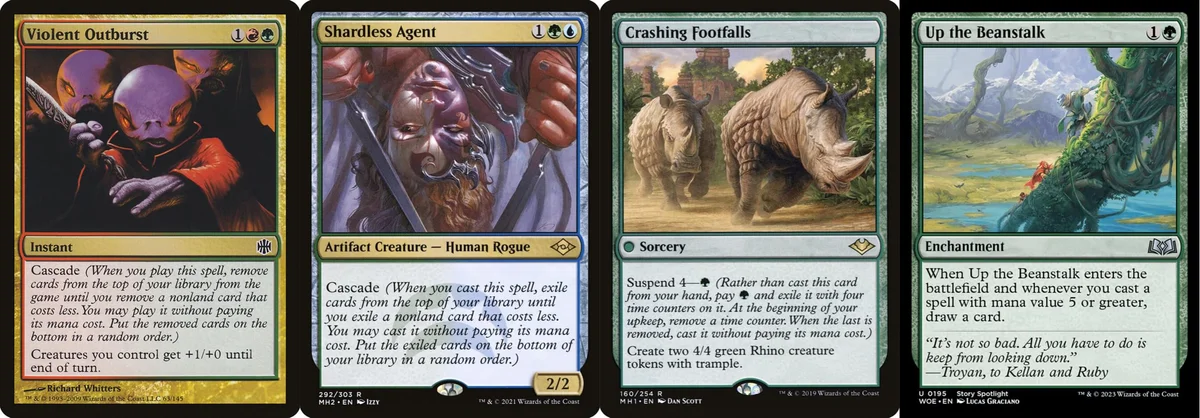
- Cascade: who says you can only have four copies of a card in your deck?
- You do your thing, I do mine: I’ll just turtle up and see who wins first
Let’s start with Scam. After LTR brought Orcish Bowmasters, it surged to the top. What used to be most feared was the resource gap an opponent opens up with a mid-game burst, and now an opponent using draw effects to pull ahead in resources has to bear more risk than ever: the more you draw, the more it hurts, and the sooner the opponent can call the game.
Cascade, on the other hand, is the other extreme: find the most brutal board (Shardless Agent into Crashing Footfalls) or find a pile of draw engines (into Up the Beanstalk), and crush the opponent with a board/resource gap they can’t catch up to.
Finally there are the turtle decks: I do my own thing, and if you affect me, so be it; I’ll keep going for my topdecks (like Green Tron and Amulet Titan), and when I draw the right thing, I’m going to kill you.
So What Is Going On?
Of course, not every match is equally boring. Even among these top meta decks there are plenty of details to watch for, and the plays between experts are still exciting: the flashy Kiki + Dauthi plays, and cascade Rhinos in the hands of a skilled pilot being a Murktide that wins even faster, especially after sideboarding.
But more often it isn’t like that. Many times it goes like
The opponent slams a Shardless Agent on turn three, I try to fight back once and get countered, and then there’s no then.
or
The opponent plays Grief + Feign Death on turn one and takes two cards from my hand, then slams an extra monkey to gain resources and removes my creature once more, and I lose.
Although not every Scam or Rhinos match is this extreme, it reflects a problem from the side: single-card value has inflated too much, and as a result “whether you have the hate card” matters more than “the resource gap” and “playing correctly”.
Back when Jund midrange was dominant, you won by a card or half a card of advantage through various plays and board trades; now you might casually crack a The One Ring to draw once, or get a single Up the Beanstalk trigger, and that’s already made up, never mind the even greater resources every turn after.
For a while there was a joke in our friend circle: building a deck nowadays means first stuffing in four Up the Beanstalk, then thinking about which cheat-y expensive cards you could fit in.
To put it simply and bluntly: today’s cards are all too strong, and sometimes you don’t necessarily lose even after giving away a few turns.
To put it in more detail: today’s cards all have too much margin for error, so the situation where one misplay gets severely punished and loses you the game happens less often than before.
Sir, the Times Have Changed
Free spells have always been Legacy’s privilege. Although Modern still has free spells, they’re still only usable by a small number of decks.
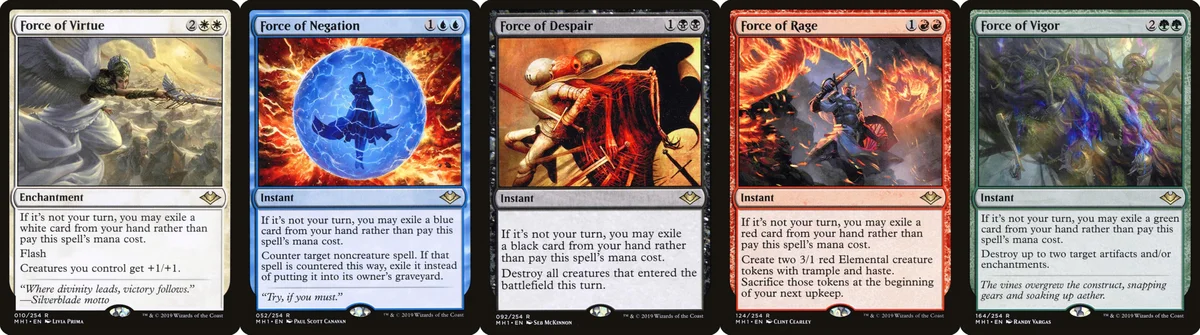
Until Modern Horizons 1 (MH1) was released, when a powerful cycle of free spells joined the environment.
These spells are so powerful (especially Force of Negation and Force of Vigor) that you can see them even in the Legacy environment.
But at best these cards are defensive: they can’t proactively do anything, and they can’t be cast for free on your own turn. Although they let you defend without paying, it hadn’t yet reached the point of completely wrecking the environment, and at least it gave the opponent a turn cycle to try to find an answer.
But WotC went further and further astray on the road of free spells. In MH2, besides trickling Shardless Agent down into Modern to make the cascade system more complete, they also added another, even more powerful free spell cycle: the Elemental Incarnations.
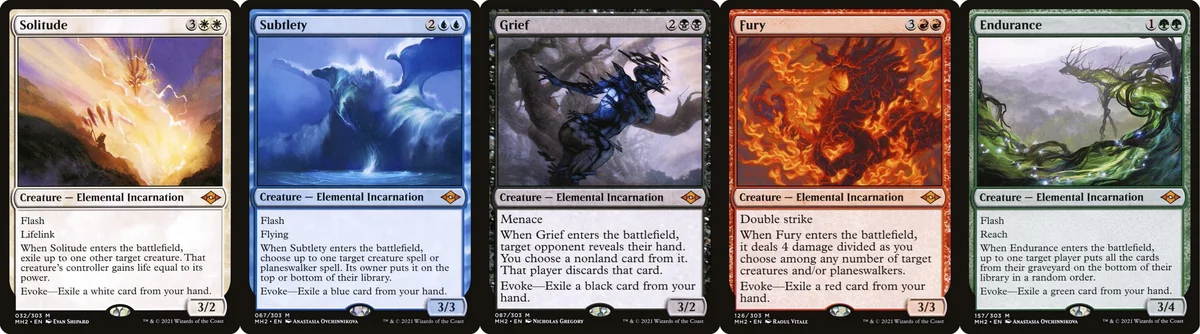
These Elementals are creatures that can only be cast on your own turn, which doesn’t sound that bad.
WotC R&D: Got it, we’ll give three of them flash.
Free graveyard hate, a free Swords to Plowshares, a free counter for creature and planeswalker spells (oh wait, we can’t call it a counter, it’s bounce: put the creature or planeswalker spell on top or bottom of the library).
Not to mention a free sorcery dealing four to a creature or planeswalker, and a free Thoughtseize, and since they’re creatures, you can’t even counter them with Force of Negation.
Although MH2 has been out for a long time (more than two years now), I still remember when it was just released: turn-two 5/5 Murktide, turn-two digs for Feasting Troll King, all kinds of fancy Urza’s Saga plays, and so on.
But as the environment evolved, decks went from the Lurrus era of chasing one-mana plays that do one thing and can be used again later if removed, to Murktide no longer pursuing the brutal turn-two 5/5 flyer and abandoning the somewhat clunky Archmage’s Charm, announcing the arrival of an era where a two-mana cap is the standard for top-tier Modern decks.
But not every deck joined this trend. Let’s take Dimir Control as an example, with this opening hand:
3x Lands
1x Fatal Push
1x Archmage’s Charm
1x Counterspell
1x any other card
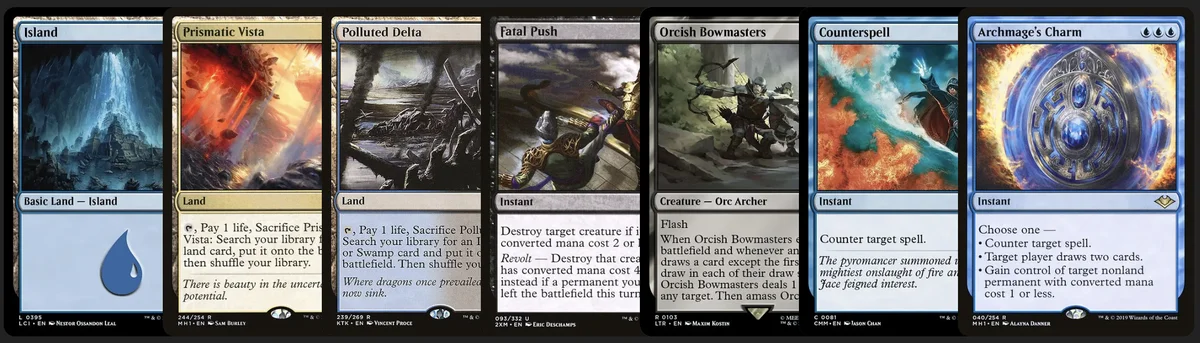
For a control deck this is a good hand and you should keep it, but what if I told you this is a sideboard game and the opponent is Rakdos Scam? What if the opponent has Grief + Feign Death on turn one?
If it were me, I’d think: once I eat a turn-one Grief + Feign Death it’s over, and I’d probably bite the bullet and mulligan looking for Subtlety.
Some people may find it strange; aggressively mulliganing in Modern to find a hate card should be normal, right? But those cards are almost all “if it lands, I win” cards (for example, slamming Stony Silence on turn two against Green Tron, finding Damping Sphere
against Storm, or finding Leyline of Sanctity against Boros Burn), and the penalty for aggressive mulligans is smaller in those matches, since the nature of the match has changed.
But in the matchups we mentioned earlier, what is the consequence of aggressively mulliganing to find Subtlety?
Let’s analyze it. Suppose our opening seven has no Subtlety, so we mulligan once to look for it. Normally, after one mulligan you already have to keep, otherwise mulliganing further and discarding two cards from the opening hand just to dodge Scam means, in a way, the opponent has still achieved their goal.
Now let’s talk about hate cards. Essentially Scam is still a midrange deck. What if the opponent doesn’t have a turn-one Feign Death and instead slowly plays Ragavan, Nimble Pilferer on turn one, Dauthi Voidwalker on turn two, and Fable of the Mirror-Breaker on turn three? Should we discard two cards from hand to throw Subtlety at these one- and two-drops? It feels like a big loss, but saving it for four mana is also weird; unless the opponent does the evoke + Feign Death play, we’d almost never cast Subtlety, so in other words we wasted a card of resources on a situation that may never occur.
But this is all out of necessity. Who wants to waste cards? If the environment weren’t going to kill me before I even played a single land, who would want to play this kind of card?
The Burn Deck That Didn’t Care About Your Patches
Around June or July last year, I had this conversation with a friend:
Friend: Your Azorius control is gone, so what do you want to play in Modern next?
Me: I don’t know, I tried Rock and I tried Yawgmoth, but neither feels right. Maybe I’ll build Boros Burn. It doesn’t need lots of practice, and I don’t care how you update the format, so nice; call me when a red card that deals four to the face comes out.
Friend: True, Burn hasn’t moved for a long time. Basically it’s just changing a bit of the sideboard for the environment.
Then I got slapped in the face. Today’s Boros Burn decklist is far, far from what it used to be: Eidolon of the Great Revel has vanished from the deck entirely, replaced by Roiling Vortex; Lightning Helix has also disappeared, all replaced by highly targeted cards like Skullcrack.
Taking these two biggest changes together: in the past we relied on Eidolon, a card that hurts friend and foe alike, and on Lightning Helix, which could be pointed at creatures to clear the board.
The old Burn wasn’t as mindless as it is now: when to clear the board so Eidolon survives another turn or two to deal four or six more damage, when to throw Lightning Helix first to regain life, when to throw Boros Charm first to steal more damage or hold it to protect Eidolon, when to push with creatures and when to chump block; questions of many different dimensions.
And now? Eidolon gets removed in countless painless ways (Leyline Binding, Solitude, Fury, Force of Vigor, etc.), or it deals two damage and then gets removed, gaining three extra life isn’t important because you’re about to take ten anyway, dealing one more damage makes no difference because you’re about to gain seven; situations like these happen every day.
It’s not just Boros Burn; many more decks have likewise vanished into the tide of the times. This echoes the section I mentioned earlier, Sir, the Times Have Changed: while you’re still practicing swordsmanship to make a name for yourself in the world, the opponent holds a firearm and tells you hesitation is defeat.
Swords basically can’t beat guns head-on; you either join the Ashina swordsmanship crowd and everyone abandons martial ethics together, or you strike more insidiously and in the dark, reaching for the vital points with every move.
In the end Boros Burn could only go the latter route: everyone is paying life to do things early and healing back later, so I have no choice but to stuff in cards that can’t gain life; if I can’t win the mid to late game, I have no choice but to keep the game from reaching it. If the environment didn’t force me, I wouldn’t want to be this twisted either.
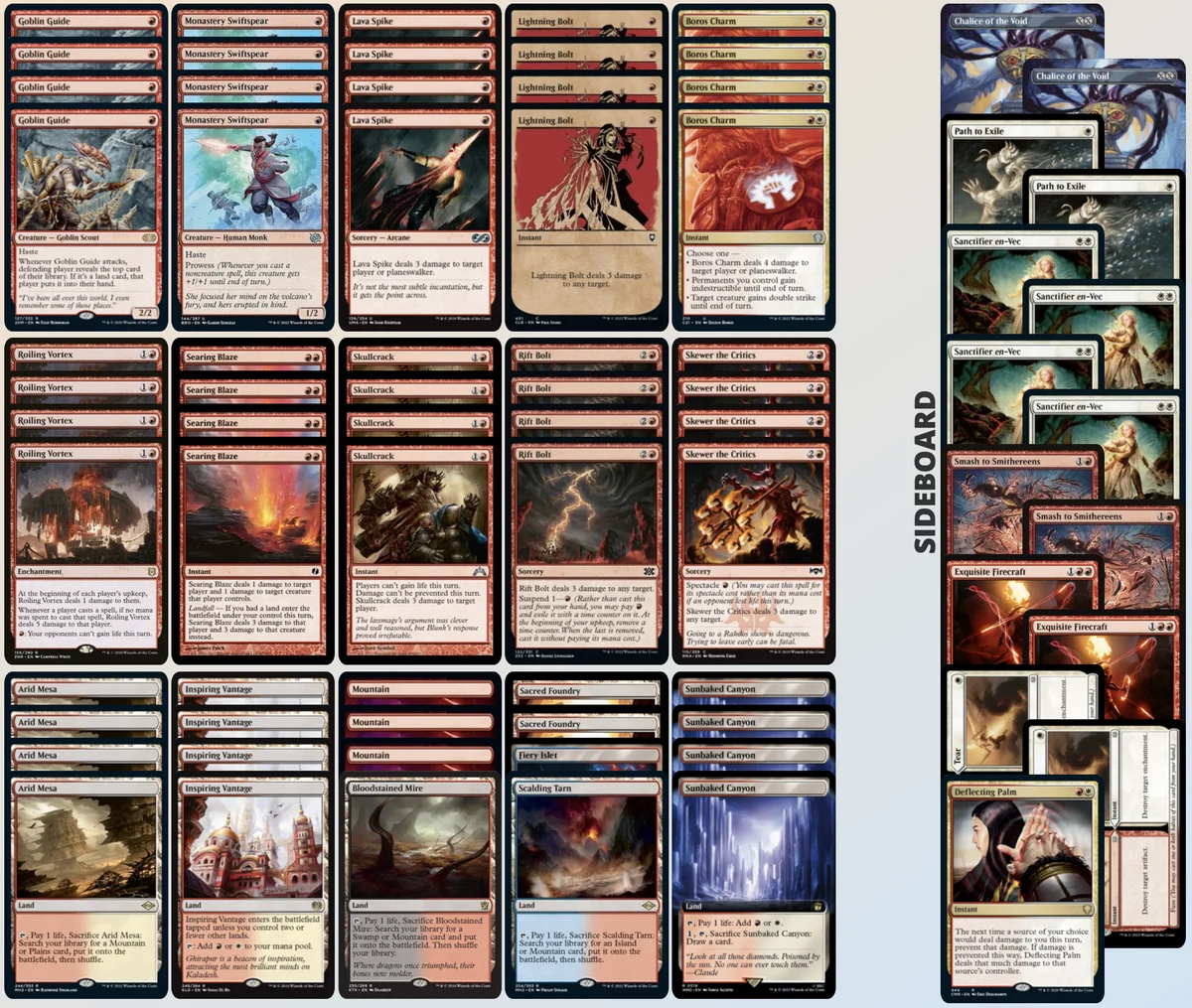
Many decks have sacrificed some part of their lists to keep up with the environment; besides the deck’s main axis, they may also have sacrificed some interactive flexibility, making the floor and ceiling of games further apart and less fun.
Scam Isn’t as Disgusting as You Think
Most people find Scam disgusting and format-wrecking because of the turn-one Grief and Feign Death situation, and it feels like Scam does turn-one Grief with Feign Death every day, but is that really so?
Here we take the probability part from an article on CIXS’s MTG Diary: What Is the Probability of Reanimating Grief on Turn One?. His calculation has some flaws, though, so we recalculate here:
The decklist is the same as the one in my earlier Scam article.
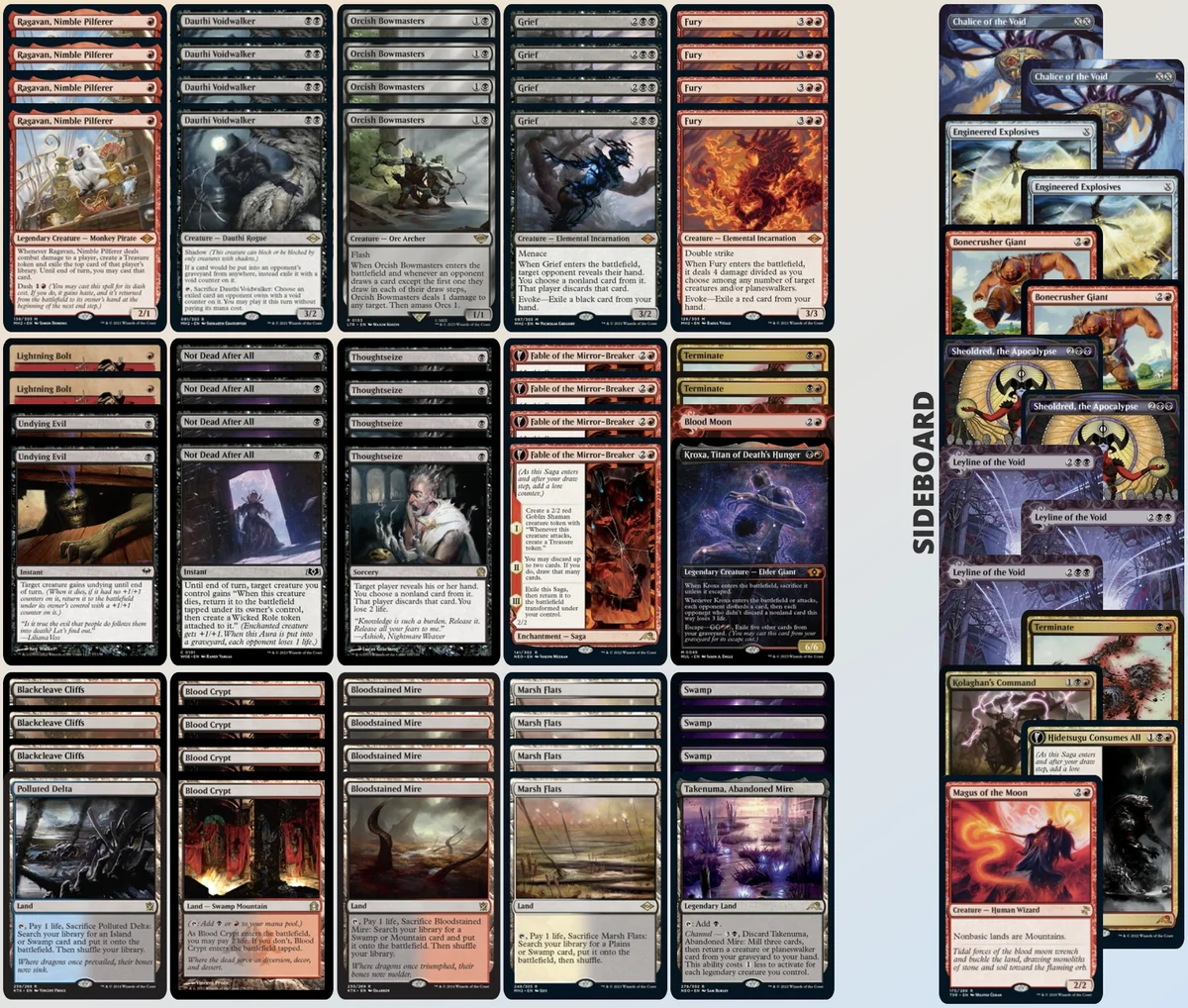
It has four Grief, six Feign Death, and 15 other black cards.
Then we can define a turn-one Scam opening hand as having:
- At least one Grief
- At least one Feign Death
- At least one land
- At least one other black card in hand (this can be Grief/Feign Death, or any other card)
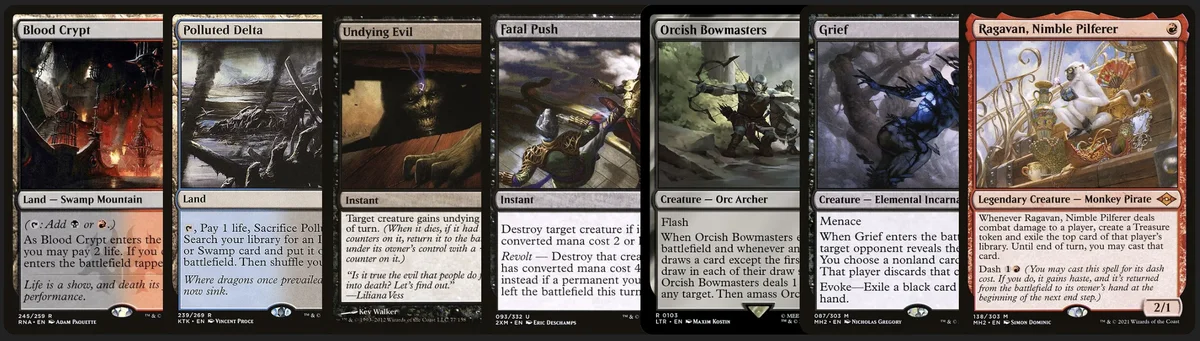
Because counting condition four together is a bit complicated, we break it down into four states (of course every opening hand contains a land; I don’t believe any Magic player would keep a zero-land hand in a normal deck):
- One each of Grief/Feign Death/other black card
- Two or more Grief, one Undying, zero other black cards
- Two or more Undying, one Grief, zero other black cards
- Two or more each of Grief & Undying, zero other black cards
The probabilities of these states are 14.55%, 0.51%, 0.93%, and 0.17% respectively, for a total of 16.16% (all probability results come from the Yu-Gi-Oh opening hand calculator mentioned in the article).
Also, to double-check the correctness of the probabilities, we recalculated the probability of being able to do turn-one Grief + Feign Death within two mulligans.
Here again we split into three cases:
- The opening hand can do turn-one Grief + Feign Death
- The opening hand can’t, but after one mulligan it can
- The opening hand can’t, one mulligan can’t, but two mulligans can
Their probabilities are 16.16%, 13.55%, and 11.36%, for a total of 41.07%.
So that is to say, the probability of a turn-one Grief with Feign Death is actually only 16.16%. Even with two mulligans it’s only 41.07%.
Although with three mulligans there is a more than 50% chance of a turn-one Grief with Feign Death, in that situation once it gets removed you can only live off topdecks, so unless the second mulligan has no land, I personally wouldn’t mulligan a third time.
I also calculated the probability of opening Fury + Feign Death as 13.82%, so only a bit under 30% of the time you open with an Elemental evoked into Feign Death, and within two mulligans it’s about 50%. (The calculation here is even more complicated, so please allow me to use approximate numbers QAQ)
And actually most Scam players, even if they can’t evoke into Feign Death on turn one, will still keep a hand that can curve out on one, two, and three mana.

Also, in the data our team collected through the end of October, Scam’s non-mirror win rate actually hovers around 52%, not as high as imagined.
The decks with the highest win rate are Coffers and Living End, probably because they appear less often and most players aren’t familiar with how to deal with them.
But at the same time we also notice that Coffers and Living End have a higher center offset, which can be interpreted as extreme win rates in some matchups.
However, these decks don’t have such a high meta share, and with little data there may be more serious statistical error.
Center offsetis the average of the absolute values of (win rate - 50) across all matchups.
Data source: 【每周摩登】WOE 第 7 周 (上):热闹的线下线上竞技之周!
Taking all the above results together, we can only conclude that Scam is a very consistent deck, but not as disgusting as imagined.
But Coach, I Don’t Want to Play Scam
Besides “if you can’t beat them, join them”, are there any other ways? Of course there are; the current meta isn’t completely dominated by Scam (at least not as disgusting as past periods like Hogaak, Eldrazi Winter, Splinter Twin, or Storm), and there are other decks like Tron, Hardened Scales, and Amulet Titan that also have good results and each have their own ways of dealing with Scam, but as mentioned above, they sacrifice some of the fun of certain matchups.
On the other hand, Taiwanese players are hyper-competitive to an extreme, basically touching nothing that isn’t at the front of the meta, let alone some purely recreational Modern decks; rather than spend money getting beaten up, they’d rather build an EDH deck that they enjoy playing and their friends find interesting too.
But
not touching anything outside the top of the metaisn’t a bad thing; it means Taiwanese players all keep a certain drive to win. It’s just that when the environment converges toward the front of the meta, the fun of the games naturally declines.
The Current Modern Environment
Having said all that, the current Modern environment may still be the most balanced of all formats.
Standard has been stagnant ever since The Meathook Massacre was banned, with fewer people playing and fewer meta deck types, and looking around it’s always the same few similar decks on top.
Pioneer, needless to say, many people just finished experiencing it not long ago; luck (positioning) far outweighs practice, and in many games you basically know the result as soon as you sit down and decide who goes first.
Legacy goes without saying: cast one Brainstorm and you get hit in the face for four plus the opponent gets a 4/4, or before I’ve even drawn a card the opponent kills me on turn one, or slams a Trinisphere and just watches me there.
Pauper has more and more powerful commons (not to mention some uncommons or even rares being downshifted to Pauper), and the whole field is getting more chaotic.
At the time of writing the full LCI card list hadn’t been revealed, and I didn’t expect LCI to have such a big impact on Standard and even Pioneer; after a while more diverse decks may appear in the environment.
But rather than balanced, it’s more of a balance of terror. The decks at the top of the meta are almost all at two extremes: either pushing tempo to the limit like Scam, Burn, Rhinos, and Hardened Scales, or pulling the game into a super late game with mid-game resource refills like Cascade Beanstalk/Omnath and Mono-Black Coffers.
As I mentioned in the previous Rakdos Scam article, WotC’s position is awkward right now: whether to cut or not to cut is a dilemma. If they cut, they’d contradict their decision to ban only once a year in eternal formats; if they don’t, more and more players will hate this format.
Printing new cards doesn’t seem like a good way either, especially since before MH3 those new cards would be printed in Standard sets, where they might be too strong and cause another ban (but then why print them in Standard sets?).
The best course right now might be to make evoke unable to be responded to (sacrifice immediately after it enters, with no point to respond in between), or to attach the evoke text after its own ETB, so that after the ETB finishes resolving you can’t respond to Feign Death anymore and must respond before it resolves (so at least you can’t strip cards before Feign Death is cast).
But these all feel like treating the symptoms and not the cause, and would indirectly nerf other evoke decks (like Pauper’s Jeskai Ephemerate).
My feeling at the moment is that WotC refuses to admit a mistake. As early as the announcement after PT LTR, they were already going to preemptively detain some cards (like Grief or Orcish Bowmasters), although we all know WotC still has an LTR product to sell so they basically won’t touch anything from LTR; but this also further reflects WotC’s recent terrible policy. To avoid slapping their own face, they can only play dead and hypnotize everyone into believing the environment is fine, holding out until MH3 in Q2 next year, using even more powerful cards to overshadow these problems.
But honestly, overshadowing MH2 with MH3 is really not a good approach; it doesn’t solve the problem, it just shifts everyone’s target from Scam to another deck.
At least there hasn’t yet been something like the funny incident that happened in Pauper in August and September 2021: nearly every entrant at a Pauper Challenge showed up with a 60-basic-land deck to protest the Chatterstorm deck that was left unaddressed for so long.
I guess that counts as a good thing…
Does that still count as a good thing?
I’m not sure. Maybe in a few years we’ll start to miss the current meta, saying “Back when Scam ran rampant, it wasn’t like now…” It’s possible.
But I hope such days don’t come, and that the environment can become a bit more fun.
Right after I wrote this, an official source said there would be a new banned and restricted announcement on 12/4.
Will the article I just finished writing be in vain like this?
Let’s look forward to it.
- Title
- What's Going On with Modern Lately?
- Author
- MiohitoKiri5474
- Created at
- November 23, 2023
- License
- This work is licensed under CC BY-NC-SA 4.0 .