The Lost Caverns of Ixalan (LCI) Limited Introduction — Black


Note: This article was translated from Chinese by AI and may contain errors. Read the original Chinese version.
The Lost Caverns of Ixalan (LCI) holds its prerelease events on November 10, 2023, and is officially released a week later on November 17, 2023. Want to learn more about card ratings in Limited and some potentially interesting synergies? Then take a look at this series of LCI Limited introductions!
For the mechanics, see this article: The Lost Caverns of Ixalan Mechanics Explained
Rating Scale
5.0: Must-pick, unconditionally
4.0: Worth a first pick
3.5: Strong enough, but not necessarily a first pick
3.0: Above average (you’d really like it in your final deck)
2.5: Average, maybe around the 6th or 7th pick in a draft
2.0 to 1.0: Below average (you’d rather not play it than play it)
0.5 to 0.0: Unplayable (basically don’t play it; it will only help you lose)
Black
Number of cards of each rarity in black
C: 19
U: 14
R: 9
MR: 2

Jru: 2.0
When ahead it can be a bomb, but when behind it may become a dead card, so it performs very unstably. Sometimes your own creatures are even better than the opponent’s, and then you wish it were a 6/6 vanilla. If you want to play it, it’s best to make sure your deck has enough fodder creatures to give it.
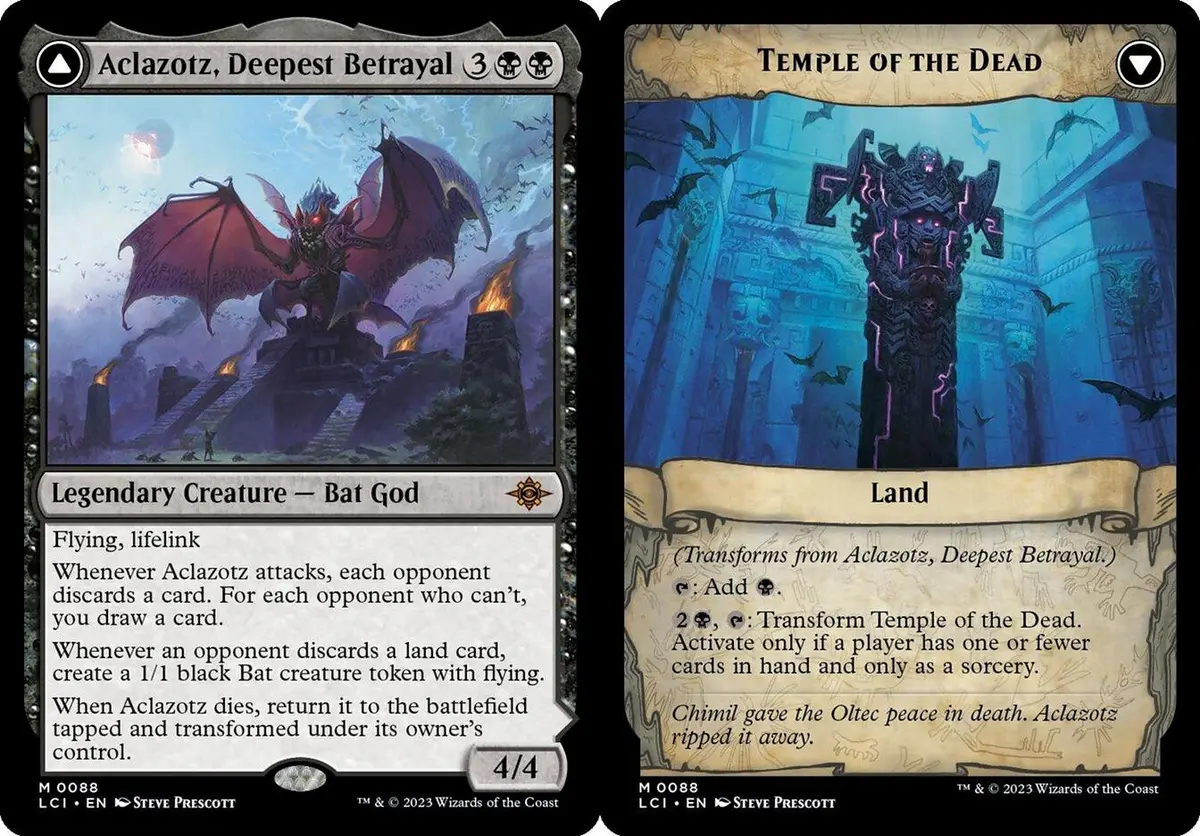
Jru: 5.0
A god-tier bomb. A 5-mana 4/4 flyer with lifelink has a body that fights well, and once it starts attacking it rolls out a hopeless resource gap and even gains a life differential on the side. It is the kind of bomb where, if you don’t remove it within a turn, that alone is enough to decide the game. What’s even more hopeless is that this Bat God is hard to remove cleanly. The land on the back needs only any player to have 1 or fewer cards in hand to return to the front-side Bat God, which in Limited is hardly a condition at all. Normally, once the board reaches five mana everyone’s hands are about played out, and even if the opponent deliberately holds cards to keep two or more in hand, you can just play whatever you draw and burn your own hand down to one or fewer. Conventional damage and destroy effects have almost no answer to the Bat God.

Jru: 2.0
The sacrifice theme in this set is thin in the traditional sense; red doesn’t even have an Act of Treason effect. Although the set has many ways to produce artifact tokens, sacrifice outlets are also plentiful, and this one is among the less efficient ones. On top of that, for a three-mana creature the base body is somewhat feeble, so it is a low-priority filler.

Jru: 3.0
Returning two creatures to hand at instant speed for three mana is a decent way to gain a resource edge, and a controllable self-mill of two cards has special meaning in this set. When you need a source to trigger descend, this card can very likely do it, and after filling the graveyard there are mechanics like descend 4, descend 8, fathomless descent, and craft to reuse resources. Also note that this card has no target; the two creature cards to return from the graveyard are chosen on resolution.

Jru: 3.0
A removal spell with a very heavy cost, but at least it is a two-mana instant-speed outright kill. Also, when you need to trigger descend or have other graveyard-filling needs, make good use of the additional cost of discarding a card; instantly filling the graveyard in this set may produce other gains to offset the cost of discarding a card.

Jru: 3.0
Judged purely on function it is actually great: once it enters, the opponent easily feels life pressure, and a flyer with 4 toughness isn’t so easy to deal with. Unfortunately the color requirement is really too heavy, so I docked some points for the fixing expectation.

Jru: 2.5
If you only look at the normal mana-paying part of the equip cost it is a bit clunky but acceptable, and being able to use discarding as a cost gives this card a bit more flexibility; when necessary you can also use that discard equip to fill the graveyard.

Jru: 2.0
A creature version of Living Death, with a mandatory trigger on entering. Although it’s a 6/6 flyer that fights well, at 8 mana it is too heavy any way you look at it, and it only makes sense if your own graveyard is stocked better than the opponent’s. Although black is good at actively filling the graveyard, it is still an extra condition. Also, if you’re ahead on board you may not want to call it. It is a high-ceiling dream card, but there are quite a few situations where you can’t afford to cast it or the board state doesn’t suit it.

Kappa: 2.5
Without descend it’s a four-mana 4/3, a passable body; with it, the bonus is creating an unblockable 1/1 every turn. If you can cheaply descend every turn, it works as a continuous token-generating machine, and the tokens can be used for sacrifice, beans, tapping, craft, and so on; even if they can’t block, they’re not necessarily completely useless. But you must pay attention to whether your deck can withstand a heavy amount of mill. Conversely, if descend support is insufficient, it becomes a 4/3 vanilla, and in combat its 3 toughness is easily traded off by two- and three-mana creatures, and when you want to use it as a production machine you naturally fight less. All in all, it is a mainstay creature with obvious strengths and weaknesses.

Jru: 1.5
One of the payoff cards encouraging you to descend continually, but the reward isn’t rich; when you have no creatures you can’t even collect the reward. Plus, continuous descending is still somewhat difficult in Limited, so you can probably profit little from this enchantment. Fortunately it has an instant-speed seven-mana ability to turn itself into a 4/3 flying token, so in the mid to late game it won’t be a completely dead card.

Jru & Kappa: 4.0
I don’t know if it has the soul of Ravenous Chupacabra. Although the range of what its enter-the-battlefield effect can remove may be limited, as long as it removes something it’s a gain, and used well it will be a black Flametongue Kavu. Used normally it is already a creature with a three-mana body, and more descends extend the ETB’s reach; at the extreme, without actively descending, just through simple early creature trades it can already remove creatures with 2 or 3 toughness, and since the ETB has already done this creature’s job, the next step is to use its high power to trade for another creature, achieving a 2-for-1.

Jru & Kappa: 5.0
The body can be seen as a three-mana 3/2 haste creature, and once you descend once it’s a gain, and it can create board pressure that is extremely uncomfortable for the opponent. Plus enchantments are not easy to deal with in this set, making it a payoff card worth actively fighting for continuous descending.
One of the biggest prizes in this Limited format’s descend system, a semi-permanent generator of 3/2 haste creatures. If you can descend steadily, you can produce a 3/2 harasser every turn; even if it can’t get through, you can keep casting this and descending each turn, slowly raising a large army of 3/2 skeletons. Not to mention that with two or more copies, each skeleton’s clock gets higher and higher. A semi-infinite resource with simple conditions is absolutely a bomb in this Limited format.

Jru: 2.5
This one is also a reprint; although its range as removal is short, being a permanent that triggers descend after removal is a plus in this set.

Jru & Kappa: 3.0
The familiar deathtouch guy who stands there lounging and watches which creature the opponent wants to send as the suicide squad, a decent blocker for the graveyard approach that hopes to stretch the game out, and the controllable self-mill of 2 also has no small value in this set.
A worse Mire Triton (the only point in which this one wins in comparison is that you can choose not to mill when your own deck is running low), but in this set it is a creature that can complete descend tasks and fill the graveyard, and at the very least, used as the front face of Aetherblade Agent // Gitaxian Mindstinger, it is a high-quality defensive two-drop.

Jru: 2.5
One of the descend payoff cards, but its starting body is feeble, and it takes at least two turns of growing before it shows its value.

Kappa: 3.5
A two-mana flying creature that also comes with two extra beneficial abilities? And it can hold up one of the opponent’s cards in hand? For the opponent to get it back they have to cast a removal spell at it? If the opponent has no forces that can block flyers, you can keep draining the opponent and trading life? That’s broken… Seriously, unless the opposing deck is mainly all-flying forces, this is an excellent two-mana option.

Jru: 3.0
A very benchmark five-mana recursion spell, but it can only recur from your own graveyard; in essence it is still a one-for-one card. The bonus of exploring twice is decent, and it has more chance of using five-mana recursion to create more than five mana of value.
Also, each of the five colors in this set has a creature with basic land type cycling, which pairs nicely with this card.

Jru: 2.0
Without descend 4 early on it’s just a Grizzly Bears, and in the mid to late game becoming a 3/3 with lifelink isn’t particularly brilliant force either.

Jru: 3.5
A Map version of Deadly Dispute. This set has plenty of token fodder, so it easily becomes an equivalent of instant-speed two-mana draw two, or you can also sacrifice some fodder that has finished its enters-the-battlefield ability and is just sitting in place to fill the graveyard, which is not bad either.

Jru: 2.0
A recently common Feign Death-like effect, which is essentially a kind of combat trick. Making this kind of card two mana is a little clunky, but the permanent type is a good plus in this set.

Jru: 2.0 (Sealed) / 2.5 (Draft)
In Sealed you should find it hard to gather many Caves to reduce its cost; in practice I estimate it’s just a 6-mana 5/5 with lifelink, usable but not outstanding. Even if you have enough Caves you must draw it early enough for the cost reduction to show value; once the game reaches the mid to late game and you have more than 8 lands and few cards left in hand, whether there’s a cost reduction doesn’t matter much anymore.
In Draft you can raise efficiency by actively grabbing Caves, but the Cave system’s payoff in this set isn’t strong, and in practice it should be hard to gather a number of Caves that qualitatively changes this creature’s performance.
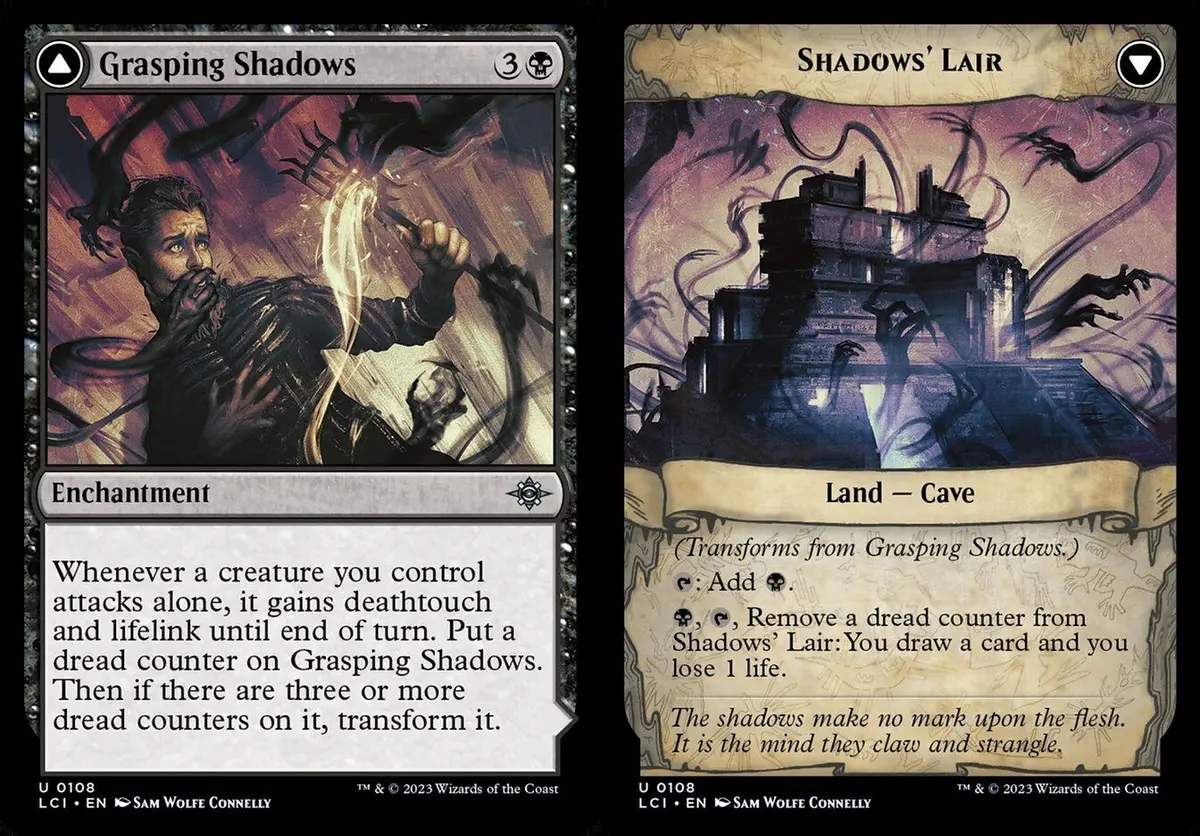
Jru: 3.5
A decent machine for gaining life and card advantage. The front face needs to attack alone to trigger, which dooms it to not suit an approach of aggressively seizing tempo, but it suits a slow, steady strategy of solidifying the line and gradually widening the resource advantage, because it gives the lone attacking creature deathtouch and lifelink. As long as the opponent has no first strike you needn’t worry much about handing over a creature for free, and at the least you can trade one-for-one with the opponent while gaining a little life; it would be perfect if the attacking creature had first strike.

Jru: 1.5
Basically a piece of fodder that makes a second piece of fodder when it dies. The death ability itself isn’t bad, but the body has no combat power to speak of; look for it when you’ve built very heavy on sacrifice and lack fodder.

Jru: 3.5
An instant-speed three-mana -5/-5 is already very useful in Limited, and the -10/-10 after descend 4 is something almost no creature can withstand. A quite useful removal spell.

Jru: 2.5
Another new variant of the three-mana -2/-2 sweeper, a complete upgrade of Malicious Malfunction, with the only difference being that the opponent’s dying creatures are exiled instead. This kind of small sweeper is more often a sideboard card in Limited, but in this descend set, the ability to turn the opponent’s creature deaths into exile matters more than in regular sets. When the opponent has double-faced bombs and you lack exile-based removal, this card is also one of the precious answers; although this kind of answer may cost you card advantage, it’s better than being beaten down by an undying god.

Jru: 2.0
A card-draw piece doubling as fodder, but for this card to draw a second time it must go from the battlefield to the graveyard, meaning if it’s used as craft fodder it can’t draw cards. Its value only shows when you have enough good artifact sacrifice sources (such as Fanatical Offering above).

Jru: 4.0
As long as it attacks it’s a gain. After attacking, a 2/4 deathtouch body relatively easily survives, or it forces the opponent to double-block and then uses its 2 deathtouch damage to trade one for two. In the early game it can put great blocking pressure on the opponent, and in the mid to late game, even if it’s no longer easy to attack with, a 2/4 deathtouch standing there is equally hard for the opponent to attack into.

Jru: 2.5
A suicide-squad member that, on dying, uses discover 3 for resource continuity. Overall it’s a gain, but if you trade a five-mana creature for a Grizzly Bears, that doesn’t seem to gain much, and it may be better at blocking than attacking; only by trading with the opponent’s big creature can the value of the discover 3 attached to its death show.

Jru: 2.5
On entering or attacking, it performs a Vampire-exclusive Reanimate. Limited creature curves aren’t too low, and the Vampires in this set aren’t very good at gaining life; the most important lifegain engine is another two-color rare, so you can’t really expect this effect to be done many times. But before discussing life totals there is another, bigger problem: Vampires in this set are scarce. Commons and uncommons total only 6 Vampires, and including this card there are 7 from rare up (and one of them is an 8-drop, so by the time you recur it you’re nearly dead yourself). Before putting it in, remember to check how many Vampires you actually have, otherwise it’s very likely a five-mana 5/4 vanilla.

Kappa: 2.5
My appetite was raised by Troll of Khazad-dûm, so seeing a 2-mana swampcycler I almost wanted to give it a low score, but thinking carefully, it has the body of a 6-drop, entering gives one creature a chance to attack hard, and in the worst case of being stuck in hand it can be exchanged for a land. You can’t call it a bad card, it just meets the standard; just remember not to take too many.

Jru: 3.0
A super clunky sorcery-speed exile kill, but since this set has too many cards that don’t die cleanly, exile-based removal is still necessary. In addition, although this set doesn’t have many Vehicles, their average strength is high, and with the existence of creature lands and other utility lands, this removal spell can handle quite a lot of problems.

Jru: 3.0
Another variant of Wind Drake. Flying is always good in Limited, and the ability to self-mill on attack is a good plus in this set.

Jru: 3.5
Those who have experienced the annoyance of Burglar Rat should be no strangers to it; this is still an exile-upgraded, strengthened version.

Jru: 3.0
The body isn’t strong in combat, but it has a chance to swap itself for a better creature in the graveyard. This set easily discards or self-mills frequently, so a creature with built-in recursion is a bit better than in regular sets. There is also a possibility of unfair early pressure by discarding or self-milling a big guy into the graveyard and quickly pulling it into play, though that is a bit of a dream.

Jru & cephille: 2.5
This set counts as a graveyard set, so graveyard-filling efficiency is somewhat better than in regular sets, but early on its body can still be weak, and without abundant resources whichever additional cost you choose to pay hurts, so making it a strong-bodied creature mostly happens in the mid to late game. Also, this card is positioned somewhat similarly to WOE’s Cruel Somnophage // Can’t Wake Up: basically you never want to play a 0/1 on curve on turn two and also discard one of your own cards or sacrifice a permanent. Although this set has the descend theme that focuses on graveyard permanents, whether self-mill or sacrifice/discard, they all count as a loss to your own resources. Unless your deck has a great many descend-theme payoff cards, its body will not be big enough to join attacks until at least turn four or five, and I’d still rather play creatures with matching bodies on curve than rely on this kind of card that depends heavily on the graveyard to determine its strength.

Jru: 2.5
Great ability but the starting body is too small; it takes more turns of growing to fully show its value. It is very strong when drawn on turn one, but drawing it after the midgame may be a bit awkward; instead of a 1-mana 1/1 I’d prefer a 3-mana 3/3.

Jru: 4.0
The body is acceptable and the entry is a good enough gain, and depending on the situation you can choose to pay life to draw cards or fill the graveyard, because when surveilling 2 you already know what those cards are, so you can always make the most correct decision based on the board. Although there are still awkward moments when your life is low and you see a key card on top of your library, the merits outweigh the flaws, not to mention it has the lifegain ability. Although descend 8 is no small challenge, black happens to be the best color at filling the graveyard, and with its own surveil 2, it has quite a good chance to reach it.

Jru: 2.5
Before descend 4 is satisfied, its combat power is a bit weak for a three-mana creature. Once descend 4 is met, it can force the opponent to choose between feeding you a creature or letting you freeload a card for 1 life again and again, but a 1/3 body isn’t that hard to trade with; the opponent may just use any two- or three-mana creature to trade with you, and when you meet descend 4 the opponent’s board probably won’t be too empty, so they have more trade options, so don’t expect this guy to freeload much card advantage.

Jru & Kappa: 1.5
Alive, its body doesn’t meet the standard, and the 1/1 token after death can’t even block. As fodder it would have few outlets without artifact types; only consider it when you’ve truly run out of three-drops. Although it can provide fodder for this set’s sacrifice theme, making 3 bodies for 3 mana, unfortunately this set’s sacrifice theme, as mentioned above, isn’t strong, so providing fodder doesn’t yield much benefit, not to mention when you’re not on a sacrifice theme, its body is completely substandard.
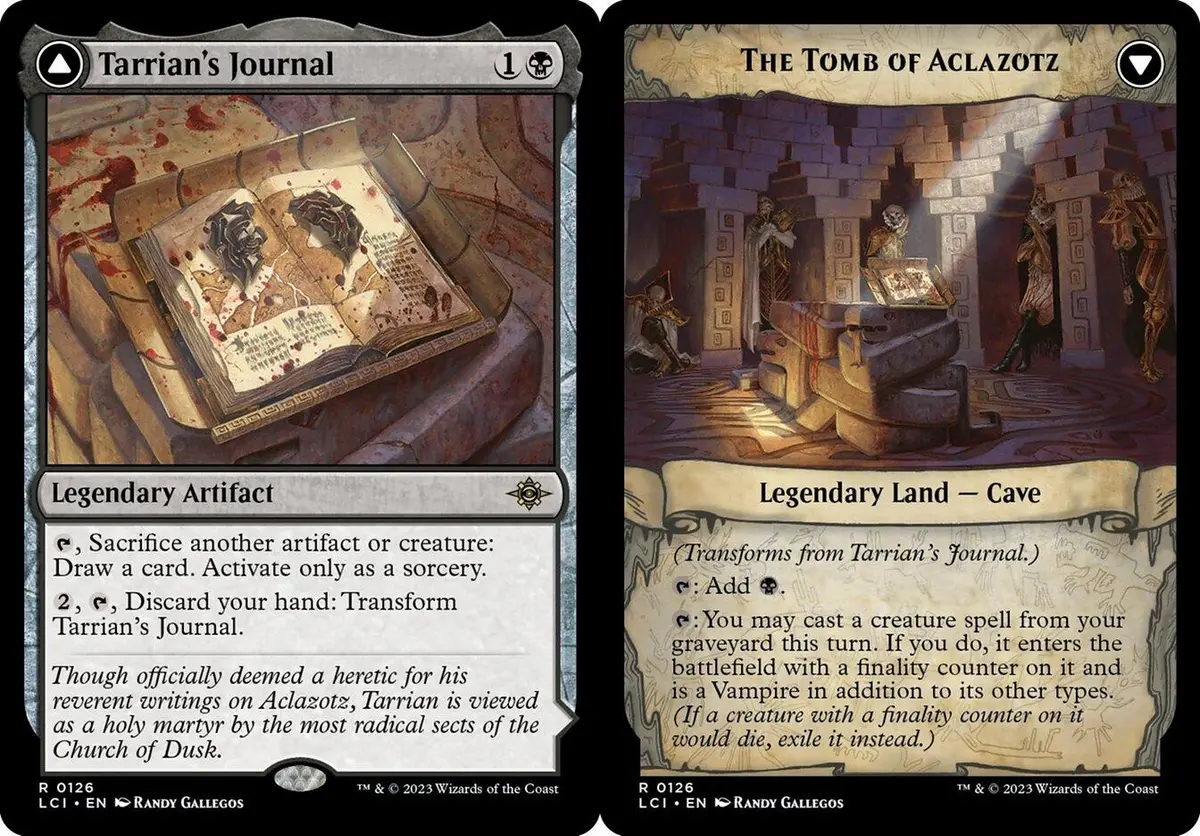
Jru: 5.0
When you have enough fodder it is a sustainable resource engine, and when your hand is mostly spent it can convert into a super card-advantage machine; being able to cast a creature from the graveyard every turn gives a resource gap enough to drown the opponent, and lands are a category extremely hard to answer. It is a big bomb that can help you win steadily.
Also note that its front face is an artifact, so be careful against opponents with plentiful artifact removal. When you can transform safely, don’t be greedy about the chance to sacrifice and draw; the back face earns you plenty anyway. Conversely, when the opponent may respond by destroying the artifact, be careful, because discarding for the transform ability is a cost and transforming is the effect, so if you painfully discard a card to activate the transform ability and get answered by artifact removal, you’ll be left crying with no tears.
Also, creatures recurred by the back face get a finality counter, and a creature with a finality counter is exiled when it dies, so don’t fantasize about endlessly freeloading some big guy from the graveyard.

Kappa: 4.0
An AOE sweeper needs no explanation, but it is rated under 5.0 because this card is harder to use. In Limited the number of permanents in the graveyard isn’t that controllable, so it’s hard to control your own firepower to kill only the opponent’s creatures and leave yours, or to make it just big enough to kill the opponent’s biggest creature, or the opponent may even just exile your graveyard, and then this card becomes a joke. But in the vast majority of cases it is a powerful sweeper, very much worth a first pick.
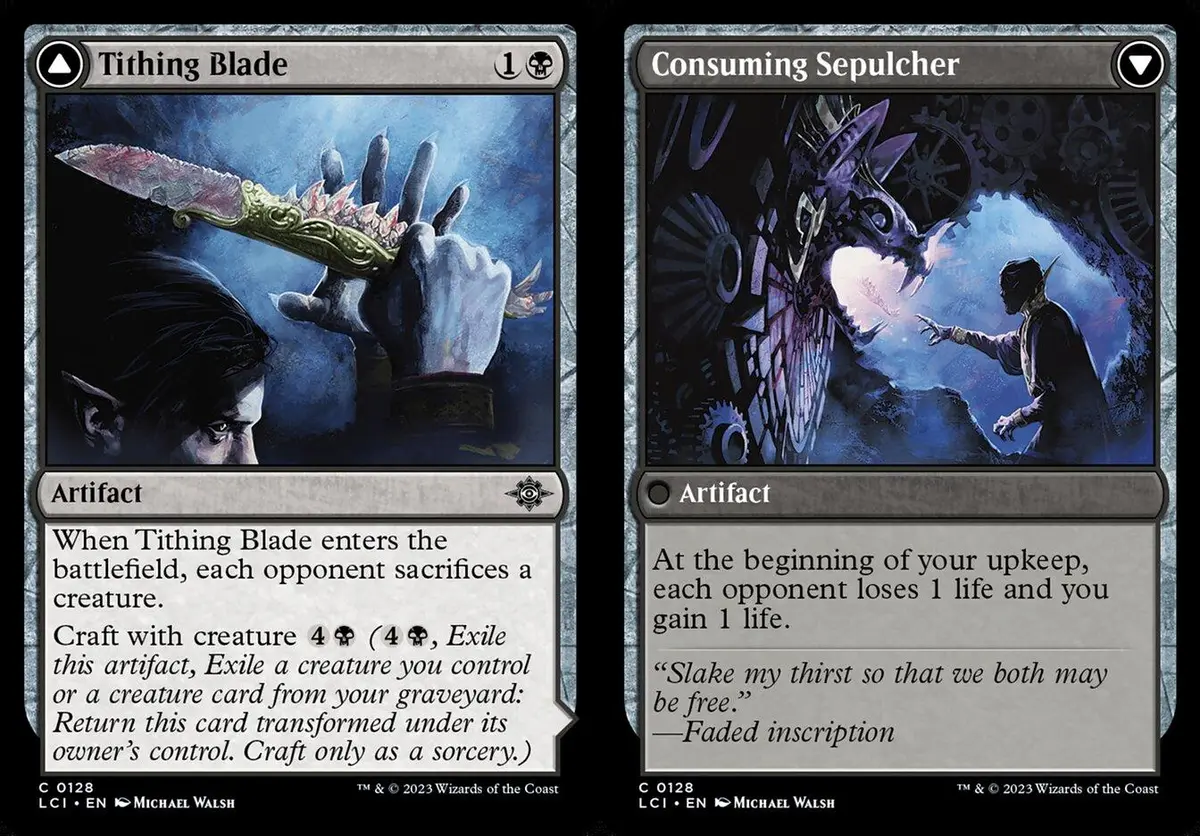
Jru: 3.0
As a Trial of Ambition-like removal on its front face it isn’t efficient, but at least it is a two-mana removal spell, and its yield is better early in the game or after baiting the opponent’s small creatures into trades. The craft fodder requires just one creature card, which you can normally find in the graveyard, and once successfully transformed it is a death countdown for the opponent; as long as you find a way to hold the line, that’s enough to win.
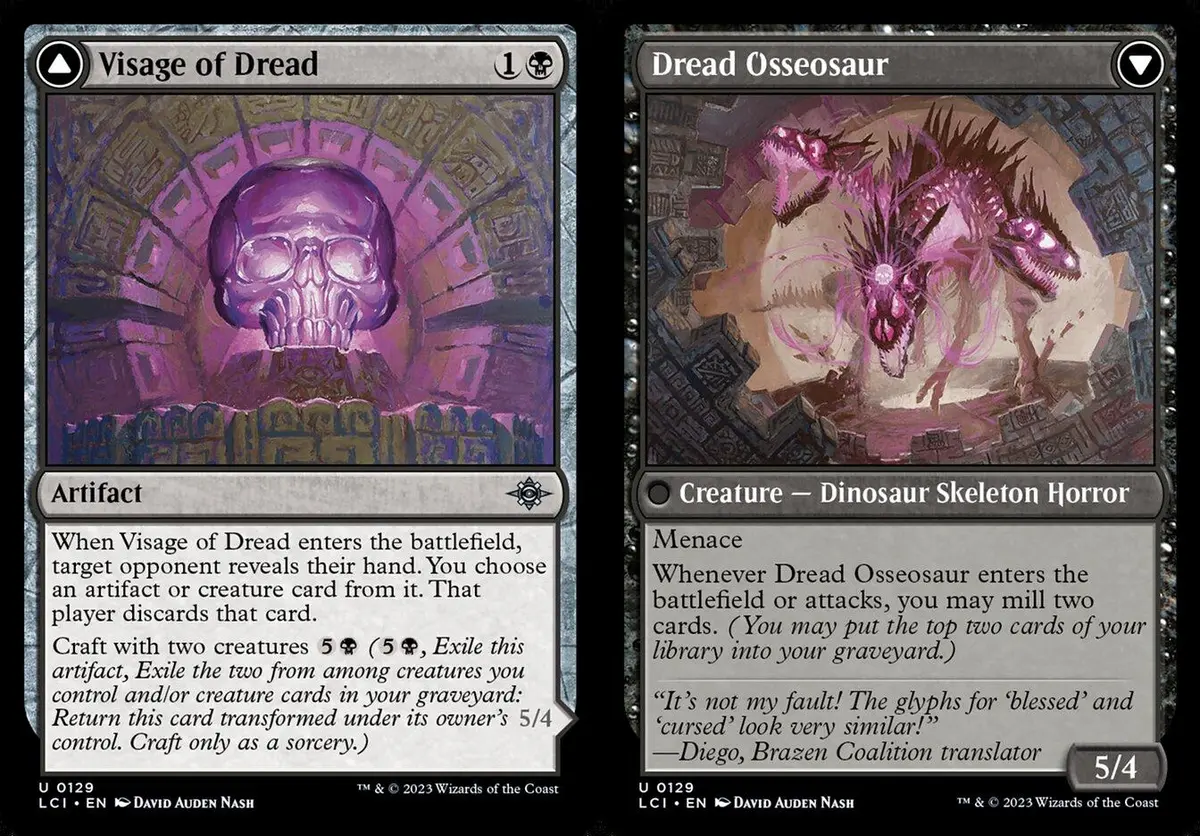
Jru: 3.5
The most important and numerous cards in this set are creatures and artifacts, so restricting discard to those two types isn’t much of a problem. Although the craft cost is a bit heavy, the transformed dinosaur has enough combat power too, and since craft materials can be pulled from the graveyard, it is in effect a good card that creates an additional card-advantage point as long as you pay.

Jru: 3.0
Among sacrifice outlets it is a relatively good one. The ability can be activated at instant speed with no tap or once-per-turn limit, and the gains are permanent +1/+1 counters. As long as you still have mana, the opponent mostly has to prioritize removing this guy, or else whoever the opponent removes next, you eat, and it will always become a threat that’s hard to deal with. Don’t forget that a sacrifice outlet is also a potential descend engine.
- Title
- The Lost Caverns of Ixalan (LCI) Limited Introduction — Black
- Author
- Jru, Kappa
- Created at
- November 16, 2023
- License
- This work is licensed under CC BY-NC-SA 4.0 .