The Lost Caverns of Ixalan (LCI) Limited Guide — Green



Note: This article was translated from Chinese by AI and may contain errors. Read the original Chinese version.
The Lost Caverns of Ixalan (LCI) prerelease events are held on November 10, 2023, with the official release one week later on November 17, 2023. Want to know more about individual card ratings in Limited and some potentially fun synergies? Then check out this LCI Limited guide series!
For a mechanics rundown, see this article: The Lost Caverns of Ixalan Mechanics Explained
Rating Scale
5.0: Unconditional must-pick
4.0: First-pick quality
3.5: Strong enough, but not necessarily a first pick
3.0: Above average (you will really want it in your final deck)
2.5: Average, maybe around the 6th or 7th pick in a draft
2.0 to 1.0: Below average (you would rather not play it than play it)
0.5 to 0.0: Unplayable (basically don’t play it, it will only help you lose)
Green
Number of green cards by rarity
C: 19
U: 14
R: 8
MR: 4

cephille: 2.0
A plain, unadorned three-mana 3/3. Its creature type is Dinosaur, so if you are playing the matching theme you can take it earlier. The life gain isn’t impressive, but in the early game it basically means the opponent’s attack last turn was for nothing and they now also have a 3/3 to face.

cephille: 1.0
A two-mana 1/3 is terrible, don’t play it. With descend 4 it can become a 4/3, but by then a 4/3 may not be that impressive, and if it gets its graveyard card exiled, forget about playing it.

Jru: 4.0
This one is written so that creatures meeting the condition deal combat damage equal to their toughness. In normal combat, whether attacking or blocking, you can treat it as a four-mana 6/6, and with only one green mana of color requirement and pseudo-hexproof, it is a very high-quality body. But you don’t need to put a pile of high-toughness creatures in your deck just for it and slow down your own tempo.

Kappa: 2.0
A big 6/7/7 creature. It scries on entering to secure the quality of your upcoming hand, and for four it stops the opponent’s small creatures from blocking. But apart from the body it really isn’t strong. When you have no other good finishers it is not a bad choice. In mono-green it can work with other Dinosaurs or cards that grant trample, so it is a finisher that needs support.

Kappa: 3.0
A 1/1 that gets a land card on entering, or a Grizzly Bears with surveil 1. The end. Strange, why can’t I see any weakness after writing this? (Admittedly being drawn too late is still a bit weak, but played early, drawing either side is a gain.)

cephille: 3.0
The Eternal Witness raccoon! One more power and toughness each, but you have to wait until descend 4 to get permanent cards back, so it is actually much weaker. But at worst it is still a three-mana 3/2, and in curve-is-king Limited you sometimes have to slam it down as a 3/2 vanilla. Drawn in the mid-to-late game it is a very strong topdeck that lets one of your threats enter again, or picks up a common Cave to do another discover 4, which is lovely too.

Kappa: 3.0
Reach + trample + four mana with toughness 5. It is a Wrecking Crew in a different color, with two colored mana requirements and cheaper. Simple and brutal, able to attack or defend, though conversely you can only pick one of its two abilities (granting vigilance can fix this, and this set has 2 such cards), but it is still an excellent mainstay creature.

cephille: 3.0
Most of the time it finds 1 or 2 Caves and turns one creature into a 3/3 to beat down with. Destroying enchantments isn’t critical in this set, but having the option is always good.

cephille: 2.0
A sneaky trick for offense and defense. What it turns into when attacking is a Dinosaur, which sometimes benefits from tribal bonuses, and since it must be blocked once it attacks, it has a chance to break through the opponent’s defenses or force a trade with a mid-sized creature the opponent should lose. Remember that on defense you can also make a 4/4 land creature for a decent block.

Jru: 3.5
Colossal Dreadmaw is well worth playing in Limited, and with the extra resource of drawing cards, the opponent will have a big headache. The ceiling of this draw is very high: given this set’s Dinosaur density, drawing 1 is very easy, and drawing 2 has a decent chance too.

cephille: 2.0
An artifact that can move counters around. The payoff should be biggest in green-white. It is very strong on flyers or trample creatures.

cephille: 3.0
By the time you can slam it at eight mana, the Dinosaurs in your hand should all have been played already, but an eight-mana 12/12 trampler coming out basically wins the game if the opponent has no removal or interference.

cephille: 2.5
Early on it is an Into the North that can only find Forests; in the mid-to-late game it can return to the battlefield a Cave you’ve already used, but only finding Forests still can’t solve color-screw in extreme situations. If you are playing green and need acceleration, you can run one.

cephille: 1.5
A somewhat subtle Equipment. Even if I can look at the top card of my library, I can’t do much with it. Spending two mana to equip it and explore when attacking, and if you don’t flip a nonland card it doesn’t count as growth, spending three mana without adding to the body is too much of a loss. Basically you only consider playing it when you lack explore sources.
cephille: 1.5
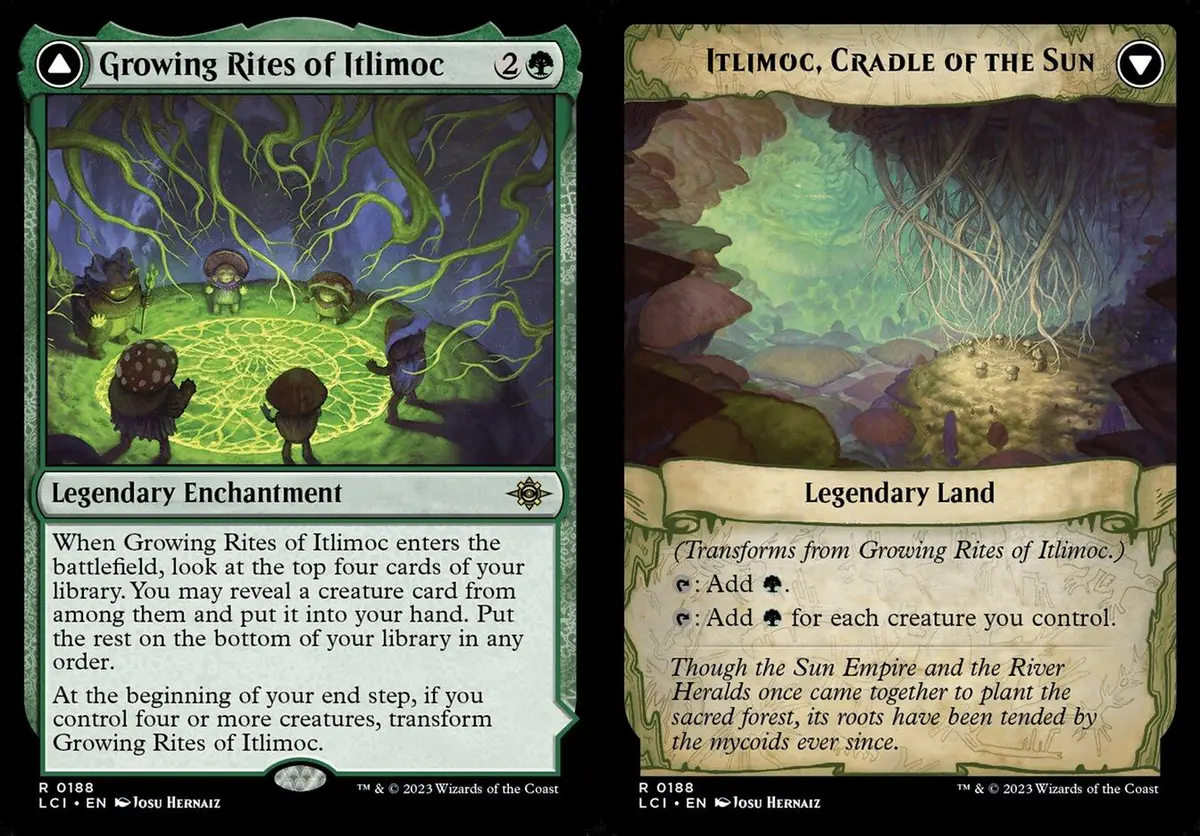
A reprint. Entering for three mana and looking at four to take a creature can still whiff, getting four creatures on the battlefield to transform isn’t an easy condition either, and by the time it flips into Gaea’s Cradle you may not need the mana that much anyway. To me it is a card I wouldn’t want to play.
cephille: 4.0
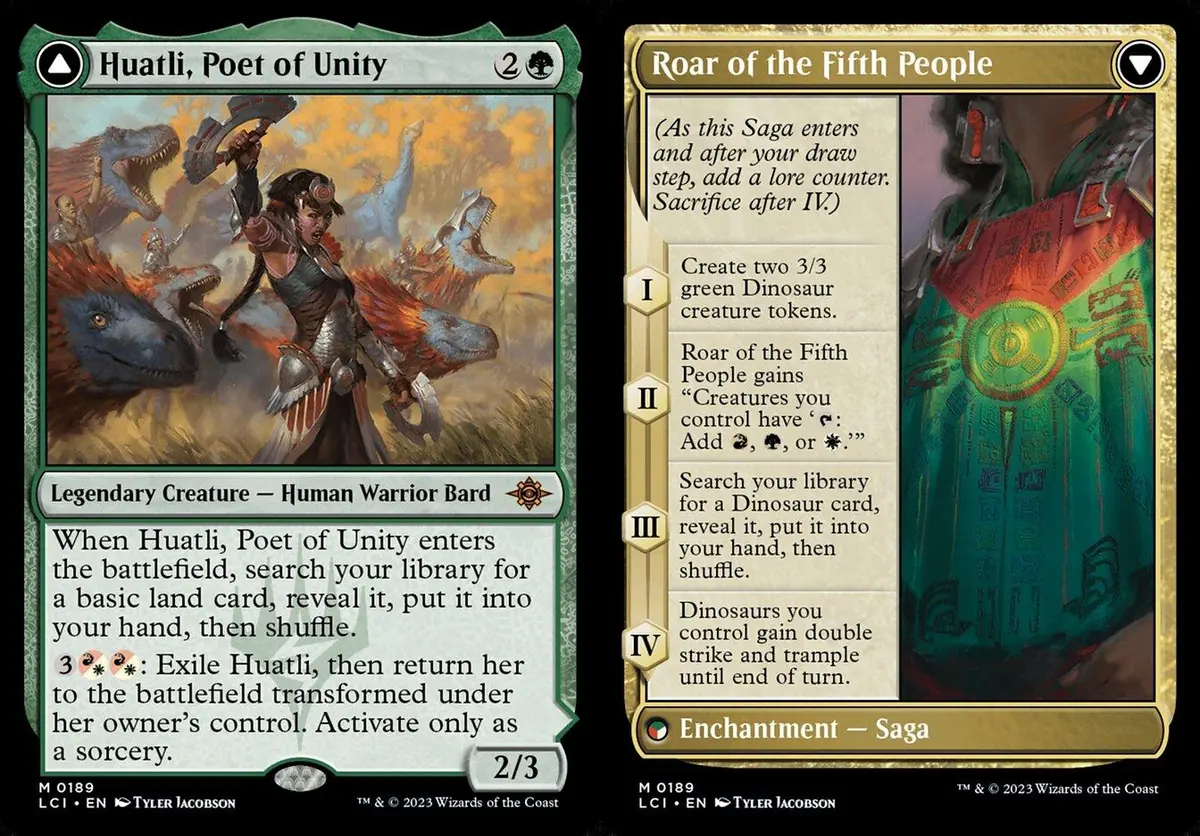
When Huatli enters, first finding a basic land to hand means you probably won’t be color-screwed and it doesn’t cost you a card. The three-mana 2/3 body isn’t of much use, but at five mana you can then flip it into a Saga, which is very strong: chapter I makes two 3/3 Dinosaurs, chapter II makes your creatures able to produce the color needed to cast Dinosaurs, chapter III finds a Dinosaur card to hand, and chapter IV gives your Dinosaurs double strike and trample, and you should win by attacking.

Kappa: 3.0
Instant-speed removal in the form of dealing damage. The cost is a bit heavy and inflexible, and you need to prepare high-power creatures yourself, but used well it can be a one-for-two. For example, you declare your 2/3 as a blocker against an opposing 2/3, then use this card to grow your 2/3, blast the other 3-toughness creature next to it, and then make a favorable trade with the 2/3.

cephille: 3.5
A four-mana 5/3 with ward (2). The body is plain, but it lets you go from five to seven mana, which may be very key in a green-based deck.

Kappa: 3.0
At instant speed, fetch up to 1 creature and 1 land to hand, with the rest going to the graveyard. A two-for-one, plus doing the descend job, plus the flexibility of instant timing, a very strong resource card.

cephille: 3.5
Green’s two-mana mana dorks really are numerous. The two-mana activation can also remove a card from a graveyard, which can interfere with the opponent’s descend and craft themes, and is a creature that black-green graveyard-recursion decks will find a headache. She can also let you remove Dinosaur cards from your own graveyard and cast them again later, so having a certain number of Dinosaur cards in the deck is equivalent to paying two more mana to earn a creature from the graveyard. Very strong!

cephille: 1.0
A one-mana 1/1 Dinosaur mana dork. I would only consider it if my deck has more than eight Dinosaurs and no good two-mana color fixing. Basically it is bad unless it comes out on turn one. Maybe it will be more key in a Dinosaur-theme draft, but I probably still wouldn’t want to play it.
cephille: 2.5
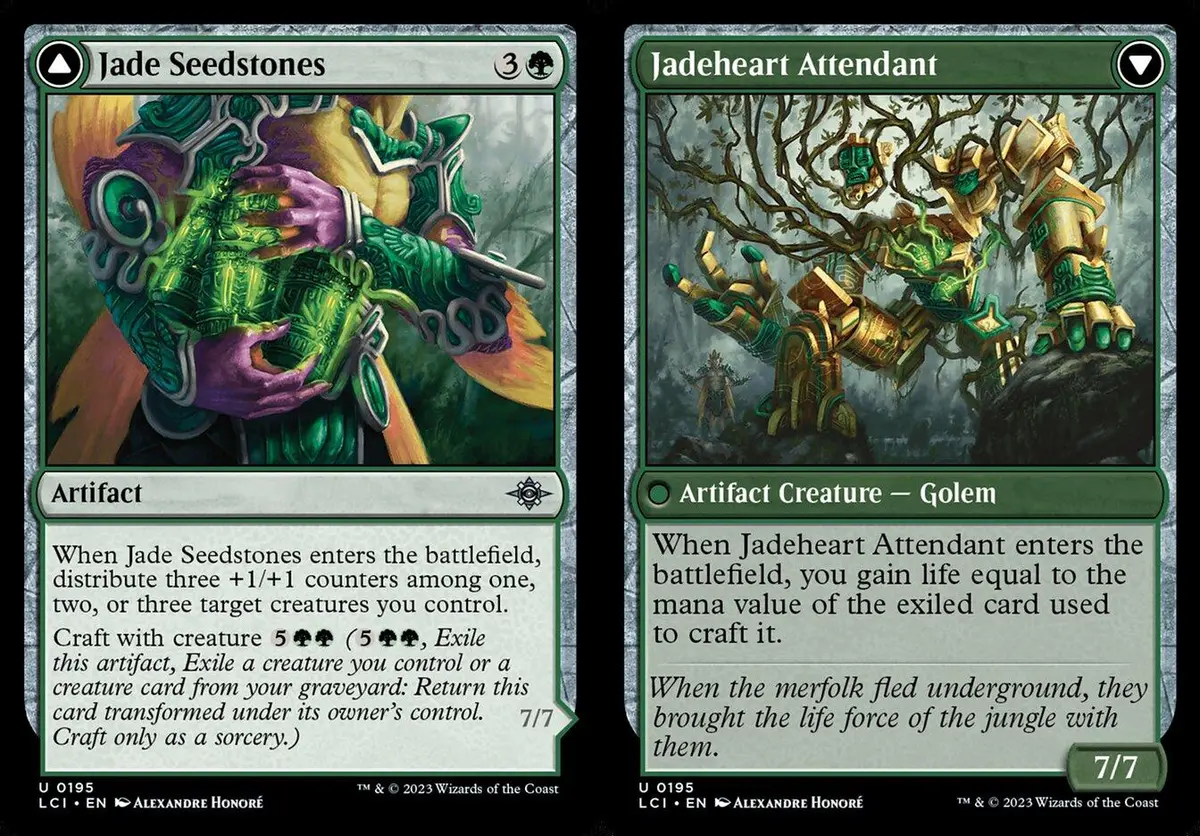
In the green-white theme, this card is much stronger than other green lines. Distributing three counters as you like on entering basically lets your whole team reach power above its starting value and start earning resources. In the late game, you can craft it to get a 7/7 artifact creature and gain a big mouthful of life, which is quite nice.

cephille: 4.0
The body may be a slight loss, but giving up body means you won’t be land-screwed from here on, and in the mid-to-late game, making one big play even just to get a pile of lands means every draw afterward will be much better. Worth first-picking into green.
cephille: 2.0
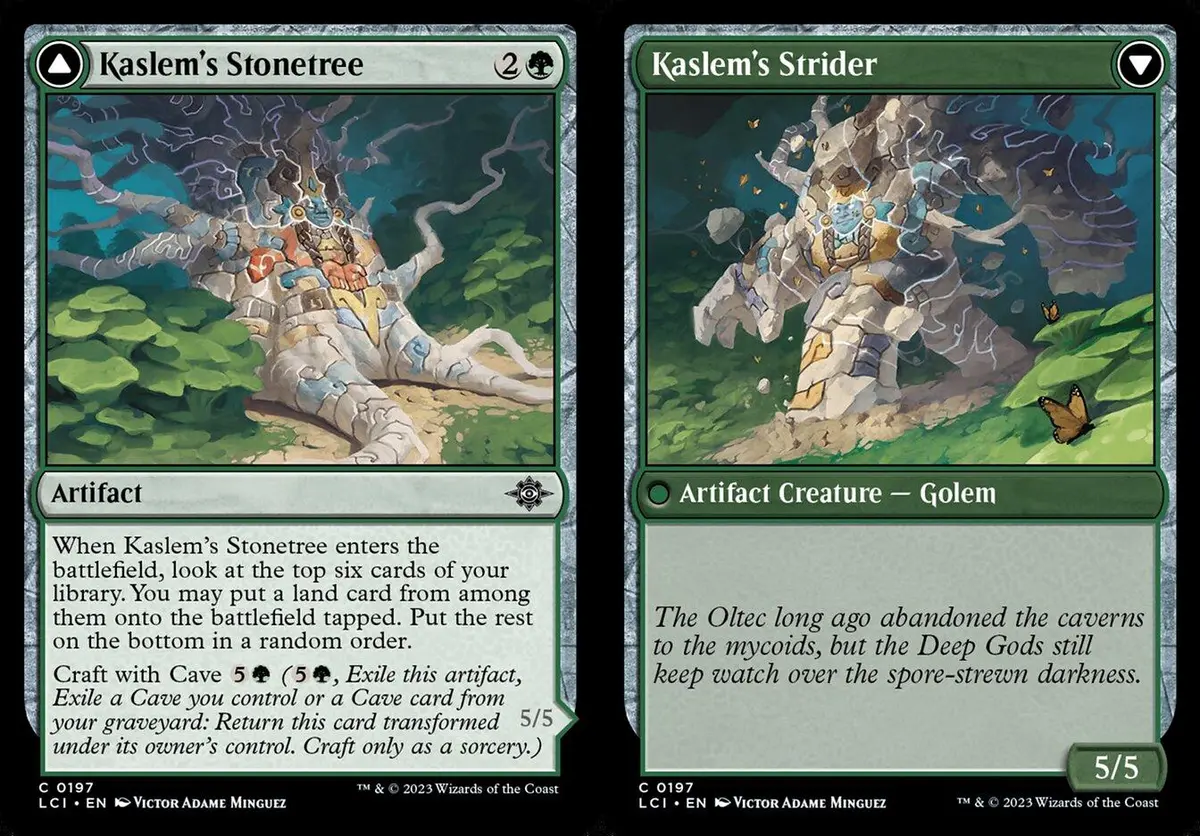
Basically a three-mana accelerant, with a chance to put a Cave onto the battlefield (if your deck includes them), and in the mid-to-late game it may become a 5/5 that joins offense and defense. Considering this set actually has quite a few Caves, after six mana you may use a common Cave sacrifice to discover 4 to find a spell, and at that time you can craft with it. It isn’t very strong, but even making it is still resource-advantageous in Limited, though you shouldn’t be too fixated on crafting and play many unsuitable Caves that jam your own tempo.

Kappa: 2.0
A fight removal spell, with the pump condition being that the creature entered this turn. One mana is very cheap and fits the pump condition above, but it can’t escape the general downsides of fight spells: you must first prepare a big enough creature, and you fear the opponent growing a creature at instant speed or removing the fighting creature. Sorcery timing also makes this card less flexible than the old Tail Swipe. Fortunately green creatures this time mostly have big toughness, which raises the chance of surviving. All in all, it is still a filler removal spell.

Kappa: 2.0
A very standard two-mana common, but trample on green is not bad. When necessary it can make a suicide attack to crash through and open a path for the big Dinosaur next to it.

cephille: 2.0
Flash equip as a combat trick. Four mana to equip is clunky, but if needed you can still move it to another creature that can get through. In green-white it may be picked higher than in other colors, and with the matching theme it may work wonders.

cephille: 2.5
A five-mana 5/4 trampler with no loss in body. Once the creatures traded earlier let it reach descend 4 or more, each of its attacks makes your creatures stronger. Note that the pump doesn’t have to go on itself; putting it on flyers or other creatures that can get through is great too.

Kappa: 2.5
A standard body with reach. Toughness 4 stops more than half of blue’s flying force from getting through, but this set has Map tokens, so the opponent’s flyers may also grow, and you can’t rely on this card too much. It can mill 2 on entering, satisfying the descend job. It is an average card and better when the opponent’s main force is flyers.
Side note: yet another upgrade swap for Giant Spider.

Kappa: 2.5
cephille: 3.0 (black-green has graveyard recursion)
Forest cycling 2, but the most awkward one in the cycling cycle. This time green has 3 any-color mana dorks (1 restricted to Dinosaurs), and finding a Forest to ramp also exists with Glimpse the Core and Kaslem’s Stonetree, so in effect a mono-green main color has no need to prioritize this card for finding lands. Only other color pairs splashing green get unique value from it. The body is a 5/5 plus a 3/3, not bad, but seven mana is too heavy. To use it well: one, in decks splashing green, half give up on casting the body; or in ramp decks as filler, finding lands as well as hardcasting the body; it can also work with black cycling followed by graveyard recursion.
I think this card is second only to the Mountain cycler in strength, and a great target for graveyard recursion. Entering as a two-for-one is very nice. Cycle it early and hardcast it late, or take a few more accelerants and hardcast every one as a two-for-one, which feels very comfortable to use.
cephille: 5.0
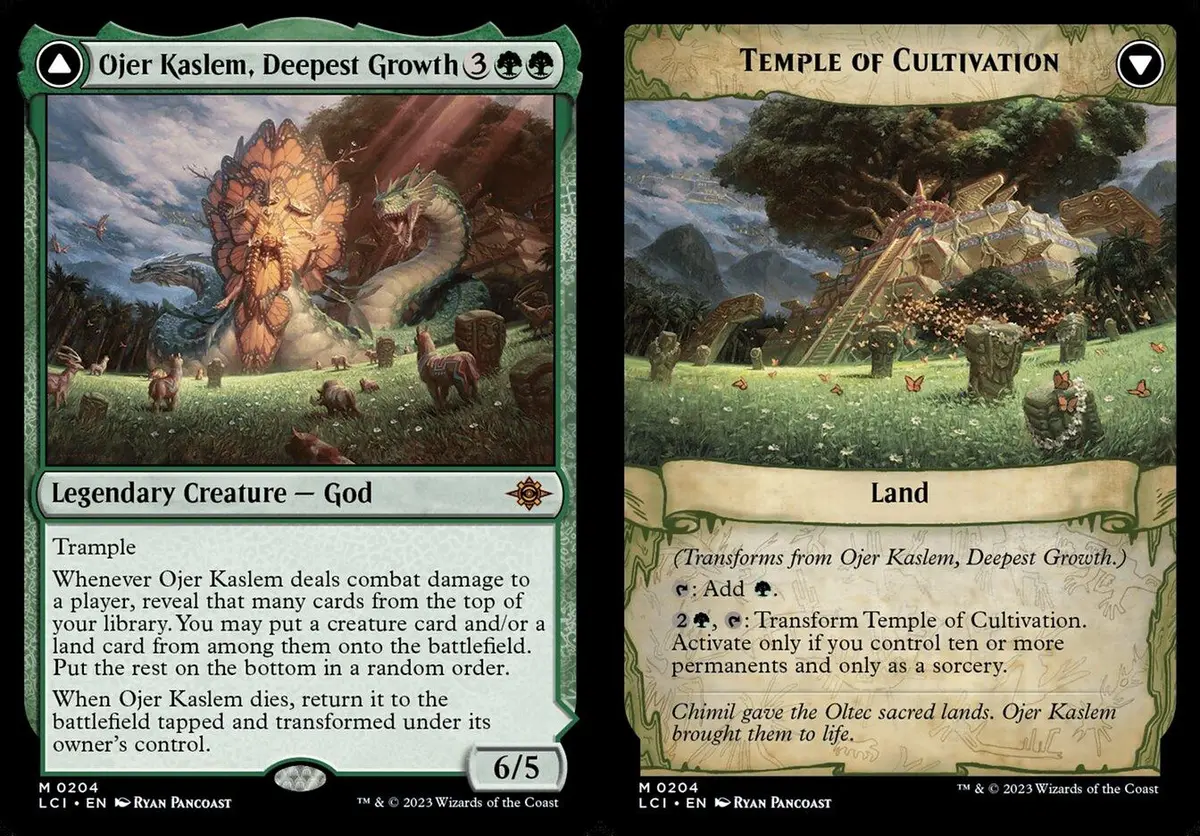
A five-mana 6/5 trampler has a very strong body. Basically once it hits you with one punch the resources get pulled apart, and when it dies it isn’t too hard to flip back. It is the representative of green’s mindlessly strong cards.

cephille: 2.5
Whenever I play green I basically want to run one. Destroying artifacts is basically very important in this set, and destroying enchantments is sometimes key too, freeing your big creature that got Pacifism stuck on it. Exploring twice can be done if needed, so it is basically a utility card. But remember that if you have no creature to explore with, finding a land can’t be done.

cephille: 2.5
A four-mana 4/3, even 5/4, is a good body, and its Dinosaur type has synergy, making it a solid four-drop.

cephille: 3.0
The poison dart frog can produce color, block flyers, and has deathtouch. As a mana dork, it can’t get any better. A card I will really want when I play green.

cephille: 3.5
A three-mana 6/6 can stand there without attacking and block creatures of other colors (except flyers) until the end of time, and since green is the Dinosaur color, taking a few more Dinosaurs makes the drawback nearly nothing. You can also use it as a wall early and let it join combat later when you have other Dinosaurs.

Jru: 2.5
A card whose focus is easily thrown off by the high-power, low-toughness vigilance. After testing, a three-mana creature that explores on entering is very solid, but this is an evaluation based not on offense but on defense. Many people’s first reaction to this card is probably that a 3/1 or 4/2 with vigilance kicking out will just trade with a bear, looking like a terrible loss. From an aggressive angle that’s indeed true, but the green creatures in this set aren’t designed to attack aggressively on turns two and three to race for life; the main source of power is the strong creatures from four mana onward, so the early requirement isn’t to race for damage but to stabilize the board first. A 3/1 or 4/2 body going out will naturally easily be traded down with, but conversely it can also easily trade up when blocking.
So the correct role for this card is to explore once on entering to improve the stability of later operation, and after that it is a suicide squad that tries to get even or favorable trades. Don’t underestimate that one explore; early explore contributes quite a bit to stabilizing the midgame. As for vigilance, treat it as a free bonus, occasionally letting you get in a free punch or two. If the creatures the opponent can block with at that moment are all worth more than this one, charge forward with confidence thanks to vigilance: if the opponent doesn’t block, it’s free damage, and if they block, it is still a favorable trade. Of course this fragile body dooms the score from being very high; at most it is playable, but it isn’t as weak as it looks on the surface.

cephille: 2.0
A mana sink. It can be used when you lack low-cost creatures, but it is bad early and only gets strong after five or six lands.

cephille: 4.0
A three-mana 3/4 with vigilance has a decent body, and makes a Map on entering and on attacking. Basically you cast it on three, and on four you first eat a Map to see whether to take a land or become a 4/5. If it becomes a 4/5, keep attacking to make Maps and keep growing bigger and bigger or drawing more and more lands. It is very strong when you smoothly curve out one, two, three, but occasionally there is the awkward situation of being unable to get through and earning no Map.

Jru: 5.0
A variant of The Great Henge. Given green’s creature sizes, getting it out on four mana isn’t hard. As long as it lands, almost all your nontoken creatures effectively have two lives, and every even trade becomes a favorable trade. Normally, as long as this artifact isn’t destroyed, no opponent can win on board against you. When a creature is about to die and you have enough mana, remember to respond by transforming for two mana to double that creature’s power, and you can earn a decent or very huge Dinosaur!

Kappa: 1.0
This set has a total of 13 lands that enter tapped, 8 of which are Caves, and there are 13 Caves in total that can trigger the life gain on entering. As expected, in a draft the five-color Cave strategy will have this as the one core card for pulling back the tapped-land tempo. Conversely, unless you are playing this theme, this card will very likely turn into a super bad enchantment that draws one card for three mana and is done. In addition, this card gives no help to combat on the board (a rather extreme example is letting a creature land enter untapped to help on defense, but that situation is a bit rare). I don’t recommend it before your own strategy is established. In short, it is a support card that depends heavily on the deck.

cephille: 2.0
Giant Growth with one more mana to give trample. A plain, good trick. The trample might ruin the opponent’s plan of propping up with a chump blocker to stop your big creature.

cephille: 2.0
Without acceleration, the vast majority of the time this is just a bear, and surviving until seven mana for the land to appear also means it has to enter tapped. It isn’t suited to relying on too much, but sometimes it can create a board that is hard to beat.

cephille: 3.5
A reprint of Thrashing Brontodon. A three-mana 3/4 body is very reliable, and the sacrifice can destroy artifacts and enchantments, giving you a more flexible way to use it in the mid-to-late game when you can’t get through.
cephille: 3.5
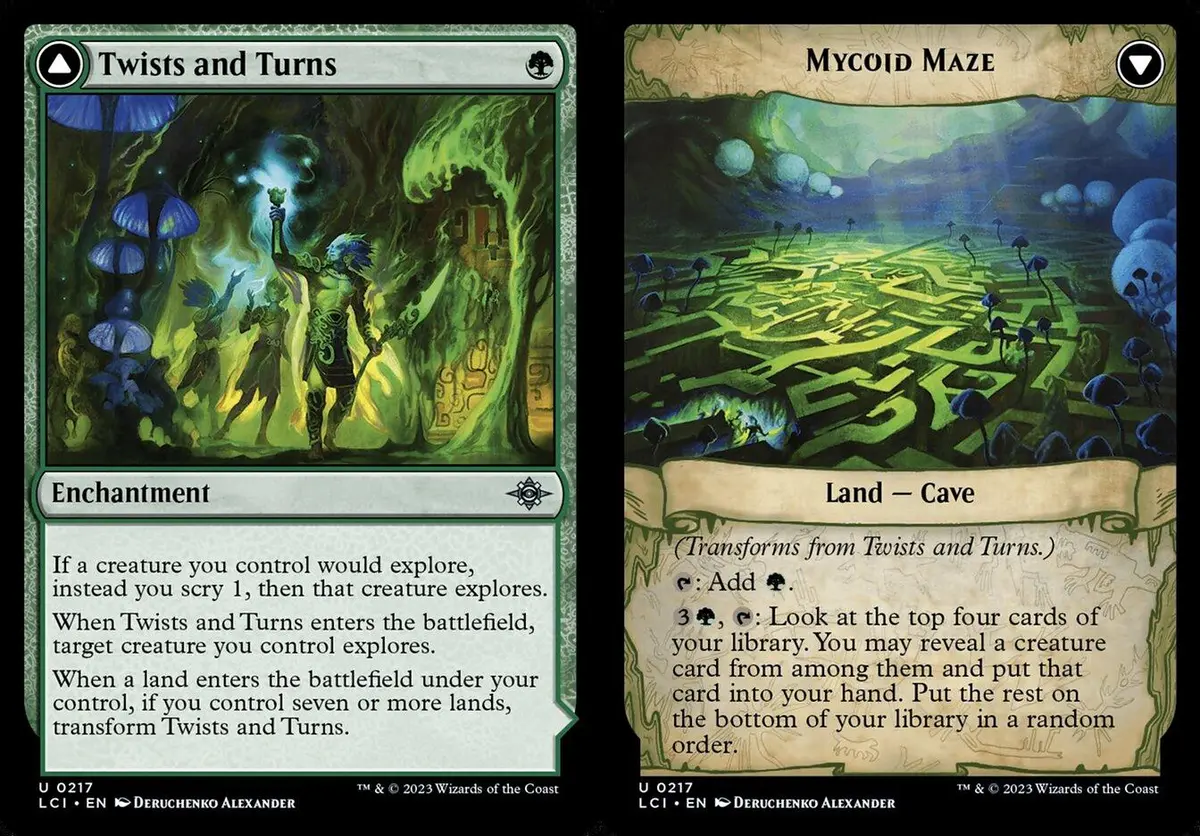
It explores once on entering, and while it is on the battlefield each of your explores also gets a scry 1, making them better. When the seventh land enters and it transforms, you no longer lack lands by then, and its activated ability gives you an endless stream of creatures to win the game. It is a card I really want when playing green.

cephille: 3.0
Five mana to pick up a permanent and then discover 4, a two-for-one that can often pull the board back in one go. If the permanent you pick up is also a two-for-one or better, that is a ridiculous gain!
Also note that this card is written as up to one target, so if you are truly forced to, you can cast it with no target and only do the discover 4.
- Title
- The Lost Caverns of Ixalan (LCI) Limited Guide — Green
- Author
- cephille, Kappa, Jru
- Created at
- November 17, 2023
- License
- This work is licensed under CC BY-NC-SA 4.0 .