Modern Mardu Energy: When Ocelot Pride Meets The One Ring

Note: This article was translated from Chinese by AI and may contain errors. Read the original Chinese version.
Deck Construction
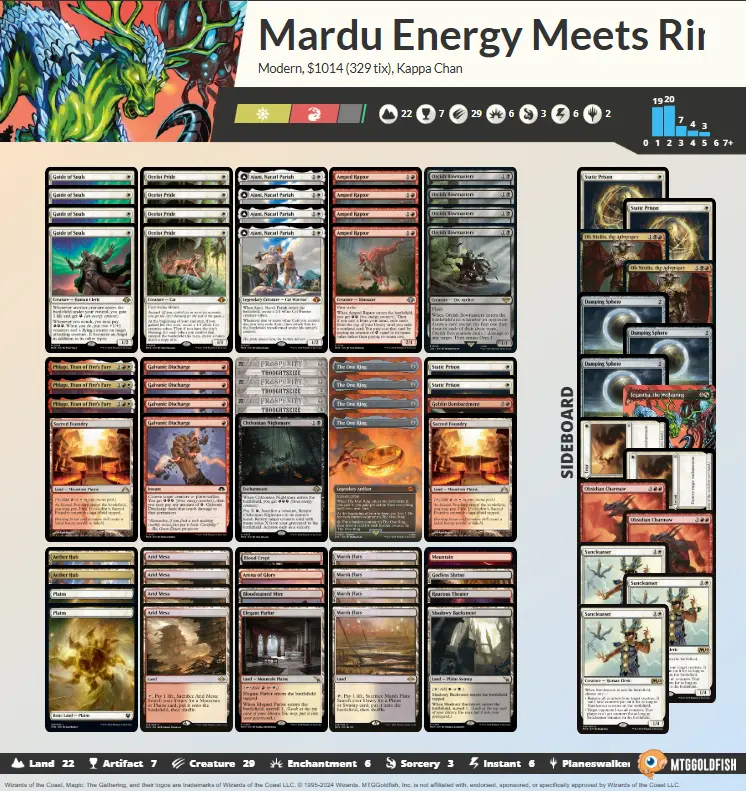
Q: What exactly is this deck?
A: A deck built out of money, for beating the opponent up with brute force.
Wait wait wait, not that kind.

This kind is much better.
By the way, the deck currently costs $1,000, but when I qualified with it, it cost $1,300.That swing was caused entirely by our Modern cursed object, The One Ring.
Q: It’s already a mainstream deck, but how does it actually play?
A: It overpowers the opponent with raw card power. (Seriously.)
The new MH3 cards are just that strong.
For example, using the energy package alone, you build an early board advantage with Amped Raptor or Ocelot Pride, punish the opponent’s card draw with Orcish Bowmasters, pick apart their hand with Thoughtseize, and while they can’t do anything, clear the way with various removal spells and crush them. A plain tempo beatdown route.
Pair Guide of Souls with Ocelot Pride to mass-produce cats. With 3 Ocelot Prides, gaining life once each turn makes 14 cats appear at end of turn, gaining 14 life and 14 energy. You beat the opponent on the lifegain route.
Use Chthonian Nightmare to keep pulling valuable cards like Ajani, Nacatl Pariah or Ocelot Pride back onto the battlefield. A quasi-combo route.
Flip Ajani, Nacatl Pariah into a planeswalker, and add the sideboard Ob Nixilis, the Adversary for a long-distance planeswalker war route.
And of course, we can’t leave out blowing up your card draw with The One Ring and crushing the opponent with card advantage. The Ring route.
The Mardu energy shell looks like an ordinary midrange deck, but it actually contains many routes to victory, and you adjust your plan flexibly depending on your hand and the opponent’s deck.
Q: But the results sites show that Boros (red-white) energy has a higher win rate than Mardu. Why still play Mardu?
The short answer first: Boros additionally gets Blood Moon as an extra route that punishes multicolor decks. If you only want to play The One Ring, Boros makes more sense (fewer shocklands, so you don’t have to worry about losing too much life), and you don’t have to worry about mana issues either. It loses the Chthonian Nightmare combo route, can’t take cards from the opponent’s hand, and can’t punish card draw with Orcish Bowmasters, but the floor it provides is very high.
Mardu is somewhat prone to color problems. On 22 lands you also have to fit various utility lands. If you don’t have enough black sources you can’t use Chthonian Nightmare to its full effect, and because it’s three colors, you inevitably sacrifice some consistency in the red-white cards. Not to mention that against a Boros opponent you get punished by Blood Moon (you can only run three basic lands at most, and because of the escape on Phlage, Titan of Fire’s Fury, every land has to produce at least one of red or white, so no basic Swamp).
So why play Mardu anyway? Again, it’s the multi-angle attack: the Bowmasters punishment, the hand information from Thoughtseize, the possibilities Chthonian Nightmare provides, and the Ob Nixilis planeswalker war are all very worthwhile. I would rather raise the ceiling and lower the floor, so I’m going with Mardu.
Q: Can you explain what you’d swap in if you don’t play The One Ring?
A: Fable of the Mirror-Breaker, I’d say. In my original reference list, I swapped out one Goblin Bombardment, one Chthonian Nightmare, and two Ob Nixilis, the Adversary. You can also increase the number of Static Prison, or go up to a full four Phlage, Titan of Fire’s Fury. Those are flex slots anyway, so basically just use your own creativity.
If you remember Amped Raptor, you’ll remember that the energy deck was originally built around it, so every card costs 3 or less, so that when you cast Raptor for 2 mana you can reliably hit any card in the deck. But our The One Ring is simply too good. It’s like putting Tabasco on spaghetti or extra garlic on ramen: sure, you can add it, but it doesn’t match the spaghetti or ramen at all… Raptor can now whiff on turn 2, but the Ring is just too tempting…
If you’re obsessive about a deck’s thematic consistency and aesthetics, don’t play The One Ring. Every time I use it, I feel like a foreign object has slipped in, but it really is strong.
Fable of the Mirror-Breaker is the closest in function, but I always laugh that the Ring can draw 10-plus cards while Fable can only draw 2 and discard 2, so how could it compare? The Ring’s life loss? We have Guide of Souls, Phlage, and Ocelot Pride to gain it right back!
Q: Why not play a fun deck? Like a Modern version of Soulflayer?
A: Call me back after Innistrad Remastered gives us Griselbrand, and wake me up after The One Ring gets banned. (I’ve been hiding in Standard and Pioneer for two months now.)
Q: The tournament ended more than two months ago. Why write this article only now?
Because if I don’t write it now, once the December banned-and-restricted announcement arrives, this deck might be completely thrown in the trash. The One Ring getting banned is basically a certainty, but if Guide of Souls is banned too, the whole deck takes a fatal blow… (details below)
As an offering, I have to write this deck up no matter what!
On October 5th I suddenly flew to Japan for my oshi’s fan meeting, and after I came back I kept forgetting to write this, which is how it ended up like this.
This article will not be translated into Japanese.
Also, she is really cute, and I recommend everyone go listen to her sing. Although I won’t be promoting my oshi on the MTG page or here, I’ve already smuggled in some personal stuff, so those who know can look for it themselves~I think the whole world should listen to her new song.
イカれたメンバーを紹介するぜ! (Let me introduce the crazy members!)

By the way, 5 of these 11 cards have been rebalanced in MTGA’s Alchemy. Wizards, you know exactly what kind of fake cards you made, right?
The MH3 Crew
Guide of Souls

Nickname: GoS
This is what Soul Warden looks like after training in the mountains for 10 years, and it’s the unsung hero of the energy deck. Whether it’s storing energy for the two removal spells, preparing energy for Amped Raptor, making a pile of creatures so your life total is healthy enough to pay life, or even, when you have too much energy and nobody to spend it, using its own ability to add power and fly over to deny ground combat, it does a three-heads-six-arms level of work in this deck.
In particular, there’s the combo with Ocelot Pride mentioned earlier. With GoS on the battlefield, whenever you gain life, you make cats according to the number of Ocelot Prides, and the new cats trigger GoS again, adding even more life and more energy. GoS can also make a flier every turn to sneak across, and the best target is of course Ocelot Pride itself. Attack with lifelink to trigger the end-of-turn effect, and once it’s the city’s blessing, the cats you make keep growing and the lifegain snowball keeps getting bigger (the Ocelot Pride quick-reference table is in the next section). This creates an irreversible gap in life total and board, a seamless combination.
Because of this, if energy gets nerfed next month, the thing I fear most is that they hit GoS. Pull one thread and the whole thing moves: it indirectly reduces the output of both removal spells, and it loses one route to victory (lifegain). That cut would hurt enormously, so I hope they don’t go this way… Wizards, would you take Phlage, Titan of Fire’s Fury as a sacrifice instead? (I’ve already sold mine anyway.)
Ocelot Pride

The culprit that knocked Ragavan, Nimble Pilferer off his pedestal (although Tamiyo, Inquisitive Student already seems to have punched Ragavan once).
Being a 1-mana first striker with lifelink isn’t enough; it also has an ability text so long you don’t want to read it. Simply put, if you gain life, you make 1 cat at end of turn, and once you have the city’s blessing, at the end of your turn, all tokens that entered this turn are copied again. The scariest part of this ability is that other tokens get copied too. At the light end, there’s the Orc Army token from Orcish Bowmasters (the copy enters without any +1/+1 counters and immediately dies), and the 2/1 cat from Ajani, Nacatl Pariah. At the heavy end, even a copy of Ob Nixilis, the Adversary (its loyalty is determined by the value when Casualty was paid) can be made again, and if you run Fable of the Mirror-Breaker, the Goblin, Treasure, and even the flipped copy token can be made one more time. This is where the magic starts. I already covered the combo with GoS above, so Ocelot Pride is the second card I fear getting banned; without it, there’s no more magic. That said, what reassures me a bit is that it’s a mythic rare, and Wizards still wants to sell cards, so they’ll probably let it slide.
Ocelot Pride quick-reference table
Number of 1/1 cats made once you have the city’s blessing:
- 1 Ocelot Pride: 1 + 1 = 2
- 2: 2 + 1 + 3 = 6
- 3: 6 + 1 + 7 = 14
- 4: 14 + 1 + 15 = 30
- 5 or more only happens in Naya with Springheart Nantuko, or with Fable of the Mirror-Breaker, so I’ll skip it here; the formula is right there and it’s simple anyway.
So you can see how big a life-total gap you can roll up each turn with 1 GoS and 3 or 4 Ocelot Prides. No wonder every deck with red has been bringing Pyroclasm in the sideboard lately.
Tokens other than 1/1 cats:
- 1 Ocelot Pride: 1 becomes 2
- 2: 2 becomes 4
- 3: 4 becomes 8
- 4: 8 becomes 16
It’s basically just simple x2 math.Anyway, in recent MTG everyone has to learn to count primes.
Ajani, Nacatl Pariah
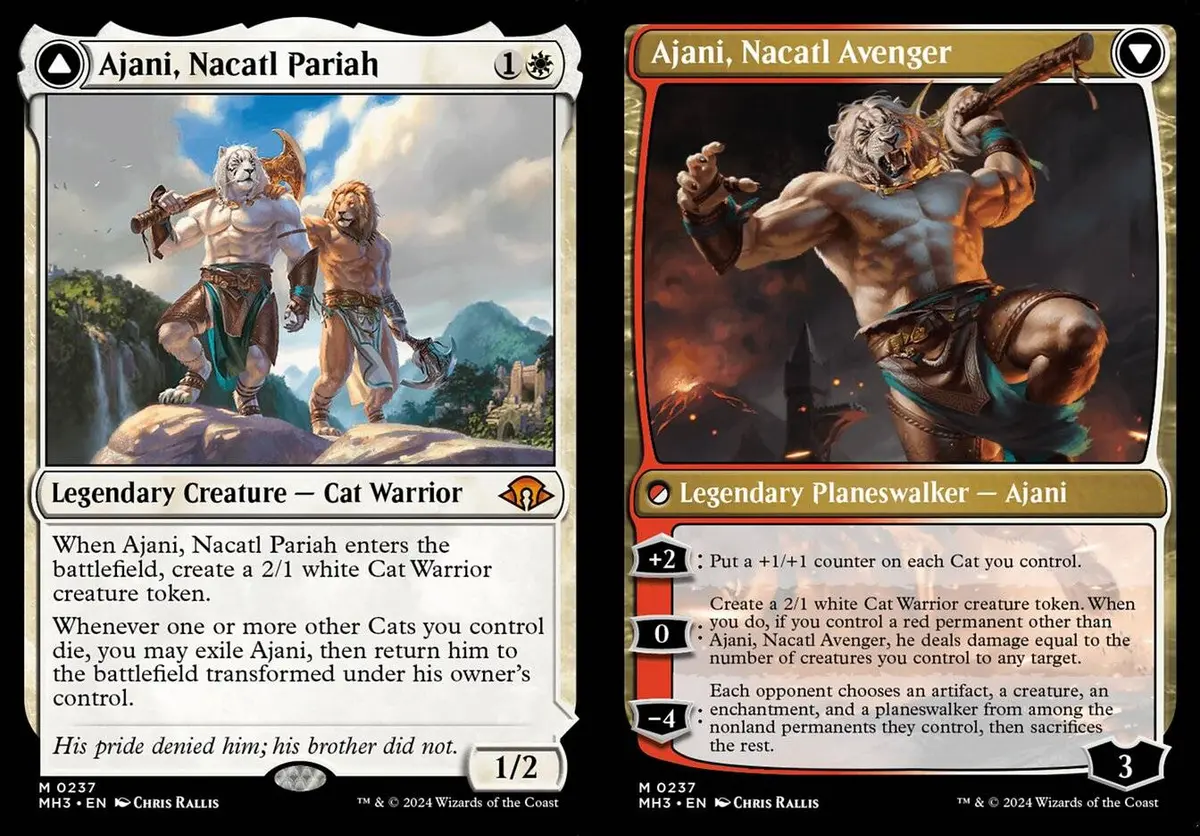
Ajani comes in with a 2/1 cat and goes into a rampage whenever another Cat dies. The token it brings along was deliberately made nonlegendary to avoid breaking the legend rule (the cat is probably modeled on Jazal Goldmane, Ajani’s older brother), but it still couldn’t withstand the creative minds of players.
Watch his brother get shot out by Goblin Bombardment and go berserk. Watch his brother become the Casualty cost for Ob Nixilis, the Adversary and go berserk. Use Bowmasters to stage the Jazal assassination yourself. Or even make Ajani see a second version of himself, die to the legend rule, and then go berserk. How is it just a single mentally disturbed cat
Having said that, Ajani is the strongest card in this deck on its own merits. On the front side he’s a 3/3 in total, and while Ajani is on the battlefield he deters the opponent from using removal on Ocelot Pride. When you ram into the opponent with cats, they have to think about whether to block, to stop Ajani from flipping.
What stands out after flipping is of course the [+0] ability: besides painlessly making 1 cat, as long as you control another red permanent, it deals damage equal to the number of creatures you control to any target, handling the board and going for the head at the same time.
Because the [+0] ability is so strong, I’ve basically never used the other two abilities. Well, pressing [+2] to force the opponent to hurry up and kill Ajani, or else risk the [-4], is also a tactic.
But this is where Mardu’s weakness comes in. The red permanents that can stick around in the main deck are only Amped Raptor, Phlage, Titan of Fire’s Fury, Goblin Bombardment, and the companion Jegantha, the Wellspring. By the time Phlage can stay on the battlefield, you can already escape it and decide the game, and if you’re casting Jegantha straight up, your hand must be in terrible shape, so normally you only look at the other two. Raptor is a creature and easily answered in response, and Goblin Bombardment is too weak on its own. This is one of Mardu’s weaknesses: Ajani is easier to flip, but there are fewer situations where you get to use the full [+0] ability. Making one 2/1 cat each turn is already strong, but firepower of Lightning Bolt or better every turn would obviously be more useful, wouldn’t it?
After sideboarding, the possible red permanents grow to include Obsidian Charmaw and Ob Nixilis, and the latter in particular can sacrifice a cat on demand while providing a red permanent, making it Ajani’s best partner. (Like Goblin Bombardment, it’s a card for Ajani, and Ob Nixilis is exclusive to Mardu.)
Amped Raptor

It should be one of the reasons to play the energy deck, but Raptor is fading more and more into the background. Simply put, it flips cards from the top of your library until you hit a nonland card, and lets you cast it using energy in place of its mana cost, a bit like Cascade. Getting two for one is powerful, but if you flip the wrong card on the fastest turn, or even whiff completely, it gets awkward. To prevent that, the deck keeps its mana values at 3 or less, so that after one Aether Hub or GoS, a 2-mana Raptor can hit any card. Except… The One Ring… never mind…
Two-for-one is certainly strong, and even if you flip Galvanic Discharge, you can target nothing in particular and still gain the energy (note that Static Prison can’t necessarily do the same thing; more on that later).
Remember to pay energy when you hit one, especially with Galvanic Discharge, which is very easy to forget.
Note that the sideboard Obsidian Charmaw might eat too much energy, and you can choose not to cast it. Also, all lands flipped over during the process get exiled, which quietly reduces the lands you draw later, so watch out for that.
Phlage, Titan of Fire’s Fury

A new member of the Titan series, whose price has finally dropped back to a normal level recently. It’s a Lightning Helix that walks. Before escaping, a sorcery-speed Lightning Helix costing 3 is admittedly weaker, but once escaped it’s a huge 6/6, and each attack shoots another Lightning Helix, which is incredibly powerful. The problem is that there isn’t much room for it to shine in current Modern; against combo decks it’s just a liability, and it gets awkward if the opponent has too many creatures with 4 toughness. You also have to pick the timing for escaping, so you don’t eat a removal spell and go straight back to the graveyard. It’s been one of the first cards sided out in many matchups recently, but even so, it’s still incredibly strong in energy mirrors or against midrange decks that aren’t too fast, and 3 copies are still necessary.
Also, with Arena of Glory, after escaping it can run out and attack immediately, raising the ceiling of surprise attacks. Suddenly hitting the opponent’s face for 12 still hurts.
Galvanic Discharge

An energy removal spell. It provides 3 energy itself, so (as long as the opponent has no Suncleanser on the battlefield) it’s guaranteed to be at least a 3-damage removal for 1 mana, and apart from not being able to hit face, it’s better than Lightning Bolt. Note that after targeting, you don’t have to announce how much damage right away. You decide how much energy to spend only after both players pass priority and the spell resolves, and the opponent can’t respond to it. Using this, you can target your own creature, declare paying 0, and just happily take 3 energy.
After pulling off the GoS + Ocelot Pride combo, I call pointing at an opposing creature and firing 20-plus damage the Lightning of Laputa.

Static Prison

The energy world’s Leyline Binding. You don’t have to pay the energy right away either: you’re only asked whether to pay starting next turn. The sorcery speed is a little sluggish, but it still covers Galvanic Discharge’s weaknesses from the side. Too many would be clunky, so the main deck only runs 2.
Its main enemies are Suncleanser and troublesome noncreature permanents (for example, Amulet of Vigor).
Rules gotchas:
Note that when the opponent has nothing to exile, you can’t take the energy.
Note that the time to pay the energy is the beginning of your precombat main phase.
Note that after exiling Suncleanser, you do take the 2 energy.
Chthonian Nightmare

The Recurring Nightmare of 2024, 1 mana cheaper but with an energy restriction. It’s Mardu’s cheat code. For example, after Ajani, Nacatl Pariah himself gets killed and only the 2/1 cat is left sitting there alone, you play Nightmare and sacrifice the cat to bring Ajani back. Incredible! Ajani makes another cat, and it only cost two mana. The 2/1 cat is still there but Ajani is back! (And you made 1 energy on top of that!)
Other uses include turning excess Ocelot Pride tokens back into the real Ocelot Pride, urgently pulling Phlage, Titan of Fire’s Fury back before it can escape to fire a Lightning Helix, sacrificing Ajani’s cat to actively drive Ajani insane, and, after sideboarding with enough energy, repeatedly pulling up Obsidian Charmaw to blow up lands. Surely the opponent won’t side in graveyard hate for one trick card? If they do, you came out ahead!
Note that returning Amped Raptor this way also doesn’t trigger the two-for-one effect. (The Raptor’s effect is a casting trigger issue.)
Note that you can’t directly bring back a creature whose cost you just sacrificed. (You can’t target it.)
The more black lands you have, the more times you can use Nightmare in a turn. The most extreme case I tried was returning three Ocelot Prides in one turn, so watch out for the details of color-changing before using it.
Since the ability is sorcery-speed only, if the energy trigger on entering gets responded to by destroying Nightmare, you can’t do the trick either.
The Lord of the Rings Crew
Orcish Bowmasters

The second-biggest villain of The Lord of the Rings, which punishes the opponent’s card draw. To MTG players, this nobody who appears in the movie for less than 5 seconds matters more than all the legendary characters of the Lord of the Rings world.
When I rewatched the Lord of the Rings movies, all I could think was “this character would be killed by one arrow from the Bowmasters!” or “this character could survive one arrow,” and other disrespectful thoughts like that.
Honestly there’s no need to explain. Haven’t you been shot enough by this guy? The human rights of 1-toughness creatures have all been shot away…
But it has to exist as a necessary evil to keep The One Ring in check… Even if the opponent draws no extra cards, as a 2-mana creature it’s at the very top of the curve.
(Resolute Reinforcements: …
Although many people already know, I’ll mention it here anyway: if the 1-damage target is lost, the Orc Army fails to be created.
The One Ring
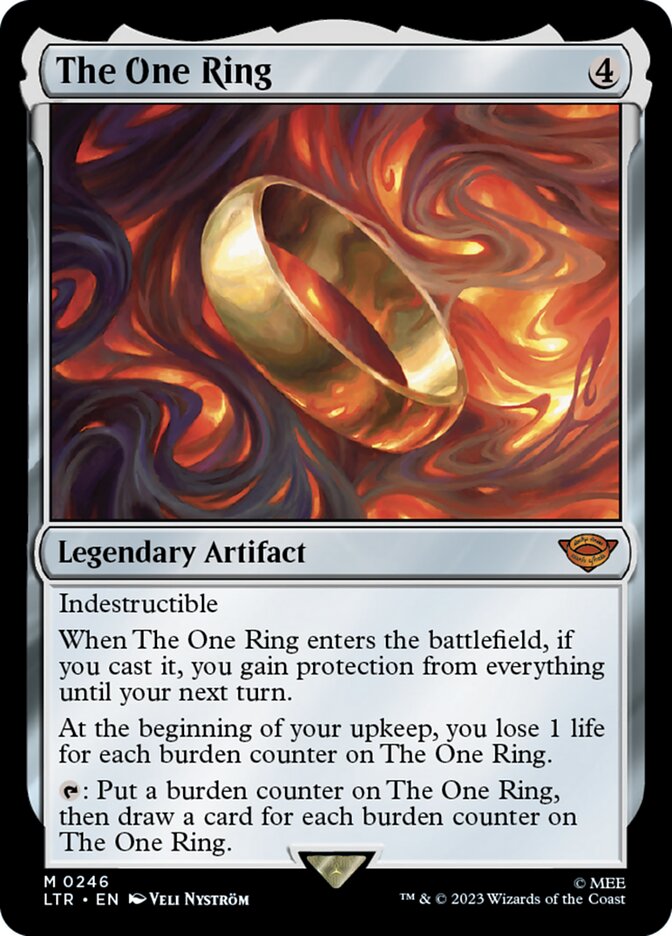
The cursed object.
The biggest legacy of the Lord of the Rings set.
You can think of it as a 4-mana Time Walk plus draw at least 3 cards. (The cost is only 1 life.)
After drawing to your heart’s content, swap in a new Ring and it’s another hero!
It’s truly strange that a single card forms a winning route. Even without the GoS + Ocelot Pride combo, this deck still has Phlage, Titan of Fire’s Fury, so you really don’t need to worry about regaining life. Convert your life total into cards in hand to your heart’s content!
Although it has no sense of elegant synergy with the energy deck at all, the card on its own is just too strong.
Okay, I don’t want to introduce this cursed object any more. It probably has less than a month to live anyway.
Cards from Other Sets
Thoughtseize
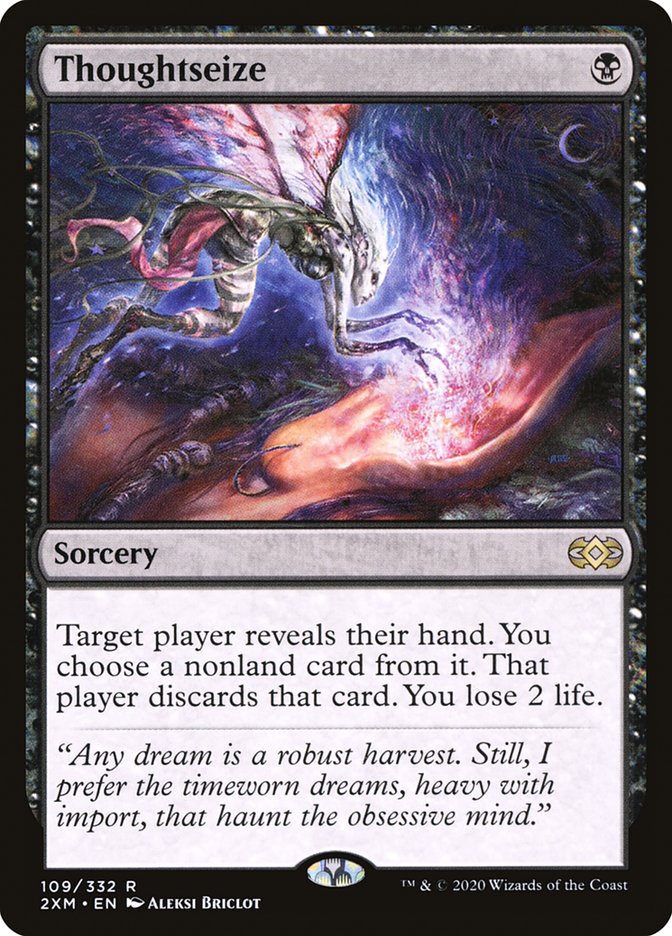
The strongest hand disruption card of all time, anywhere. No matter how strong a card is, it’s meaningless if it can’t be cast! The cost is only 1 mana and 2 life. Strong card! No explanation needed!
(If I had room, I’d probably play 4.)
Any card that can get a job in this cutting-edge Modern deck must have a certain level of card power!
Goblin Bombardment

Sorry for the immediate slap in the face, but this card’s raw power is really low, and it’s probably the weakest main deck card in the whole deck.
Never mind that it can’t do anything by itself, and that converting 1 creature into only 1 damage is too low. So why still run 1? Because it works too perfectly with Ajani, Nacatl Pariah: first, it’s a red permanent, and second, it can proactively shoot cats out. It’s one of the few single cards that fits both Ajani’s flip and his maximum output, so it’s worth running one for the ceiling. (Though it usually gets sided out quickly.)
After the GoS + Ocelot Pride combo, you can also shoot out the cats one by one during the opponent’s upkeep, preventing the opponent from turning the game around on their turn.
Lands
First, the two utility lands. You can run 1 to 3 Aether Hub, but running 3 Hubs has color-screwed me too many times, and having only a Hub in hand is miserable, especially now that the reliance on Amped Raptor has dropped. I think 2 is enough, and the Boros version can probably play more.
Arena of Glory is the same story. I originally tried 2, but after finding that the Phlage it’s meant for often gets sided out, I decided a single one for the ceiling is enough. And when your first land happens to be Godless Shrine and the second land is Arena, it has to enter tapped, which is awkward.
For the other lands, just include the fetchlands and the shocklands in the three color pairs. (Fetch priority is red-white, then black-white, then red-black; you can only grab a basic Plains in an emergency if you can reach white, and unless you have a special need, the order of use goes from right to left.)
Include the surveil lands in the three color pairs, and oh, you should run one extra Sacred Foundry, and the rest are basic lands, yes.
You can refer to this decklist’s land distribution. The only spot I think could be improved is that, now that the highest mana value is 4, one Bloodstained Mire should be swapped for Blood Crypt.
Sideboard
Jegantha, the Wellspring

Remember to take it out of the deck box, and don’t forget to reveal your companion!
Remember to reveal your companion again after every game!
If you side in Obsidian Charmaw, don’t foolishly leave Jegantha in the companion zone. Clearly indicate that you’re taking it away!
Suncleanser

The final weapon against energy decks. How many you run depends on how much you hate energy mirrors. Once its ability targeting the opponent resolves, they can never get energy again until Suncleanser leaves the battlefield, and when the ability resolves their energy is wiped out completely. That means Galvanic Discharge can only hit for 0, Guide of Souls turns straight back into a slightly bigger Soul Warden, and Amped Raptor can only ever flip for 0. The only one that avoids this is Static Prison. This time I really hated the mirror so I ran 3, but I never faced a single energy deck, so I adjusted the number afterward.
Another thing to note: if the opponent has 1 or more energy, you can still deal with it by killing Suncleanser with Galvanic Discharge before the ETB ability resolves. (It still wipes out all of the opponent’s remaining energy, though.)
Aside from that, in the rarer cases you can also target a creature of the opponent’s that will carry a pile of counters, such as in Heliod, Sun-Crowned Walking Ballista and Hardened Scales decks, which see this situation more often. But against the latter, there are lots of cases where they respond by sacrificing the targeted creature and moving the counters to another creature or to The Ozolith, so treat Suncleanser as just one sideboard option and don’t trust it too much.
Static Prison
2 in the main and 2 in the sideboard, as extra copies. For example, it’s still very good against mono-red Storm, and it’s not bad as a creature removal either.
Against decks with too many varied targets, like Yawgmoth, Thran Physician, it also works as a universal answer.
Damping Sphere
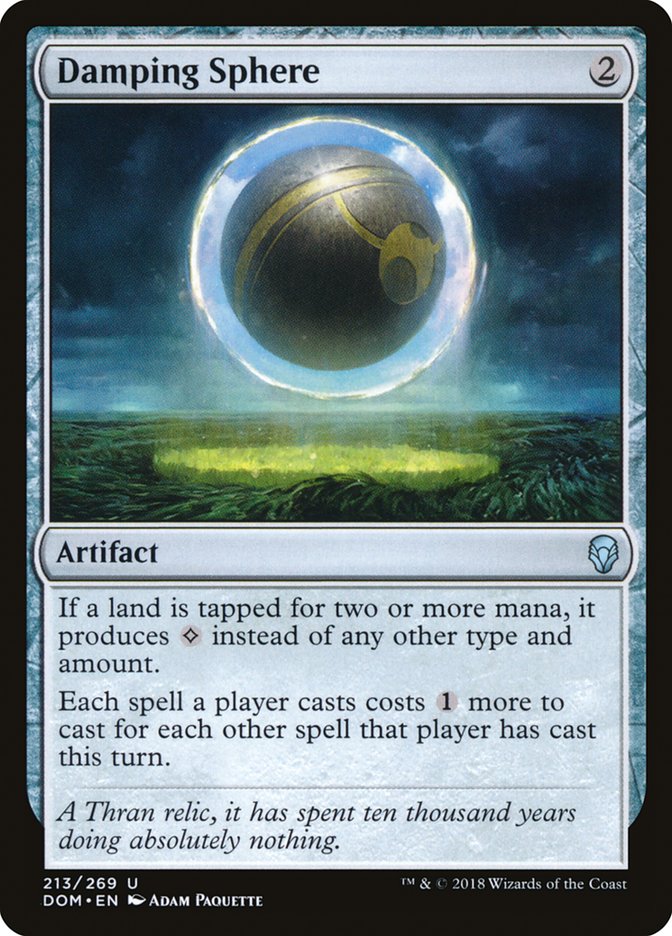
For decks like Primeval Titan, mono-red Storm, Tron, and Eldrazi (& Through the Breach); among the more niche ones there’s also Twiddle Lotus Field.
Its first ability is for hitting combos, and its second ability punishes lands that tap for 2 mana. Bring in extra copies when the metagame has more of the decks above.
Wear // Tear
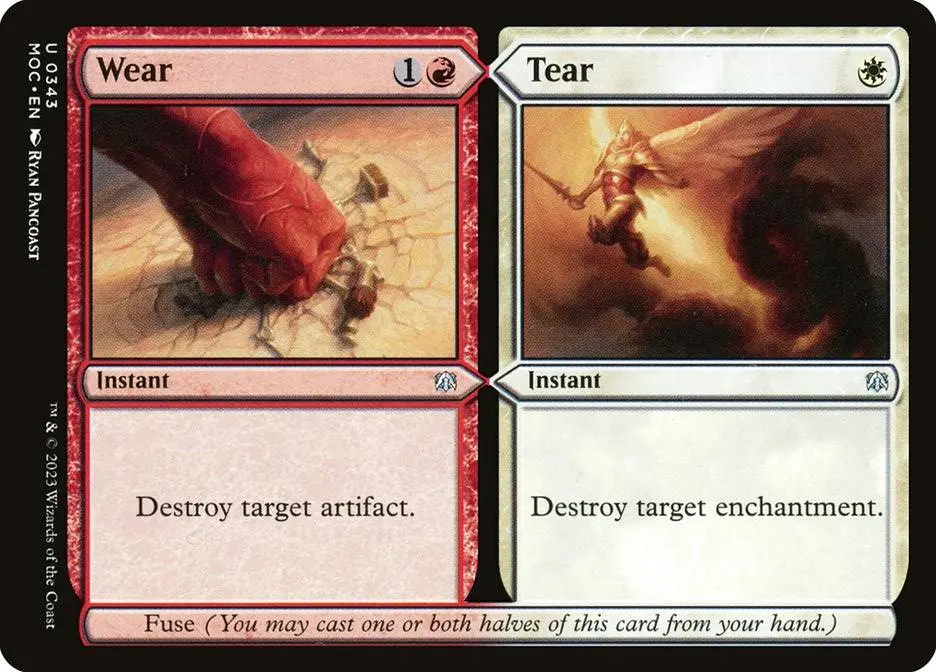
For Domain, Goblin Charbelcher decks (keeping the opponent from casting Goblin Charbelcher and just waiting a turn), Grinding Station, Primeval Titan, Hardened Scales, Colossus Hammer, Affinity decks, and so on.
It simply destroys artifacts and enchantments, and with enough mana you can get a 2-for-1. Aside from not being able to hit The One Ring, it’s a very good universal answer. The awkward part is decks like Yawgmoth, Thran Physician that win with an add-on Agatha’s Soul Cauldron but only have one target; it’s really hard to use there (that’s where Static Prison, which can exile anything, comes out ahead).
Ob Nixilis, the Adversary

For decks like Murktide Regent (& Abhorrent Oculus), Jeskai Control, and Izzet Wizards. The imagined enemy is draw-go decks with plenty of counterspells, or slower control decks.
The Casualty effect is naturally suited to dodging counterspells, so use it when you expect the opponent to play a slow game. Note that in combo matchups it’s awkward in the same way as Phlage, Titan of Fire’s Fury: sacrificing your own creatures slows your tempo a little. Also, against decks that discard cards (for example Goryo’s Vengeance), it may make the opponent discard exactly what they wanted to dig up, completing a friendly combo of helping them with their graveyard. (In effect, a fancy way of raising your hand in surrender.)
When you notice that the opponent’s deck leans on the graveyard to some degree, you should avoid siding this in. (So be careful about this against Murktide or Oculus.)
Obsidian Charmaw

Nickname: the land-blasting dragon
The final weapon against decks built mostly on colorless lands, like Tron and Eldrazi. Besides those, it can also be used against decks with lots of utility lands and nonbasic lands, such as Charbelcher, Titan, and Scales decks, if you’re confident you can slow the opponent’s tempo.
Combined with Chthonian Nightmare, pulling it up from the graveyard over and over to blow up all the opposing lands is super satisfying, but it takes a lot of energy, so you basically need to have completed the Guide of Souls and Ocelot Pride combo before you can use it freely.
Note that after siding it in, remember to put your companion away, so you don’t take a game loss for no reason.
Rest in Peace

For Murktide Regent (& Abhorrent Oculus), Grinding Station, mono-red Storm that hasn’t sided out Past in Flames, the newest form of Titan (the version that uses Aftermath Analyst for graveyard combos), and of course graveyard-leaning decks like Living End and Yawgmoth.
Although it isn’t in this decklist, thinking back on it, I could have used it. If I rewrote the list, I’d reduce the number of Suncleanser and adjust the numbers of Damping Sphere and Rest in Peace.
There may be many more usable sideboard cards I haven’t mentioned, but based on my personal habits, these are the ones I reach for first. (I don’t like using sideboard cards that are too hard to use, such as Magebane Lizard.)
Cycle 8 MITQ Report
Of course I’ll include the match report, though the details may be a little off. (The traditional ability of recalling the day from the life-total sheet.)
豐原諾亞 MITQ (Cycle 8)
Format: Modern
15 participants, final placement: champion
R1: Domain Rhino XX
Game 1, I mulliganed twice, then saw The One Ring in my opening hand, and in the end I got stuck on three lands and was trampled to death by Crashing Footfalls.
Side in:
Static Prison x 2
Wear // Tear x 2
Damping Sphere x 3
Side out:
Orcish Bowmasters x 4
Goblin Bombardment x 1
Phlage, Titan of Fire’s Fury x 2
Rather than saying I wanted to use these 7 cards, it’s more that the 7 cards I sided out really don’t do much… Damping Sphere only prevents the fastest Cascade; if I can stall long enough to reach the Ring zone, that’s my win.
Leyline of the Guildpact + a turn-two Scion of Draco? Then I concede.
Game 2, no mulligan. I managed to destroy the Leyline the opponent started with, but I was stuck on three lands again, and the 2 Rings in my hand were completely useless. Still, considering that in both games I saw Force of Negation and Bonecrusher Giant in the opponent’s hand, even a Ring cast on time on turn 4 would probably have died anyway.
The best card to fight Rhino is probably Legion’s End, but I really didn’t want to put a hard-to-use answer in just for one matchup…
R2: VS Rakdos Midrange (with a Sorin, Imperious Bloodlord + Vein Ripper combo) OO
Game 1, my opening hand included Thoughtseize,
Opponent’s hand:
Bloodghast
Fatal Push
Swamp
Blazemire Verge
Fable of the Mirror-Breaker
Sorin, Imperious Bloodlord
Me:
Apart from Bloodghast, everything was Pioneer or even Standard-legal cards, and my jaw dropped. But the moment I saw Sorin, Imperious Bloodlord I immediately knew what they wanted to play. I couldn’t see Vein Ripper, so the combo wasn’t online and I took Fable. In the end, as I recall, I just steamrolled the opponent, and Ripper showing up couldn’t stop a flipped Ajani from blasting their face.
Side in:
Static Prison x 2
Side out:
Chthonian Nightmare x 1
Goblin Bombardment x 1
I didn’t know what to swap either; anyway the opponent seemed to have quite a few permanents, so I just increased the removal.
Game 2, Thoughtseize,
Bloodstained Mire
Verdant Catacombs
Sorin, Imperious Bloodlord x 2
Dauthi Voidwalker
I saw two Sorins in the opponent’s hand and still no Ripper, so I took Voidwalker. Later the opponent drew Ripper, but my Ajani had long since flipped and I had plenty of energy, so one Galvanic Discharge killed it to clear the way, and I won by pushing through.
R3: VS Mono-Black Reanimator OXO
For some reason I always run into this friend in round 3… (See the Golgari Soulflayer report for that time.)
Game 1, Thoughtseize in my opening hand,
Opponent’s hand:
Swamp
Deserted Temple
Persist
Unmarked Grave
Archon of Cruelty
Me:
(Here we go again, but this time it’s a bit easier to understand.)
Seeing Unmarked Grave, Persist, and Archon of Cruelty, I knew what they were playing. I took Unmarked Grave and beat them to death with one Ocelot Pride and one Bowmasters. The opponent even tried to change strategy at 3 lands, casting nothing and exceeding their maximum hand size to discard the Archon and dig it back up, but I was one turn faster.
Side in:
Static Prison x 2
Damping Sphere x 2
Ob Nixilis, the Adversary x 2
Wear // Tear x 2
Side out:
Phlage, Titan of Fire’s Fury x 3
Goblin Bombardment x 1
Galvanic Discharge x 4
Of course it’s in matchups like this that I didn’t bring Rest in Peace…!
Same as game 1, I mainly wanted to side out the cards that are weak in this matchup, and I’d rather bring in a few assorted hate cards than keep those.
Phlage is too slow, Galvanic Discharge can only hit the Archon (and if the Archon has already resolved, honestly it’s too late anyway), and Goblin Bombardment is too slow.
The Sphere is for Cabal Coffers, and Static Prison and Wear // Tear are mainly for the various artifacts Karn, the Great Creator fetches from the sideboard (especially Ensnaring Bridge). Ob Nixilis is a big gamble to side in: the [+1] ability has a chance to put the opponent’s Archon into the graveyard, completing the friendly combo mentioned earlier. I expected to keep control of the opponent’s hand, or only cast it after confirming it’s safe with Thoughtseize. After all, the opponent’s deck doesn’t look like it has many creatures, so dragging the game into planeswalker-war territory favors me, and if the opponent’s Archon unfortunately does get out in the end, Static Prison can serve as the last rescue.
Game 2, the opponent played Unmarked Grave on turn 2 and Persist on Archon on turn 3. Even though I flipped Ajani on turn 3 and added 2 Ob Nixilis, it was too late. I couldn’t find the Ring or an answer, and was pushed to death by a single Archon.
Game 3, no changes. One Ocelot Pride and three Bowmasters beat the opponent to death, a board even blacker than Mono-Black…
R4: VS Mono-Red Storm OXO
Game 1 was an aggro start and I even killed Ral, Monsoon Mage once, but the opponent played 2 Ruby Medallion and just started performing, digging through about 40 cards to find Wish. There was nothing I could do; this game was just sitting and watching the opponent perform. Looking back, I should have conceded earlier here; a minute earlier here, and game 3 could have been finished.
Side in:
Damping Sphere x 3
Wear // Tear x 2
Side out:
Phlage, Titan of Fire’s Fury x 3
The One Ring x 2
Slow cards out, disruption in. I thought about adding extra Static Prison, but since I was on the play in game 2, too many removal spells would clog my tempo.
Game 2, Thoughtseize in my opening hand,
Opponent’s hand:
Valakut Awakening
Past in Flames
Static Prison
Desperate Ritual x 2
Reckless Impulse
Ruby Medallion
The opponent effectively kept a 1-lander. I considered taking Valakut Awakening to try to make them miss land drops, but looking at my hand, I had no removal and only 2 Spheres, and if they drew lands off the top two turns in a row it would be rather bad for me, so I should take either Ruby Medallion or Static Prison. After thinking about it, I felt the Medallion was harder to deal with, so I took it first, and my first Sphere would be fed to their Static Prison (it comes back after 2 turns anyway). I didn’t expect them to quickly draw a second Static Prison, and my 2 Spheres were answered by 2 Static Prisons, but under my aggro pressure the opponent still couldn’t get going, and had to Grapeshot for storm 10 to clear the board. In the end I drew 3 cards with the Ring, found enough creatures to enter, and let the GoS on the battlefield have enough energy to fly over and kill the opponent.
Game 3 we started right away since time was short. The opponent mulliganed three times. I planned to take them out with one wave of aggro, but Static Prison dragged out the time, and with just one minute to spare, I was one turn short of killing the opponent. Considering that a draw here would send both players into the top four, they let me go up in the end.
R5: VS Dimir Murktide XO
Game 1, I had a hand of 2-drops but one land, and by the time I died I was still on one land.
Side in:
Static Prison x 2
Ob Nixilis, the Adversary x 2
Side out:
Phlage, Titan of Fire’s Fury x 1
Chthonian Nightmare x 1
Goblin Bombardment x 1
Thoughtseize x 1
By elimination, I first swapped out 2 enchantments that are only strong in combos (they can’t reach full potential when the opponent has Thoughtseize). The key to this matchup is The One Ring, so life total matters a lot. By elimination I cut Thoughtseize, and because I’m bringing in two 3-mana Ob Nixilis, I cut a 3-mana Titan. I added 2 Static Prison to answer Psychic Frog or Murktide Regent, and used Ob Nixilis’s Casualty to get around the opponent’s counterspells.
Game 2, I suppressed the board with the Ajani + Ob Nixilis combo, but the opponent repeatedly flew over with Psychic Frog and killed my planeswalker gang (why does this frog get to draw cards when it hits a planeswalker? What kind of design is that?). Even punishing it with Bowmasters wasn’t enough, and the board of city’s-blessing cats was wiped by The Meathook Massacre, but in the end I still won on the overwhelming resources from the Ring.
Game 3, no changes. It stayed even throughout. The board built by Ocelot Pride was again swept by Meathook Massacre, I dealt with the opponent’s Psychic Frog and Murktide, I got punished by Bowmasters when drawing with the Ring, and I was lucky not to die, but in the end neither side could kill the other.
Final swiss record 3-1-1, and I barely slid into the top four in 4th place!
Top 4: VS Heliod Walking Ballista OO
On the draw, game 1. I was too eager to quickly set up the Guide of Souls + Ocelot Pride combo, and I only cast Thoughtseize on turn 3 on the draw. The opponent had already played Heliod, Sun-Crowned and used Collected Company (hitting Arbor Elf & Scurry Oak, so they probably didn’t flip very well). Looking at their hand,
A second Heliod, Sun-Crowned
Temple Garden
Basking Broodscale
There wasn’t much to choose, so I could only take Broodscale. Afterward the opponent topdecked another Broodscale, but by then I had completed the system of 1 GoS + 2 Ocelot Prides, making 6 cats every turn and then flying each Ocelot Pride over one by one to hit the opponent, so they couldn’t be blocked to death by the opponent’s ground forces. Finally I cast The One Ring so the opponent had no chance to hit back with lifelink. Win.
Side in:
Static Prison x 2
Suncleanser x 2
Wear // Tear x 2
Side out:
Phlage, Titan of Fire’s Fury x 3
Chthonian Nightmare x 1
The One Ring x 2
Because I saw the opponent had GoS in game 1, I worried about some strange combo and brought in Suncleanser. Since I’m on the draw I added more Static Prison, which could also lock down Heliod, Sun-Crowned, while Wear // Tear is for hitting Agatha’s Soul Cauldron and, in the worst case, Utopia Sprawl to buy time; otherwise a turn-2 Arbor Elf + Utopia Sprawl making 4 mana is just too fast and painful. The opponent’s combo is faster than mine, and the lifegain from the GoS + Ocelot Pride combo can’t stop an infinite Walking Ballista once their combo is complete, and I also have no answer to the infinite life from Spike Feeder. So I had to avoid tapping out on my own turn at all costs: I pulled all the clunkiest Phlages first, then reduced the Ring, and finally, considering the opponent has Cauldron, swapped out Chthonian Nightmare.
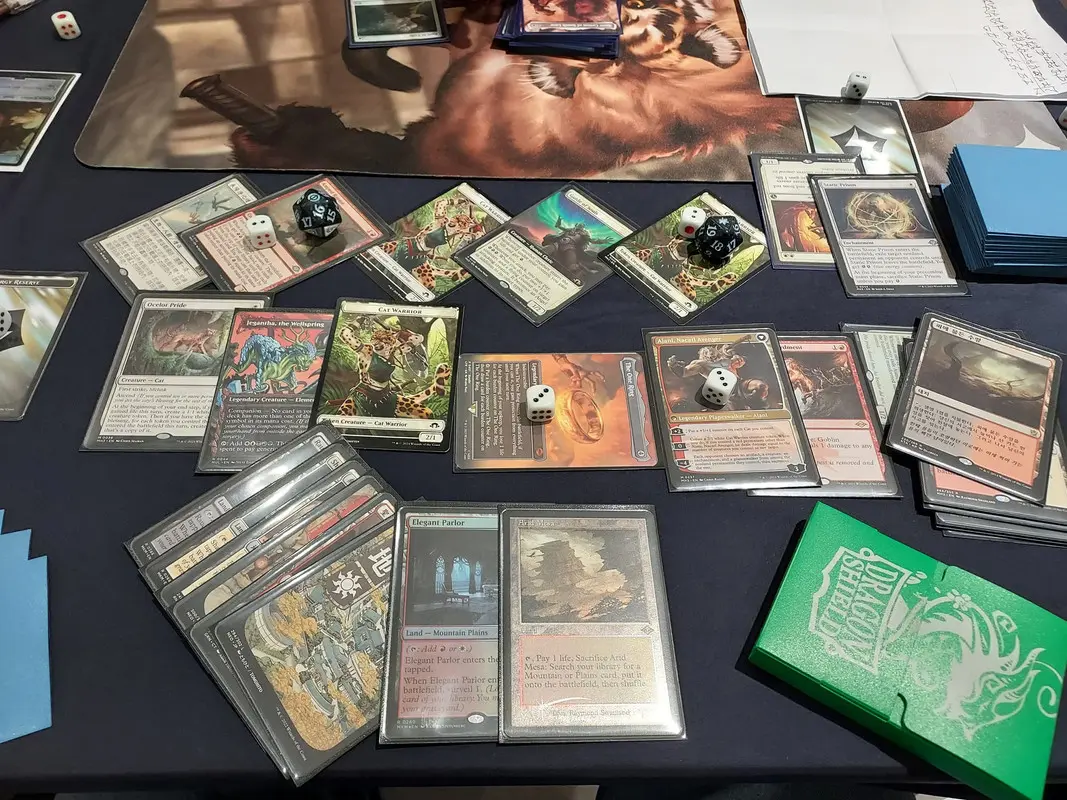
Game 2, the opponent’s fastest Auriok Champion was a bit troublesome, and I could only hope to draw Static Prison. Midgame I drew Suncleanser and reflexively targeted the opponent’s face, but thinking about it now I should have targeted Champion with it. I forgot how I won this game; I think I laid out a board, played Bowmasters, activated the Ring, then drew Static Prison, and pushed through… (The result was the board in the image below.)
Finals: VS Hardened Scales OXO
The opponent was a well-known Hardened Scales player, and honestly my familiarity with Scales is really lacking, so I expected a tough fight. I did at least have an idea in my head of how I could win, which was to complete the GoS + Ocelot Pride combo and win on the life-total gap, which can ignore the opponent’s offense to a certain degree (and I did pull it off twice).
I was on the draw. In game 1, the opponent’s turn-1 Scales and turn-2 Walking Ballista took out my Ocelot Pride, forcing me to trade with Bowmasters. Then the opponent played Patchwork Automaton, Welding Jar, Shadowspear, The Ozolith, and other common Scales cards, growing the Automaton to be super huge, and all I could do was cast the Ring and activate it to look for a solution.
At one point my life total dropped to 4 when I drew Static Prison. Looking at the opponent’s Ozolith and the Inkmoth Nexus behind it, a flash of inspiration hit: instead of exiling the Automaton, I exiled the Shadowspear. (I’d realized the Ozolith transfers counters when it leaves the battlefield.)
I had 3 mana left at the time and 1 Galvanic Discharge in hand. If I had Prisoned the Automaton itself, I’d be tapped out, and next turn the Ozolith would move all the counters onto the Inkmoth land and I could get killed by 10 poison right away. I remembered that in Scales lists Shadowspear usually has only one copy, and an Automaton without its evasion can only be fed one creature per turn.
On the key turn I already had GoS on the battlefield, one Ocelot Pride in hand, and two Ocelot Prides in the graveyard. I activated the Ring and drew Chthonian Nightmare. I’ve been waiting for you for so long! I first cast the Ocelot Pride in my hand, then cast Nightmare twice in a row to trade 2 creatures for Ocelot Prides, and with 3 Ocelot Prides plus 14 cats at end of turn, I went from 7 life to 21 in one go.
Next turn I calculated that an all-out attack still couldn’t kill the opponent (they were at 22), so I decided to only fly the Ocelot Prides over for one hit and make 14 more cats, then prayed that the opponent had no way of sacrificing Patchwork Automaton to give the counters to Inkmoth Nexus. Luckily they didn’t draw it, and I successfully turned the game around.
Side in:
Static Prison x 2
Wear // Tear x 2
Obsidian Charmaw x 2
Side out:
Orcish Bowmasters x 1
Thoughtseize x 3
Phlage, Titan of Fire’s Fury x 1
Goblin Bombardment x 1
The opponent was too fast, but since it wasn’t an infinite combo, I could still endure by feeding creatures until The One Ring came out, opening up a big gap in hand size in one go, and as long as I could complete the GoS + Ocelot Pride combo, I would win. Static Prison and Wear // Tear need no explanation, since there are many targets. As for Charmaw, the opponent’s deck has quite a few colorless lands, such as Inkmoth Nexus, Urza’s Saga, and Phyrexian Tower, and each one is key: Inkmoth is the finisher, Saga can open a midrange route on its own, and Tower is one of the combo pieces, so I had to punish them by blowing up lands.
Because life total matters, by elimination I first pulled all the Thoughtseizes. Considering that this deck basically has no time to attack the opponent early on, even after completing the combo and making 6 or 14 cats (30 cats is too hard) I couldn’t kill the opponent that same turn, so I took out Goblin Bombardment too. Phlage is sluggish, but at least it gains life, so I only took out 1. For the last slot I originally wanted to take out Chthonian Nightmare, since I’d shown it once in front of the opponent and their Agatha’s Soul Cauldron would surely focus all its attention on my graveyard’s Nightmare, but in the end I felt Nightmare still raises the ceiling, so I took out 1 Bowmasters instead (the opponent doesn’t draw extra cards).
Game 2, I don’t remember very well; the life-total sheet doesn’t have any life changes written on it. I only remember doing something wrong that let the opponent block my GoS to death, and then after a round of their combo the opponent produced a Walking Ballista with 12 counters, used it to shoot away all my blockers, then hit my face and shot me dead. Loss.
Game 3, no changes. I mulliganed once, and the opponent started the game with Gemstone Caverns. Early on I kept getting beaten down by Hangarback Walker with counters, while Zabaz, the Glimmerwasp was also on the battlefield, making the opponent’s combos more varied. While I blocked with creatures, once I had enough mana I used Charmaw to blow up the opponent’s Phyrexian Tower, stopping them from suddenly sacrificing Hangarback Walker to produce 10-plus Ornithopter tokens. (I also learned that a Gemstone Caverns with a luck counter doesn’t count as a colorless land, so Charmaw can’t be reduced in cost.)
After feeding Charmaw to the opponent’s Hangarback Walker, the opponent played Agatha’s Soul Cauldron and used the legend rule to make Zabaz kill itself. My turn: I tried sneaking in an attack with Ajani to see whether the opponent would blow themselves up; the opponent activated the Cauldron to eat Zabaz, which gave their Hangarback Walker a way to blow itself up, and suddenly 11 Ornithopter tokens appeared to block my Ajani & the 2/1 cat to death. Great, the Cauldron couldn’t be activated any more, so I cast the Chthonian Nightmare in my hand, ate GoS to bring that Charmaw back and destroyed the Gemstone Caverns, and after that the opponent had only a Forest left. The opponent drew only one Urza’s Saga, while I activated the Ring and drew Wear // Tear (for the Cauldron & Urza’s Saga), GoS, Ocelot Pride, and a pile of other material, which I slowly cast one by one, once again pulling my life total up to 27, and the opponent lost to the hand-size gap the Ring created.
Victory! The winning tactic in the last game against Scales was “if you raise your life total high enough, you won’t get killed”! (You still have to watch out for Inkmoth Nexus, though.)
Afterthoughts
At the moment of victory I felt no joy of winning, only the guilt of having stolen 15 cards with the Ring in the finals. This deck is literally beating the opponent in the face with money… (It cost $1,300 at the time of the win.)
I’d slept only three hours that day and still managed to win the championship, so the Ring really is powerful! It’s all the power of the Ring! Well, this card really is strange, with usage over 50%, so it’s going into the banned list in December, right!?
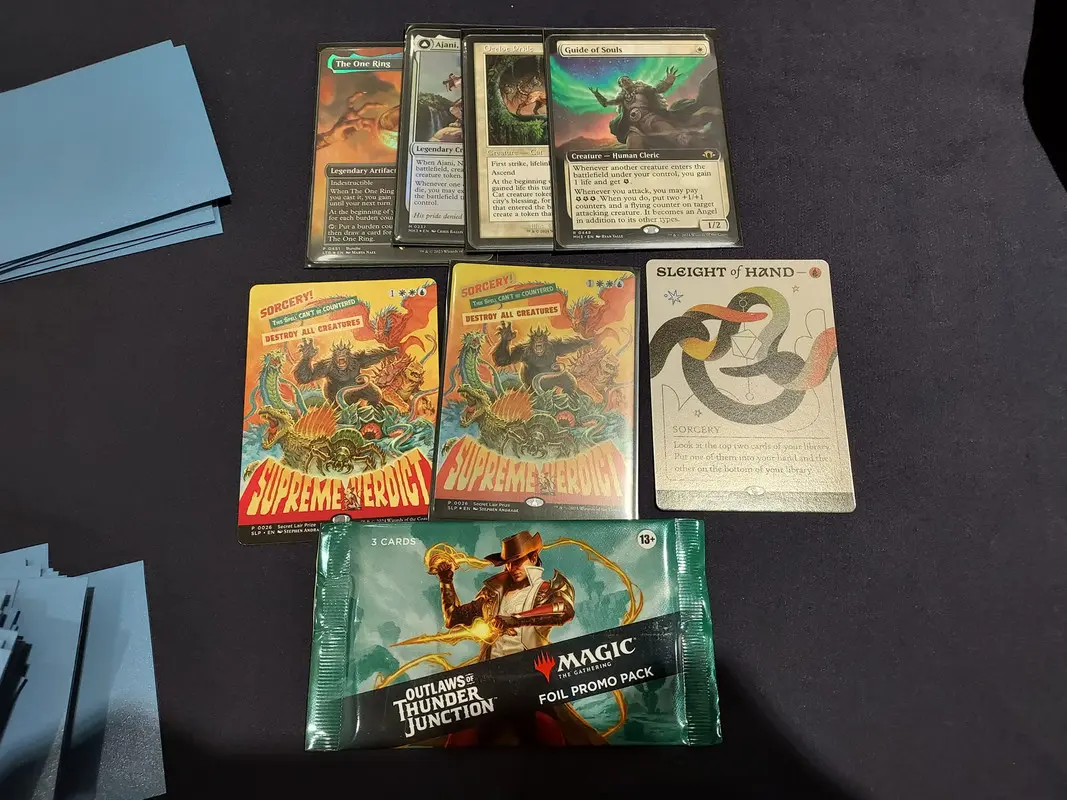
(Besides the prizes, here’s the Gang of Four villains.
GoS! Ocelot Pride! Ajani! The Ring! All four are cards from Modern-exclusive sets? HAHAHA)
Anyway, before I knew it I’d been playing MTG in Taiwan for 2 years and 3 months; actually I only got into the game with SNC. When my friends first pulled me in, I basically only played draft and sealed. I only started taking Standard seriously with DMU (which also happened to be right when I had just arrived in Taiwan). From the earliest decks I stumbled around throwing together, to qualifying by accident in the second cycle, then moving on to Pioneer and even Modern, and up to now, I’ve entered the Taipei championship every cycle since the second one. (Though my skills are lacking and I’ve never placed higher than top 8.)
Let me casually recap the finals decks of each season.
Cycle 2: Esper Legends (Standard)
Cycle 3: Sultai Soulflayer (Pioneer)
Cycle 4: Sultai Soulflayer (Pioneer)
Cycle 5: Domain Zoo (Modern)
Cycle 6: Esper Legends (Standard)
Cycle 7: Mono-Black Demons (Modern)
On this journey, which is neither short nor long, I met a lot of people, spent a lot of time studying MTG, made quite a few friends, and by a stroke of luck joined this website, Guildmages’ Forum (I have to say that looking back now it really was a strange fate).
When the relationships around me were falling apart, one of the things I did was specifically open an MTG page and write down my journey of playing, to make my life a bit more fulfilling and also to leave a record. (The reason I don’t post here often is definitely not that I find writing long articles a hassle every time and got lazy; I’m better suited to writing essays or scattered notes)
Barring accidents, Cycle 8 will probably be the last time I play in the championship while living in Taiwan, since I’ll have to go back to Hong Kong for personal reasons. (Yes, I’m not a local from Taiwan.)
In the future I might even fly over specifically to play in an LCQ and go straight into the championship? But that’s all in the future, who knows. I tend to treat each time as if it were the last chance, because nothing is guaranteed, and a life you take for granted can completely collapse one day, which is why I give everything each time.
Although recently, because of my oshi activities and flying to Japan too many times, I’ve somewhat wanted to quit MTG. But when I faced many strong players at the Cycle 7 championship, I felt that I truly love playing MTG. After all, matches between strong players are so exciting, and playing against strong opponents is so fun!
And it also satisfies my need for recognition
(When will I finish writing up Cycle 7? Haha, next time…
Since it’s the last time, let me prepare properly. Putting up a good result in the last one and ending with a dazzling firework wouldn’t be bad. I’ve already thought of the deck! I might end with my own soul deck! It’s also possible the December banned list sends the whole plan straight into the trash
Oh, I accidentally made the closing remarks too long. Finally, let me end with a song I’ve been enjoying lately. Well then everyone, see you in the next article!
Living in the present
Embracing the past
From 0 to 1, shouting until hoarse
- Title
- Modern Mardu Energy: When Ocelot Pride Meets The One Ring
- Author
- Kappa
- Created at
- November 25, 2024
- License
- This work is licensed under CC BY-NC-SA 4.0 .