Outlaws of Thunder Junction (OTJ) Limited Guide — Black

Note: This article was translated from Chinese by AI and may contain errors. Read the original Chinese version.
Outlaws of Thunder Junction (OTJ) prerelease events are held on April 12, 2024, with the official release one week later on April 19, 2024. Want to know more about individual card ratings in Limited and some potentially fun synergies? Then check out this OTJ Limited guide series!
For a mechanics rundown, see this article: Outlaws of Thunder Junction Mechanics Explained
Rating Scale
5.0: Unconditional must-pick
4.0: First-pick quality
3.5: Strong enough, but not necessarily a first pick
3.0: Above average (you will really want it in your final deck)
2.5: Average, maybe around the 6th or 7th pick in a draft
2.0 to 1.0: Below average (you would rather not play it than play it)
0.5 to 0.0: Unplayable (basically don’t play it, it will only help you lose)
Black

Kappa: 2.5
A flash bug with an abnormally small butt. Its ability and its power are both very good. If you use flash well, on defense you can first use the ability to kill a small creature, then trade its own power with a big one. The downsides are also obvious. First, the butt is too small, especially against red and green, where a small butt means it is easier to kill, though flash can save it to some extent, since at least it avoids sorcery-speed removal. Second, the cost is too high. Played normally, it is just so-so at six mana, but if you pair it with ramp, you can make up for the ramp gap with the one-for-two trade described above, which adds about 0.5 to the rating. It is a decent defensive choice, and in a more controlling deck, leaving the opponent with an empty board and then using it as an attacker is not out of the question.

Kappa: 2.5
A two-mana discard of any card, and one of the few cards in this set that can interfere with plotted cards that haven’t been cast yet. Straight discard has always been the ultimate answer to bombs that are hard to deal with once they hit the battlefield. Similar cards in the past never scored as high as 3.0, because this card’s biggest advantages are being cheap and unique, and it is also a good way to commit a crime. Similar commons and uncommons in the past were mostly three mana, which leaves quite a gap and makes it easy to have your life total collapse to creatures the opponent brings out on turns two or three. Two mana leaves a much smaller gap, and you can also adjust your game plan to the contents of the opponent’s hand. In addition, this card’s unique advantage is that it can handle plotted cards, such as Stingerback Terror and Railway Brawler, bombs that lie in wait in exile or trigger a chain reaction with a huge payoff the moment they enter. This card can stop them before they happen. If the opponent’s hand has nothing worth discarding, switch to handling these plotted bombs and earn a mana advantage and tempo advantage. Although the drawbacks of straight discard, being late, remain unsolved, having a different way of handling bombs from removal is a good thing, especially for noncreature bombs, where this card is clearly better.

Kappa: 3.0
This is the black 3-2-1 flying common that is close to becoming a tradition of every set, but this one is especially strong, since it actually has a conditional counter effect. The condition is that a creature died this turn, and combined with the plot ability, you can imagine the designers want you to plot it first and wait for a turn in which one of your own creatures died before bringing it in, or to kill an opposing creature with removal and then bring it in. But I think the card’s real value is that, as long as you have black, if you’re on the play and attack with your two-drop on turn three, once the opponent trades with it using their turn-two creature, what awaits them is a 3/2 flyer. For a common, such a smooth curve is very rare, forcing the opponent to bring out a flying force and removal to trade with you, and if they have none, what awaits them is this bird whittling down their life. Of course, even if it is late or the opponent doesn’t trade with you, a 3-2-1 flyer has already proven its strength across many sets: in Limited, flyers are the boss. In short, it is a common creature with a decent floor and a very good ceiling. If you take multiples, consider leaning your curve earlier, so the opponent must choose between taking damage and letting the upgraded bird out. If you have a two-mana creature that earns a resource advantage, like Caustic Bronco, it is even better, tempting the opponent more to trade.
Kappa: 2.5
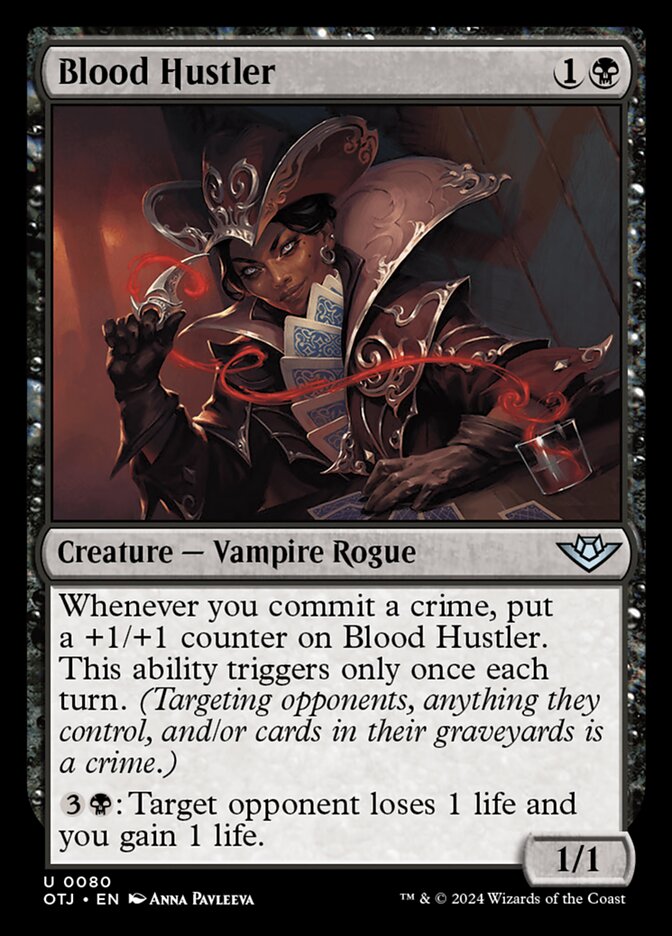
One of the few Outlaws that has both a crime bonus and its own way to commit a crime. Whether it is a crime on time for a growth plan, or a source of crime and a way to widen the life gap when flooding, it is a convenient uncommon. Unfortunately its body is too poor at two mana, so you easily lose tempo on the board. If you want to use the growth plan, you must prepare plenty of crime sources. Its own crime payoff is good, but the cost is a bit too high.

Kappa: 2.0
A common sacrifice-outlet creature, and sacrificing an Outlaw gives a Treasure in return, which reduces the tempo loss, but considering it costs four itself, it is harder for it to serve as ramp. In a red-black Outlaws theme, a nice plan is to first pump it with a Mercenary token, then eat the Mercenary to add power, then use the resulting Treasure to cast a combat trick to protect it. It also has menace, which makes it easier to hit the opponent’s face. The problem is that this card’s raw power is just ordinary. Rather than using this one as a single point of breakthrough and worrying about removal, it is more stable to choose other, more powerful commons and uncommons for midrange games. And the sacrifice costing two mana to activate is a bit awkward to use. Overall, you only take it as a finisher when you have no better options.

Kappa: 2.5
A snake-horse mount that can sell some life when attacking to generate a resource advantage, and in late-game stalls can switch to dealing direct damage to the opponent through saddling. If it comes on time it basically earns one card of advantage, and otherwise it can bait out a removal spell. It is a decent option in the two-mana creature curve, but the drawbacks are also obvious: you can’t control the cost of the card you get, so you might lose too much life or deal too little direct damage, and in the mid-to-late game its body is too weak to attack freely, so running out basically means a suicide attack to trade for cards. Overall, it is a two-drop with very obvious pros and cons.

Kappa: 3.5
Finally, even the four-mana common removal has evolved into an exile effect… and comes with a conditional surveil 2 as a bonus. In Limited, hard removal is the boss, and for a common there is really nothing to pick at.

Kappa: 2.5
You reprinted it after only a year? (MOM)
Is the name Village Rites really that hard to reprint? Back to the point: unlike before the reprint, this set has a red-black Mercenary-making theme, which makes it easy to use Mercenaries as sacrifice fodder to draw two cards. Also, the basic use of responding to the opponent’s removal and turning your own creature into two cards is good too, so you can say it is a resource card you are glad to have in reserve.

Kappa: 3.0
A removal spell that encourages using more Deserts. This set has 15 Deserts in total. Unlike LCI’s cave system, where caves are mostly mono-colored lands and also need to work together, with plenty of colorless lands, this time’s Deserts have a cycle of 10 two-color ones, 2 for color fixing, and 2 colorless utility lands (plus the somewhat puzzling Arid Archway). Besides making multicolor easier, there is no fear of jamming yourself by playing too many colorless Deserts. This card pays off with just one Desert, and even with zero Deserts, -2/-2 is the minimum acceptable bar for removal, so you can say it is a removal spell worth picking up extra copies of, and later Deserts raise its value further.

Kappa: 2.5
Child of Night: How come this guy has 1 more toughness than me, plus an ETB bonus, and the same creature type too?
Ajani’s Sunstriker: How come this guy doesn’t need two mana of a specific color?
Alabaster Host Sanctifier: How come we are only one year apart, and just by changing color it can have an ETB bonus?
Blood Burglar, Echo of Dusk: How come he gets lifelink with no condition, and we need the same creature type?
That’s right, a card that turns many past commons into a joke. This is probably the baseline for commons in the new era… Back to the point, an unconditional lifelink standard body can be called a mainstay among two-mana creatures. Besides protecting the life gap, the ETB bonus can target yourself in black-green to help fill the graveyard, and in blue-black can target the opponent to complete a crime, so it is a common that wears three faces and has six arms. It’s a pity it isn’t an Outlaw.

Kappa: 2.0
Maybe not many people noticed, but this is actually a reprint (SNC). A blink effect plus a Treasure for color fixing and ramp sounds great, but the two abilities don’t work well together: by the time you need to protect a creature and reuse its ETB, you may no longer need the mana, or when you want the Treasure for fixing and ramp, you may have no creature to target. And unlike the environment before the reprint, OTJ doesn’t demand playing three colors, so the fixing value of Treasure is relatively lower. Overall it is a filler combat trick. Of course, when removal, protecting a creature, and ramp are all useful at the same time it will be strong, but given this slot I would rather add one more removal spell.

Kappa: 1.5
A skeleton Outlaw that can come back for a crime payment, but it can’t block, which dooms it to be a clown standing there watching the show in midgame fights. Fortunately this set also has the Mercenary theme (red-black), which can concentrate pumps on one single point of breakthrough, and a sacrifice theme (white-black), but the crime theme is mainly blue-black, so to use it most effectively you might want black as the main color mixed with the other two colors. I think a card that is late and can’t reach its maximum effectiveness without other cards is really not a good option in a draft, unless you can build a very fast red-black aggro deck or a full sacrifice theme.

Kappa: 5.0
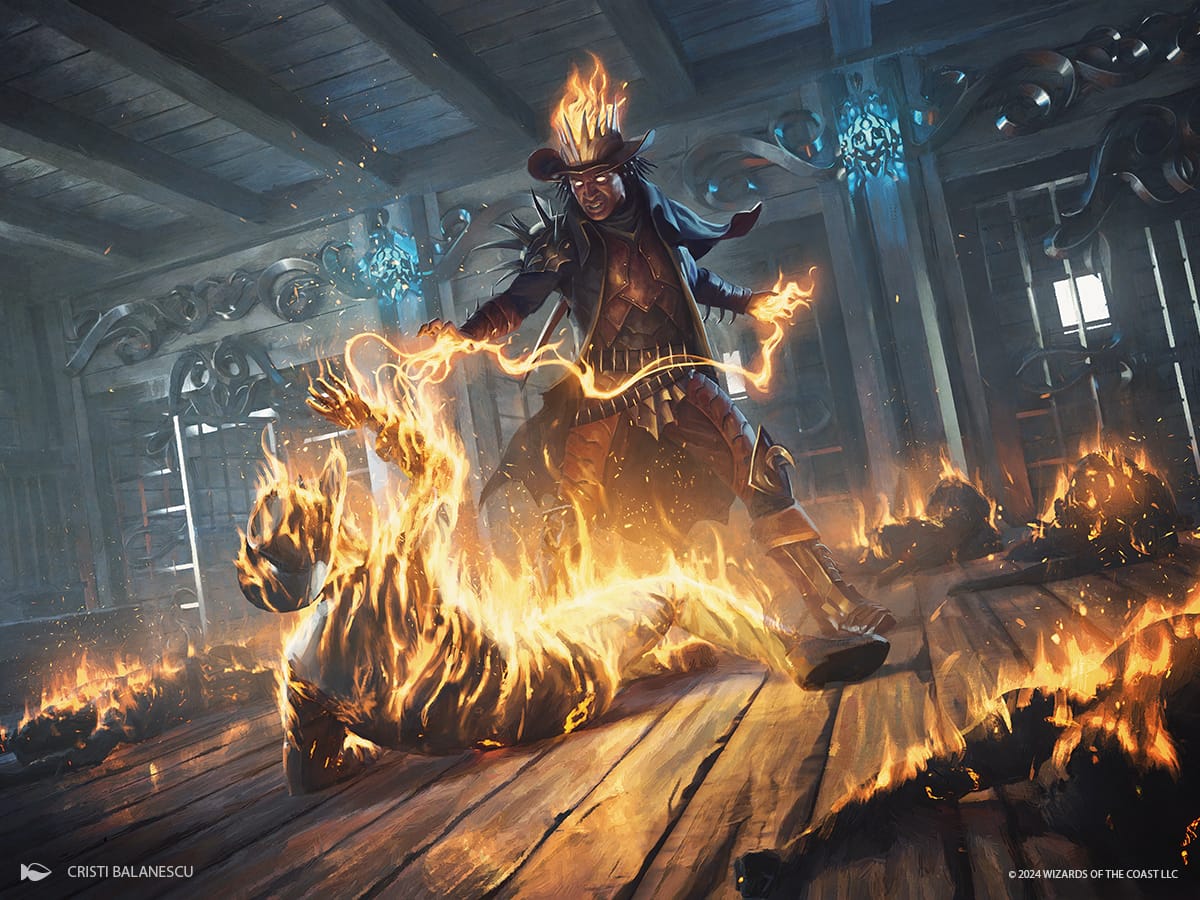
Lord Gisa, the Outlaw making her fourth appearance together with her little brother. Although she costs more than her brother, she is full of self-protection, and the ward cost makes it hard to remove Gisa directly with a single removal spell. After that is a team pump for Skeletons and Zombies (even menace!). There aren’t many Zombies and Skeletons in this set, only four in black, so this ability is destined to be used together with the second ability. And the key second ability, as long as you have a steady source of crime, can produce an endless sea of Zombies. The point is that it is limited to once per turn, so you can commit a crime once on your own turn and once again on the opponent’s turn. As long as Gisa stands for more than a turn, you basically have plenty of mana available to commit crimes. Apart from the downsides that she can’t rescue you when behind and can’t commit a crime on her own, she is a finishing bomb for the crime archetype.

Kappa: 3.5
A flying ghost Outlaw. It is a bit big at seven mana by itself, but it costs 1 less for each creature card in your graveyard, so in the black-green graveyard theme it can come out early. Even in other color pairs, during creature trades it can drop by two or three, so playing it at around four mana isn’t a loss, because the card forces the opponent to discard: if the opponent doesn’t discard a card with mana value 4 or more, you draw a card, so either way you gain a card advantage. The draw condition also ensures the opponent can’t throw away junk or lands to avoid the card disadvantage; if they don’t discard a quality card, they must fall two cards behind. The body is a 4/2 flyer, and five punches kill the opponent, which is a very high threat, forcing the opponent to have flying force and removal to trade. The small downsides are that it is quite powerless when graveyard hate comes (I’m talking about you, BIG’s Rest in Peace), that it is hard to rescue you when behind, and that its butt is really small, so like most flyers in this set it can only trade one-for-one. But on top of that it has the strength of a deck mainstay and, depending on the situation, can even finish the game by itself.

Kappa: 1.5
Mode one is a three-mana sorcery version of Vampiric Tutor; mode two is three black mana to draw three cards and lose three life. For the former, spending three mana to skip a turn, and when you have more mana the card you want can only be drawn next turn, so you wouldn’t do this unless you have a game-turning bomb. The latter’s drawing three is attractive, but three black mana is really hard, and unless you build a nearly mono-black deck it can’t be used effectively. Combining the two means choosing one card you want plus drawing two, but it doesn’t solve the problem of three black mana and leaves quite a gap. Unless your deck has a sweeper or bomb you urgently need to tutor for, or is a near mono-black deck that can easily pay three black mana, I don’t recommend this card. You would be better off using Vault Plunderer to block and cycle at the same time.

Kappa: 3.5
First, a three-mana 3/3 body is acceptable. Then its ability, once you commit a crime, lets you use all black cards in your graveyard as resources for reuse, with no restriction on card type. That means as long as you have a steady way to commit crimes, you can keep pulling creatures out of the graveyard to serve as meat shields and pile up a sea of Zombies. It is a very powerful resource card. Of course there are corresponding downsides: first, the chosen card must be exiled, so it can only be reused once; second, it can only reuse black cards; and you must have enough mana in the same turn to both commit the crime and pay for that card, plus pay life. Weighing these downsides together, after it lands you may need a few turns of setup to have an effect. It is strong if your game plan is a long, controlling game; otherwise there is a chance that losing too much life unbalances your life total. Still, this doesn’t change that the card is about half a bomb. As a measure of strength, it is the kind of card you would take immediately in packs one and two, but in pack three, if you aren’t playing the crime theme, you wouldn’t want to step into the crime theme for it.

Kappa: 2.0
Mode one is a three-mana sorcery Entomb; mode two is four mana to dig back up to two creatures with total mana value at most 4; combined it is five mana to dig back one of your choice plus a bonus one. It is cost-efficient, and depending on the situation it is fine to dig back a bomb or two small creatures to widen the creature gap, but it is too ordinary. In a set with this much leaping single-card power, a card that is unremarkable is a weaker card, and a card that needs creatures in the graveyard in advance isn’t easy to use. In Limited you basically never use mode one of the tutor alone; you only use mode two alone when there is a good creature in the graveyard, or use both modes together to force one out, and even then it is still too ordinary.

Kappa: 2.0
Recovers a creature from the graveyard and makes a Mercenary, a stable card, but its raw power is a bit lacking. Because it needs to target a creature in the graveyard, it is also harder to use as a variant two-drop on the curve. Considering that it doesn’t lose resources and makes a bonus creature, it is still playable.

Kappa: 2.5
No cycling; instead it is Suffocating Fumes with surveil 2. The reach is the bare minimum, and this set mostly has creatures with 2 or 3 toughness, which this card alone can’t kill. But please note that it is actually an instant, so it can be used as a combat trick to win trades against bigger creatures, and since it targets the opponent, it is also an instant-speed source of crime. Ironically, what this card hoses most is the red-black Mercenary theme or black’s 1-toughness creatures (black especially has a lot of 1-toughness creatures). When you are sure you will be in a main-black color pair, taking it first to stop other black drafters from hosing you is also a good draft pick option, but I won’t go into detail here.

Kappa: 1.5
A 1/1 rat Outlaw that makes a Mercenary when it dies. The whole card is filled with rules, but its raw power is too low. Without clear synergy such as a sacrifice outlet, it is best not to play it.

Kappa: 2.0
An Outlaw that gains indestructible for the turn as long as you commit a crime on your own turn. With a steady source of crime, it is indeed a good attacker, but the opponent can respond before it gets indestructible and kill it outright. The indestructibility is also limited to your own turn, so it can’t act as an indestructible blocker on the opponent’s turn. Overall, it is a common that encourages players to be crime attackers. If you can trigger the ability every turn, it is still painful for the opponent to be unable to trade creatures. When attacking, note that having an instant-speed source of crime can help you fend off the opponent’s combat tricks. (As for hard removal, the opponent has mostly already used it on their own turn.)

Kappa: 1.5
Good news for flood decks: a fair-priced card that lets you trade one permanent for one card, a good card for getting back into the game. That said, it is still too passive. The only situations in which this card can be used well are when you have a pile of Mercenaries on the battlefield to trade in for cards, or when you flood and sacrifice a pile of lands to draw. The former already means you have a board advantage, and the latter means you are far behind or both sides have entered a topdeck stalemate. If you are far behind, even playing this card will probably just get you beaten to death, so I won’t discuss it; only when both sides have empty boards and are drawing lands does drawing this card become a bit stronger. In every other situation it is a failing card. The plot ability lets you bide your time, but if you can’t create either of the two situations above, you shouldn’t play this card, since commons and uncommons have other, more effective ways to draw cards.

Kappa: 2.0
An Outlaws-only Bastion of Remembrance. The selling point is the Mercenary it makes, which is a little better than making a Human Soldier. I can understand the designers putting this here to give the red-black Outlaws theme an uncommon that widens the life gap and finishes games, but its raw power is a bit too low, though at least Bastion of Remembrance reacts to any of your creatures dying… To use this card effectively, nearly the whole deck has to be Outlaws, or you need a strategy that makes many Mercenaries, but it is still too slow. This set has many ways to claw back the life gap, so only draining a little at a time through combat is a bit too drawn out. That said, if you have no better life-gap or finishing methods, you still have to use this card, and since an Outlaw dying drains life, trades can also effectively hold off the opponent’s faster strategies. For the Outlaws theme, one in the sideboard is a good precaution.

Kappa: 2.5
When you commit a crime, you can give one of your creatures menace or lifelink for a turn. The former helps with a strong attack, the latter helps widen the life gap. These two abilities can support your other creatures on offense and defense: menace forces the opponent to make a two-for-one trade when their life is low, and lifelink forces the opponent, to avoid a bigger life gap, to bite the bullet and trade one-for-one using their current best option. The body plus deathtouch is more than acceptable. With an instant-speed way to commit a crime, you can use lifelink to give one of your mid-to-large creatures a favorable block and gain a big mouthful of life, which messes up the opponent’s life calculation and wastes their turn. Overall it is a plain, unadorned role-player, and even with few crime sources it can hold the board on its body plus deathtouch.

Kappa: 2.0
A bird that, once per turn, drains the opponent for 1 when you commit a crime. Although it flies, 1 power is too weak. On its own it just keeps the opponent’s flying force in check, and you can treat the ability as a free bonus, since flying is already great.

Kappa: 2.5
If a creature died, it makes a Zombie on entering, and it also has a cheaper plot cost so it can bide its time. This familiar ability configuration is, yes, similar to another common in this set, Blacksnag Buzzard. The difference is that this one costs four and doesn’t fly, so it can’t easily make curve tempo or similar threats like the Buzzard. In exchange, this card has a higher payoff: it makes an extra creature out of thin air, and the standard body that adds more force isn’t bad. Other uses are about the same as the Buzzard: used normally, you pair it with the sacrifice theme, playing it after creatures collide, or after removal, or plotting it first to put trade pressure on the opponent. Also, since it is a Zombie itself and makes Zombies, it works very well with this set’s huge bomb Gisa, the Hellraiser. If you get Lord Gisa, consider taking one more of this, but normally one copy at most.

Kappa: 3.5
Unconditional flying lifelink… the notorious Deep-Cavern Bat!?
Nope. Considering this card is four mana, the corresponding comparison is Aetherborn Marauder. It comes with a conditional removal on entering, and if the removal results in two creatures trading evenly with nobody dying, it is an even bigger gain, equal to getting a free zero-for-one. Even if the ability doesn’t trigger, I don’t think I need to explain how scary a lifelinker with flash and evasion is, which highlights how important it is to have air power for blocking in this set.
Stingblade Assassin: Born in the same Standard cycle, are you being polite?

Kappa: 2.0
A card where the ideal is beautiful and reality is harsh. In Limited, mode one is the main one used, but because of how it is written, to make the opponent actually sacrifice the creature you most want to kill you can only do it when the opponent has just one creature, but then it is no different from four-mana spot removal. As soon as the opponent has two or more creatures, they will always choose the lowest-value creature as a lightning rod, so it is a variant sweeper, but it needs spot removal on the side to deal with the opponent’s most threatening creature. So the card’s most valuable timing is when the opponent has exactly one creature or exactly three creatures; beyond that it is easily dodged by the opponent’s lightning rods.
Using mode two alone takes five mana, by which time both players’ hands are nearly empty, so it basically does little, and can only be said to be somewhat useful against control-oriented decks, and the opponent also chooses the discard, so they will certainly keep the most valuable card. Cases for using mode three alone are rare, unless you are sure that after taking half the opponent’s life you can finish the game this turn. Mixing modes is the card’s greatest value, but the cost is a bit heavy, so when building your deck you should first aim for a stalled, long game.
The creature quality in this set is too high. I think this set is not so easy to drag out, and a sweeper that can’t choose to kill the most effective creature gets a lower rating. For now I lean toward using it as a sideboard card, bringing it in only if I am sure the opponent’s tempo isn’t fast. The longer the game drags on, the higher this card’s rating.
Cheat sheet: although it is a card that can trade one for many, eight times out of ten you can’t trade for the creature and card you most want to.

Kappa: 3.0
A 1/3 deathtouch at two mana is already a very high rating at this point. Even without looking at the ability below, it can be an excellent defensive member, not to mention the ability below. As soon as this one attacks, the opponent has to worry about whether you have an instant-speed way to commit a crime, or you commit a crime first and then attack with this, forcing the opponent to trade, or else you tutor the best card in your deck (usually a bomb) to hand. Overall the body is excellent and the payoff for crime is very high. It is a priority two-drop.

Kappa: 2.0
Although it is removal, in this set, depending on the opponent’s color pair, it can be an all-purpose spot removal or a dead piece of paper all game. The risk of putting it straight into the main deck is too high, so it goes in the sideboard, to be brought in when the opponent’s color pair is right. The most fitting example is Go for the Throat in BRO Limited. Overall it isn’t as high a priority as other removal, unless you are sure nobody at your table plays red-black or a black theme. Also, quite a few bombs in this set are Outlaws, which is another point against it (black alone already has Lord Gisa).

Kappa: 3.0
A mere combat trick gets a 3.0 rating!? Hold on, let me explain. As long as the opponent has a creature, this card is the cheapest instant-speed way to commit a crime in the set. Many earlier cards mentioned how powerful instant-speed crime sources are, and that alone raises this card’s value a lot. Second, as a combat trick, this card is also very good. For the cheapest cost it can narrow the combat gap in a fight by 2 power and 2 toughness, can interfere with both sides in a multi-creature combat, with a chance to make a one-for-two, and can even, when combat isn’t relevant, kill one of the opponent’s 1-toughness creatures by itself, or mix the above uses: pump one of your creatures in combat and kill one of the opponent’s 1-toughness creatures, which is even better if that 1-toughness creature is part of a double block. In short, although it still has the common flaw of combat tricks, namely depending on your creatures’ bodies, even setting aside the combat trick part, being the cheapest instant-speed crime source doesn’t change, and it can work with most of the crime theme cards this time.

Kappa: 1.0
When played as early as possible, the opponent will usually just discard a land. It is weak, but the ETB is at least a source of crime. You only have a chance to make them discard something good if you catch the time when the opponent has only one card in hand, so just treat this ETB as a free bonus. You can ignore the second effect of milling a card and losing one life. Its real value is that it lets each legendary creature you cast complete a crime. This set, including BIG, has 44 legendary creatures, all uncommon or above, most of them requiring multiple colors. Only 18 touch black, 5 of which have three or more colored mana symbols, and some require three colors, which adds even more difficulty.
Playing this card is meant to be a free crime source in a deck with many legendaries, completing two or more crimes. If your deck can fit 6 to 7 legendaries without forcing off-color cards, then indeed this card sounds wonderful. But if you do that, why not find sorceries or instants that commit crimes more easily? OTP has many. Forcing together a legendary deck makes your mana base hard to control, or you will be dysfunctional when you don’t draw this card, and quite a few legendaries in this set have abilities unsuited to Limited, with countless problems. Overall, the chance for this card to reach full potential is too low. Don’t take it; grab stronger commons and uncommons instead.

Kappa: 2.5
Ideally it can steal permanents from the opponent’s graveyard, which sounds wonderful, but in reality as long as the opponent just plays creatures on curve, even a small skeleton can’t get through. In the mid-to-late game, most situations only let it be used as a black Ankle Biter, which is definitely not what you want a mythic card doing. If it can’t hit the opponent, the second ability is as good as nothing. If the opponent has no early blockers, their graveyard probably has nothing to dig for either; if they have removal, they might first kill the small skeleton depending on the situation. Even so, a one-mana card can force the opponent to play creatures on curve to defend, and they can’t carelessly throw things into the graveyard. Overall, early on it fights over whether the ability can earn you a creature or two, and late it stands on defense trading with the opponent’s big creatures. Although it is not the behavior of a mythic card, it is at least an acceptable card.

Kappa: 2.5
A standard-body two-mana creature. Drawn early it can hold the board, and drawn late, when you stare at your hand with nothing to do, it can keep making Treasures out of thin air. Since it costs one mana itself, you can treat it as the idea of banking one mana into a Treasure for savings, and it costs one life, so when your life total isn’t healthy you still need to think it over. Considering synergy with other cards, actively making Treasures works with many of BIG’s artifact cards, saving up to ramp is also great, and you can even pair it with Magda, the Hoardmaster to make a 4/4 haste flying Dragon. If you can pull off small combos the rating can be higher. Overall, it is a quality two-mana creature option useful in both early and late game.

Kappa: 3.0
Add three mana and it is a four-mana kill spell; add one mana to make one Mercenary, so basically it is a kill spell and you won’t use mode two alone, unless you can trade with the opponent’s small creatures or use it for other small combos. Overall the card’s raw power is acceptable, with the potential for a one-for-two if you have enough mana, and after all it is removal, the boss. If the other four-mana kill spell can get 3.5, there is no reason for this one to be rated too low.

Kappa: 3.0
A quite convenient creature. The ideal is to eat a Mercenary on the battlefield or a creature that has already done its job to pay 2 life and draw 2. When you lack creatures it can stand as a 3/3 vanilla body, and when you have nothing to do you can plot it first and leave it in exile, then use it later when you have creatures. In the very worst case, with no other creature, you enter and sacrifice itself, as if casting a three-mana pay-2-life-draw-2 spell. Note that this pay-2-life-draw-2 can target the opponent to complete a crime, which is worth remembering in an emergency. Also, if the opponent responds to the ETB by killing it, with no other creature on the battlefield you will be unable to sacrifice, which is something to watch for.

Kappa: 2.5
An ordinary two-mana legendary creature that puts a counter on itself whenever you commit a crime, and with four or more counters it gets menace and lifelink. This set doesn’t have many ways to put counters on creatures: OTJ has 14 cards, OTP and BIG have 2 each, and none of them are only black, so you can treat the above effects as a crime payoff and mix with other colors to increase the chance of putting counters. With a steady source of crime, or an instant-speed source of crime, it can keep growing. The downside is that needing four counters to get menace and lifelink is too drawn out, and in the end growing bigger is just a matter of one removal spell and doesn’t widen the resource gap, so it can be said to be an unremarkable two-drop for the curve.

Kappa: 3.0
A variant of Phyrexian Rager. Besides the difference in body, the draw-and-lose-life effect can target the opponent, which can complete a crime or finish the opponent when they are at exactly 1 life, but in most situations you won’t use it this way… just treat it as a Rager. The body changes by one up and one down, so on defense it can more easily trade with big creatures. The downside is that it is too easily traded away by the opponent’s Mercenaries, and this set has quite a few 1-power cards that easily eat removal. Overall, a card-flow creature that serves as a meat shield gets a very high rating. After all, it doesn’t lose a card when it enters, and the opponent has already lost a card by the time they remove it. Unless your life total is too low or the situation is too dire, it is a good above-average card.
Conclusion
Have you committed a crime? With someone other than me… (X
First, black as a mono-color really encourages committing crimes. Going Outlaws is middle of the road, going sacrifice is a bit hard, and you don’t need to manage your graveyard specially. It basically encourages more crimes, encourages players to be criminals (X
Fortunately we have the whole Breaking News, OTP, to support us committing crimes! You could say it is the color most influenced by the bonus sheet.
Also, Gisa, the Hellraiser is my big sis. Commit one crime on entering and you instantly produce 10 power on board. Absolutely outrageous.
This time there are 38 black cards in total
- The average score is 2.5
- The highest score is 5.0
- The lowest score is 1.0
- Title
- Outlaws of Thunder Junction (OTJ) Limited Guide — Black
- Author
- Kappa
- Created at
- April 12, 2024
- License
- This work is licensed under CC BY-NC-SA 4.0 .
Related Articles
cephille's Outlaws of Thunder Junction Limited Analysis (Written Before PT OTJ)
April 23, 2024
Outlaws of Thunder Junction (OTJ) Limited Primer — Breaking News (OTP)
April 12, 2024

Outlaws of Thunder Junction (OTJ) Limited Introduction: The Big Score (BIG) & Special Guests (SPG)
April 12, 2024

Outlaws of Thunder Junction (OTJ) Limited Introduction: Green
April 12, 2024