Golgari Soulflayer

Note: This article was translated from Chinese by AI and may contain errors. Read the original Chinese version.
Deck Composition
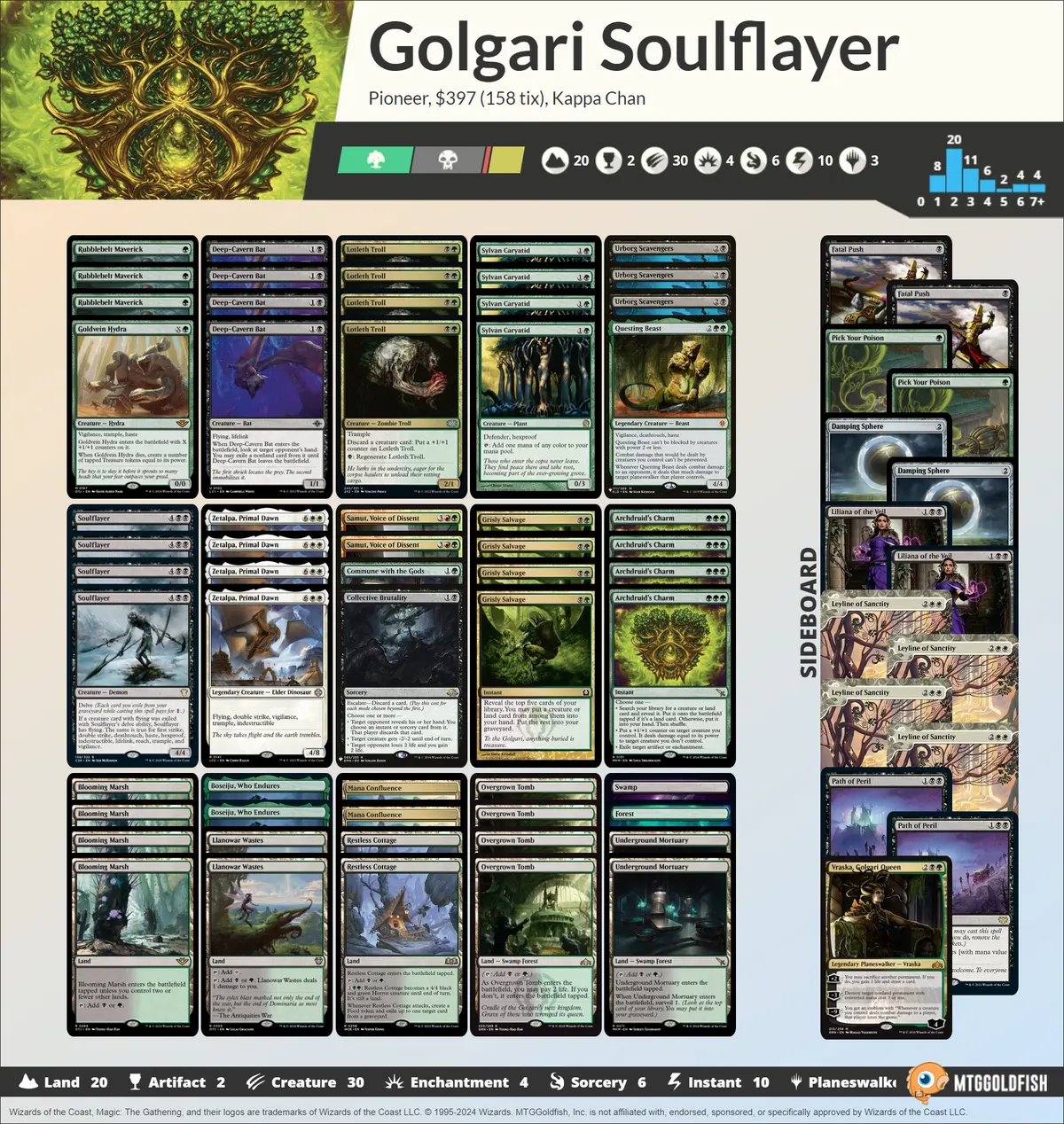
Q: What on earth is this deck?
A: It’s Soulflayer Season 2!
Season 1 is here
I already covered the basic plays and introduction last time, so I’ll skip them. Before I start introducing the deck, there is something very important I have to say: don’t play Soulflayer. (It is truly contradictory coming from me, someone who pushes Soulflayer, and you all clicked in to read this, so kicking you out now would be really weird.)
The reasons are as follows:
- Soulflayer depends heavily on the metagame and its matchups swing wildly. When the environment is full of graveyard hate, this deck dies in a way that is beyond recognition.
- Next, although the explosiveness is plentiful, the consistency of drawing and the reproducibility are lacking, so just treat it as a deck for the chosen ones.
- Third, this deck relies heavily on information asymmetry and is a first-encounter-kill deck. If the opponent understands how your deck is built and how it works, they will keep the corresponding answer cards, so whether you play smoothly depends a lot on the opponent’s experience.
- Finally, it looks simple, but this version uses a few cards that are harder to choose (described later). Sometimes even with a normal three or four lands plus effective fodder you may not be able to keep the hand, so mulligan judgment matters: you have to decide whether to play normally as a midrange game with quality creatures or suddenly go all in and blow the opponent’s face off, all of which depends on experience and reading the opponent’s deck.
Given the four points above, this really isn’t a deck to casually recommend to others. Even so, if you like raiding tournaments, and enjoy the thrill of killing the opponent on first encounter, suddenly hitting for 8 in a single turn with the opponent unable to remove your creature, then this deck will definitely satisfy you. My most enjoyable moments with this deck are when I explain what abilities my creature has to the opponent and read them out one by one XD. Since Season 7 MIT was in the Pioneer format for once, I had been trying out the Amalia combo, but in the end I still decided on the most reassuring Soulflayer. Rounding off, both are combo decks, right? (X
Up to now the usual form of Soulflayer has been Sultai (green-black-blue). So why give up blue this time? There is only one reason: Archdruid’s Charm. This card, which requires three green mana, is really hard to use casually in a three-color deck (especially when, for Soulflayer, you want black on as many lands as possible). I believe quite a few people have seen this card when playing against Lotus Field, and in this deck it is practically the core. The first mode searches for a creature or a land, and it is the mode this deck uses most. Generally you use the former: for example, when you need to start the combo you fetch Soulflayer, when you have too many creatures that need to go to the graveyard you fetch Lotleth Troll, and when you want a specific ability such as hexproof or lifelink you fetch the corresponding creature. You could say it is a multitasker with many hands. The land-searching ability is used less, but it is still workable, for example fetching a surveil land or creature land when you need a fourth land, or fetching Mana Confluence when you need to hard cast Samut, Voice of Dissent or Zetalpa, Primal Dawn.
The second mode is the emergency board-clearing mode. It is basically the least used mode, but in tournaments it has still saved my life (described later). In particular, having a creature with lifelink do the shooting gains you life, which can save you against aggro decks. The third mode destroys an artifact or enchantment. Unlicensed Hearse? Rest in Peace? Leyline of the Void? Everyone die!
Thanks to Archdruid’s Charm, the Golgari version improves its consistency in finding a specific creature, and it isn’t helpless when facing graveyard hate. At the same time its color consistency improves, so it doesn’t need too many Mana Confluences, which keeps the life total healthy, and the spare room can even be used for tapped lands like surveil lands or manlands. But the mill speed is certainly no match for the Sultai version, and it can’t use Otherworldly Gaze twice like the Sultai version to forcibly improve the quality of the next draw. You could call it a trade-off, one long and one short.
Introduction to Some Individual Cards
Goldvein Hydra

The only new OTJ card, run as a single copy in an experimental slot, handling vigilance, trample, and haste (it is mainly here for haste). Its advantages: with Sylvan Caryatid it can become very big and push by itself, and if the opponent only has destroy effects it puts pressure on them over whether to give me a pile of Treasures (possibly the pressure of hard casting Zetalpa). Having vigilance makes it both offense and defense. Another advantage is that if X is 0, it means paying 1 mana to put itself into the graveyard, which is handy when Scavengers or Soulflayer needs to come out in an emergency, contributing to both the midrange route and the Soulflayer route. The drawbacks are also obvious: when you lack Caryatids, its body isn’t big enough to affect the game, and the vigilance and trample it provides overlap with many cards in this deck, so if you only want haste it becomes a downgrade of Samut.
Overall it feels decent to use. A rising star to look forward to, and in the future I could add one more copy.
Sylvan Caryatid

The hexproof and ramp midrange piece, and one of the returning staff from the Sultai version. If you can’t play it on turn two, it is basically just the hexproof provider, and it’s a little hard for it to die by itself… But for opening up a new route and protecting against edicts and so on, it is still worth four copies. Most importantly, among hexproof options it is cheap: at one mana there is only Gladecover Scout.
Rubblebelt Maverick

The number one rising star from MKM. Basically it is the Golgari-colors Otherworldly Gaze, making up for the shortcoming of having few one-mana plays. I originally thought it was only surveil 2 and a +1/+1 counter, and since the single-card performance seemed insufficient I conservatively ran only 3 copies, but after using it I found that:
- Golgari can’t power out a turn-two Soulflayer by itself, so there’s no need to rush to dump a pile of things into the graveyard on turn one
- Surveil 2 can dig to the third card
- The +1/+1 counter is significant on Soulflayer: power 4 double strike versus power 5 double strike differs by a turn, and it can also dodge Languish
- One more creature means you can dodge one more edict, and it also forces the opponent into the dilemma of whether to let me add another counter to Soulflayer next turn
The drawback is also obvious: if you have blue, Otherworldly Gaze is always strictly better, so this card can only live in the Golgari version, but running a full playset is worth considering.
Deep-Cavern Bat

The lifelink provider, and it also doubles as Thoughtseize. It’s overpowered, and it’s worthy of being the king that goes in as a four-of in any Standard deck with black. This deck finds creatures relatively easily, and it can also pave the way before Soulflayer comes out. Turn two Caryatid, turn three Caryatid plus Bat is simply wonderful.
Questing Beast
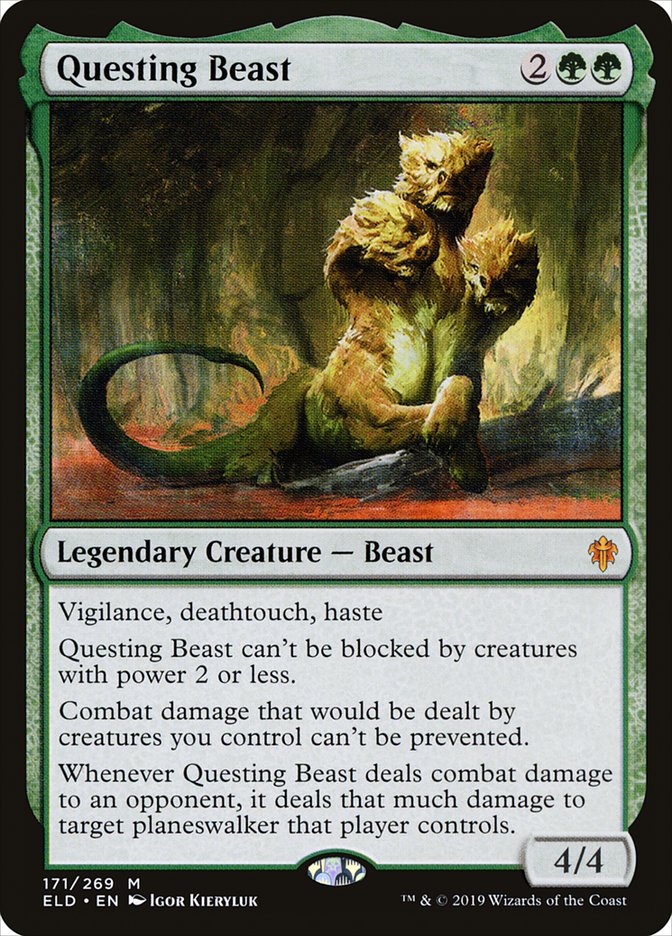
The vigilance, deathtouch, and haste provider (mainly for the latter two). It’s an experimental slot, so just one copy. Originally the plan was that if I have trample and double strike, then I must have one deathtouch so I can get past fliers or reach creatures, but I found that the creature I most needed to get past in the old days was Cavalier of Thorns, and it passed away together with the demise of Big Green. Looking at it from another angle, at least Questing Beast’s advantage is that after a turn-two Caryatid, turn three Questing Beast can turn the deck straight into midrange, and it can also hit planeswalkers like Liliana of the Veil and The Wandering Emperor that are troublesome to deal with, going around the blockers. But overall it is not that necessary in the current environment, and I may give the slot to Goldvein Hydra.
Samut, Voice of Dissent

The vigilance, double strike, and haste provider. You can see how much vigilance this deck has. Basically it is the brute-force piece of the whole deck, and among Soulflayer fodder (?), apart from Zetalpa, the number one most popular. But this time I wanted to free up space for 2 experimental slots, so only two copies. When you want to hard cast it, the red mana has to come from Mana Confluence or Caryatid, though it basically rarely needs to come out as itself.
Collective Brutality

Basically a fifth Lotleth Troll, a card that can go either way. Although it easily loses card advantage, it provides strong defense against aggro and can also act as half a Duress. If the Troll is the offensive piece, this is the defensive standalone card, so adjust the count of the two according to the environment.
Commune with the Gods

A fifth Grisly Salvage. The only enchantments are the four Leyline of Sanctity in the sideboard, so perhaps Gather the Pack would be better.
Underground Mortuary

A surveil land. It should originally have been a full playset, since there aren’t many one-mana plays anyway, but when building I found I only had 2 copies, and with not enough time, I filled the remaining space with 2 creature lands. You can temporarily stack one into the graveyard, and sometimes you stack an important creature into the graveyard, but the black-green creature land is just too powerful, beyond comparison. My final impression is that a ratio of 3 surveil lands to 1 creature land is best.
Restless Cottage

A creature land. Generally these slots shouldn’t be wasted on tapped lands, but this card is excessively powerful: effectively a 5/4/4, and it also exiles a card from the graveyard and makes a Food when it connects, which is far too useful. But the total number of tapped lands in this deck still can’t exceed 4. It was originally just an experimental slot to replace a surveil land, but turned out to be more useful than I imagined, especially in the middle of the all-in strategy, when your hand is often empty with nothing to do, and this creature land can help attack and force the opponent’s ground troops into defensive trades. The best example was trading with Omnath, Locus of Creation, and not being affected by Leyline Binding is also an advantage. In an emergency it can untap to prevent the opponent’s edict, and suddenly hitting the opponent for 4 after they sweep the board is also a good option. It supports the midrange or all-in strategy from the side. The drawback is that it is hard to use if it arrives late.
Leyline of Sanctity

The sideboard is basically not finished being tuned, but there are 2 cards I especially want to talk about. First is Leyline of Sanctity. Let me explain that this main deck build is already favorable against Arclight Phoenix and Rakdos Vampires, but unfavorable against Waste Not, Amalia, and Lotus Field, and the white Leyline is used in the sideboard to target the latter two. Against Waste Not it’s a free win, since a quarter of the opponent’s cards become useless. Against Amalia, once there is a creature on the battlefield that has done the Zetalpa effect, Amalia’s 20-point sweeper effect can’t go straight to the face, so the only thing left to guard against is Aetherflux Reservoir, and for that… the white Leyline!
Also, this is a deck that relies heavily on mulligans, so it works well with cards like Leylines that call for mulliganing. (I really wouldn’t dare put this in against Lotus Field, even though it could prevent Chandra, Hope’s Beacon from shooting me dead outright, it can’t stop Approach of the Second Sun…)
Vraska, Golgari Queen

The second card I wanted to mention. The [+2] effect can become a way to gain resources against control decks or games that drag on (turning excess lands or Food tokens into cards), and the real value is activating the ultimate against Amalia, so that even if they gain 10000 life it’s still a one-hit kill! (super idealized
Season 7 MITQ Report
Of course there will be an actual play section, though the details may be slightly different.
豐原諾亞 MITQ
Format: Pioneer
17 participants, finished runner-up
R1 Rakdos Vampires OO
In game one the opponent mulliganed to 6 and, on the play, kept a combination of Sorin, Imperious Bloodlord and Vein Ripper, but they were one land short and so were a turn slow, while I had turn one Rubblebelt Maverick, turn two Lotleth Troll, turn three Urborg Scavengers. Suddenly eating the Samut the Troll discarded and the Zetalpa the Maverick surveiled, I hit for 11 on turn three. Even though the opponent made the Sorin 665 combo, next turn the Scavengers turned into a 5/5 double strike trampler that couldn’t be blocked, and I took the first game in 3 minutes.
In game two the opponent mulliganed to 5 (mulligan 2) and couldn’t make the fastest Sorin combo. I could only dig through my deck with the Maverick’s surveil. Along the way the opponent kept attacking with creatures, tempting me into blocking Dusk Legion Zealot with the Maverick. After thinking for a moment, I judged it was a signal of Sheoldred’s Edict, so I must never lose the only lightning-rod creature on the battlefield here. After taking two or three hits I drew Archdruid’s Charm, directly fetched Soulflayer, and made a Soulflayer with flying, vigilance, lifelink, trample, haste, and hexproof. Finally, when I looked at the opponent’s hand with the Bat, it was Leyline of the Void, Bitter Triumph, Vein Ripper, and Liliana of the Veil. After confirming my hand was safe, I continued to deploy the creatures in my hand as edict lightning rods, and finally pushed through from start to finish with a single Soulflayer.
R2 5C Bring to Light OXO
My pre-match prediction was an unfavorable matchup, and since my sideboard was prepared at the last minute, I had no special answer cards for Bring to Light. In game one, on the play, I put down a Caryatid on each of turns two and three, and on turn four I used the Charm first to exile the opponent’s Fable of the Mirror-Breaker from their turn three, preventing the opponent from drawing cards, but I still couldn’t stop the opponent from punctually playing Niv-Mizzet Reborn on turn four on the draw (the opponent also had a turn-two Caryatid), though it revealed zero cards. Then on my turn, with 5 lands and 2 Caryatids, I suddenly dropped Goldvein Hydra with X=6 and attacked with haste to race them. After thinking for a moment, the opponent chose not to block with Niv-Mizzet, and we traded 6 points each, and the opponent recovered Yorion, Sky Nomad, preparing to Cloudshift Niv-Mizzet and add blockers. I played a Soulflayer with only trample, preparing a big attack next turn together with the creature land. On the key turn the opponent cast Yorion, and I responded with Archdruid’s Charm, using the only mode 2 of the day, so that Hydra shot Niv-Mizzet dead for 7. After that the Hydra, Soulflayer, and creature land pushed together. Although the opponent used Lightning Helix to forcibly hold their life total, they ultimately couldn’t withstand the 7-power Hydra pushing every turn, and I won.
In game two I kept a midrange opening hand with a Caryatid and a Bat, but I took the wrong card with the Bat, too worried that the opponent would use Deadly Cover-Up to sweep the board and snipe my Soulflayer, and as a result I let the opponent’s Niv-Mizzet go. Then Niv-Mizzet came down, and as soon as it grabbed Lightning Helix and Unmoored Ego, I knew the game was lost. Although I resisted desperately with the Hydra, I was finally defeated when the opponent hard cast the back face of Valki, God of Lies, and I conceded.
In game three, the first time I played the Bat I saw Up the Beanstalk, Sunfall, and two Leyline Binding in the opponent’s hand, but noting the opponent was short on green, I planned to take the Beanstalk first to stop the opponent’s draw engine. As a result the opponent immediately drew Stomping Ground next turn, and the turn after drew the next Beanstalk, which I couldn’t stop, and the Bat was also pressed down directly by Leyline Binding. In a flash of inspiration, at five lands I began to untap and attack with the creature land. Leyline Binding can’t hit lands, so I landed two hits and got the opponent down to 9 life. The opponent began drawing with the two Beanstalks, but drew past their maximum hand size the first time, and when they had to discard, they actually discarded the Sunfall that had been revealed at the start. On the key turn, the opponent, probably seeing 0 cards in my graveyard, began casting Omnath, Locus of Creation to gain life and resources, which also stopped my creature land from getting through. But my hand was actually Samut, Zetalpa, Caryatid, Archdruid’s Charm, and Soulflayer, and next turn I drew a land, giving me 6 lands plus a Caryatid, while the opponent had only one empty green-white land open, presumably holding Leyline Binding and waiting for me. First, Archdruid’s Charm fetched Lotleth Troll, then the Troll entered and I activated its ability 3 times to throw all 3 creatures other than Soulflayer into the graveyard, leaving exactly 4 cards in the graveyard, and finally I used the remaining 2 mana to call out Soulflayer. And so a Soulflayer with flying, double strike, vigilance, trample, indestructible, haste, and hexproof was suddenly born and began to attack the opponent fiercely. The opponent realized all the removal in their hand was useless, and could only hand over their 2 Bindings to tie down my pointless creatures to draw cards, and I attacked together with the creature land, forcing the opponent to trade Omnath. In the last turn the opponent used Pillage the Bog and looked at 16 cards without finding a solution, and I won. Close call. If the opponent hadn’t discarded the Sunfall, I would have lost. This is exactly the point I mentioned earlier about winning on information asymmetry and first-encounter kills.
R3 Mono-Black Midrange OO
A friend’s original deck. Instead of Waste Not it uses more Sheoldred, the Apocalypse, more Kaervek the Punisher, and more Invoke Despair, a Mono-Black deck that focuses on the heft of expensive cards. Game one was nothing special. After the opponent Thoughtseized me, they found that I had two draw cards and two creature-eaters, with nothing worth discarding. I ordinarily raised a Soulflayer with Zetalpa + Caryatid and attacked, winning. Flying so I could ignore the ground-bound Sheoldred was nice.
In game two, each of us mulliganed to 6, but I directly played Leyline of Sanctity, which first turned the Necromentia in the opponent’s hand into trash. With a turn-two Caryatid and a turn-three Caryatid + Bat midrange combo, the Bat saw that the only effective cards were Sheoldred and Aclazotz. After considering it, I disliked Aclazotz more, so I took it. Later I drew Grisly Salvage and milled a bit, and although I got Soulflayer, I could only feed it Zetalpa + Bat. Without Caryatid’s hexproof, the opponent’s only effective card was The End. The opponent had Sheoldred on the battlefield, so the long game was unfavorable for me, and I could only pray that they wouldn’t draw it. The opponent also had no plans to attack with Sheoldred, probably afraid I would block with Caryatid, which would make my next creature hexproof, but then I wouldn’t be afraid of Sheoldred’s Edict anyway. After that the opponent made a staggering blunder: they did draw The End, but for some reason shot the Bat, probably thinking Soulflayer had hexproof (and I had no obligation to remind them). So after they got Aclazotz back, I gained 8 life each turn while pushing at their face, and they used Sheoldred and lands like Geier Reach Sanitarium to keep milking their life back and forcibly hold the line. The life swings in this stretch were so intense that I filled half a life pad on this stretch alone. My highest life total once reached 56, Sheoldred survived the whole game, and by the end I was hard casting Zetalpa with the mana from two Caryatids… it was far too confusing. Later, when the opponent used Field of Ruin to trigger Kaervek the Punisher to reuse The End, it was too late, since the pusher had already changed to Zetalpa, and under the brute force of 8 each turn the opponent finally fell.
R4 Rakdos Vampires ID
R5 5C Bring to Light ID
Breakthrough result: second place in the preliminary rounds!
Top 8 Lotus Field Combo OXO
An extremely unfavorable matchup, but I was on the play, and as long as I could race on speed there was still some hope. In game one, turn two Troll, turn three I threw Questing Beast and a Caryatid in for Urborg Scavengers to eat, hitting for 8 at top speed. On their turn three the opponent gave up on slamming Lotus Field and instead first played Thespian’s Stage & Vizier of Tumbling Sands. On the play turn four I continued to attack and used the Scavengers to eat another card for a total of 9 damage, with Boseiju, Who Endures in hand waiting for the timing of the opponent’s Stage copy to respond. The opponent was forced to start the combo directly on their turn four, doing Pore Over the Pages twice before the Stage had copied, but seemingly could not find an effective solution, and I won.
Game two was again a turn-two Troll, but the opponent doing nothing for their first three turns made me a bit scared, and I didn’t dare to directly play Soulflayer or Scavengers on turn three, only keeping the push going with the Troll and then putting down Damping Sphere. Unexpectedly the opponent immediately responded with Archdruid’s Charm to destroy the Sphere. With no other choice, on turn four on the draw I was forced to start running with Soulflayer, but the opponent’s ruthless second Archdruid’s Charm directly found Lotus Field, and with the Stage on the battlefield, they began the combo directly after copying on turn five. Throughout I could only sit and watch, praying the opponent’s Pore Over the Pages would draw a pile of lands. I also chose the highest survival-rate option for Emergent Ultimatum, but in the end the opponent still got to do a second Emergent Ultimatum, and I conceded.
Game three was once again, once again, once again a turn-two Troll, and on turn three I threw the Goldvein Hydra to the Scavengers and started running directly. I considered whether to throw the Soulflayer in my hand to give the Troll and Scavengers 2 more points of firepower, but after calculating, unless I drew one of the 6 double strikers in my deck next turn, the number of turns to close out was the same, three hits, which wouldn’t change, so I decided to hold it first. After a painful struggle the opponent went directly on their turn three with Sylvan Scrying and slammed Lotus Field, and I could only slam down on turn four the last card of my opening hand… Damping Sphere, and then I won.
Afterward I felt I was really too lucky in this matchup: all three games were turn-two Troll and I drew Damping Sphere in 2 of them, I’m sorry to my Lotus Field friend.
Top 4 Waste Not OO
In game one, I didn’t draw particularly well this time, and first started a midrange route with the Troll. But I could feel the opponent drawing badly. After they played Waste Not they had to keep activating the Sanitarium to draw, but still drew a pile of lands. In contrast I kept drawing cards to throw into the graveyard, and having Waste Not make Zombies for me was completely no problem. Once Soulflayer was down, the opponent’s creatures couldn’t get through at all, and after I made a Scavengers, the opponent kept drawing lands and flooded out, never seeing Go Blank.
In game two, I saw a white Leyline opening hand and took it, with a Scavengers and a Soulflayer in hand, turn one Rubblebelt Maverick, and tried to play midrange with Caryatid and the Troll. Unexpectedly the opponent directly cast Extinction Event, and I forget which creature I threw into the graveyard in response. Anyway, next turn with 3 lands, I suddenly made a 5/5 flying double strike trample vigilance indestructible lifelink haste, putting the opponent directly within a two-hit death line. Finally the opponent used the Sanitarium to draw, and since I didn’t want any mistakes, I threw the other Soulflayer into it, and after the opponent got a useless Zombie, they conceded.
I felt this game was only like this because the opponent’s hand was so clunky…
Finals 5C Bring to Light
I had already qualified, so I let the opponent go up.
Afterthoughts
Only in game two against Bring to Light did I feel my own play; in most of the others I felt I was playing on luck… Although this is somewhat of a luck deck, the Golgari color combination has too little room for play (play almost entirely revolves around Archdruid’s Charm), so there is room for improvement, and next time I will probably try other color combinations.
Special thanks: Japan’s Soulflayer research group, and thanks to the Soulflayer YouTuber who inspired me, ゆーせい MAX の魂剥ぎ道場. Everyone can follow them and see what weird Soulflayer decks there are XD
- Title
- Golgari Soulflayer
- Author
- Kappa
- Created at
- June 5, 2024
- License
- This work is licensed under CC BY-NC-SA 4.0 .