Standard Rakdos Discover

Note: This article was translated from Chinese by AI and may contain errors. Read the original Chinese version.
Deck Introduction
First things first, here’s the decklist: Decklist link
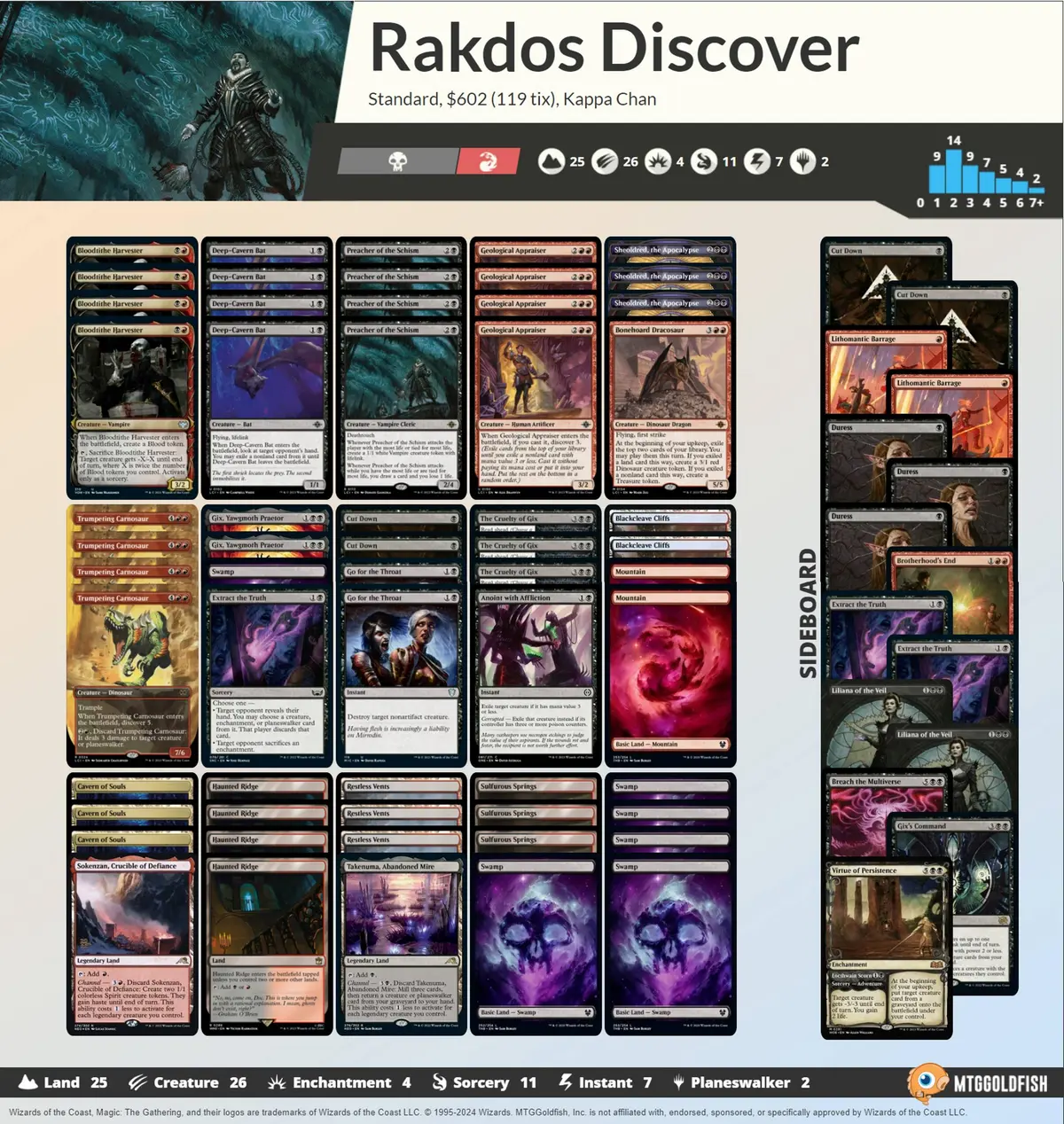
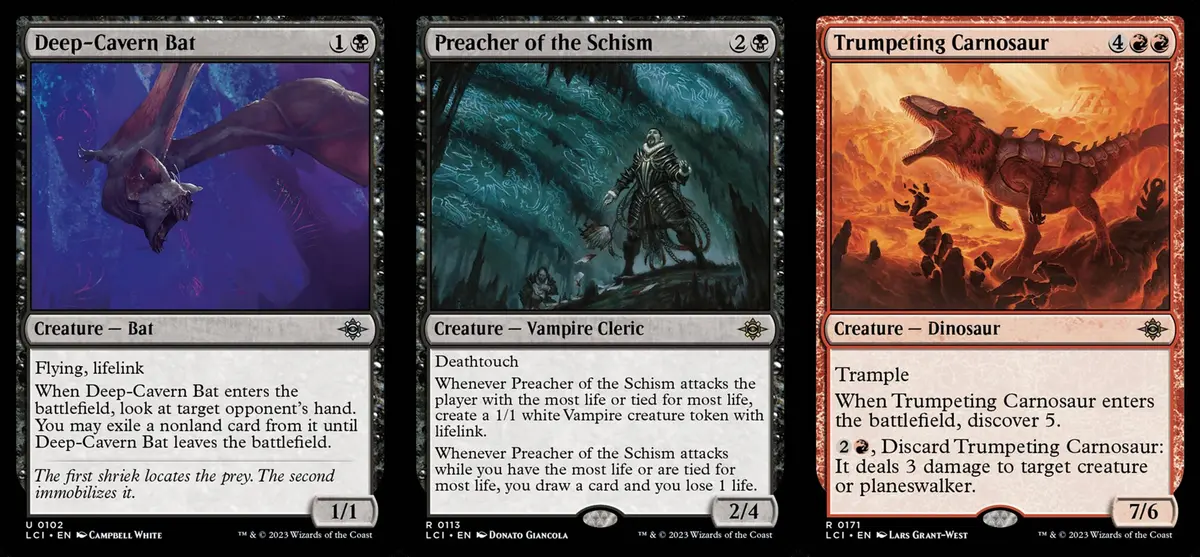
Standard Rakdos Discover is a deck that, after Standard Rakdos lost three mainstays in the last ban announcement, Fable of the Mirror-Breaker // Reflection of Kiki-Jiki, Reckoner Bankbuster and Invoke Despair, was upgraded through a pile of powerful LCI single cards such as Deep-Cavern Bat, Preacher of the Schism, and Trumpeting Carnosaur, and has once again joined the ranks of top environment decks.
Environment Overview
There are plenty of guides online about how to play and operate this deck, so in this article I want to start from the current Standard environment and explain why I chose Rakdos. I think the LCI environment can be defined by two color groups: one is five-color, the other is black.

Domain
Resources that win the game the moment they land, plus the must-answer huge body of Atraxa, Grand Unifier.
The cheapest one-mana exile, Leyline Binding, which has had a job from Standard all the way to Modern; Herd Migration (5 Dogs), which fixes colors and gains life early and can close the game late; Archangel of Wrath, which at six mana fires off 2 shocks, gains 4 life, and whose body keeps gaining life with lifelink; and so on, plus all kinds of cost-skipping and sweepers. This deck has held a top spot in the environment since the start of the LCI environment. The advantage is of course the unmatched single-card power in fair matchups: while others are still using strong 4- and 5-mana cards, five-color Domain may already have slammed down finishers like Atraxa. Against creature decks it has sweeper answers like Sunfall, and against aggro decks led by red aggro, it can desperately gain life with the 5 Dogs and Archangel of Wrath to hold off the damage and then counterattack for the win.
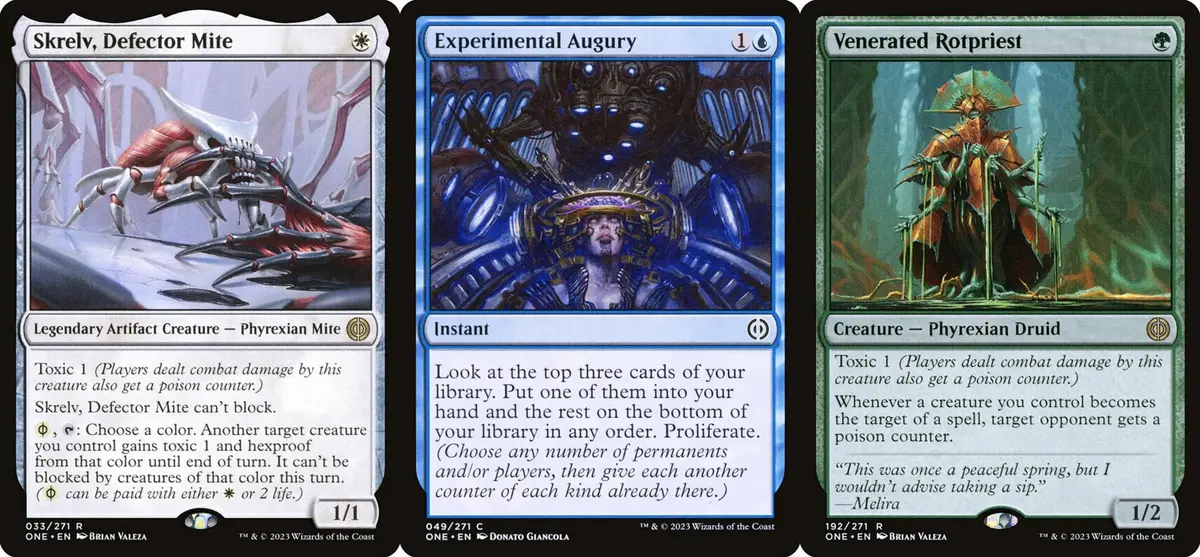
However, this kind of deck has recently not achieved great results in major competitive events abroad and in Taiwan, because of the rise of Bant Poison, which uses poison as its win condition, negating Domain’s life-gain tactics, and, led by Skrelv’s Hive, unfolds a sea of insects that can quickly rebuild even after being swept. Most importantly, poison is different from life loss: Standard currently has no way to recover from it (only Melira, the Living Cure can act as a vaccine, but you still get one poison counter every turn), which is also why, after analysis, I think there’s a risk of getting caught and killed when using Domain in the current tournament scene.
Black
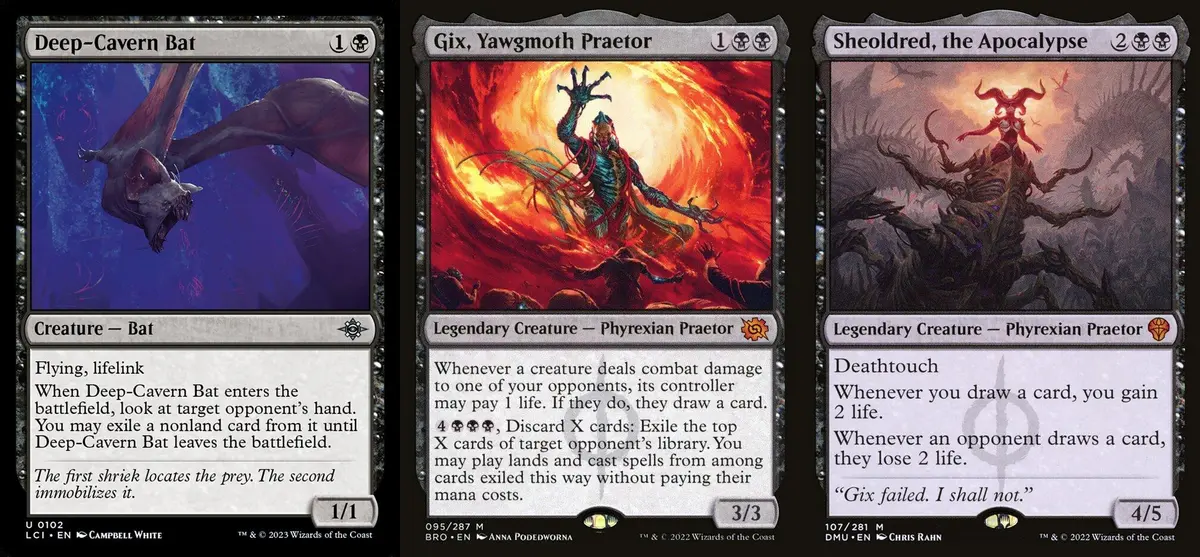
I call them the Three Great Villains of Black.
The other color defining the environment is black. Why only black and not Rakdos? Because mono-black alone can complete this environment-defining play. 2-mana Deep-Cavern Bat, 3-mana Gix, Yawgmoth Praetor, 4-mana Sheoldred, the Apocalypse: the Bat strips the opponent’s answers, then Gix’s effect and its own lifelink let you draw cards painlessly, and Sheoldred further stabilizes the ground defense and, by drawing cards one-sidedly, widens the life gap.
Even if you don’t assemble this golden combination, it doesn’t matter; black has plenty of removal to clear out the opponent’s key creatures and forcibly hold the line, and the not-yet-mentioned Preacher of the Schism (324) is also a premier strong card of this LCI. With 4 toughness and deathtouch, most ground creatures can’t trade favorably with it, and it can even create a situation where it can’t be attacked through; this body also lets it attack with confidence to gain board or card advantage, and you can use pain lands to manage your life total, striving to trigger both the Vampire-making and card-drawing effects at once. (Being too versatile also put a certain black werewolf out of a job.)
To go even more extreme, there’s the tactic of drawing a pile of Bats, stripping the opponent’s entire hand, praying the opponent doesn’t draw an answer, and then forcibly beating them to victory with a pile of Bats; all I can say is it’s worthy of being the strongest color in Standard right now, as mono-black alone can use quite a few strong cards and suppress the opponent.
So Why Choose Rakdos?
Simply put, there’s no reason to play mono-black in Standard now: Invoke Despair is gone, and Standard now has fast lands, slow lands, pain lands and other excellent dual lands coexisting, even tri-lands. Without a special reason, it naturally trends toward multiple colors to seek good cards from other color groups and play the midrange deck with the greatest single-card value. And because Standard now has two utility lands that can blow up nonbasic lands (Field of Ruin and Demolition Field), mana bases for three colors have become even less stable, and moreover among current three-color decks only the Esper color group has a clear reason to use three colors (because of Raffine, Scheming Seer), so the natural train of thought develops toward two-color decks.
Among the colors that combine with black, Dimir and Rakdos draw the most attention in competition. To describe the two simply, the former emphasizes mobility and the latter emphasizes explosiveness. The former keeps costs low, uses low-cost blue flyers to assist damage, and supports combat with Tishana’s Tidebinder and various counterspells, forcibly beating the opponent when they’re not fully functional. But playing Dimir feels like walking a tightrope; there are many options each turn, and a slight misstep easily lets the opponent push through a big play, causing a chain reaction and collapse.
For more about Dimir midrange, you can read this article: cephille’s Standard Dimir Midrange Analysis and Tournament Report
In terms of difficulty of operation, Rakdos has fewer worries, because the cards used are also strong cards at their cost, for example Bloodtithe Harvester, the stalwart of the old Rakdos midrange, whose cost is also appropriately pulled up to 6. Use this deck’s golden combination or Preacher of the Schism to gain cards and smoothly increase mana, then convert the extra mana into large creatures and crush the opponent directly with board advantage. Many of this deck’s creatures also have ETB effects, absorbing the strengths of the old Rakdos midrange: resource volume and immediacy, which this deck also aims for. The opponent’s only effective solution is counterspells, but thanks to LCI reprinting Cavern of Souls, the success rate of Rakdos creatures entering the battlefield is greatly increased.
A brief summary: Rakdos is a deck that wins by slamming cards in order by cost, with strong snowball power; once advantage accumulates you keep drawing cards, suitable for players who like this exhilarating feeling and those who like simple brutality.
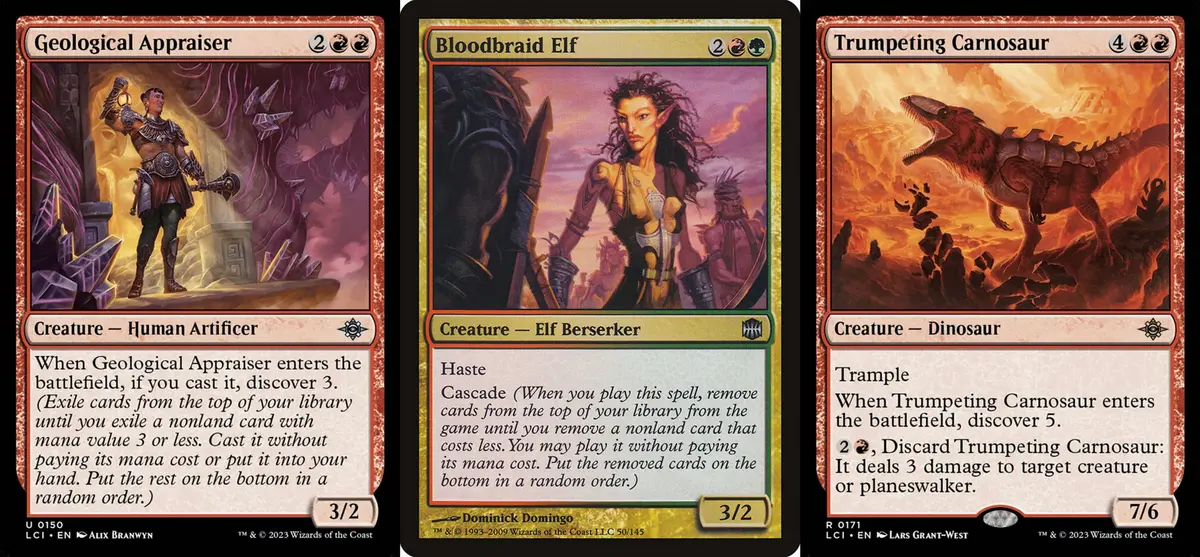
The biggest beneficiary of red in LCI this time is the 2 discover creatures. As a variant of the notorious cascade ability, discover raises flexibility: even if the player doesn’t cast the spell immediately it can be taken to hand, meaning that as long as a discover creature lands successfully, the best case is an extra spell and the worst case is still one more card in hand; on the side of explosiveness, there’s also a side of gaining resource value.
It feels so good to have Bloodbraid Elf back in Standard!
Of course there are still differences: discover requires the creature to enter the battlefield before the ability can trigger, unlike cascade, where one-for-one is determined on cast; but as mentioned above, discover in Standard has Cavern of Souls to escort it, so the success rate is actually not low.
Pros
- Simple, exhilarating, brutal to operate
- Snowball through the golden combination, easy win
- Plenty of explosive power; depending on what discover flips, there’s the power to turn the board in one shot
- Doesn’t over-rely on card synergy; each card has a certain amount of power fighting alone
- The main deck can win through big plays, and after sideboarding you can match the opponent’s game speed, using Duress, Bat, and Extract the Truth to pull away high-cost threats to keep your costs low and fight them
- Bloodbraid Elf fans rejoice
- Every discover feels like drawing a card, so good!
Cons
- The inescapable fate of creature decks: sweepers.

(This deck has Bat, and after sideboarding has cards like Duress to avoid this problem, but when the opponent topdecks it all you can do is applaud)
- Discover drawing a huge dud
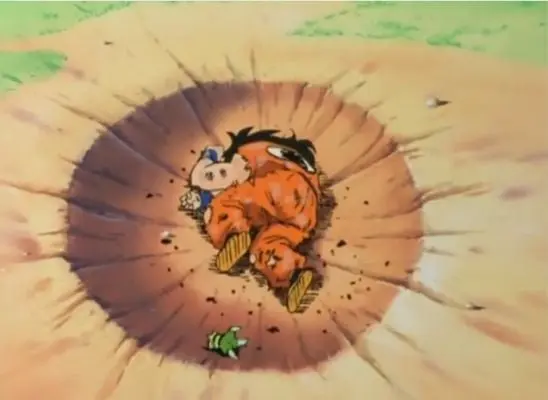
(When Trumpeting Carnosaur flips Cut Down, trust me, it feels awful)
- Because every action is relatively big, it’s easy to be punished by counterspells or removal; after sideboarding you can refine your plays to some extent to improve this, but it’s still not as flexible as Dimir
- If you can’t snowball, you easily get stuck on lands or flood out and die
- Domain is an unfavorable matchup
This impostor Bloodbraid Elf has no haste, insulting my Bloodbraid Elf (extremist opinion)- Expensive (at the time of writing, the whole deck cost exactly $600 on MTGGoldfish)
Small Features of the Build
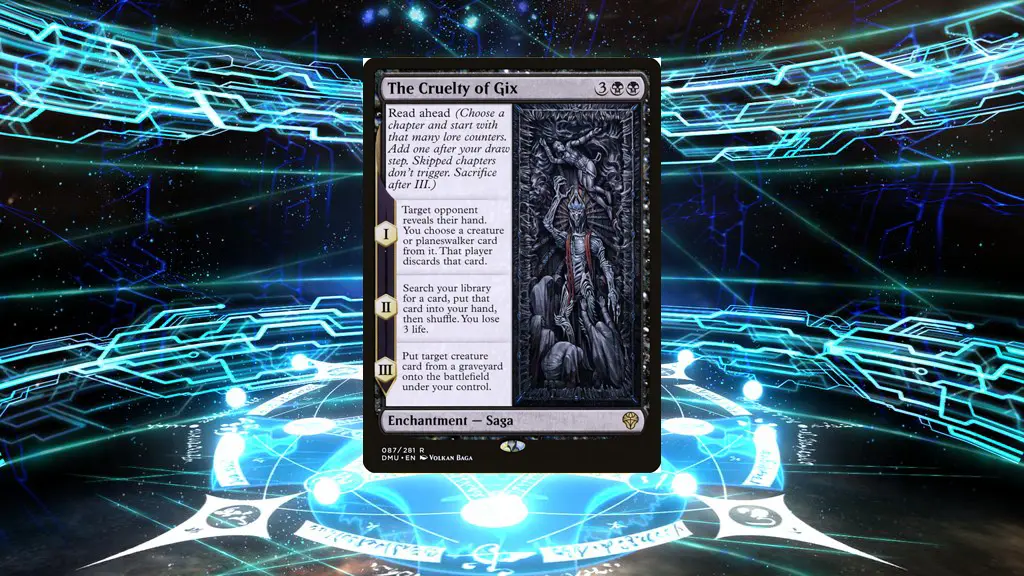
This time I used the common balanced 25-land build, and used the combination of The Cruelty of Gix + Trumpeting Carnosaur, increasing the chance of digging it back from the graveyard to get Carnosaur out early, adding a few unfair plays to a fair deck. Compared with common builds online, I changed only a few parts, briefly described below:
The reason the main deck doesn’t run a full 4 Restless Vents:
Rakdos’s creature lands are quite strong this time: at 4 mana it’s a 2/3 menace that can rummage when attacking. But considering that after sideboarding there are many plays that start at one mana, such as Duress and Cut Down, in those matchups whether you can play an untapped land on turn one is your lifeline, so I’d rather use one more Swamp than add risk of tapped lands, and so used 3 to strike a balance.The sideboard uses 1 Virtue of Persistence (the black Virtue) and 2 Lithomantic Barrage, taking out in exchange the extra Go for the Throat, Anoint with Affliction, and Abrade:
Starting with the former, it’s for use against red aggro; I’ll take any 2 life I can drain, but there are too many 4-toughness creatures in the currently popular decks, so you can swap back to Go for the Throat if needed. The other two cards are entirely aimed at Raffine, where there are actually few places to use them, so if needed you can swap back the other 2 general-purpose removal spells. You could say all 3 of these cards target the tournament environment I wanted to enter at the time, and readers can adjust them as needed.
For more deck introduction and sideboard strategy about Rakdos midrange, you’re also welcome to refer to another article: Rakdos Discover: King of Midrange
Tournament Report
A deck introduction alone isn’t enough, so below I’ll directly post the report of how I won a MITQ qualification with this deck. Details may be slightly off, because I’m recalling the situation only from my life-total sheet.
20240113 彰化鬥陣 MITQ, 14 players total
Played Rakdos Discover, first place wins the qualification

台中七面鳥, mapo tofu hamburger steak with thick soup ramen (extra spicy), NT$320
(I originally wanted to post the ramen I ate after winning the championship that day, but that photo’s quality was a bit low, so I used a ramen I ate recently instead)
R1: VS Domain XOX (1-2)
- Game 1: Although I was on the play, I mulliganed once and also didn’t draw a 2-mana creature. The only time I hit the opponent’s face in the whole game was one punch from Preacher of the Schism, then I got hit by Sunfall. Later I drew Deep-Cavern Bat, but seeing two Atraxa, Grand Unifier there was nothing I could do. Finally Atraxa landed, took 5 cards including Nissa, Ascended Animist, and after a look I conceded right away.
- Sideboard: (Domain is unfavorable, so I swap a lot)
| Side Out | Side In |
|---|---|
| -2 Cut Down | +3 Duress |
| -1 Anoint with Affliction | +2 Extract the Truth |
| -1 Bonehoard Dracosaur | +2 Liliana of the Veil |
| -4 Trumpeting Carnosaur | +1 Breach the Multiverse |
| -1 Swamp | +1 Virtue of Persistence |
Brief explanation:
Referring to overseas strategy articles, there are only two ways to fight Domain: one is to wreck their hand early so they can’t ramp, and kill them while they’re not fully functional; the other is to compete with them on the weight of big plays. This sideboard leans toward the former, but I also worried there was a chance of not finishing the game in time, so I prepared 2 big plays.
- Game 2: On the play, mulligan once, but the sideboard cards all showed up: turn-one Duress, turn-two Bat, turn-three Extract the Truth, successively stripping or discarding Depopulate, Negate, and Chrome Host Seedshark. The opponent never drew a powerful answer, and I went crazy gaining resources with the Bat + Gix, Yawgmoth Praetor combination; a few turns later I had 7 cards in hand while he had just 1, and the opponent realized there was nothing to be done and conceded. At the time I hadn’t yet noticed what he had sided out…
- Game 3: This time not as many sideboard cards came, and with only 2 Bats I couldn’t effectively strip all of the opponent’s hand, especially since on seeing 2 Herd Migration (5 Dogs) in the opening hand, I felt I couldn’t lock down his mana costs and so could only change to stripping Sunfall. In the middle of the game I noticed he’d used the 5 Dogs only once to find a land, and roughly realized he wanted to use the 5 Dogs to close the game. Although I desperately hit with Bats, I still couldn’t beat the opponent topdecking a Sunfall, and in the end, as expected, I was pushed back and killed by the 5 Dogs. Only then did I realize that the opponent’s sideboard plan was probably that, seeing I had The Cruelty of Gix, he sided out all the Atraxas. In Game 2, when I had no hand, I didn’t plan to drag it out because without Atraxa there was no way for a one-shot reversal, and now looking at another card in my sideboard I thought that having it would have wiped out the 5 Dogs all at once; I could only take this lesson along with the loss.
R2: VS Dimir Midrange OO (2-0)
Game 1: The opponent used flyers like Spyglass Siren, Faerie Mastermind, and Bat as main attackers, with backup from stalwart creatures like Sheoldred, the Apocalypse, Ertai Resurrected, and Tishana’s Tidebinder. For me, the most annoying thing in this matchup was not being able to use the Bat’s one-sided lifelink to widen the life gap. Game 1 was also a back-and-forth between both sides’ creatures, with both life totals dropping to single digits together. I also tried to use the Bat to strip the opponent’s Sheoldred and answers, but the opponent had Cut Down so I couldn’t keep it up for long. I tried several times to use Sheoldred to recover life, but it was either answered or neutralized by Tidebinder. After dragging on for about 25 minutes, finally through the combination of Preacher of the Schism and pain lands, I gained both creature advantage and a card-resource gap, and used the little Vampires it made to suicide-attack for lifelink, opening a gap in the opponent’s defense. Because Restless Reef’s activation cost was too high, the opponent didn’t have enough defenders, and in the end couldn’t hold, and I pushed everything through to kill them.
Sideboard:
| Side Out | Side In |
|---|---|
| -2 Trumpeting Carnosaur | +2 Cut Down |
| -1 Extract the Truth | +1 Virtue of Persistence |
| -1 Gix, Yawgmoth Praetor | +1 Brotherhood’s End |
| -1 The Cruelty of Gix | +1 Gix’s Command |
Brief explanation:
This sideboard plan is very similar to the one against red aggro: the opponent is faster than me, so I need to use more removal to deal with their flyers, especially things like Faerie Mastermind that give them cards if left alone, which must be answered first. Start by taking out the highest-cost cards and the cards for enchantments, then cut 1 each of the 2 kinds of cards that cost life, and finally bring in various removal spells and sweepers.
- Game 2: This time I had a 2-mana Bat + Preacher of the Schism opening hand. The opponent went turn-two Faerie Mastermind and turn-three Preacher, so I didn’t dare play my Preacher and could only trade with removal. Unfortunately the opponent played a second Preacher, so I could only play mine to stop the opponent; sure enough the opponent had removal, and then started using Preacher to gain creatures and a card gap. I wanted to use the Bat to pull the life gap back, but the opponent slammed Spyglass Siren and took the Map, so I couldn’t get through. The key turning point was slamming Trumpeting Carnosaur, which directly discovered a Preacher to help defend, and then next turn using the drawn Gix’s Command to sweep the board and give the Carnosaur lifelink, gaining 8 life in one hit…
A quick interruption: why 8 and not 9? Because for about three turns I thought the Carnosaur with 2 counters was 8 power rather than 9, which was entirely my own mistake orz
Back to the topic: after that one big hit of life gain, I successfully pulled the life gap back. The opponent added new flyers to keep trading life with me, and I used the Carnosaur with counters as the main attacker. On the key turn I used Sheoldred, and the opponent on their turn used the Tidebinder to counter Sheoldred’s draw-and-lose-life effect, neutralizing my Sheoldred; but back on my turn’s upkeep I killed the Tidebinder with removal, so it didn’t stop my life gain, and finally with the Bat holding down the Sheoldred in the opponent’s hand, the life gap reversed and the opponent could only concede.
R3: VS Dimir Control O (1-0)
Game 1: The opponent was someone I know, so I roughly knew what deck he was playing before sitting down. It gains life through the day/night swapping of March of Wretched Sorrow and The Celestus, exchanges cards through that day/night effect, fills out the hand with Memory Deluge, and finally ends the game with Aclazotz, Deepest Betrayal // Temple of the Dead, Virtue of Persistence, or Hullbreaker Horror. Early on I smoothly played the Bat into Gix combination to gain cards, at one point pushing the opponent to 6 life, and I drew so many cards I had to discard at cleanup, but the opponent swept the board with the cleave effect of Path of Peril, and then the real game began. The opponent used the nature of their deck, which doesn’t act on its own turn, to keep going into night and recovering life, and then used the nature of mine as a discover deck, where it’s easy to cast more than two spells in a turn and turn back to day, to continue recovering life and exchanging hands. Along the way the opponent cast Memory Deluge 4 times (including flashback from the graveyard), keeping the hand gap close to mine. Fearing the opponent had a counterspell or Hullbreaker Horror, I didn’t dare use all my mana, and even used chapter 2 of The Cruelty of Gix to search for Cavern of Souls to help Bonehoard Dracosaur land. On the key turn both boards were empty, and I used chapter 3 of the aforementioned Cruelty to dig out Trumpeting Carnosaur, discovered Geological Appraiser, and then discovered a Bat, and sure enough saw the opponent had Hullbreaker Horror in hand, but he had another removal spell, so I could only strip the removal first and then think about how to deal with the Horror. I first slammed Bloodtithe Harvester and left plenty of mana open to act on the opponent’s turn, and on the opponent’s turn, just as I imagined, they did nothing. On my turn I drew the next Bat and played it right away, forcing him to have to cast the Horror; at this point the opponent’s hand was down to Aclazotz, Memory Deluge, and Consider, with the opponent having 4 mana and me 2, and my only removal in hand was one Go for the Throat. A flash of inspiration: I first stripped Memory Deluge, and attacked him with the Carnosaur to lure him into a favorable block with the Horror, then in the second main phase sacrificed the Harvester to give the Horror -2/-2; the opponent immediately responded by casting Consider, using the Horror’s trigger to return the Horror to hand, and I instantly responded with the Go for the Throat in hand to kill the Horror. On the opponent’s turn, they couldn’t find a fifth Memory Deluge (one was still held by the earlier Bat), and could only cast Aclazotz to block; I used the The Cruelty of Gix I’d been holding in hand to go straight to chapter 2 and search for an answer to remove the black god, and pushed everything through to win. (By this time 37 minutes had passed)
Sideboard:
| Side Out | Side In |
|---|---|
| -2 Cut Down | +3 Duress |
| -1 Anoint with Affliction | +2 Liliana of the Veil |
| -1 Bonehoard Dracosaur | +1 Breach the Multiverse |
| -2 Trumpeting Carnosaur |
Brief explanation:
Honestly I don’t quite remember why I changed it this way; probably I again wanted to start from a hand-wrecking plan. I considered whether to add 2 more Extract the Truth, but the opponent’s numbers of creatures and enchantments are really few, so I decided to put in only 1; if the opponent really slams the Virtue, I can just dig it out with Cruelty.
- Game 2: I don’t remember what happened, and in the end it didn’t finish. I only remember that during the stage when I wanted to race life totals, I tried attacking him with Geological Appraiser to lure his Aclazotz into blocking and then kill Aclazotz with Bloodtithe, but after the opponent declared the block they instantly responded with March of Wretched Sorrow to kill the Bloodtithe; as expected, the same trick can’t be used twice… I also remember that after the opponent slammed the Virtue, I also cast a Breach the Multiverse and nearly wanted to dig the Aclazotz over to use, but after reading how it’s written, when Aclazotz dies it goes back to the opponent’s battlefield, so I dug Ertai Resurrected instead, but in the end it didn’t finish anyway so it made no difference…
R4: VS Red Aggro ID
At round 4 I was in 6th place and knew the opponent must be red aggro, and not wanting to risk being killed by red aggro’s ceiling and with a chance of slipping out of the Top 8, I still had to offer the opponent an intentional draw (ID).
Final overall standing: 7th place, into the Top 8
Top 8: VS Domain with Virtue OO (2-0)
Game 1: Again a matchup where I knew what deck the opponent played before sitting down. The opponent mulliganed twice and was still playing a tapped tri-land on their turn two, and after my turn two I slammed a Bat on time and saw the opponent had in hand 2 Topiary Stomper, 1 Temporary Lockdown, 1 Virtue, and 1 tri-land that includes black; at this point I checked that the opponent’s first two tri-lands couldn’t produce black, and I had another Bat in hand, so I first stripped Lockdown. On the opponent’s next turn, when they wanted to slam Virtue on the Adventure side, they discovered they had no black, so they had to pass another turn. I followed up and slammed Gix, also as bait for the Virtue’s Adventure, and sure enough Gix successfully tricked the opponent’s Virtue away and saved the Bat. Although I used the second Bat to strip one Stomper, the opponent still slammed two Stompers in a row and smoothly jumped to 7 mana to slam the Virtue itself. But the only creature in either graveyard was my earlier-dead Gix, so he could only pull Gix; since the opponent was already out of cards in hand and had drawn only a land, he could only go all-in on Gix’s 7-mana effect to swap the top card of my deck, and in the end he swapped to Preacher of the Schism. The opponent began using Stompers to push my face to refill cards, and I defended with the tokens earlier made by Sokenzan, Crucible of Defiance, which first doesn’t create an extra graveyard, and second doesn’t let him hit my face to trigger Gix’s effect. The next turn was the key turn: the opponent’s board had only Preacher, Gix, and Stomper; besides Gix’s two coming over, the opponent made a Vampire, I had a pile of creatures on board, and as I was considering blocks I saw the chapter 1 Cruelty on my board, and checking my hand I had 2 removal spells, so I decided to gamble and let his two attackers through; the opponent lost 2 life and drew 2, and although he got a Leyline Binding to pin down my Sheoldred, I still had attackers led by the Carnosaur on board, and next turn Cruelty dug out a removal spell; the 3 removal spells killed the Stomper, Gix, and the little Vampire respectively, leaving the opponent no blockers, and I pushed everything through to win.
Sideboard: Almost the same as the first game of the Swiss round; the only difference is that the Virtue brought in became Brotherhood’s End.
Brief explanation:
The Virtue coming too early can’t do anything, and as a late-game big play there’s also the subtle situation of having no Atraxa to dig. After sideboarding I dropped all the Trumpeting Carnosaurs; if the opponent has nothing to dig, digging my own things is a bit subtle, and Brotherhood’s End, which can wipe out all five Dogs at once, is more useful.Game 2: I don’t remember the details; in this game the opponent mulliganed once, was also pressured by my Bloodtithe + Gix going crazy on his life total and widening the hand gap, and his cost-skipping was also unsmooth. On turn 4 I played a Bat to strip the opponent’s Depopulate, on turn 5 I played The Cruelty of Gix to discard the Atraxa in the opponent’s hand, and 2 turns later dug it back and gained 3 cards. The opponent was stuck on four lands the whole time and even with Sunfall in hand couldn’t use it, and in the end was punched to death by Atraxa and other creatures.
Semifinals: VS Domain with Jace, the Perfected Mind in the main deck OXO (2-1)
Game 1: The opponent mulliganed once; looking at the life-total sheet, I remember I seemingly attacked from start to finish with 3 Bats (1 of which was found by Appraiser)… The first time I used the Bat to look at the opponent’s hand it was 2 Stompers, 2 Archangel of Wrath, and 1 Jace, then going by the markers in my hand, the Bats stripped a Stomper, Invasion of Zendikar, and an Archangel of Wrath respectively, and I remember the other Archangel of Wrath was discarded by Extract the Truth, so my Bats never died at all. Then looking at the life-total sheet, besides attacking the opponent with Bats, Gix should have also supported my resources; I remember being excited by the cards I drew that game. Strange, Domain was supposed to be an unfavorable matchup…
Sideboard: Same as the Top 8
Brief explanation: Just wreck the opponent’s hand, ideally starting from a turn-one Duress.Game 2: I remember this game started with turn-one Duress discarding Up the Beanstalk, then turn-two Bat stripping the opponent’s Seedshark, but since I had already seen two Atraxas in the opponent’s hand on turn two, this game was basically a race against time. Unfortunately the opponent slowly drew into them one by one, and also used Leyline Binding to pin down my big attackers as moderate disruption, but in the end I couldn’t catch up and was hit by a slammed Atraxa, which not only gained 5 cards but included the next Atraxa; the opponent still had 10 life, and I was pushed back with 2 punches and lost.
Game 3: This game I really won on luck. From the start I played the Bat + Gix golden combination, stripped the opponent’s Seedshark and then pushed the opponent’s life low, kept my hand around 7 cards through the golden combination’s effect, discarded the opponent’s Atraxa with The Cruelty of Gix, and forced the opponent to have to hand a Leyline Binding to the Cruelty; I remember I also played Liliana to wreck the opponent’s hand, but unfortunately in the end the opponent topdecked Sunfall to resolve it. After that, the opponent tried to use the Seedshark to make Eggs to reshape the board, including a 6-mana Egg with Leyline Binding; at this point, luckily I drew Brotherhood’s End from my deck and swept all the Eggs directly. After that, both sides stayed deadlocked, and I used Sheoldred together with the rummage effect of the Rakdos creature lands to keep pulling my life total back while lowering the opponent’s life line. I don’t remember how I won this game; I think I finally cast one Breach the Multiverse and that ended it… or the opponent flooded out at the end, I truly forgot; the early and middle parts of this game were so intense that my memories of the second half flew away. Oh right, in these 3 games a total of 7 Bats came out.
Finals: VS Red Aggro OO (2-0)
Game 1: The opponent from the Swiss round 4 ID, an unavoidable fate in the end. I think this deck has only 2 technical points against red aggro: one is the die roll, and the other is whether to keep or mulligan. Red aggro on the play basically depends on whether the opponent’s hand is smooth; if the opponent plays out the smoothest combination, no matter how good my hand is I still lose; since the finals can’t decide the former, I could only do my best on the latter. Fortunately the opponent mulliganed once, and I saw a 1-mana Cut Down, a 2-mana removal, and a 3-mana Preacher in my opening hand, a perfect hand. The opponent opened turn one with Kumano Faces Kakkazan // Etching of Kumano, making my turn-one Cut Down temporarily useless. The opponent’s turn-two Feldon, Ronom Excavator with haste, together with Kumano, confirmed I’d take 3 damage, leaving me at 16; on turn two I held a removal spell, waiting for the opponent’s turn three, and if they played Goddric, Cloaked Reveler I could just concede. Unexpectedly the opponent, besides being stuck with 2 Mishra’s Foundry and not having two red sources, took the action of channeling Sokenzan, so the 2-mana removal in my hand was definitely going to Feldon, leaving me at 12 life. On my turn three I could finally slam Preacher, the strongest creature of this matchup, which red aggro can’t kill with any single card besides Witchstalker Frenzy. On the opponent’s turn four they finally successfully slammed Goddric, but couldn’t make it fly, and I immediately blocked Goddric with Preacher; the opponent handed a Play with Fire to Preacher, and although Preacher died, the opponent’s hand was nearly dry. I then played a Gix and gave the Cut Down from the start to the flipped Kumano, slowly stabilizing the board. The opponent also used the power of 3 Foundry lands to keep putting heavy life pressure on me; perhaps because this game had gone on too long and my brain stopped working, I somehow thought for a while that a Foundry defending could also pump other Foundries, so I played pointlessly too defensively, and only felt safe after finding Sheoldred and Gix and getting to double-digit life. In the middle of this game, if I had used Cruelty to dig the opponent’s Goddric and race life, it should have ended nearly 10 minutes sooner…
Sideboard:
| Side Out | Side In |
|---|---|
| -2 Trumpeting Carnosaur | +2 Cut Down |
| -1 Extract the Truth | +1 Virtue of Persistence |
| -1 Gix, Yawgmoth Praetor | +1 Brotherhood’s End |
| -1 The Cruelty of Gix | +1 Gix’s Command |
Short explanation: All the removal comes in, all the high-cost and life-costing cards go out, and that’s it.
- Game 2: The final showdown ended in a baffling way… Both sides mulliganed once, then the opponent was stuck on 2 lands, opening turn one with Monastery Swiftspear. Apart from the opening Cut Down and the Virtue’s Adventure I only drew lands; in the middle I relied on Restless Vents standing up to help defend, even slammed the Virtue itself on time on turn 7, and then started digging creatures from the opponent’s graveyard to counterattack. A baffling game… My life total never even dropped below 9 this game, and it just ended like that with both sides dumbfounded.
Afterthoughts:
How many times did I mention Gix’s name in this article? (A no-prize guessing game)
Also, black is so strong that it’s actually the red discover half that’s often the first thing to be swapped out in sideboarding…
- Title
- Standard Rakdos Discover
- Author
- Kappa
- Created at
- January 29, 2024
- License
- This work is licensed under CC BY-NC-SA 4.0 .